
For the last 3 years I’ve been writing a Biblical Historical Fiction novel. Mine is set during the time of Isaiah.1
In my research on the genre I have found two other books (probably the 2 most popular) that cover the same events and characters as mine: Isaiah’s Daughter by Mesu Andrews, and Gods and Kings by Lynn Austin. Looking into the overlap and differences between Mesu, Lynn, and my takes on the same content has been a great writing exercise.23 In this vein of thought, I want to compare and contrast 3 story elements across these 3 books: Main Character, Timeline, and Treatment of Prophecies.
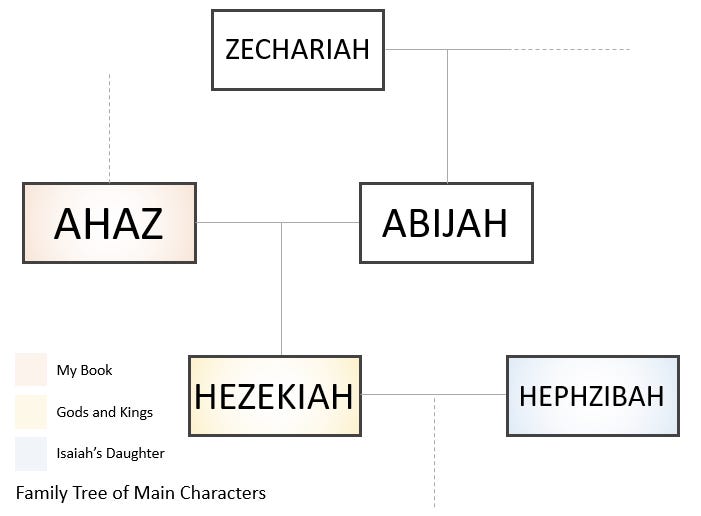
In my book, the main character is Ahaz, a wicked king of Judah. The book starts with him as an anxious 16 year old prince, and ends with him as a world-weary, 23 year old tyrant. It’s a tragedy.
In Gods and Kings I had a hard time identifying the main character. I want to say its a true ensemble piece, with Zechariah, (Ahaz’ father-in-law), functioning as the spoke that connects the disparate parts. But, occasionally, parts of the structure feel like it’s trying to be Hezekiah’s book. Hezekiah, as he is written in the book, though, is not much of an active protagonist.4 The most well-developed character, and the one who pushes and directs the story most is Uriah, the High Priest. He is one of the book’s two main bad guys.
In Isaiah’s Daughter, the main character is Hephzibah, Ahaz’ daughter-in-law. In this book, Hephzibah is also written as the adopted daughter of Isaiah, though that’s not historical. She is thus the titular “Isaiah’s Daughter.” This book focuses a lot on her dealing with childhood trauma. In this book, both her and Hezekiah have a lot of PTSD and kind of come together to support one another.
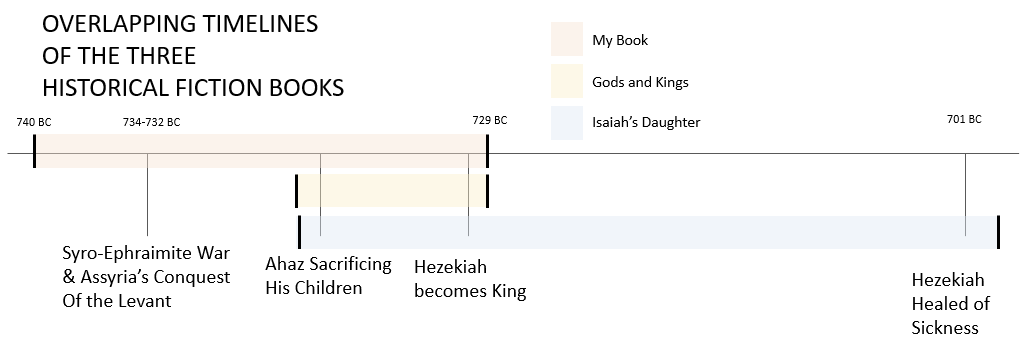
Mesu, Lynn, and my books pull their Biblical stories, mainly, from the same handful of chapters found in 2 Kings, 2 Chronicles, and Isaiah.5
Ahaz sacrificing his children in fire, an event mentioned in 2 Chronicles 28:3, occurs in all three books. In my book it happens about 85% of the way through. It’s the climax of Ahaz’ descent into madness, the peak of his tragic arc.
In Isaiah’s Daughter, this event happens in Chapter 3, and in Gods and Kings it occurs in Chapter 1. In Mesu and Lynn’s books, right out of the gate, Ahaz is a monster. He’s described pretty grotesquely, too. Like Baron Vladimir Harkonnen in Dune.

A major element of all these books are the words of the prophet Isaiah.
In Isaiah’s Daughter, Isaiah is presented as a man who is a conduit for revelation that neither he nor anyone else understands.
In Chapter 52, Mesu’s Isaiah explains this predicament.
“When I hear Yahweh’s voice echo in my spirit, I write on a scroll exactly what I hear, or repeat it word for word to whomever God specifies. Interpreting prophecy is an entirely different matter. Our understanding is still God directed but is, unfortunately, subject to human fallibility. Opinion—as you, Hezekiah, have so frequently pointed out—comes completely from my own intellect.”
Isaiah is written in this book as someone who regularly gets frustrated that he has no idea what’s going on. He gets revelations from God, and then just makes up interpretations for them. He doesn’t know what they mean. His interpretations are often even wrong. And normal, non-religious citizens will tell Isaiah, the prophet, “Hey. I think your wrong about your interpretations".”
It’s an interesting take on the idea of a prophet. The idea that you could say something, and not know what it means. Personally, this doesn’t match with my understanding of revelation. My understanding is more in line with 2 Peter 1:20-21:
Knowing this first, that no prophecy of the scripture is of any private interpretation.
21 For the prophecy came not in old time by the will of man: but holy men of God spake as they were moved by the Holy Ghost
That being said, one of my favorite scriptures does have a tinge of Mesu Andrews’ understanding of revelation. This scripture is D&C 130:14-17. It is Joseph Smith, writing on April 2, 1843. And, even though Joseph Smith was always, if anything, sure and certain of his revelations, this does present a bit of ambiguity regarding the timing and nature of a revelation’s fulfillment:
I was once praying very earnestly to know the time of the coming of the Son of Man, when I heard a voice repeat the following: Joseph, my son, if thou livest until thou art eighty-five years old, thou shalt see the face of the Son of Man; therefore let this suffice, and trouble me no more on this matter. I was left thus, without being able to decide whether this coming referred to the beginning of the millennium or to some previous appearing, or whether I should die and thus see his face. I believe the coming of the Son of Man will not be any sooner than that time.
In Gods and Kings, Isaiah is not concerned at all with the interpretation of his prophecies. He is a very minor character who randomly shows up in big moments, delivers a prophecy, and then leaves. Oftentimes his prophecies have no relationship to the current context or plot of the story. Lynn’s Isaiah will walk out of a grove of trees, or from behind a building, find a main character, tell them a random revelation, and then turn around and leave. The staging and blocking of Isaiah in this book almost felt like he was an actor in a play. He feels disconnected to the narrative.
My own characterization of Isaiah is heavily influenced by my being a member of The Church of Jesus Christ of Latter-day Saints. In our religion we have a very strong, clearly defined understanding of what a prophet is, how revelation works, and how that is relayed to other people. My Isaiah is written as being much more confident and sure of himself. He knows the correct interpretations of his prophecies more than he’d let on. Also, his revelations are grounded in reality, circumstance, and situations. They feel pragmatic.
If you’ve read this far, and some of it sounds interesting, and you can figure out how to transfer an epub file to your kindle on by yourself, and you would like to get an ARC (Advanced Reader Copy, or Advanced Review Copy) of my book, drop me a message below in the comments, or DM me or something.

I’ll get your e-mail and put it in my list. My book is set to come out September 1. ARC Copies should be sent out July 1, with the hope that you would submit a review of the book on Amazon when it comes out.
In working on the novel, I have done a lot of research on the time period: Mesopotamia 736 - 729 BC. My research largely centers on the Syro-Ephraimite war and the subsequent conquest of the Levant by the Tiglath-Pileser III and the Assyrian Empire.
It takes me back to the Fall ‘98 when I was a confused thirteen year old trying to figure out why and how Antz and A Bugs Life were released within six weeks of one another. I remember thinking Antz had Woody Allen in it, which meant it was more grown up, and since I was 13, I should probably like it more than the Pixar one.
Here is a list of twin films (“when rival companies spring to develop similar concepts”) from Tim Robey’s Box Office Poison:
Volcano and Dante’s Peak - 1997
Deep Impact and Armageddon - 1998
Antz and A Bug’s Life - 1998
Capote and Infamous - 2005/2006
Friends with Benefits and No Strings Attached - 2011
Olympus Has Fallen and White House Down - 2013
Churchill and Darkest Hour - 2017
I just checked the book’s Amazon page. The subtitle of the book is: A Biblical Ancient World Novel about Hezekiah. So, I’m going to say he’s the main character, at least from a marketing perspective. Definitely not from a story perspective.
My book is a bit different from the other two in that I pull from a lot extra-biblical historical records: Assyrian transcriptions, Egyptian Steles, and Babylonian Letters.
Comments
Nothing yet. Say the first thing.
Sign in to join the conversation.