
A few weeks ago, this post got passed around a little corner of Substack:
It was interesting. I’m somewhat familiar with the author of it. I follow his Substack. I went to one of his New Play Project shows sometime back in 2007 or 2008. It was a collection of short plays written by a lot of people. A guy I was in school with had a play in it. I went to go watch. I don’t remember much more about it than that. Back in 2019 I bought two of James’ books of poetry: Phoenix Song & Let Me Drown With Moses. I think I expected the second book to be some sort of reference or allusion to the African American spiritual. I don’t think it was. If it was, I missed it.
His two poems I liked best were from “Canto V: This is the Place” in Let Me Drown With Moses. The poems are “Up Rock Canyon (Wars)” & “Provo, 2010”.
The first poem is about an 1850 battle in Rock Canyon in Provo, Utah. The battle was between LDS Pioneers & a local Indian tribe. The second poem is about Rock Canyon in 2010. It replaces the LDS Pioneers with the BYU Cougars, and the defeated Indian tribe for the Utah Utes football team (at the time in the Pac-10). When read together the poems contrast current Rock Canyon (sledding, dates, temple visits) with an ancient battleground.

I often think of these poems whenever I’m on a hike somewhere in Utah and come across a random plaque or historical marker.
A lot of Goldberg’s Canto #5, This is the Place looks at Utah history from a perspective of social justice. There is a lot of focus on the hypocrisy and ills of colonization. Lots of commentary on social inequality. Sometimes the poems feel like a first nations land acknowledgement. I am, admittedly, uninterested in these ideas and themes of the poem.
The theme that I do love, in which I am very interested, is that of the old getting replaced by the new. Things being built on top of one another. The cycles of civilization. Thats a big theme in the Book of Mormon and the Book of Deuteronomy. Civilizations built on civilizations.
…they succeeded them, and dwelt in their stead.
This is, you know, Shelley’s Ozymandias, which got picked up by Breaking Bad and Watchmen.
It’s Richard McGuire’s Here, which was later adapted into a movie by Robert Zemeckis. I didn’t see the movie. I think my brother liked it. Here’s some images from the graphic novel:
T.S. Eliot’s Four Quartets is all about this:
In my beginning is my end. In succession
Houses rise and fall, crumble, are extended,
Are removed, destroyed, restored, or in their place
Is an open field, or a factory, or a by-pass.
Old stone to new building, old timber to new fires,
Old fires to ashes, and ashes to the earth
Which is already flesh, fur and faeces,
Bone of man and beast, cornstalk and leaf.
Houses live and die: there is a time for building
And a time for living and for generation
And a time for the wind to break the loosened pane
And to shake the wainscot where the field-mouse trots
And to shake the tattered arras woven with a silent motto.
All these things remind me of this great picture I saw on reddit years ago:
What a great picture. New stuff built on top of old stuff. People in the new stuff trying to understand the old stuff. Trying to make sense of it all.
I thought of all this because today I watched this video on Goldberg’s YouTube channel:
It’s him talking with Melissa Leilani Larson about literature made by and for members of The Church of Jesus Christ of Latter-day Saints.1 I’m about as aware of Melissa as I am of James, I suppose.
Melissa and I both wrote screenplays that Garrett Batty turned into films. She wrote Freetown, which I really enjoyed. I wrote Out of Liberty. She also wrote the screenplay for Jane and Emma - a movie which came out at the same time as Out of Liberty. That film has a title card, right at the beginning of the movie, that I think about every once in a while. Here’s a screenshot of that:
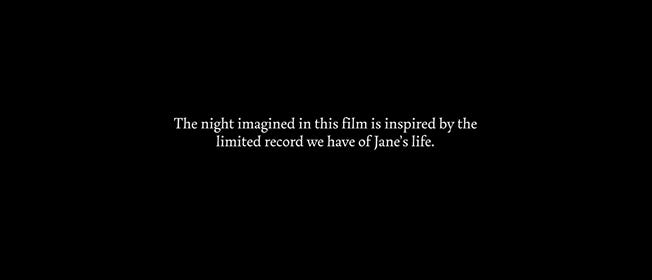
I think about this title card every so often. Probably about as frequently as I think of James’ poems. It is a wild title card. I don’t know if she wrote it. Or, a producer. Or, the director. I have no idea who stuck it in the movie.
It’s quite the thing to state at the beginning of a Historical Fiction film. Imagined. Inspired by. Limited record. There’s lots of “real” things going on in the film. And, a lot of not real things. All mixed up together.
It reminds me of Moby-Dick and the idea of presenting the truth. What is a whale? Is the most realistic portrayal of it a 1:1 recreation? Is a piece of art with the highest fidelity actually an understatement of the facts? Is it an exaggeration of them? To get to the emotional or subjective truth of what a whale is do you have to move beyond the objective reality? Seems dangerous. But, maybe necessary? Maybe not.
In a way, the Jane & Emma title card is pretty similar to the image I posted above of the ruins, framed by the metal and transparent plexiglass overlaid with a line drawing of what the ruins could have looked like anciently. It’s an acknowledgement of a limited record and an acknowledgement of the imagination being used to fill in the blanks. But the recreation is not as painterly as the painting of the whale in The Spouter’s Inn.
Years ago, for some reason, I was Googling about whether or not there were any video games that had been built around, or based on, T.S. Eliot’s Four Quartets. It seems like a pretty nerdy thing to do, now that I look back on it. Video games & poetry.
But, I found one! Home is Where One Starts, whose title comes from T.S. Eliot’s Four Quartets:
Home is where one starts from. As we grow older
The world becomes stranger, the pattern more complicated
Of dead and living. Not the intense moment
Isolated, with no before and after,
But a lifetime burning in every moment
And not the lifetime of one man only
But of old stones that cannot be deciphered.
And, it turned out, Home is Where One Starts (a very small, indie game made by one person), was made by David Wehle, who was (is? I don’t know) a member of The Church of Jesus Christ of Latter-day Saints.

So, maybe “In my beginning is my end,” is an important element of LDS Art or stories. Obviously, Zemeckis, Eliot, McGuire, and Shelley aren’t members of The Church of Jesus Christ of Latter-day Saints. So, it isn’t that is a theme which is unique to LDS stories. But, maybe an important part of them? It does fit into larger theological themes and spiritual ideas of the church.
Family history & ancestry matters a lot to us. Joseph Smith taught: The greatest responsibility in this world that God has laid upon us is to seek after our dead. The Apostle says, “They without us cannot be made perfect;” for it is necessary that the sealing power should be in our hands to seal our children and our dead for the fulness of the dispensation of times.”2
The prophet Spencer W. Kimball said, “From time immemorial the Lord has counseled us to be a record-keeping people.” Keeping a journal or a diary is allowing someone at the end to look back to the beginning. It facilitates the action.
The 1993 church film “The Mountain of the Lord,” is about the construction of the Salt Lake City Temple. It opens with a title card emphasizing the use of records in its creation:
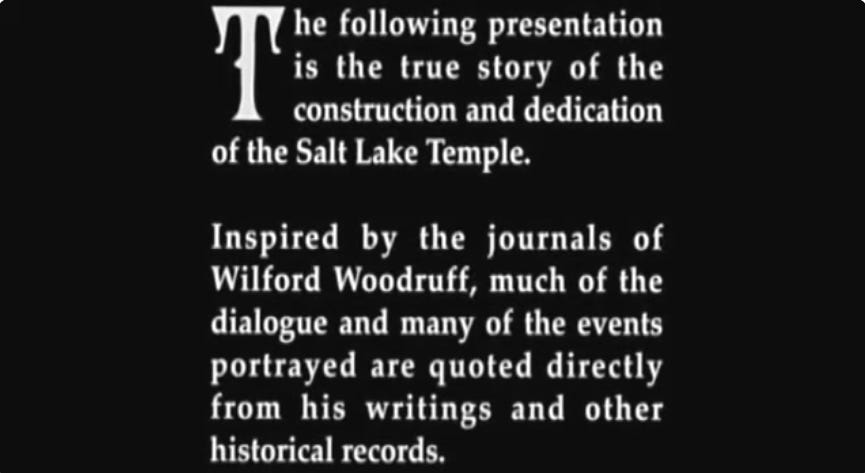
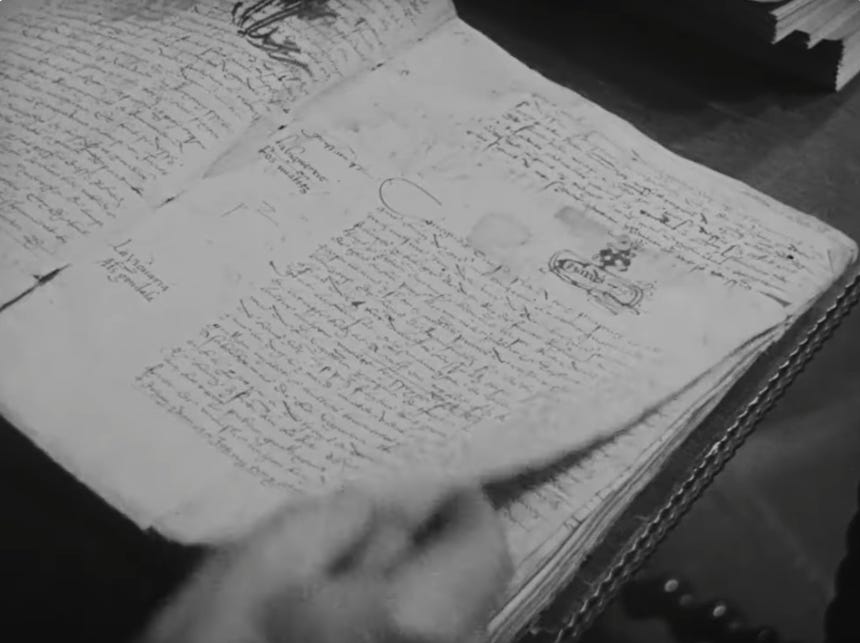
But, again, you can’t say this is a uniquely LDS thing. The Mountain of the Lord title card is not so different from the ones that open up Dreyer’s The Passion of Joan of Arc. Those title cards, and intercut video clips, also emphasize that the film was pulled from the actual records of Joan’s trial. They also emphasize the importance of records.
I just listened to a great podcast this week, Angus Fletcher on Tetragrammaton:
Towards the end of the podcast, Angus talked about how people who can think about the past, and understand the past, have less anxiety and less stress. Looking toward the future often causes anxiety. And, the further you look into the future, the more anxiety you get, because the future is unknown. And, the distant future as an unknown of unknowns. Looking into the past allows you to place yourself into a narrative context. It helps you understand yourself. It helps you move forward with more hope and less fear. He said it something like that.
But, this reminds me of one of the complaints that James & Melissa noted some people have about LDS art, which is that it is too optimistic. It is too positive. There’s not enough “authenticity” and “reality.” I assume, this could mean, some people think “there’s not enough anxiety and stress and messed up people,” in LDS Art.
Perhaps, this idea of “In my Beginning is My End” being a theme of LDS art is one of the culprits of that. Perhaps being so familiar with one’s past, and one’s history, and spending a lot of time putting it into a narrative context, does make you less anxious. Maybe it does, like Angus says, make you more well adjusted. This, of course, presents a problem for drama. Drama needs conflict, tension, faults, and maybe a little anxiety, to work. Got to have something to overcome and work through.
Perhaps a fix for this is having the theme “In My Beginning is My End” be more than just a theme. Maybe it is a story element. Maybe it is the elixir with which the hero returns to the Ordinary World.
This idea almost gets back to one of the main points of Hadestown. Hadestown is a musical about the myth of Sisyphus & Orpheus. It’s set-up to be cyclical. The story you watch is linear, until it isn’t. It turns out it’s a continuous loop. And, the point of the story becomes its cyclical structure. The end of Hadestown is the beginning of Hadestown. In my beginning is my end. A continuous loop.
The cyclical aspect of the story is used as instruction to the audience who is dealing with the sorrow of seeing Sisyphus taken back to the underworld. They’re emotional about the story’s end result. It’s linearity. The play’s cyclical twist is like a, “Hey. It’s gonna’ be okay. We’re just gonna’ tell the story again. And, Sisyphus & Orpheus will be back together for a little bit longer. And, then they’ll be separated. But, don’t worry. We’ll just tell the story again, and they’ll be back together for a bit.”
I know Hadestown has been a popular play performed out here on the Wasatch Front for the last 3 years. I feel like every high school, junior high, and community theater has put it on in the last three years.
Here’s one of my favorite songs from the play:
I’ve read that before Zoroastrianism, time was largely thought of as cyclical. The seasons. The moon. The stars. All that stuff is cyclical. But, Zoroaster taught that there were three times: Creation, Mixture, and Separation — a beginning, middle, and end. Time is linear. So, unlike the seasons, and the story of Sisyphus & Orpheus, time doesn’t just repeat itself over and over again. But, it moves on and progresses towards a final event.
I think one of the interesting aspects of “In my beginning is my end” is that it seems to be an acknowledgement of linear time, and an acknowledgement of its cyclical nature. You’re moving forward over the same ground. Doing the same thing. Going over the same spots that others have. The first time for yourself. But, perhaps with less anxiety and stress about it, because you’re familiar with the people that did it before you.
Again, this, was mentioned by T.S. Eliot in Four Quartets:
And what there is to conquer
By strength and submission, has already been discovered
Once or twice, or several times, by men whom one cannot hope
To emulate—but there is no competition—
There is only the fight to recover what has been lost
And found and lost again and again:
The video and Substack article both are talking about the question: what is an LDS story? More importantly, perhaps, the question(s) seem to be:
What are the current elements, conventions, and themes of LDS Stories?
What are the ideal elements, conventions, and themes for LDS Stories?
Why are they different?
How do we get from where we are, to where we want to be?
What do our current story elements reveal about what we value?
What do our ideal story elements reveal about what we value?
The prophet, however, is a seer, not a scholar; his prophetic vision has created our concept of history as being essentially of the future. Time becomes primarily future, and future the primary content of our historical thought. For this new future “the creator of heaven and earth” is not sufficient. He has to create “a new heaven and a new earth.” In this transformation the idea of progress is implied. Instead of a golden age in the mythological past, the true historical existence on earth is constituted by an eschatological future.
Hermann Cohen, translated by Karl Lowith, Meaning in History, p.18
Comments
Nothing yet. Say the first thing.
Sign in to join the conversation.