
Suppose medicine is to fulfill its deepest purpose. In that case, it must evolve from a rescue-based industry into a partnership-based ecosystem that helps people remember their agency, their connection to nature, and their capacity to shape their own health trajectories.
Medicine stands at a crossroads: continuing to expand the medico-industrial complex without investing equally in behavior change and upstream determinants will only deepen the gap between what is possible and what we live. The science is clear that most of the chronic diseases burdening our clinics and hospitals are driven by patterns of behavior and by social, economic, and environmental conditions that nudge those behaviors in unhealthy directions. Yet our systems overwhelmingly reward downstream interventions, reimbursing procedures and pharmaceuticals while underfunding prevention, community, and education.
At the core of this evolution is a radical reframing: human beings are not their beliefs, diagnoses, or labels. Beliefs are stories that can be examined, updated, and even released; when patients see that they are not identical to the narratives they have inherited from family, culture, or advertising, a space opens for change. In that space, the role of the clinician shifts from expert fixer to skilled guide in behavior change, helping individuals discover that they have choices even amid constraint. Behavior change science, motivational interviewing, mindfulness, and trauma-informed care are not “extras” but essential tools for unlocking this inner freedom.
To make this vision real, medicine must decisively invest in the upstream. That means focusing on food systems rather than just blood sugar, walkable communities rather than just statins, clean air and water rather than just inhalers and dialysis. It means designing schools, workplaces, and digital environments that make the healthy choice the easy, obvious, and socially supported choice. These investments often look less dramatic than a new device or blockbuster drug, but they quietly produce fewer strokes, fewer amputations, fewer nights in the ICU. They also honor the truth that health is co-created by individuals, communities, and ecosystems, not manufactured in isolation nor routinely rescued by a silver bullet.
For individuals, the message must be both honest and hopeful: optimizing health is not reserved for the privileged or the perfectly disciplined. Many of the most powerful interventions—breathwork, sleep hygiene, movement, nourishing whole foods, cultivation of meaning and connection—are simple, often free, and deeply evidence-based. Small, repeated choices accumulate: ten minutes of walking after dinner, five quiet breaths before reacting, one more vegetable on the plate, one more hour of sleep, one more kind interaction with a neighbor or child. When framed as experiments rather than moral tests, these behaviors become accessible and even playful.
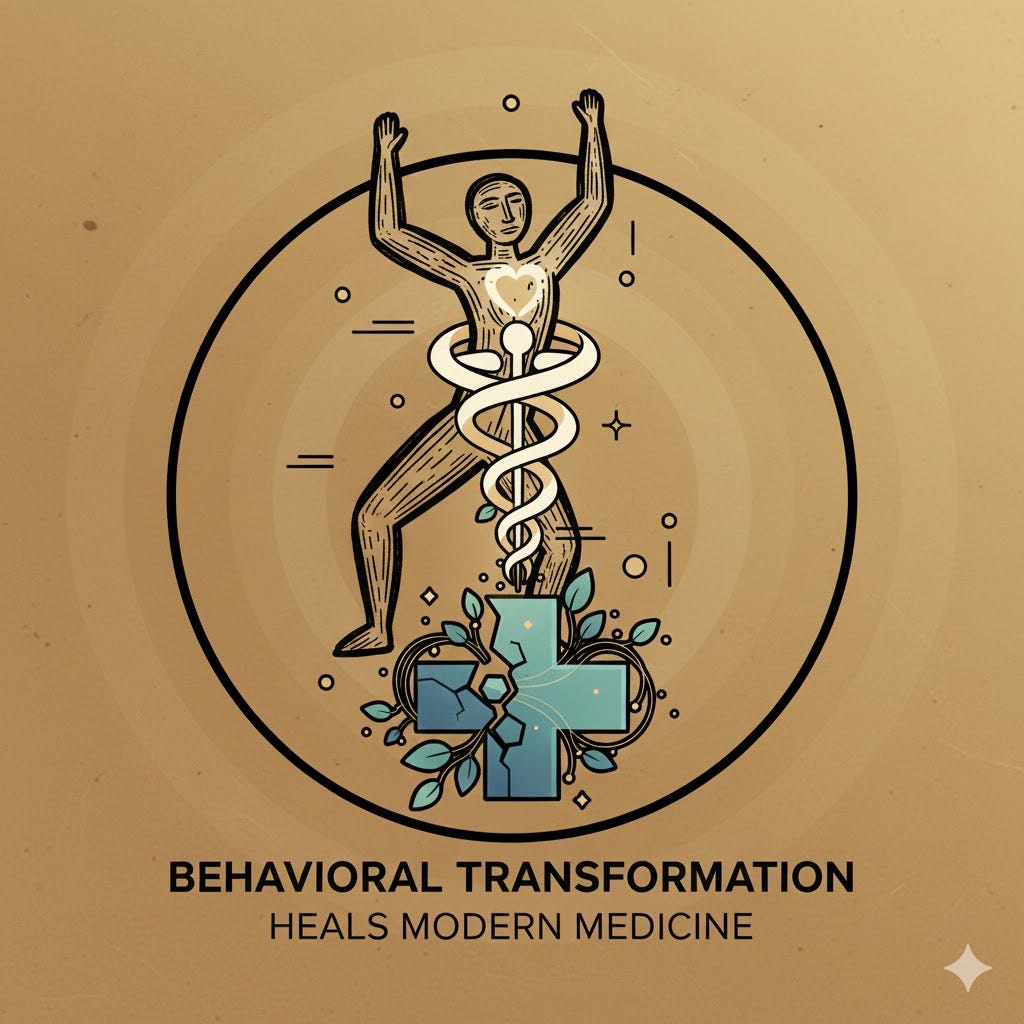
The future of medicine depends on inspiring this kind of change early and often, especially in children. If young people grow up in environments where healthful behaviors are modeled, celebrated, and woven into daily life, they will require fewer heroic medical interventions later in life. The task ahead is to build a culture—in clinics, communities, and our own homes—where behavior change is seen not as punishment or perfectionism, but as an ongoing act of creativity, self-respect, and love. In that culture, the medico-industrial complex still has a role, but it no longer defines the story. Instead, the story becomes one of shared responsibility and possibility: behavioral transformation heals modern medicine
.
No posts
Comments
Nothing yet. Say the first thing.
Sign in to join the conversation.