
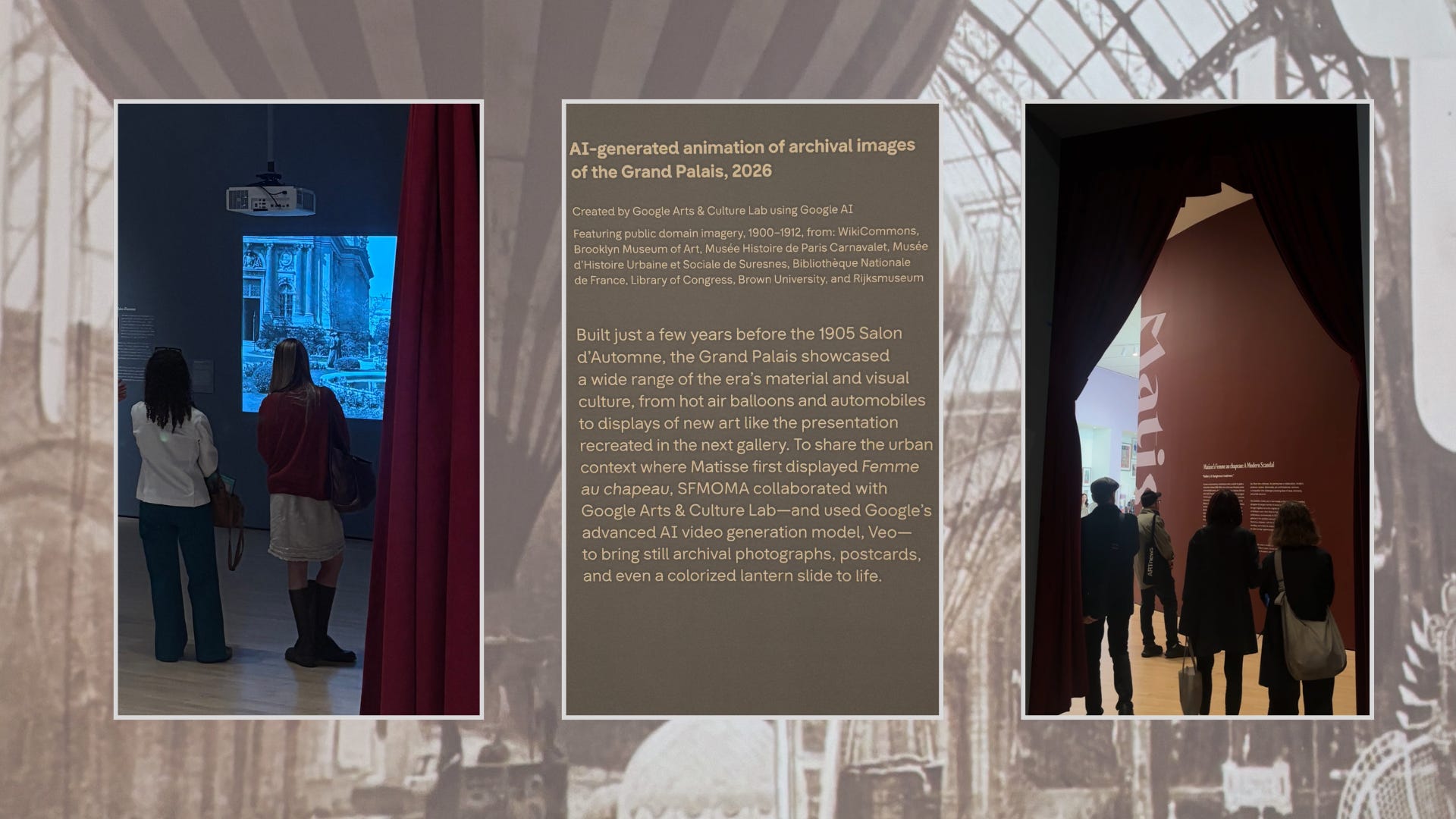
Entering SFMOMA’s newest exhibition, “Matisse’s Femme au chapeau: A Modern Scandal,” visitors walk under a set of pulled-back red curtains to view a video of Paris’s Grand Palais, the original venue for Matisse’s 1905 painting. Except the video isn’t real. It’s a digitized pastiche of archival photos, brought to life with Google’s AI video generation tool, Veo.
“It’s A..I..,” whispered one older female visitor to her husband after reading the video’s object label on a recent May afternoon. Their jaws slightly dropped as they watched in bewilderment while 20th-century Parisians walked around in the projection.
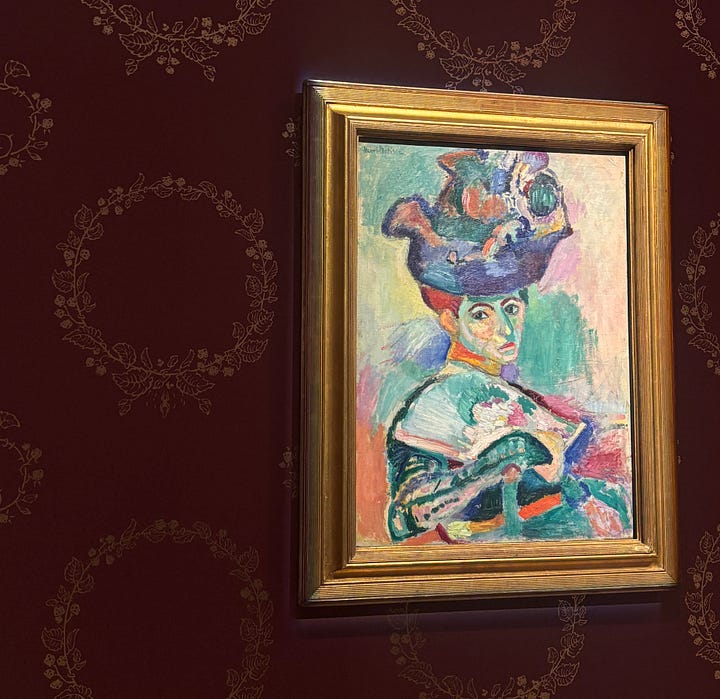
The video is one of two AI activations SFMOMA created in partnership with Google Arts & Culture, one of the tech giant’s non-profit initiatives, for Matisse’s Femme au chapeau. The painting portrays Matisse’s wife, Amélie, seated with a fierce gaze. A brave, green line contours her nose. Her towering hat and dress are composed of chaotic paint blotches in every color, despite reports of Amélie wearing black during the portrait session.
Calling it the most historically significant work of art in SFMOMA’s 52,000-piece collection, Janet Bishop, the exhibition’s co-curator, said Femme au chapeau sent shockwaves through the art world as soon as it left Matisse’s studio. Art critics at the time were flummoxed.

“Is this art?...Then we confess we are not qualified to understand it. Is this a joke?...Then we will leave the creators to laugh amongst themselves,” wrote Felix d’Anner in 1905.
In 2026, no one is arguing that Femme au chapeau is anything but a masterwork. The controversy du jour is whether AI can actually help visitors connect with the acclaimed painting. SFMOMA, along with other Bay Area institutions, is boldly experimenting with AI and hoping people won’t make a big to-do about the new modern scandal unfolding during their visit.
For more contemporary art reflections, follow along on Instagram @ourmodernarchive.
Erica Gangsei, SFMOMA’s Head of Interpretative Media, spoke to the AI inclusions her team helped execute, referring to them as “time travel experiences.” Gangsei argued for museums to experiment further with technology and “participate in those conversations [about AI] in order for those tools to reflect our community.”
Museum visitors aren’t nearly as excited about witnessing AI in the exhibition they paid $40 to see. Like SFMOMA’s other special exhibitions, Matisse’s Femme au chapeau is curated with an extreme attention to detail — historically accurate wallpaper, paintings on loan from across the globe, and images sourced from Matisse’s personal archives. Visitors noted that adding AI into the mix wasn’t enhancing their experience.
To be sure, the exhibit surrounding “Femme au chapeau” has very little to do with AI. Bishop selected dozens of archival photographs, sculptures, and paintings to track the painting’s ownership from collectors in Paris to the Bay Area, plus works by modern and contemporary artists that took inspiration from Matisse’s “Woman with a Hat.”

The museum is certainly not going out of its way to promote the AI inclusion. Visitors have no way of knowing about the AI partnership before they step foot inside. It’s not advertised on SFMOMA’s website, exhibition materials, or social media channels. The AI videos are small enough to go unnoticed, but unnerving for visitors who stop to experience them.
“You’re almost pushed to interact with it,” said David, a San Francisco visitor in his sixties of the AI-assisted video that is unavoidable in the very first gallery.
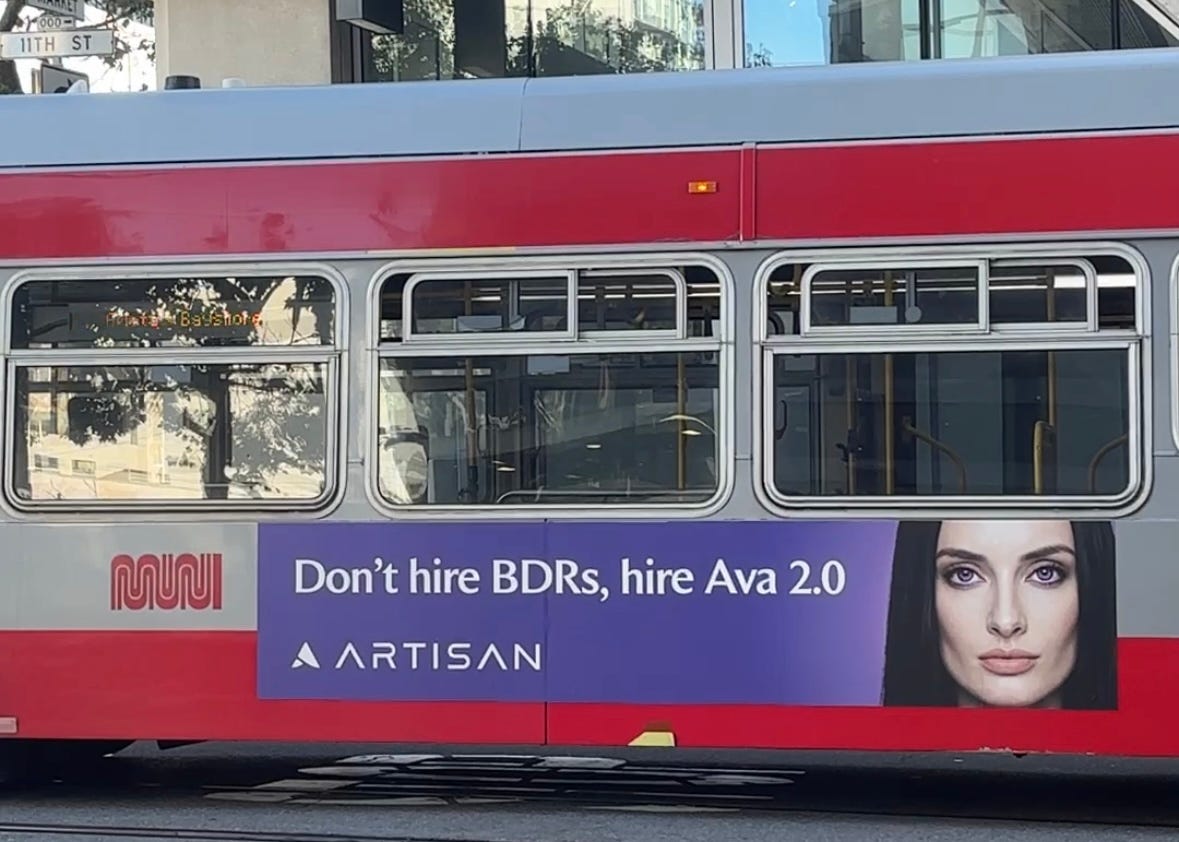
Other visitors lamented that they see AI everywhere in the Bay Area and seeing it inside the exhibition felt somewhat inevitable. Just outside SFMOMA are dozens of billboards and Muni bus ads about autonomous virtual employees and optimization technology. It feels safe to assume that people are likely spending their time at the museum to seek an escape from AI everything in San Francisco, not to see it among masterworks by some of art history’s most legendary names. Now, that’s changing.
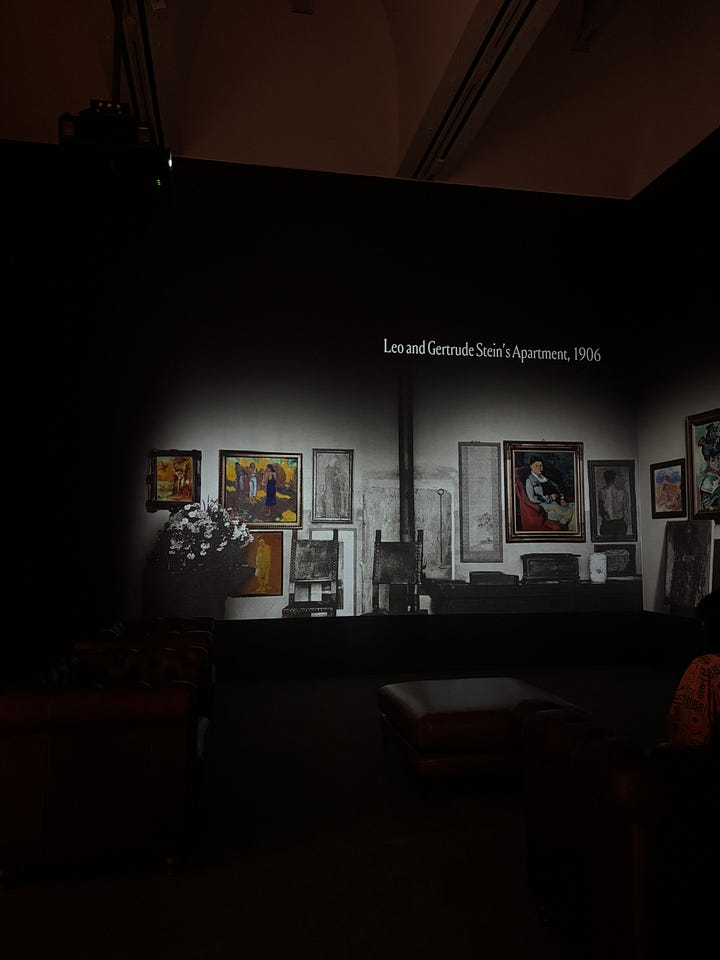
Femme au chapeau’s first owners were Leo and Gertrude Stein, who purchased the work at the Grand Palais in 1905 and hung it hastily in their Paris apartment. A decade later, their brother and sister-in-law, Michael and Sarah Stein, assumed ownership, bringing the work home to Palo Alto and on loan for a show at the San Francisco Museum of Art in 1936.
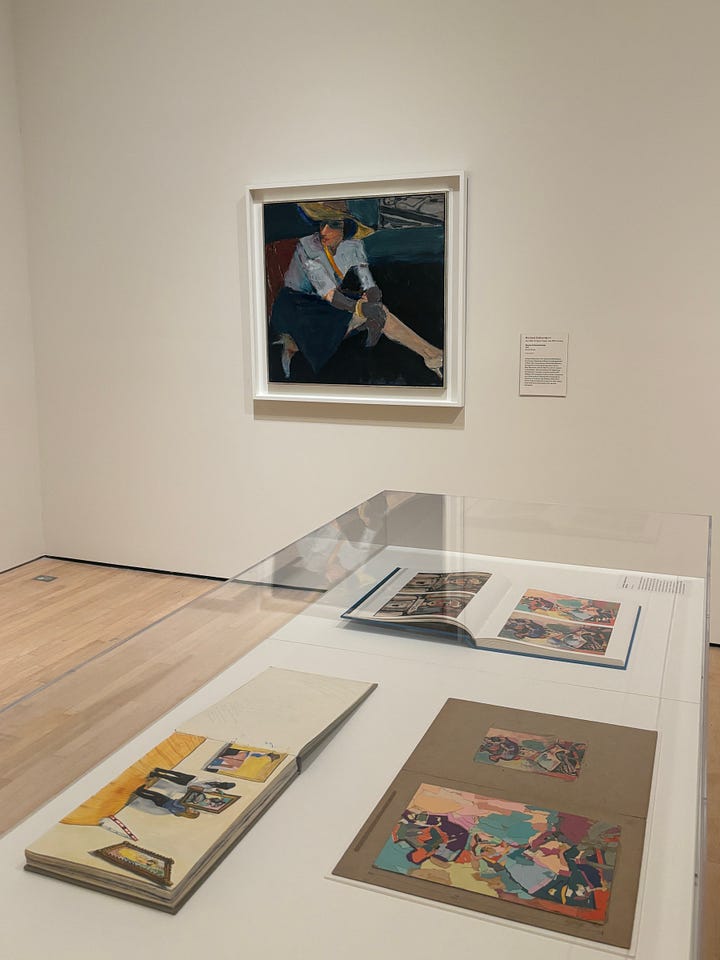
Few artists got the opportunity to view Femme au chapeau in a context as intimate as legendary Bay Area figurative painter Richard Diebenkorn, whose visit to the Steins in Palo Alto while enrolled in Stanford University prompted a deep admiration for Matisse and his own woman-in-a-hat painting that’s on view in the exhibition.

By the 1950s, Levi’s heiress and art collector Elise S. Haas got her hands on the painting, later donating the work to SFMOMA’s collection in 1991. In the eyes of Haas, Femme au chapeau was too priceless to travel. Thus, the exhibition is a Bay Area exclusive, leaning heavily into the masterwork’s local patronage.
Also in the final gallery are some remarkable paintings by living women artists Hilary Harkness and Mickalene Thomas that solidify the exhibition’s thesis: Femme au chapeau didn’t just inspire artists of the 20th century following the Fauvists. Rather, the work is a touchpoint for artists in the 2020s, too.
All of this unique Bay Area art history and contemporary art curation competes with two touch screens featuring another AI partnership with Google placed right before the exit. Dubbed “The Wild Palette,” these AI-generated animations bring works by Matisse inside the exhibition to life through 3D modeling and video. Visitors are invited to swipe through videos that show Femme au chapeau tipping her hat, and the subject of Matisse’s La fille aux yeux verts (1908) walking through an imagined room.
“It’s a little…spooky,” said 30-year-old San Francisco resident Chris, as he watched the subject of Matisse’s La fille aux yeux verts begin moving almost robotically in the AI video.
Sure, the AI animations excited children in the exhibition, who furiously swiped through the screens and giggled as an AI Amélie Matisse began to slowly move and tip her hat. But several adult took a quick glance at the AI videos, scoffed at them, and promptly exited. Why are these videos even here, anyways? They’re not even providing visitors with further historical information about Matisse. The story presented in “The Wild Palette” is more like an AI overview of the show that does a disservice to SFMOMA’s own curatorial team, who spent years conducting research on Femme au chapeau’s origins and decades-long journey through private collections in Northern California.
SFMOMA’s partnership with Google happens in the midst of other Bay Area art institutions dipping their toes into AI. These include the de Young Museum’s work with Anthropic on its “Monet and Venice” exhibition. Adobe even hosted an activation during the de Young’s family day that used Firefly to create AI-generated images of families set in landscape paintings. At Stanford University’s Cantor Arts Center, a show highlighting the work of artist Miljohn Ruperto features an entirely AI-generated artwork.
For museums, the AI playbook is one of stealth. SFMOMA has yet to share anything from official channels about its Google partnership. The de Young left its only mentions of AI activations for LinkedIn. Into the vacuum has stepped social media creators, like creator Bunny McFadden, whose video documenting her discovery of the AI videos following SFMOMA’s press preview just days before the exhibition’s opening got some online traction.
Several SFMOMA visitors on May 31 admitted that they weren’t particularly bothered by the first video that animated archival images of the Grand Palais. Tommy, an 18-year-old San Franciscan who was visiting with a friend, said he was “entranced.” Even though the video was assisted with AI, he didn’t take issue with it because “it’s not generating anything.” Samantha, a 25-year-old Atlanta resident in town for a work conference, even praised the introductory video, noting that she “likes when it’s used to recreate historical events.”
Yet when asked for reactions to the animations of Matisse’s paintings, most visitors found the inclusion unnecessary. “Let the people do this…I just feel like this is such an easy cop-out,” said Nicole, a San Francisco resident in her early 20s who was unnerved by the video of Femme au chapeau coming to life.
Nancy, a frequent SFMOMA visitor in her 50s, felt disappointed, but not entirely surprised by Google’s role in the exhibition. Like other Bay Area locals, she has become desensitized to AI applications in nearly all aspects of everyday life. But the introduction of tech that doesn’t necessarily add to a visitor’s experience gave her pause, especially after walking through such a thoughtfully curated show. “AI is here, it’s just a question if it’s used for good or evil,” she said.
In their main lobby hanging over where visitors enter, SFMOMA has more AI slop: a deepfake drag video. Most visitors don’t see it or know that it’s AI because the object label is hard to find and easy to dismiss.
At a time when San Francisco’s museums are still reeling from last year’s federal grant cuts and cutting costs with layoffs, tech money isn’t just a source of potential patronage, but a necessity they may not survive without. Last year, Google.org granted SFMOMA $1.5 million for Ruth Asawa: A Retrospective. In New York, the Guggenheim and LG have partnered for an initiative supporting artists working at the intersection of art and technology, with $100,000 awarded annually to one artist.
This in-gallery experiment in partnership with Google might be the beginning of a bigger exploration of AI art for SFMOMA, which has concurrently opened a deepfake drag installation in its main lobby. A few hours south, Los Angeles’s newly-opened AI art museum by Refik Anadol, Dataland, is setting a new precedent and pointing to a future of museums that remove actual artists from the work on view.
AI art and exhibition elements are easy to dismiss now as appealing to 2026’s AI explosion, but what happens when museums’ adoption of AI becomes the norm? When exhibition design teams are traded for ChatGPT, guided tours are slashed in favor of AI overviews, and hardworking artists lose commissions because AI can do it faster, cheaper, and without copyright complications?
Whenever the time comes for San Francisco’s first fully algorithmic art exhibition, we can only hope that it shocks visitors enough to protest.
Thank you so much for reading! This piece was a feat of original research, hours spent inside the exhibition, and weeks of organizing my thoughts. If you found this post to be meaningful and important, consider supporting future work with a paid subscription instead of buying tickets to AI exhibitions.
For more contemporary art reflections and spotlights on women artists, follow along on Instagram @ourmodernarchive.
Comments
Nothing yet. Say the first thing.
Sign in to join the conversation.