
Hello! I’m visiting my home state of Washington this week and have a wonderful guest author lined up for you!
Karina Baloleanu, CFNC is a certified functional nutritional counselor who writes the weekly newsletter Back to Wholesome. I love the healthy advice and information she shares through her newsletter and Substack notes– it’s always practical, relatable, and incredibly valuable to anyone interested in learning about their blood sugar, hormones, and gut health.
Today, Karina is sharing more about the relationship between blood sugar and hormones, as well as a few of her favorite tips for keeping blood sugar in check.
I hope you enjoy this guest post— it’s free for all and a great one to share!
Thank you, Karina!
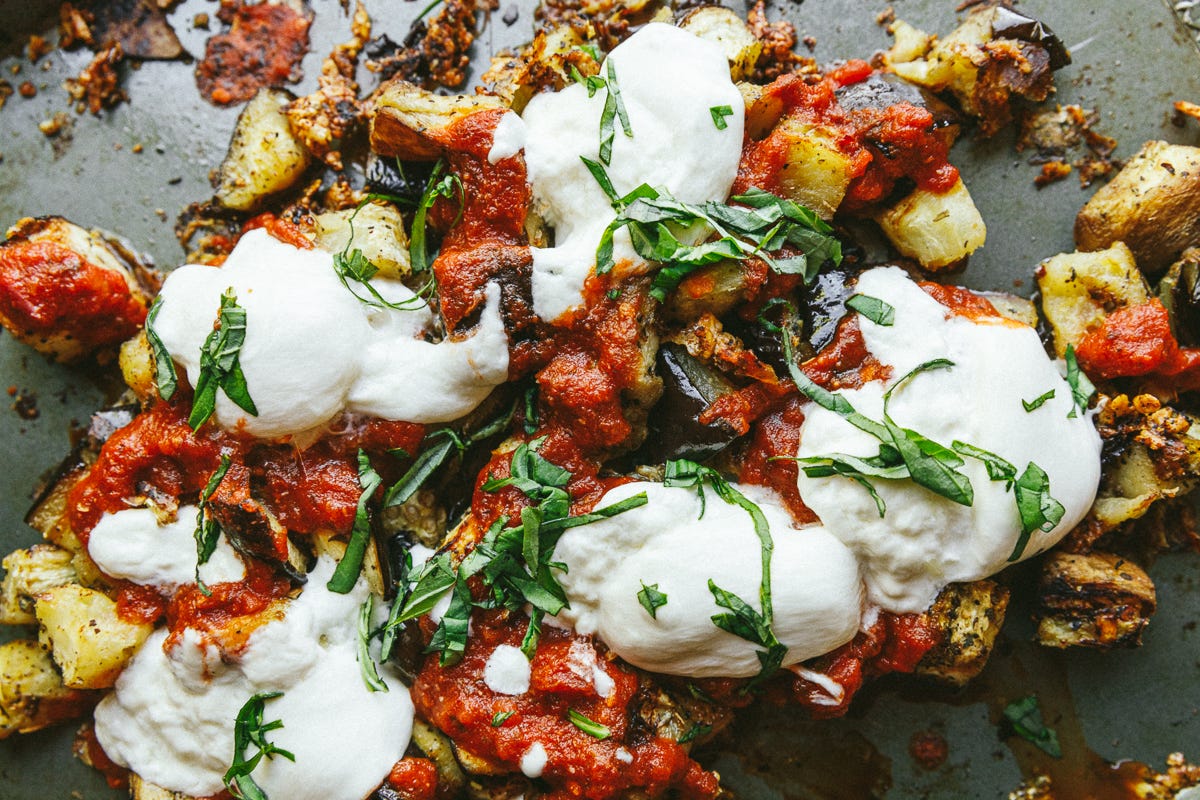
p.s. I’ve also unlocked a favorite summertime recipe for everyone to enjoy. Sheet pan eggplant Parmesan is quick, delicious, and a simplified, blood sugar-friendly version of the classic.

Q: Karina, tell us a little bit about your background, what you do, and how you became a functional nutritional counselor.
A: Thanks for having me! My journey into nutrition actually started with me as a patient. It began with a gestational diabetes diagnosis I never saw coming, followed by a hormonal cascade: hypothyroidism, burnout, the whole picture.
The conventional medicine route took me from doctor’s office to doctor’s office and left me with more questions than answers, until I stopped accepting “let’s wait and see” and “your labs look normal” while I was feeling horrible, and decided to take my health into my own hands. That’s when I discovered Dr. Mark Hyman and got introduced to functional medicine, which led me to functional nutrition. I became a patient of it first, and it was what finally moved the needle for my health. From there, I got certified and started helping women who felt as lost, hopeless, and frustrated as I once did.

Q: What led you to start a newsletter with a focus on blood sugar and hormones?
A: There’s a lot of misinformation out there, on both the conventional side and the wellness side. My goal with the newsletter was to share information that’s accurate, backed by science, and grounded in my own lived experience.
Why blood sugar and hormones specifically? Because that’s where it all started for me, and I want this information to reach as many women as possible, so they know they’re not small men, and their symptoms aren’t just in their head.
Over time, my mission has grown beyond the newsletter. I’ve also co-created a course and community for women where we teach the pillars of health through this female lens, called Rooted, and I also take clients 1:1.
Q: Many people think blood sugar only matters in the context of diabetes. Why should everyone– especially women– care about this topic?
A: I think a lot of people believe blood sugar only matters in the context of diabetes, for two main reasons. First, most of us were never taught what blood sugar symptoms actually feel like in the body, or what it’s like to be on a blood sugar rollercoaster day after day. Second, doctors typically only flag blood sugar as an issue once it’s diagnosable.
But in reality, things go off track long before that point. If fasting insulin were tested alongside fasting blood sugar, we’d catch a lot more, because insulin can start rising years before it shows up in fasting glucose.
This is especially relevant for women, because blood sugar is the foundation everything else builds on: hormones, nervous system health, gut health.
Q: What are some of the most common signs that someone’s blood sugar is out of balance, even if lab work appears within “normal range”?
A: Some of the most common signs include feeling ‘hangry’ about two hours after eating, hitting an energy crash in the afternoon, and needing to snack constantly because you can’t go more than a couple of hours between meals. Other signs include headaches, excessive thirst, resistant weight loss, waking up in the middle of the night, skin issues, and PMOS (the newer term for PCOS).
It’s also worth understanding the difference between normal and optimal ranges. Standard lab reference ranges are built from a wide population, including a lot of people who aren’t metabolically healthy, so ‘normal’ can be a pretty generous bar.
Optimal ranges are narrower and reflect where your numbers ideally sit for the body to function well, not just avoid a diagnosis. That’s why someone can have a fasting glucose that falls within normal and still be dealing with real blood sugar dysregulation underneath it.
Q: How does blood sugar affect hormones like cortisol, insulin, estrogen, and progesterone, and what symptoms might people notice when those hormones are impacted?
A: I love using the delivery man analogy to explain how blood sugar and insulin work together. Picture insulin as your delivery man and glucose as the packages he’s carrying. Every time we eat carbs, a package of glucose needs to be delivered to your cells, so a delivery man (insulin) gets called in. He carries the package to its destination (the cell), rings the doorbell, and the cell opens up to receive it. The more packages that need delivering, the more delivery men get called to the job.
But when we need to deliver too many packages at once, or one right after another, the delivery men eventually can’t keep up. They keep ringing the doorbell, but the cells stop answering because it’s been rung too many times. That’s when insulin resistance starts to enter the picture.
Blood sugar balance sits at the base of the hormonal pyramid. When it’s out of balance, insulin and cortisol are usually the first hormones affected, since they’re so closely connected. Thyroid and sex hormones tend to follow after that. So it’s genuinely difficult to balance your hormones without addressing blood sugar first.
And when hormones become imbalanced, we can start to see symptoms like PMS, heavy periods, anxiety, depression, infertility, brain fog, low libido, and in more serious cases, diagnoses like fibroids, endometriosis, or cancer.
Q: If someone wants to improve their blood sugar balance starting with the foods they eat, what are the first three changes you’d recommend that have the biggest impact?
A: The first would be to crowd out ultra-processed foods and simple carbs by adding in more of the good stuff: healthy fats, protein, and fiber.
The second is making sure you’re getting enough protein at every meal, around 25 to 30 grams.
And the third, without changing anything else about your diet, is simply eating your fiber and protein before your carbs. Getting used to that order alone can make a real difference.
Q: Are there any myths about hormones or blood sugar you frequently hear and have to dispel?
A: One myth I hear all the time is that food is the only thing that matters for blood sugar. Unfortunately, you can eat an incredibly clean diet and still struggle with blood sugar and hormonal issues, because food is only part of the picture. Stress, sleep, and gut health all play a significant role too, and they can influence blood sugar and hormones just as much as what’s on your plate.
Q: What’s one simple daily habit that offers the biggest return for better blood sugar and overall metabolic health?
One of the first things I have clients implement is eating breakfast within 60 to 90 minutes of waking up, built around protein. And when I say protein, I don’t mean one or two eggs. That’s not enough. I’m talking about around 30 grams, plus some fiber and healthy fats. This one shift can be a game-changer for mood, energy, blood sugar stability throughout the day, and overall hormonal and metabolic health.
I know we’ve been told to reach for pancakes or an acai bowl in the morning, or to fast the way men do, but a carb-heavy breakfast, or skipping breakfast altogether, can trigger a hormonal cascade in women. It creates more stress for the body, especially for women who are already carrying a lot and living under chronic stress.
Q: What are your five favorite tips for keeping blood sugar in check?
A: I already touched on a few of these: a protein-rich breakfast, fat, fiber, and protein at every meal, and eating in the right order.
I’d add getting enough sleep. Poor or insufficient sleep can lead to insulin resistance over time, and even the exact same meal can trigger a completely different blood sugar response depending on whether you slept well the night before.
Then there’s movement. Even a short walk after a meal can significantly change your blood sugar response and slow down the glucose curve.
I know you asked for five, but I want to mention one more: nervous system regulation.
When we’re constantly stressed, overwhelmed, or rushing, we tend to run on cortisol, which over time raises blood sugar and insulin too. Small moments of dropping into a parasympathetic state throughout the day, especially before meals, can be incredibly helpful. Even just a few deep breaths before eating, with the inhale shorter than the exhale, can make a real difference.
Thanks for reading At the Table! This post is public so feel free to share it.
Thank you so much, Karina! I hope you give her a follow, restack this post, or send it to a friend.
And for recipes that keep blood sugar balance in mind, check out the Recipe Index along with hundreds of free recipes on my blog, Stem and Spoon.

I first began making this sheet pan eggplant Parmesan in 2024, and it’s still one I turn to often during the summer.
Here’s what makes this recipe a keeper:
cubed eggplant roasts on a sheet pan for easy prep (no breading required);
it’s a quick, 20-minute-recipe (30 tops!) that is wonderful on its own or as a side with some grilled chicken to up the protein;
it has all the flavor of classic eggplant Parm but a healthier, low-carb and grain-free version.
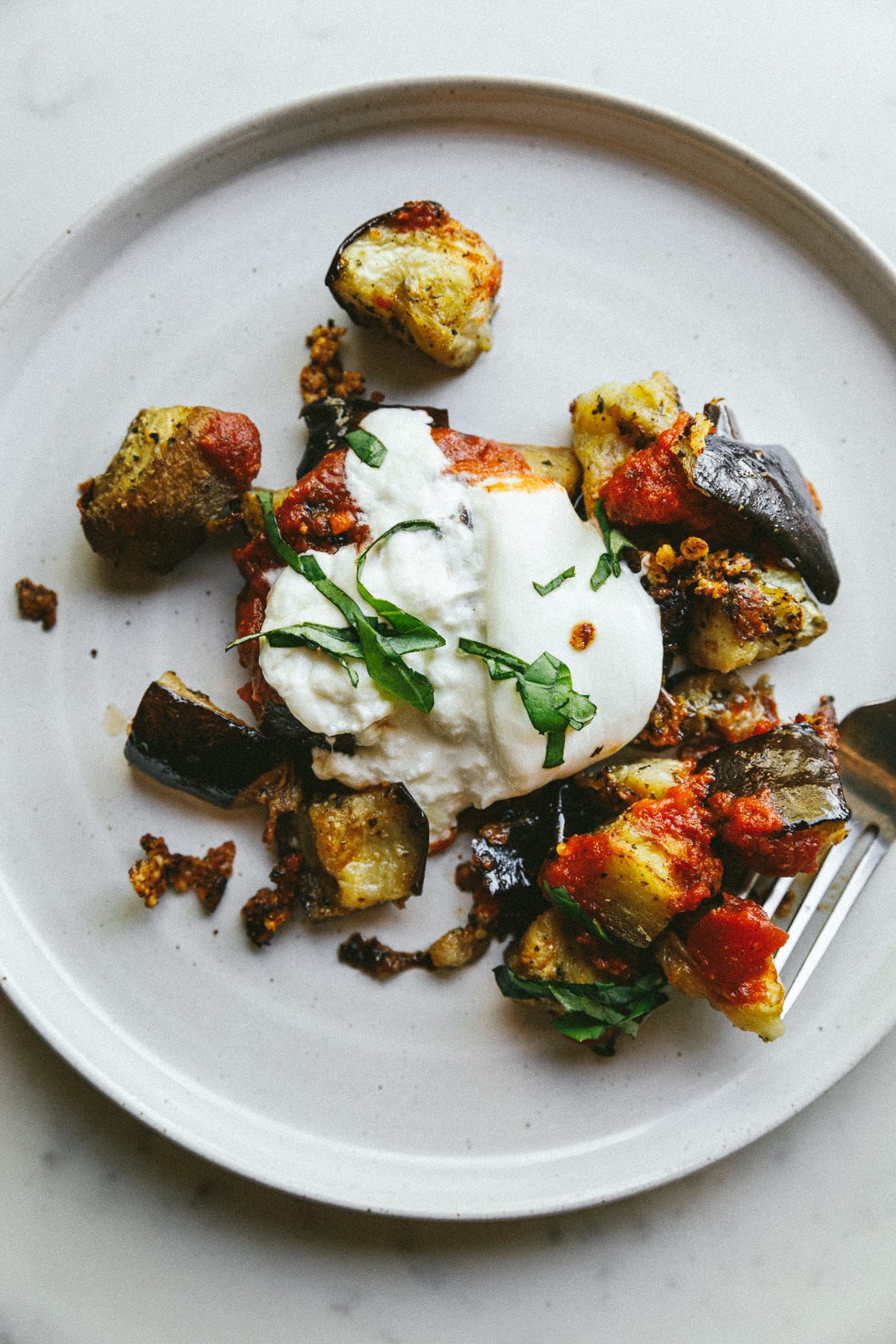
I’ve unlocked this recipe for everyone to enjoy, and I hope you love it! Here’s the original post, but I’ve copied it below for ease, too.
A low-carb, sheet pan eggplant Parmesan
·
July 18, 2024
I consider eggplant Parmesan to be sort of a gateway dish to eating eggplant. It’s smothered in marinara, there’s melty cheese involved, and the eggplant is commonly breaded and fried for a deliciously crisp coating. All elements for something really tasty.
My version eliminates many of the steps of “restaurant” eggplant Parm (I call it that because I’m not sure that the breading is traditional), but it doesn’t lack in flavor. It does cut down the prep time, however, which is always a plus.
Yield: ~3-4 servings
Prep time: ~25-30 minutes
2 medium eggplant, peeled if preferred
3 tablespoons extra virgin olive oil
½ teaspoon fine sea salt
½ teaspoon ground black pepper
½ teaspoon garlic powder
½ teaspoon onion powder
1-½ teaspoons Italian seasoning
⅓ cup grated Parmesan cheese
½ cup marinara sauce (choose one low in carbs/sugar- I like Rao’s)
½ teaspoon red pepper flakes
1 large burrata ball or a few slices of fresh mozzarella
Fresh basil or more Parmesan (optional toppings)
Preheat the oven to 450°F. Line a half sheet pan with parchment paper or a silpat baking mat.
Slice both ends off of your eggplants. You can use 1 large eggplant or 2 medium eggplants. If you’re using one large eggplant instead of two medium, I recommend peeling it as the skin tends to be tougher on large ones. Slice the eggplant into thick, 1-inch rounds, then cut those into cubes, about 1-inch all around.
Place them on the sheet pan (or in a large bowl) and drizzle them with the olive oil. Toss to coat the cubes of eggplant.
In a small dish, add the sea salt, black pepper, garlic powder, onion powder, and Italian seasoning. Finely-chop the Parmesan cheese until it’s really small, then add it to the seasoning mixture and mix well to combine.
Sprinkle all of the seasoning/Parmesan mixture on the eggplant cubes, tossing to coat. You’ll have some Parmesan mixture on the sheet pan which is fine (they’ll crisp up in the oven). Make sure that the eggplant pieces are not too close together, otherwise the pieces will steam each other.
Transfer the pan to the oven and roast the eggplant for 10 minutes. Remove the eggplant from the oven and gently toss the eggplant with a metal spatula before returning to the oven for another 7 more minutes.
Stir the red pepper flakes into your marinara sauce and set aside.
Remove the eggplant and gently push the eggplant cubes toward the center, so they’re all close together. Use your metal spatula to lift a lot of the crispy cheese bits from the pan, too.
Add spoonfuls of the marinara on top of the eggplant. Pull apart your burrata ball and add sections of it on top of the sauce (or add slices of fresh mozzarella). Return it to the oven for about 3 more minutes or until the sauce is heated and the cheese is slightly melty.
Remove from the oven and let it cool for 5 minutes. Serve with extra Parmesan, red pepper flakes, and fresh basil, if desired.
Eggplant skin is totally edible but on larger eggplants, the skin can be a bit tougher. I’ve made this dish with peeled and unpeeled eggplant- do as you prefer!
If you don’t line your baking sheet, the eggplant will want to stick to the sheet pan and you’ll have a harder time tossing it during the roast time (same goes for the Parmesan bits that cook on the sheet pan).
Burrata is so tasty on this but so is mozzarella. You can eyeball how much you need. For burrata, one large ball ends up being the perfect amount. If using grated mozzarella instead of fresh mozz, I’d suggest starting with about ¼-⅓ cup.
If you need this dish to be dairy free/vegan, substitute the Parmesan cheese for vegan Parmesan and omit the mozzarella or use your favorite dairy-free substitute. You can also enjoy this without the cheese. I would recommend omitting it entirely instead of substituting it for vegan swaps that could have questionable ingredients. Without the cheeses, this dish would be similar to my Turkish eggplant casserole.
If you don’t like eggplant, try my keto chicken parmesan recipe!
The red pepper flakes add a touch of heat to this dish but it’s still fairy mild. You can leave them out, if preferred. A friend gave me a pasta alla puttanesca seasoning she bought in Italy that looks almost exactly like this and it was so tasty in the sauce.
If you’re not a fan of marinara or don’t have any on hand, you can substitute it for pizza sauce or pesto.
Nutritional information is an estimate based on 4 servings, calculated by My Fitness Pal.
Calories: 226
Total fat: 16 g
Cholesterol: 10mg
Sodium: 507mg
Total carbohydrate: 16 g
Dietary fiber: 8 g
Total sugar: 9 g
Protein: 6 g
Total net carbs: 8 g

Thank you so much for reading and cooking along with me! I hope you have a wonderful week.

Comments
Nothing yet. Say the first thing.
Sign in to join the conversation.