
The Post Office scandal has become one of the greatest miscarriages of justice in British history. Between 2000 and 2013, more than 700 sub-postmasters and sub-postmistresses were wrongly prosecuted after the Post Office’s Horizon computer system falsely reported financial shortfalls. Many lost their livelihoods. Some sub-postmasters and sub-postmistresses were imprisoned. Families were torn apart, reputations destroyed and several people took their own lives. Yet for years, the Post Office insisted its computer system was reliable and suppressed repeated claims that it was the software, not the sub-postmasters and sub-postmistresses, that was at fault.
Nick Wallis was one of the few journalists willing to stick with the story until it finally reached public consciousness. Nick first became aware of the scandal in 2010 after hearing about a pregnant sub-postmistress who had been sent to prison. He was horrified when he realised this was not an isolated case but part of a pattern of wrongful convictions and institutional denial, shaped by senior staff in the Post Office who were mostly concerned with protecting reputations rather than admitting the truth.
““Either all these people are genuinely mistaken, or on the rob, as the Post Office were insinuating they were, or the Post Office could be responsible for putting innocent people in prison.”
The story eventually reached a turning point in 2019 when two High Court judgments delivered devastating criticism of the Post Office’s conduct and the computer system on which the prosecutions had relied. What had once seemed like a weird and unbelievable story became impossible to ignore. Then, in January 2024, ITV’s drama Mr Bates vs The Post Office brought the scandal into the public eye, transforming it from an all-consuming, long-running personal battle for devastated individuals into a national political issue.
In this episode of Beyond Gender, Nick Wallis describes how the doggedness of the campaigners ultimately won the day. He explains how Alan Bates, the leader of the fightback, was a strategic genius, like a military general plotting his next move. Nick describes Bates as “diligent, stubborn, tenacious, brilliant”. Always thinking several moves ahead, Bates was prepared to make small gains to box off the enemy. He also kept meticulous records, understanding that every document might one day matter.
Looking back, Nick can see just how important that discipline became. As he says, “Blessed are the receipt keepers because this [the trans medical scandal] is going to come back and bite a lot of people in the backside when it breaks through.”
Like the trans medical scandal, the Post Office scandal was sustained because many people ignored the evidence while powerful organisations went to extraordinary lengths to protect themselves. The Post Office scandal raises a broader question about institutional groupthink and why ordinary people, more often than not, seek to cover their own backs when they find themselves trapped inside systems that refuse to admit they are wrong.
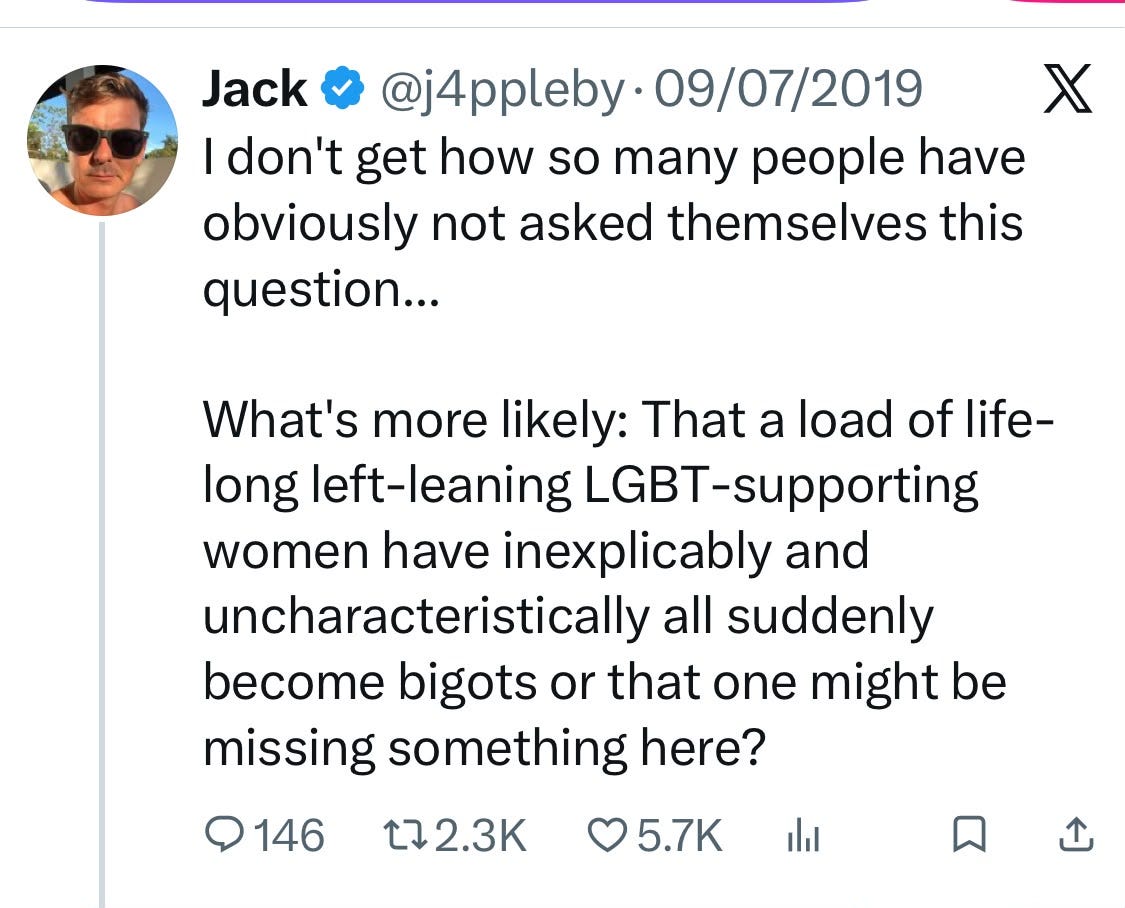
I remember Jack Appleby’s comment on Twitter back in 2019 and how, back then, I just couldn’t understand how people could look away from what was happening. Seven years later, I’m no longer incredulous, just bitterly disappointed.
Nick is keen to point out that Alan Bates didn’t break through on his own - he was aided and abetted by many post masters who were willing to speak up publicly about how their lives were ruined by this. As Nick says, “it takes an army to win a war and although this [the trans medical scandal] is a much bigger war, there are many more generals on the field.”
He recalls first noticing the similarities between the Post Office scandal and the ongoing trans medical scandal in the early 2020s. He describes how the Genspect conference in Lisbon, Portugal, in September 2024 was a life-changing experience for him. I remember being extremely keen to invite Nick to Lisbon. I knew he was a respected BBC journalist and, ever eager to try to get this story into the mainstream, I was thrilled when he accepted my invitation to attend the Lisbon conference. I also remember speaking to him at the event and realising that he was utterly hooked.
Mia also speaks about the power of the Genspect conferences, saying there is something special about bringing together the leading experts in the world to discuss these issues. When intelligent, educated people from a wide range of disciplines come together, they generate fresh conversations and make significant advances. Nick believes Genspect is second to none at building networks. He also remembers the broken-hearted parents and how sad it was to meet people who justifiably believed their children had been taken by a cult.
Nick points out that the more new information you can get out, the more likely you are to gain entry into the public realm. He describes himself as the original centrist dad. He wants everyone to talk to each other and is genuinely interested in all sides of the story. This is why he’s so frustrated by the institutional cover-up, which he believes is causing as much harm as the medical scandal itself. As Nick says, ordinary people know that men can’t be women, so they think, "Why are the BBC lying to me?" The public are losing trust in the mainstream media and, because it has utterly failed to do its job properly, it has driven ordinary people to seek news elsewhere.
I asked Nick, “What is the BBC’s mindset now?” I was also thinking of The New York Times, The Guardian, The Irish Times, the CBC in Canada and RTÉ in Ireland. Nick explains that they know they are deliberately choosing to mislead the public. When they refer to a male paedophile as “she” or “her”, they know they are saying something they do not believe to be true. But they think they need to follow the editorial policy. This is the bible they hide behind. Just as doctors hide behind the WPATH Standards of Care, “just following orders” remains one of the most powerful forces to be reckoned with.
They know it is all wrong, but they don’t feel they can manoeuvre because of the editorial policies and style guides that insist on using “she” and “her” according to self-ID. But if the BBC changed course, the smaller news outlets would follow. These news organisations know they are committing a great wrong, and I point out that, at a certain point, once Hannah Barnes’s BBC exposé on GIDS at the Tavistock had aired in 2020, “they moved from ignorance, to wilful ignorance, to complicity.”
Nick admits that he tried to use all sorts of excuses to avoid the trans medical scandal. “Oh, it’s not my fight.” But in the end he ran out of excuses and knew he had to do the right thing.
We finish our discussion deploring the abdication of responsibility by journalists, who simply have to do their job. If journalists did their job, Mia and I would not have to waste so much time and so many resources fighting this nonsense. According to Nick, this is going to take a generational shift. There are four and five-year-olds being brainwashed by this ideology and, until we get it out of schools, we are going to be fighting it from generation to generation. We have to teach children to think more critically and we have to reclaim our captured institutions.
Nick wants to write a book about this, the story of how Western institutions are so easily captured by a movement that is “anti-science, anti-logic, anti-sense and causes harm.” Ultimately, Nick believes that people like Jonni Skinner speaking to Scott Wiener, and detransitioners who are willing to speak clearly about the harm they have experienced, will bring this story to light. Evidence of harm is what will finally break it through. As Nick concludes, “Until it reaches a level of national consciousness, there will be no tipping point. Until then, just keep going.”
Watch our conversation here:
If you would like to support Nick’s important work, please subscribe to his Gender Blog.
Comments
Nothing yet. Say the first thing.
Sign in to join the conversation.