
Turkey and Ukraine Cut a Deal On M270 and ATACMS
This was one of those small stories which if you look behind the story you can find some pretty interesting implications. That being said this section is a speculative look-ahead so if you are just here for the week’s news skip on.
On Sunday-Monday news came out that Ukraine had purchased M39 ATACMS ballistic missiles, M270 multiple launch rocket systems using GMLRS and ATACMS missiles, and tens of thousands of cluster munitions and artillery shells from Turkey. US Department of State records confirmed the plan and according to the terms that the Americans sold the weapons to Turkey, once Turkey announces intent to resell the weapons the US Congress has 15 days to object or the sale goes through automatically, and Congress is out of session. No doubt the deal for some $280 million was timed that way intentionally.
Specifically, the hardware is:
12 x M270 MLRS launchers (a tracked armored vehicle launching rockets in salvos)
70 M39 ATACMS ballistic missiles (big short-range ballistic missiles launched from the M270 one or two at a time)
2,524 unguided 227 mm M26 rockets with DPICM cluster warheads launched up to 16 at a time from the M270, pretty much always in salvos
7,000 M509A1 203 mm cluster artillery shells for 2S7 “Pion” and M110 self-propelled guns , these are mucking big heavy howitzers.
The M39 ATACMS is an early variant with a 165 km. range, so well less than a lot of Ukrainian drones, but a big warhead packed with cluster munitions. Its best target is an airfield stuffed with aircraft and munitions, followed by clumps of vehicles that are high-value targets for one reason or another.
What may have been missed in this news, I think, is the “Why” Ukraine decided to buy this stuff in the first place. For one thing, Ukraine even after losses probably has around 20 M270, and 40 HIMARS launchers which fire the same munitions, that is, salvos of 227mm unguided rockets or single shots of 165-km. cluster munitions ATACMS ballistic missiles. So why buy 20 more launchers?
I think it comes down to the ATACMS, which are highly-accurate and can be ready to fire in a minute, i.e., if the crew has no idea where to shoot and then gets told, but the crew is ready to shoot, the ATACMS can be airborne in about a minute. More about that in a few paragraphs.
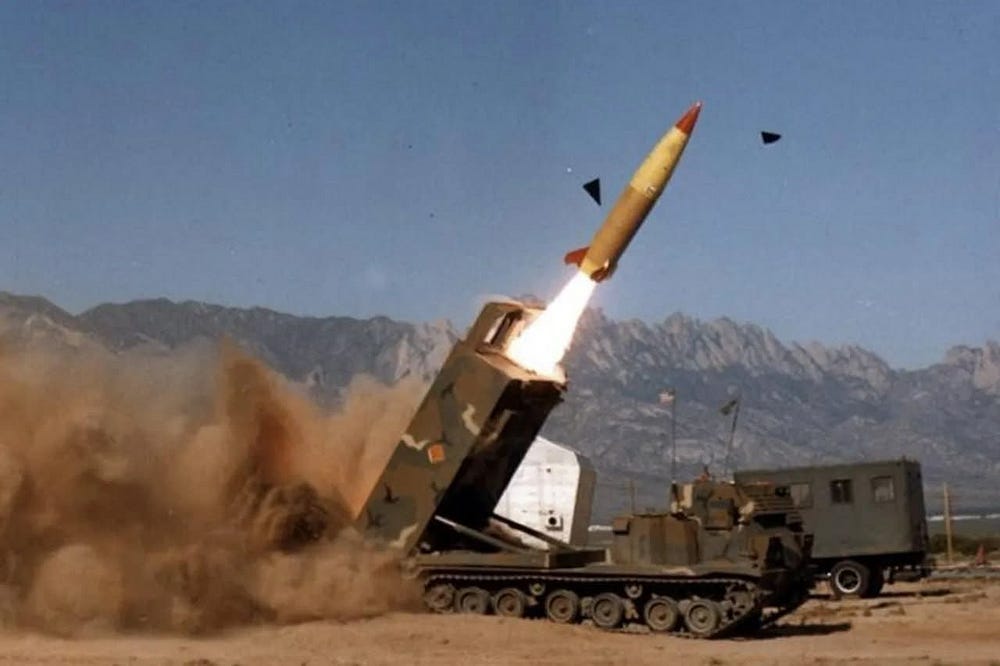
The 227mm rockets can be pointed and fired with the same speed, but because they aren’t so accurate the drill is to fire several at once and cover a large area. The older versions that the Turks are selling the Ukrainians fly 45 km; it is possible they were upgraded to 70 but that is not for sure.
Then there are the artillery shells, 203mm. This is the longest-ranged tube artillery piece in the Ukrainian inventory but still short-ranged by modern war standards (20–30 km typically), but the shell is the heaviest, around 90 kg. The best use of the shell is blowing up something resistant to smaller shells, like a bunker.
So, once they have this stuff in hand, we can say that the Ukrainians at minumum intend to make the “buzz saw” defense more lethal, that’s what the 227mm rockets are for. It’s also possible the Ukrainians have an offensive plan whereby they intend to just saturate a section or area with rockets and then move in fast behind it. What is clear is the Ukrainians have the capacity to lay down a huge number of rockets very quickly; they could probably fire off every single rocket bought from Turkey in about two days. So this acquisition is a certain indicator of increase Ukrainian capacity to make a major attack, and a possible indicator of Ukrainian intent.
But also there are ATACMS. This is a very precise, area-effect weapon that is quick to put on a target and that flies so fast targets usually are surprised. If Ukraine has roughly 70 launch platforms before, now the will have about 90. This means that along the entire front the Ukrainians will be pretty dense in launch platforms for ATACMS and 227mm rockets. The question is how might the Ukrainians try to exploit that density? Both munitions Ukraine has trouble getting in quantity. So somewhat it’s a one-shot opportunity for the Ukrainians. What is it that the Russians have, that is hard to hit, yet if it is hit, it is pretty easy to destroy because it’s not armored or especially flammable or just not really resilient.
There are two targets that fit this definition almost perfectly: Russian Iskander-M launchers; and Russian Shahed drone launchers. Both of those attack systems try and stay well out of the range of everything the Ukrainians have, and when they do launch, they try to do it quickly and then leave the launch site as fast as they can. Neither is armored against cluster munitions, both usually have lots of people and light vehicles in the area, both have a distinctive electronic signature, and both depend on quick retreat protecting them from Ukrainian counterstrikes to the location of the signature.
So the really critical bit is, after a launch, how fast can a Iskander-M crew or a Shahed crew get packed up and moving? The answer to that is almost certainly not as fast as an on-the-ball M270/HIMARS crew could put an ATACMS missile on that location, provided the Ukrainians were prepared for the launch in general and cued and waiting for the specific grid to fire on.
Earlier this review points out that shooting down Russian ballistic missiles isn’t an option for Ukraine for the near to medium term. Given that, in other words, if we are wondering how Ukraine intends to deal with the Russian ballistic missiles it can’t shoot down, or drone launchers it can’t hunt down. The answer is staring us in the face.
Admittedly, strict journalism rules, one can’t say that any of this is for sure. All we know is what the Turks are selling, the capacities of the stuff sold, and the Ukrainians’ priorities and the Russians’ priorities. Thing is, keeping civilians alive and nullifying Russia’s sole effective means of terrorizing Ukraine’s population at long range is such a top level Ukrainian national security priority, almost nothing short of assassinating Putin would be more important.
So I’m confident that once those ATACMS get to Ukraine from Turkey, their target is going to be Iskander-M launchers. If the Ukrainians can get close enough with the launchers depend on Russian Shahed launch sites coming under an “erase this square kilometer” 227mm rocket salvo. Especially launch sites in Donetsk and Luhansk region, my guess is they are going to get pounded.
The Senate Passed the “Tough” Russia Sanctions Bill
Yawn. First, this has been in the works so long that even if the bill does become law, the targets have literally had years to get ready. At this point all this is, is political posturing. Second, the Senate ain’t the House. And even if the House supports it in theory, they have to agree politically. Could happen but no guarantee.
And in Crimea
Ban on Small Watercraft Imposed in Western Crimea
Occupation authorities have imposed a ban on the use of small watercraft — including catamarans, kayaks, and canoes — and on the harvesting of marine biological resources (a/k/a fishing) along the coast in Crimea’s Chernomorsky District. This also applies to jet skies and sailboats. Further, no water activities of any kind when the sun is down. This is basically Feodosia and Tarankhut point. Almost certainly, this is so the Russians can have a free fire zone at anything headed West. Sounds reasonable, but NATO reconnaissance planes sometimes come within 70 km of those waters, so if you are looking for a place for WW3 to start, there you go.
Another assassination, I’m telling you, this is going to continue for decades
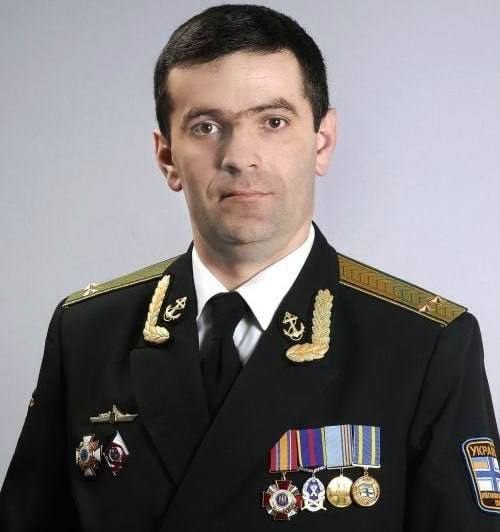
This time the explosion occurred around 10 a.m. local time on a street in western Sevastopol, on Wednesday. The FSB decided the weapon was an an explosive device was placed in a trash can and detonated when the officer walked by. The officer was Robert Shageyev, a former Ukrainian navy officer who, prior to Russia’s first invasion, commanded Ukraine’s only submarine. He went over to the Russians and had risen to a mid-level staff job in the Black Sea Fleet. The explosion blew his legs off and he died.
The FSB arrested a 32-year-old Russian woman who, it seems, told them she was acting on the instructions of Ukrainian special services. Unverified reports identified her Margarita Reutt, resident of Sochi, who had in her adulthood run several businesses including a service to clean up oil from beaches, a travel agency, and a guide service. The British Sun suggested she had been at one time a paid escort and “traveled extensively in Egypt and Turkey”.
In 2025, a Sochi court fined Reutt for “discrediting” the Russian military with some fellow train passengers, she apparently learned of a Ukrainian drone strike, reacted positively, and one of her fellow travelers ratted her out to the authorities. FSB reports said she had been paid in cryptocurrency for the attack. Which may be true. Or it may be the FSB decided this woman was a plausible guilty person to present the public.


No posts
Comments
Nothing yet. Say the first thing.
Sign in to join the conversation.