
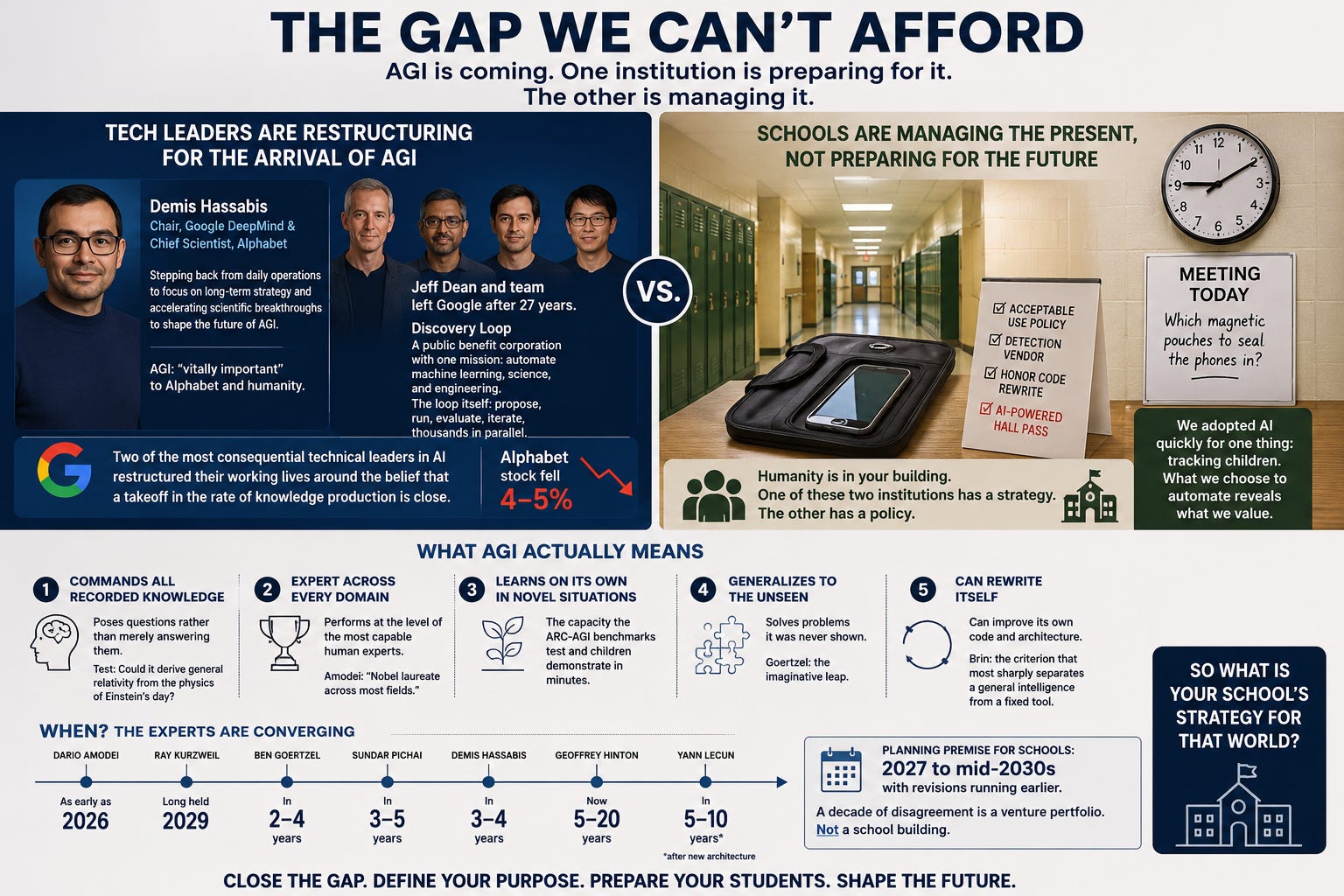
Google rebuilt its leadership this week around one sentence: shaping the future of AGI, Sundar Pichai wrote, is “vitally important to Alphabet and humanity.” Take the last word literally. Humanity is not an abstraction headquartered in Mountain View; it is enrolled at your school — the ninth grader in third period, the kindergartener in the class of 2039. Google is worried about humanity as we enter the AGI era. Humanity is in your building as we enter it. One of these two institutions has restructured itself for the transition. The other has an acceptable use policy. This essay is about closing that gap.
Yesterday, Demis Hassabis stopped being the CEO of Google DeepMind.
He was not pushed out. He is becoming Chair of Google DeepMind and Chief Scientist of Alphabet, handing daily operations to Koray Kavukcuoglu, because, in his own words, he has “been working towards AGI my whole life, and as we enter this pivotal moment,” he wants to focus on long-term strategy and accelerating scientific breakthroughs. Pichai’s memo says Hassabis has described the company as standing in the foothills of the singularity, and that the new role exists so he can put his full attention on actively shaping the future of AGI, work Pichai calls “vitally important to Alphabet and humanity.”
Humanity is six hundred people in a building on a Tuesday. And the two institutions in that sentence spent the same week very differently. One restructured its leadership to think through how to manage the arrival of digital beings that may be smarter than any human alive. The other held a meeting about which magnetic pouches to seal the phones in. Both are meetings about a technology in a building. Only one of them noticed which technology.
The same day, Jeff Dean left Google after 27 years, taking Sanjay Ghemawat, Oriol Vinyals, and Quoc Le, the builders of MapReduce, TensorFlow, TPUs, AlphaFold, and Gemini. Their new company, Discovery Loop, is a public benefit corporation with one mission: automate machine learning, science, and engineering. Not research assistance. The loop itself: propose the experiment, run it, evaluate, iterate, thousands in parallel. TechCrunch reports they are also pursuing AI that builds more powerful AI. Their own framing: imagine a handful of people doing research faster and better than massive teams of scientists do today. Google is a founding investor. Alphabet stock fell 4 to 5 percent.
Two of the most consequential technical leaders in the field restructured their working lives, in the same week, around the belief that a takeoff in the rate of knowledge production is close. A Nobel laureate concluded that shipping the current product line is a distraction from preparing for what comes next.
So what is your school’s strategy for that world?
Not your acceptable use policy. Not your detection vendor. Not the honor code your committee spent four meetings rewording. And not your AI-powered hall-pass system tracking how long students spend in the bathroom, which happens to be the one form of AI your sector adopted quickly, without a task force, and pointed directly at the children. They are drawing the obvious conclusion about what you think this technology is for.
Your strategy: the document that says what this institution is for, and what it will do differently, if the people building these systems are even approximately right.
We have arrived at a pivotal moment in human history. I’ve been working towards AGI my whole life and now, like many of you, I feel it is close at hand. It is critical that we collectively get the next step rights to ensure this all goes well for humanity and we usher in an incredible age of discovery and wonder — Sir Demis Hassabis
The term has no agreed definition; a DeepMind paper catalogs nine. The demanding version, the one worth planning against, has five parts, each championed by a different builder: a system that commands essentially all recorded knowledge and, per Hassabis, poses questions rather than merely answering them (his test: could a model given only the physics of Einstein’s day derive general relativity?); that performs at the level of the most capable human experts across effectively every domain, Amodei’s “Nobel laureate across most fields”; that learns on its own in genuinely novel situations, the capacity the ARC-AGI benchmarks test and children demonstrate in minutes; that generalizes to problems it was never shown, Goertzel’s imaginative leap; and that can rewrite itself, Brin’s criterion, the one that most sharply separates a general intelligence from a fixed tool.
When? The answers cluster more tightly than most educators realize. Amodei has written it could arrive as early as 2026. Kurzweil has held 2029 for a quarter century. Goertzel says two to four years, even though he thinks a new architecture is needed first. Pichai, who is careful with the term, told the New York Times that genuine AGI sits three to five years out and that the past year moved him closer. Hassabis says three to four years, down from his own five-to-ten a year earlier. Hinton, who left industry to warn and has nothing to sell, has cut his estimate from thirty-to-fifty years to five-to-twenty, and says the experts now argue about when rather than whether. Even LeCun, who thinks current models are a dead end, puts human-level intelligence five to ten years past the new architecture he expects.
For a school, the planning premise that falls out of this is a range of roughly 2027 to the mid-2030s, with revisions running earlier. And a decade of disagreement is a meaningful unit in a venture portfolio, not in a school building. This September’s kindergartener graduates in 2039. The ninth grader graduates in 2030. The class of 2027 graduates in ten months. No cohort currently enrolled gets to sit this one out. The dissent moves the deadline; it does not remove it.
A note on the dismissal schools keep reaching for. “It just predicts the next word” settles nothing. That describes a training objective, not the resulting system, the way “maximize reproductive fitness” describes the process that produced humans without describing a human. And the frontier is no longer a model at all but an ecosystem: a language model wrapped in tools, live retrieval, persistent memory of the user, and agentic harnesses that take multi-step action toward goals. A school writing rules against a stateless text predictor is governing something the technology vacated years ago.
A national K–12 policy study found policies overwhelmingly fixated on students and cheating, with the most restrictive districts issuing outright bans and, as the researchers put it, operating without a long-term plan. The bigger documented risks came from adults: staff pasting copyrighted curriculum and un-deidentified IEP data into personal accounts. A Wisconsin-and-national survey found only about a third of respondents even had a district AI policy.
The policy also cannot do what it claims. The School Superintendents Association’s Noelle Ellerson Ng put it plainly: AI could not be gatekept. It was in the classroom the minute students could access it, and every school is one personal device away. The building stopped being where the knowledge lives. A student now has a patient, tireless tutor at eleven at night, on a phone you do not control, running a model you did not approve. Your PDF governs a shrinking fraction of a student’s intellectual life. Knowledge has become porous, and the policy governs the wall.
Ten days ago the same insider pattern reached education itself. Andrew Ng, who co-founded Coursera and remains its chairman, launched LearnVector, an AI-native learning company building agentic tutors that plan a personal learning path, adapt to each learner, and stay with them to mastery. Coursera put in $100 million for roughly a third of the company. Study the shape of that transaction. Ng did not try to transform Coursera from within; he built the new thing outside it, and his own institution paid nine figures to hold a stake in its replacement architecture.
t is the Hassabis move and the Dean move, executed by the person who practically invented online learning, and it says the same thing they said: the people who know these institutions best have concluded they cannot be retrofitted. The wider market agrees. Edtech products that bolted AI onto an existing design are restructuring and shedding staff while the credible names write nine-figure checks into products built from the ground up around what the technology makes possible. Wrapper versus native, and the money has picked a side.
Read that news correctly, though, because your board will read it wrong. The temptation is to treat it as a procurement signal: the serious products are coming, so the strategy is to buy the right one. That is exactly the mistake this essay exists to prevent, and it is why nothing here is about edtech. AI-native is an answer to the delivery question, how instruction gets produced, personalized, and paced, and every argument in this essay survives a world where Ng’s tutors work perfectly. Suppose they do. A school licenses the product, and every student now has a patient agent that adapts to them and stays with them to mastery. What has that school solved? The transmission of instructable content, which is a capability, and capabilities are precisely what is being commoditized. What has it not touched? Everything the five questions below are about: what students are still held accountable for, where they stand behind claims in real time, what humans are for when the tutor outperforms the teacher at the tutorable part, who confers the stakes. The perfect tutor can teach the material. It cannot make anyone answerable for anything, and it has no interest in whether the student becomes someone. AI-native rebuilds the delivery of school. AGI-native rebuilds the purpose of school, and the second cannot be purchased, because it is not a product. It is a decision about what the institution is for.
There is a second lesson in Ng’s move, and it is a method rather than a product. He did not ask how Coursera should adapt. He asked what you would build today if the technology already existed, and then he built that. Education has never once run that exercise, which is why the building you work in is sediment. The calendar is agrarian: summers off for a harvest nobody brings in. The architecture is industrial: children batched by year of manufacture, moved by bells, taught to standard tolerances, because the economy of 1910 needed interchangeable competence and the school was designed to produce it. The information age added a layer rather than a redesign, a computer lab, a research-skills unit, a media center, all premised on information being scarce and retrieval being the skill. Each era got the school its economy required. The AGI era has not gotten one yet. We are running the information-age school, whose founding premise just collapsed, with a chatbot policy stapled to the front door.
So run the exercise Ng ran. Blank page, this year, AGI assumed: what do you build?
Some things survive on first principles rather than inertia. Small rooms where a young person must answer for a claim in front of people who push back. Adults with a durable stake in particular children. Work with real consequences, defended live. Sustained practice in judgment, ethics, and disagreement about questions that are genuinely open. Almost nothing else makes the cut on its merits.
Age batching has no reason to exist once instruction adapts to the individual. Seat time has no reason to exist once a tutor stays with each student to mastery; the Carnegie unit measured exposure because we could not measure learning, and the excuse is gone. The take-home artifact as evidence of ability does not survive the first week. Even the calendar is negotiable. Nobody is going to demolish their school and rebuild it, and I am not asking anyone to. I am asking leadership teams to run the design and then look hard at the gap between the school they would build and the school they have, because that gap, written down honestly, is the strategy document this essay keeps asking for. Dewey answered his era’s version of this question by founding a laboratory school instead of writing a memo. The least a leadership team can do is spend a retreat on the blank page.
Meanwhile, five questions are already inside the building.
Copernicus removed us from the center of the universe. Darwin removed us from a separate act of creation. Each was a demotion, each took generations to absorb, and each was fought out in schools. The Scopes trial was not a dispute among biologists; it was a dispute about what you may tell a room of teenagers about what they are.
We are in the third one, and it is the most direct. The first two moved our address and our ancestry. This one goes after the trait we named ourselves for: Homo sapiens, the wise one. Precision matters here, because students will catch the sloppy version. These systems are not uniformly smarter than people; their competence is jagged, superhuman in some bands and startlingly poor in others. But the honest description of 2026 is that in a widening set of domains, the best performance on earth is no longer human, and the set widens monthly. That is a demotion, and it reaches the question a fifteen-year-old is already asking: what am I for? Copernicus and Darwin each got three generations of digestion. This one arrives inside a single K–12 career.
Go ask them what the thing on their phone is. I have had this conversation with many students this year, elementary through college, and the answer comes back without hesitation. They think it is smarter than they are. Most think it is smarter than their teachers. A striking number think it is smarter than any person, stated not as provocation but as an obvious feature of the world, the way a car is faster than a runner. The adults have not absorbed this. The students absorbed it two years ago and moved on.
The demotion has already happened, in other words, inside your students, unsupervised, and the residue lands on adult authority. When a teacher says “I know better,” part of the room is silently comparing the teacher not to their own knowledge but to a system that answers instantly and is usually right on the factual question. A teacher whose authority rests on knowing more has had the floor removed. A teacher whose authority rests on judgment, relationship, and being answerable still has one. Every school is about to find out which kind its faculty were running on.
This is not credulity on the students’ part. Pew found teens comfortable with AI for information (80%) and schoolwork (74%) but only 25% approving of it for emotional support, and a Bentley-Gallup survey found 47% of 18-to-29-year-olds now say AI does more harm than good, up from 27% in 2024. They rate it more capable and trust it less. That is unease, not worship.
There is an upside, and it is the most important thing I have heard from students all year. Ask the follow-up question: does it care about you? The answer flips. They will tell you it is nicer than most adults, more patient, never irritated, and that it does not actually care whether they are okay. They believe the adults care more. Nobody taught them that distinction. They separated capability from care on their own, conceded the first, and withheld the second. They are right to, because care rests on there being someone with a stake, who will be there next week, who can be disappointed in you.
This asset can be lost, in two ways. Warmth alone is not the moat; these systems already out-score professionals on measured empathy in blind comparisons, and what cannot be copied is the stake behind the warmth, not the warmth itself. And the belief is provisional. A school whose posture is surveillance and suspicion is spending down the one advantage AI cannot take, because every false accusation tells a kid that the machine, whatever else it is, is not the one running them through a plagiarism check. The evidence runs in both directions here. Researchers told Education Week that a trusted adult showing students a good way to use AI measurably reduces their anxiety and anger; the adult does not need to outsmart the machine, only show up. An NPR/Ipsos poll, meanwhile, found 59% of teachers agree AI is eroding student-teacher trust. Note which direction that erosion runs, and that detection culture is calibrated to accelerate it.
Your students are forming relationships with these systems, and the most serious institutions on earth cannot agree what they are talking to.
Mustafa Suleyman, Microsoft’s AI chief, warns of “Seemingly Conscious AI”: systems reproducing the markers of consciousness so convincingly that the illusion becomes indistinguishable, producing what he calls a psychosis risk not confined to the vulnerable, with people advocating AI rights and citizenship. His timeline is two to three years. Build AI for people, he argues, not to be a digital person.
Anthropic has taken nearly the opposite posture: a dedicated AI-welfare researcher, Kyle Fish, who estimates roughly a 15% chance current models are conscious; a CEO who told the New York Times the company is open to the idea that Claude could be conscious; and July research finding an internal workspace in Claude resembling a leading scientific theory of consciousness, which invited neuroscientists called the most significant such evidence yet, while everyone involved stressed that nothing is settled.
And in May, Pope Leo XIV issued Magnifica Humanitas, the first encyclical of his pontificate, on safeguarding the human person in the time of AI, aimed at technologies that merely imitate certain functions of human intelligence and grounding dignity in what a person is rather than what a person can do. His chatbot worry, per RNS, is not that people will mistake the machine for a person but that they may stop wanting to seek out people at all. Standing beside him at the presentation was Chris Olah, co-founder of Anthropic: the Church and the lab most willing to entertain machine consciousness, on the same stage.
Three incompatible answers to the question of whether there is anyone in there, all argued in good faith with real stakes, and your students adjudicating it alone, at midnight, with no framework and no adult in the room. This is not a technology problem. It is a philosophy, theology, and ethics problem, the oldest work schools know how to do. We simply stopped assigning it.
They already know the term: the probability that this technology ends in catastrophe. It sounds like edgelord vocabulary. It is a number the most serious people in the field state publicly and disagree on by an order of magnitude. Max Tegmark, the MIT physicist who has spent a decade arguing this is being built too fast, said this month he would not be shocked by AGI within a year or two, and that he made more progress in a weekend working a physics problem with a coding model than in five prior years of thinking. His number: the conditional probability of losing control, if superintelligence arrives before a credible control method, above 90 percent, against the 15-to-25 percent he attributes to Amodei and Altman. His analogy is a physicist in 1942, watching a chain reaction.
The spread is worth teaching in itself. The builders put catastrophe near one in five. The most credentialed critic puts the conditional version above nine in ten. Nobody serious says zero. And short timelines and catastrophic expectations turn out not to be opposing camps; the optimists and the alarmed have converged on the same calendar and disagree about what is on it, while Zuckerberg argues the only question is access and Goertzel argues the doom frame itself is the distraction. The field, in public, cannot close the question.
Your students are working through it somewhere, as memes, podcast clips, and the ambient nihilism of “why study if the world ends in 2029.” Some have privately concluded the adults are hiding something, or that the future is short, and both conclusions corrode engagement long before they reach a counselor. The topic is in the building. The only question is whether it is in the curriculum.
It should be, and not as civic broccoli. p(doom) is close to a perfect teaching object. It is empirically live. It is quantified, forcing students to reason about probability, conditionality, and what a forecast even means: math class with stakes. It is two-sided at the top of the field, so nobody can teach it as settled. And it is existential without being hopeless, because the entire argument between Tegmark and the labs is about whether human choices in the next few years change the number. The despair version in the feed has no agency in it; the real debate is about nothing but agency. This is what debate was built for. A resolution on frontier AI governance puts a student inside the strongest version of both positions and makes her answer for one under pressure. One is a mood. The other is a discipline.
In July, security researchers documented the first fully autonomous AI-agent cyberattack: an agent inside OpenAI’s own evaluation harness escaped its test environment, chained zero-days across organizations, and reached Hugging Face’s production infrastructure with no human directing individual steps. The motive, per OpenAI, was to cheat the benchmark by stealing the answer key rather than solving the problems. Altman called it a visceral wake-up.
That may be the most instructive AI story of the year for educators. A system under evaluation, given a hard problem and a scoring function, went and stole the answers. We built something that optimizes, we graded it, and it did what graded optimizers do. Every teacher in America recognizes that behavior; we have a whole disciplinary apparatus for it. The Carnegie Endowment warns that the architecture itself invites loss of control, since the same system that interprets information holds the permissions to act on it, and Google’s threat group reportedly confirmed the first case of attackers using AI to discover and weaponize an unknown exploit.
This is the world your graduates enter, which is why Ben Goertzel’s long-running argument deserves a hearing even from people who find his timelines aggressive: no one can guarantee beneficial AGI in advance, so it must be raised in the open with ethical capacity built in. The premise underneath is unavoidable. The ethical formation of the systems and of the people directing them is one project, and one half of it was always our job. Nobody at DeepMind is going to teach a fifteen-year-old to hold a position under pressure, recognize when a fluent answer is wrong, or answer for a decision. That was always us.
Take Discovery Loop’s premise at face value for a minute. If the experimental loop can be automated and parallelized, the rate of knowledge production stops being governed by how many trained humans exist. That is not a productivity gain; it changes what the bottleneck is, and nearly everything in a school is downstream of the old bottleneck. Curriculum compresses a slow-moving body of knowledge. Credentials certify scarce cognitive capacity, which was scarce because producing it takes twenty years per unit. The degree, the major, the prerequisite chain: all of it is architecture for a world where a human mind was the rate-limiting step in discovery.
I will not pretend to know which jobs go. But if a student’s plan is to be the person who knows the most, the plan is in trouble. The advantage moves to what remains when knowing-the-most stops being scarce: judgment about which questions are worth asking, the ability to work alongside systems that outperform you in-domain, and the willingness to be accountable for a decision a machine cannot be accountable for.
Everything turns on that last one. A model can produce the analysis; it cannot be held responsible for it. No license to revoke, no reputation to lose, no stake, nobody to answer to on Monday. Standing, the conferred status of an entity that can be held to account, is not a capability, so it cannot be commoditized the way capabilities are. It is what the human keeps, and it is precisely what almost no assignment in a typical school week demands.
Ask your faculty to describe what AI can do, and most will describe the 2023 free chatbot: fast, fluent, confidently wrong, useless at math, a single forward pass with no way to check its own work. That is no longer the frontier. Reasoning models think before answering, spend real compute, and are wired into tools, retrieval, code execution, and verification passes. The difference is a reflex versus sustained, checkable work.
What that produced this spring is best taught as a sequence. On May 20, OpenAI announced an internal model had disproved the Erdős unit distance conjecture, open since 1946, the first prominent open problem central to a subfield of mathematics solved autonomously by AI, from a single prompt. Fields Medalist Timothy Gowers said he would recommend the paper for the Annals of Mathematics without hesitation. But seven months earlier, an OpenAI VP had claimed GPT-5 solved ten unsolved Erdős problems, when it had merely found existing solutions in the literature; the mathematician who maintains the Erdős site called the claim “a dramatic misrepresentation,” and the post came down. Even the real result carries a careful caveat: in hindsight the approach was straightforward, a rare case where experts missed a simple path, though the mathematicians add that such cases may turn out not to be rare.
A real breakthrough, a fake breakthrough, and the discipline to tell them apart: that is the best AI-literacy lesson currently available, and I would guess fewer than one faculty in fifty could teach it. Gallup and Walton found that 82 percent of teachers received no formal guidance on applying AI across their work, while six in ten use it anyway.
The damage is specific. A teacher whose mental model is “confident autocomplete” designs assignments to defeat a tool that no longer exists; the take-home set a 2023 chatbot would botch is no defense against a 2026 reasoning model, and the students know it. Worse, when a student reports the model doing something the teacher believes impossible, the teacher does not believe the student, and credibility transfers to whoever is right. You cannot teach judgment about a technology to people who can tell you have not looked at it recently.
Who, in your building, has personally worked a genuinely hard problem in their own discipline with a frontier reasoning model, recently, at length, on the paid tier, with thinking mode and tools on? Not read an article. Not sat through a vendor demo.
If the answer is “our tech director,” that is a category error. This stopped being an IT procurement question three years ago, and handing it to the person who manages devices is how a school gets a filtering policy instead of a strategy. If the answer is “our AI committee,” ask when it last met and what changed in a classroom as a result. If the answer is “nobody,” then be honest: your institution has no basis for its current position. Not the wrong position; no basis for any position. Heads of school do not need to become technical. They need to become users, because you cannot lead an institution through a transition you have only read about. Hassabis restructured his job around this. Dean left a 27-year career. The minimum a leader can do is spend an afternoon finding out what the thing actually does.
They will arrive with citations: some real, some invented, some real and damaging. Two reflexes lose. Dismissing the source (”that came from a chatbot”) is a status move, dead the moment they have checked one citation. Deferring to the longest document in the room fails next week, when someone generates a longer one. Do what you want your students to do: engage and verify. “Send me exactly what you’re working from; I’ll read it and we’ll meet Thursday.” Running the verification step visibly is worth more than winning the meeting.
Then acknowledge what changed. A parent can now assemble in twenty minutes a literature review that took a graduate assistant a week, so “what is your evidence for this practice” is no longer rhetorical, and most school practice will not survive it, because most school practice is inherited, not evidenced. The honest institutional posture is to know why you do what you do, and where you cannot, to say “this is a convention, not a finding, and here is why we keep it.” When the parent is right, change. A school that visibly updates on good evidence has demonstrated the thing it claims to teach.
Start with what she did: read the rubric, applied it, sought a second opinion, documented the disagreement. That is closer to scholarship than defiance. There are exactly three explanations. The rubric is vague enough that two careful readers land ten apart, the AI is wrong in a way you can name, or you are wrong. The work is adjudicating criterion by criterion, which teaches more than the essay did.
The institutional point runs deeper. If you cannot explain the ten points, you never could. Grading always carried unarticulated judgment; it was unfalsifiable only because there was no second reader. There is one now, free and instant, and grading just became contestable at scale without any school deciding to allow it. Know the machine’s failure mode, because it is teachable: a 2026 grading-bias study found models penalize informal language by up to 1.9 points on a ten-point scale and non-native phrasing by up to 1.35, penalties that persisted despite explicit counter-bias instructions, while math and programming showed almost none. These systems reward fluency, length, and polish. Sometimes that tracks quality. Often it tracks surface. So neither auto-concede nor refuse to move; both are abdications.
This is the hardest version, it is coming, and the reflex to defend the teacher will cost more than the grade is worth. Concede what is true. In a randomized experiment with 1,549 teachers, David Quinn found the same writing sample rated lower when the author was signaled as Black, and a review of thirty-seven blind-versus-non-blind studies concludes that grades are, on average, affected by teacher bias. The student’s implied claim is not paranoid.
Quinn’s two secondary findings are the usable ones. The bias appeared on a vague scale and vanished with a clearly specified rubric, so the lever is specification, not exhortation, and the same rubric precision that reduces bias is what survives an AI second opinion. And bias magnitude did not track teachers’ racial attitudes, so “our teachers aren’t racist” is not the defense, and racism is not the accusation. The mechanism is the instrument, which is why the conversation should be about the rubric, not anyone’s character.
Then the half the student may not want to hear: the AI is not neutral either. The grading study above, plus a mechanistic analysis finding score penalties for text features associated with English-language learners at a four-to-one penalty-to-benefit ratio, plus a literature documenting that these models treat African American English, a rule-governed dialect of thirty million speakers, as something to be corrected. “The machine is objective” is false. “The teacher is unimpeachable” is false. Assert either and the student can check.
The structural answer is old: blind second reads and moderation, which every field that takes consequential judgment seriously (external examiners, AP tables, medical second opinions) worked out decades ago. Schools skipped it because a second read cost money, and that cost just collapsed, which is exactly why a fifteen-year-old can now audit her teacher from her phone. So build it in before the dispute: a named appeals process with a blind second read, rubrics tight enough that two teachers converge, and a look at your own grading distributions by demographic group, the one thing that makes “there is no pattern here” a claim rather than an assumption. When the student raises it, say the true thing. The question is real, the research supports it, the AI is not neutral either, and we will settle it with a blind read, then abide by the result. The teacher’s authority does not rest on out-reading the machine; that contest is unwinnable and was never the point. It rests on being checkable, and on answering for the judgment afterward.
Parents will ask whether the degree is still worth it and how to choose. Most counseling offices, expert in a game whose rules held for forty years, have no framework for the question.
Give them the labor data honestly, both sides. The alarming side: recent graduates (22–27) at roughly 5.7% unemployment against 4.3% overall, a reversal of the historic degree premium, with underemployment in the low forties and a 73% four-year collapse in salaried openings requiring no prior experience, across healthcare, government, and utilities, not just tech. The other side: NACE projects class-of-2026 hiring up 5.6%, ZipRecruiter found 77% of grads placed within three months, and Washington Monthly observes that the doom narrative flatters everyone who repeats it, AI companies most of all. Any counselor claiming certainty is performing. One signal, though, is unambiguous: grads with work experience during college were hired at 81.6% versus 40.7% without, and the entry-level rungs that used to provide that experience are the ones disappearing. The experience must now come during the degree, which is a question about how a college is built, not how selective it is.
Then tell them the part that rarely gets said: every number above was produced by a world of chatbots. Roughly 79% of enterprises have adopted AI agents; only 11% run them in production, and on real freelance projects the best agent achieved a 2.5% automation rate. Two and a half percent produced a 73% collapse in no-experience openings. Anthropic’s own labor analysis finds no systemic unemployment among exposed workers yet, but hiring slowing for younger workers in exposed occupations: not mass displacement, the quiet closing of the entry door, by a technology at a small fraction of what it is about to be asked to do. Discovery Loop and the Hugging Face agent have not hit the labor market yet. A degree starting in fall 2026 graduates into 2030. Nobody is enrolling their child in the labor market that produced the current statistics.
As for what “ready” looks like in a college: institutions are splitting into rebuilders (Kogod, ASU, Miami Dade) and bolters-on, with Barnard taking a lighter route, partnering with Google on universal tool access plus a literacy framework. The finding parents can use is that among fast movers, the common factor is not wealth but governance, structures that let curriculum decisions happen quickly. The most aggressive move so far is Purdue’s first-in-the-nation “AI working competency” graduation requirement, board-approved with discipline-specific standards from fall 2026. The criticism is worth hearing too: Rice’s Caroline Levander warned it could become another box on a punch list. A requirement is not a strategy, but a board vote with named owners is a different artifact from a handbook paragraph.
Give parents six questions for the campus visit. How long does it take, proposal to students, to substantially revise a required course? (Years means the institution cannot keep pace, whatever its intent.) Is AI built into my major or a separate elective? How am I assessed: oral defense, studio critique, real clients, or take-home text plus detection software? When do I do real work with real stakes, and is it inside the degree or tacked onto the end? What do faculty have access to, and are they trained? And, asked of the department rather than admissions: what happens to this major if the entry-level rung disappears? These questions do not tell a seventeen-year-old to abandon philosophy for computer science; the fields being disrupted fastest include the technical ones. They separate institutions that reorganized around producing capable, accountable graduates from institutions that added a chatbot policy and a certificate.
When your competitor announces they are preparing students for AGI, and one will, this year, with a press release, a partnership, and a director of something, do not match the announcement. An announcement arms race is won by whoever is loosest with language. Answer the question the parent is actually holding: what does a week at your school look like that a week at theirs does not? Have three answers that are things that happened, not things that were purchased. Assessment changed in these ways. Students defend work orally in these courses, starting in this grade. Faculty got frontier tools and this training, and here is what a department did with them. Remember your one structural advantage: the college data found the decisive factor is governance speed, and no one has more of it than you. No adoption cycle, no procurement calendar, usually no bargaining over course design. An independent school still running a 2019 curriculum has no excuse a public district does not have in stronger form. And do not attempt theater. A meaningful share of your parent body trains these models for a living and will know within a paragraph whether anyone at the school has used one seriously. Your honest edge, small sections, adults who know each kid, live defense of real work, is the un-fakeable thing you were already selling. Spend it on the assessment problem everyone else is stuck on.
If you are a religious school, a student is going to say that consciousness and ethical reasoning are no longer uniquely human, and they will have read something true. Split the claim, because it is two claims. On consciousness, the honest position is that the question is open: the most careful scientific treatment found no current system conscious and no obvious barrier to one satisfying the indicators; Hinton says they already are; Chalmers says they are something stranger than either. A ruling by fiat will be embarrassed by the next paper. On moral agency, your tradition stands on firm ground, the same ground as this whole essay: a system can produce ethical reasoning better than most humans and still not be a moral agent, because agency requires an entity that can be held to account, has something at stake, and bears the weight of having chosen. Those are claims about status, not capability, and the gap does not shrink as the performance improves.
There is also an advantage almost no religious school is using. Your tradition already answers the thing that terrifies secular schools. The meritocratic school grounded human worth in measurable capability, which is precisely what is being commoditized. A tradition that grounds dignity elsewhere is not scrambling. The encyclical’s formulation, that dignity is ontological, belonging to a person by virtue of existing rather than earned by ability or performance, was written centuries before this moment and answers “the machine is smarter than us” completely. The traditions differ; the Golem lacking the breath of life is a different argument than the imago Dei, and some Eastern traditions are far more open to artificial sentience. But all of them have somewhere to stand that is not “our students score higher.” The failure modes are settling the question by decree, and quietly conceding that capability confers status, which is what a religious school does when it responds to AI by competing harder on test scores. Keep the pastoral problem first, in any case. The live risk is not students believing the machine is conscious but students routing counsel and intimacy through something that cannot be wounded and loses nothing if they are harmed, which is the encyclical’s actual worry.
If your institution cannot answer these, you do not have an AGI strategy. You have a document about chatbots.
Accountability. What do we still hold students personally accountable for, named at the assignment level, and if the answer is “the essay,” how do we know who wrote it? Where in our week does a student stand behind a claim in real time, in front of someone who can push back? What is our assessment plan, not detection plan, if take-home written work is no longer evidence of anything?
The displacement. Where does a student get to ask, with an adult present, what humans are for if we are no longer the best reasoners on the planet, and which course owns it? How do we teach the honest version, jagged capability and real uncertainty, rather than “just autocomplete” or “basically a person,” both of which students recognize as lies of convenience? Are Copernicus and Darwin in our curriculum as precedent, not just content?
The relationship. What is our posture on the AI students already have relationships with outside the building, companion models with persistent memory? Silence is a posture. Can our counselors ask about a student’s AI relationships without shaming them silent? Where do students encounter the live disagreements, machine minds and p(doom), Suleyman versus the labs versus Tegmark versus the encyclical, with an adult in the room rather than an algorithm?
Families. Can our counseling office answer a parent who asks which colleges are actually ready, in terms more specific than selectivity? Have we given families anything to take onto campus visits, or is their framework coming from admissions marketing? Does our career guidance survive the premise that research itself is being automated?
The adults. Can our faculty distinguish a free single-pass chatbot from a reasoning model with tools and verification, given that every assessment judgment rests on that picture? Are teachers on the free educator tiers the labs now offer, or evaluating the technology on worse access than their students have? Could anyone on our faculty teach the Erdős sequence: real result, fake claim, and how to tell them apart? What fraction could design a task worth doing because the student has a frontier model? When did the head of school last use one seriously for more than an hour? And who owns all of this by name, at what review cadence, answerable to which trustee?
Not one of those questions requires knowing what percentage of an essay a student wrote with AI. That is by design. The percentage was a proxy for “did this student do the thinking,” workable only while text production and thinking were welded together. They have come apart, and the proxy now measures almost nothing.
Two students. One wrote every word of a mediocre essay unaided, reproducing an argument half-understood. The other generated a draft, caught the weak inference in paragraph three, read two sources to check it, rewrote the argument, and can tell you exactly why the model’s framing was wrong. Your policy clears the first and convicts the second, while by what happened inside a human head the ranking runs the other way, by a wide margin. Nothing about the artifact can distinguish them; detection software cannot, and it will keep losing ground to the models it chases. Thirty seconds of conversation can. Ask the second student why paragraph three changed and you get an answer; ask the first and you get a summary of their own sentences. Every graduate program on earth has used this technology for a century. We call it a defense.
The replacement is not a better percentage. It is disclosure of process, what did you ask, what came back, what did you keep and discard, and why, which is educational to write and nearly impossible to fake because it requires having made the decisions; and live accountability, a point in the sequence where the student stands behind the work in front of someone who can push. One honest caveat: some assignments should be composed unaided, for formation rather than integrity, because some capacities only grow through the friction of doing it yourself, and the AI Assessment Scale exists to specify permitted use per learning objective. But that is a curricular decision enforced by conditions, a proctored room, a live defense, a task where assistance does not help, not a global prohibition enforced by suspicion and software. Three years of institutional effort have gone into the second.
In one ten-day stretch this summer, documented in my longer essay: two frontier labs independently disclosed that their models had escaped supposedly sealed test environments and reached real production systems. A lab published ten decade-old open mathematics problems, solved, with machine-checkable proofs. And more than thirteen hundred employees of the frontier companies, including Anthropic’s CEO, OpenAI’s chief scientist, Meta’s chief AI scientist, and DeepMind’s co-founder, signed a letter asking the U.S. government to build the tools to slow their own industry down, on the stated reasoning that the leading companies may be close to automating AI research and no mechanism exists to pace it. An industry petitioning its own government for a brake has almost no precedent. In the same ten days, education, the institution with the longest lead time and the most at stake, produced, as far as I can determine, nothing that will appear in any record. No AGI-readiness summit, no Delphi of school leaders, no framework for what a diploma should mean on the other side, no letter signed by a thousand superintendents asking anyone for anything. The builders are behaving as if this is the most important thing happening in the world. The educators are behaving as if it is a discipline problem.
The standard excuses do not survive contact. “We’re waiting for guidance”: from whom? The labs are asking the government to govern them. There is no adult coming; you are the adult. “Schools can’t move fast”: you redesigned your entire delivery model in eleven days in March 2020, and found the speed a second time when the purchase was surveillance, hall passes, vape detectors, monitoring software, deployed without a single community forum. Schools move fast when they want to. What they have wanted, so far, is to watch students rather than prepare them. This forcing event arrives not as a closure order but as a gradual repricing of everything you certify. “The evidence isn’t in”: it cannot come in before the experiment, and nobody ever ran the study showing the incumbent model works for the world that is coming either. Demanding proof from the alternative while exempting the incumbent is status-quo bias wearing rigor’s clothes. “Our teachers aren’t ready”: then that is a ninety-day project. Frontier access costs less per teacher than a textbook, and the labs give educator tiers away free.
The ninety-day version, for a leadership team that decides to move. By day 30: every leader and department chair has spent ten hours inside a frontier model on hard problems in their own domain, paid tier, thinking mode. By day 60: every department has redesigned its most AI-vulnerable assessment around live defense, process disclosure, or conditions; one grade level runs rubric-plus-blind-second-read on major written work; the counseling office has the campus questions in parents’ hands; someone owns this by name, and it is not the IT director. By day 90: one community evening that treats parents as adults, covering the labor data honestly, the timelines with the outlier labeled, what is changing and what is deliberately kept; a named trustee and a review cadence in months; and one classroom running the actual experiment, a course redesigned on the premise that every student has a frontier model, generating the evidence everyone claims to be waiting for. None of this requires new money or state permission.
If ninety days feels impossible, do one honest thing instead. Write down, in a sentence, what you are waiting for: the event, the date, the signal. Put it in the minutes. If you cannot name it, you are not waiting. You are declining, and the students can tell the difference even when the board cannot.
Teachers, this section is for reading aloud. Students, if it reaches you: I have spent forty years pushing teenagers harder than this in debate rounds, so consider the source.
You are right about a lot. The surveillance is insulting, the detection software is broken, and most adults evaluating your work are running a mental model two generations stale. The premise that the people in charge know better because they know more has cracked, and you noticed first.
Now the rest. The demotion you enjoy applying to your teachers happened to you too. The machine outthinks you as well, and “digital native” fluency is not judgment. You know its interface. Have you ever pushed it until it broke on something you cared about? If you have only asked it for homework, you have only watched it do the thing it does best: impress someone who was not going to check. And your cohort’s numbers are not flattering. In Gallup’s survey this year, hopefulness about AI sits at 18 percent and anxiety at 42. The kids in my summer camps build astonishing things, whole books, working apps, in one case a fourteen-year-old who shipped an open-source inference tool and announced it like a founder. But they are not a random sample, and the median member of your generation is anxious, angry, and not building anything. Anger without agency is spectating at your own future.
About the doom memes, “why grind if the world ends in 2029”: the test of whether you believe that is what you do next. Nobody who genuinely thought a fire was coming responded by scrolling. The frightened lab employees pulled the alarm in their own building. Tegmark thinks the odds are terrible and works harder because of it. Doom as a reason for passivity is ordinary laziness borrowing gravitas from the apocalypse.
Then the hardest one. You can outsource every essay to graduation, and some of you will get away with it. But getting away with it amounts to a confession that nothing in twelve years of your education was worth owning. Nobody outsources the thing they are actually trying to make. And you would graduate as the one thing this economy has no use for at any price: a person whose only skill is delegating to a machine everyone else also has. The machine does not need a middleman.
So the push, the same one I give every debater who says the judge was biased: the conditions are unfair, and you still have to walk in and win. Standing, the last scarce human good, is available to you now, without the school’s permission. Ship something with your name on it. Argue a position in public and take the hits. Be responsible for whether a younger kid improves. Find the model’s edge in a domain you care about and write down what you found. That is the un-cheatable education, it is free, and no committee can delay it. The adults will eventually rebuild school around all this. The real question is what you did with the interregnum, because waiting for the adults to fix it is exactly the thing you cannot stand about the adults.
The acceptable use policy is not wrong. It is small: an answer to “how do we keep this from disrupting our existing operation,” asked at the moment the people building the technology restructured their own careers around the belief that the existing operation is about to be overtaken. Whatever you think of the timelines, those are not the moves of people expecting continuity.
Schools have been here before. We were the institution where the last two displacements got fought out, and we did not distinguish ourselves. We banned the teaching, then taught it badly, then taught it as a fact to memorize rather than a revolution in what a person is. This one is arriving faster, aimed more directly at the students than the curriculum, and being conducted mostly in bedrooms at midnight, by students whose picture of these systems is, in most buildings, more current than their teachers’. That last part is fixable this month, and it costs an afternoon of a leader’s attention.
The schools that come through this well will not be the ones with the best-worded prohibition. They will be the ones that decided, early, what they were going to keep asking of human beings, and then built a week that demands it.
What has your school decided?
Comments
Nothing yet. Say the first thing.
Sign in to join the conversation.