
Smartphones landed in the hands of American teenagers around 2012. Show me the district that built a curriculum for using the thing. Not a forty-minute assembly on cyberbullying and a poster about “digital citizenship.” A curriculum. How to use the camera as a data instrument and the microphone as a newsroom. How to run a survey, map a neighborhood, publish a finding, find the expert, check the expert, and get the expert to write back. How to use an AI tutor at 11 p.m. without letting it think for you. How to tell a source from a feed. The phone is a library, a newsroom, a lab bench, a broadcast tower, and a tutor. We handed it to the kids with no instruction, and then acted betrayed when they used it as a slot machine.
And we never asked them. The one population in the building that actually understood the device was the students, and we did not sit down with them to design how it might be used for learning, because learning from students inverts the hierarchy that the whole building runs on. The sage does not take notes. Show me the district that convened its kids and said, “You know this machine better than we do. Help us build the course.” I’ll wait.
Instead, the instruction was the instruction it has always been. Eyes front. The teacher is at the board. Copy down what she writes. The board has been upgraded three times in my career, chalk to whiteboard to smartboard to whatever damned board we want her to write on this year, and the pedagogy behind it has not moved an inch. We spent the technology budget on the board and kept the stare.
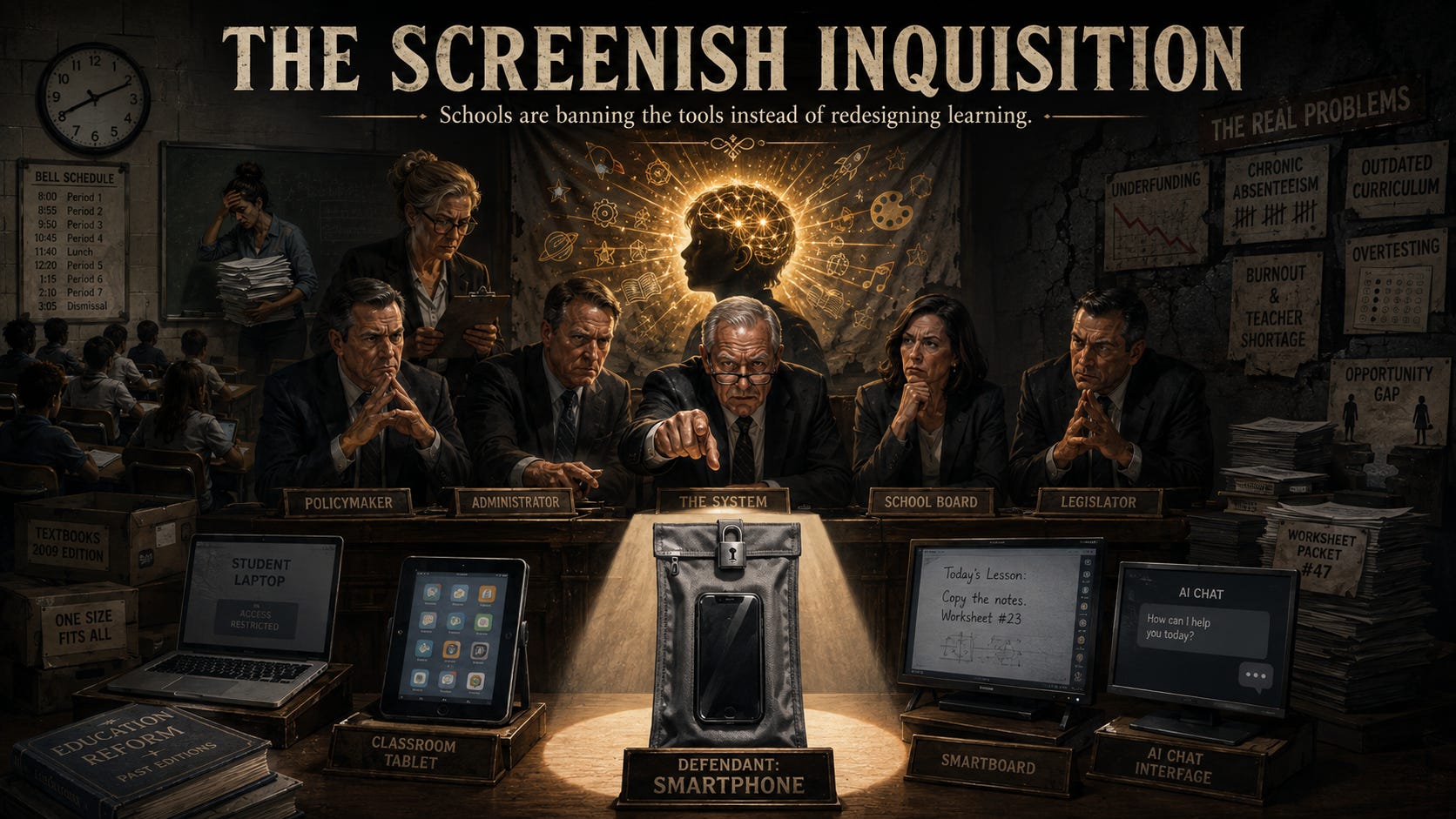
Nobody expects the Screenish Inquisition. And yet here it is, with bipartisan sponsors, a Surgeon General’s advisory, and a Velcro pouch.
As of June, 38 states and the District of Columbia require school districts to ban or restrict student phones, and 29 of them mandate it bell to bell. Three-quarters of American adults support banning phones during class. Governors who agree on nothing else have signed nearly identical bills. In a country that cannot pass a school funding formula, a reading curriculum, or a teacher pay raise without a decade of litigation, the phone ban sailed through in a couple of legislative sessions.
But the phone is only the lead defendant. Read the docket. The Chromebook is on it. So is the 1:1 cart, the learning management system, the adaptive math app, the smartboard, Google Classroom, Zoom, and now, at the top of the list in bold, ChatGPT. Sweden, for twenty years the poster child of digital schooling, pulled back toward printed textbooks and handwriting after a dip in reading scores, with its most famous medical school declaring that digital tools impair learning. The op-ed that begins “we were sold a lie about screens in schools” now has its own shelf. The mood is no longer “phones in algebra are a problem.” The mood is “technology is why school is failing,” and the proposed cure is subtraction.
This is not a triumph of consensus. It is a triumph of relief.
When the one education reform that can pass unanimously is the one that asks nothing of the adults, you have not found the problem. You have found the exit. And you took it.
The real scandal is that we are fighting over what students shouldn’t hold in their hands instead of asking what they should be capable of doing with their minds.
Let me be precise about what I am not arguing, because the Inquisition reads uncharitably.
Phones in traditional class distract kids. Seventy-two percent of high school teachers told Pew that phone distraction is a major problem in their teacher-led classrooms, and they are not hallucinating.
And Edtech has been oversold for thirty years by vendors who never met a learning outcome they couldn’t promise. Plenty of products are junk. Some districts bought devices with no plan beyond the purchase order. There is decent evidence that kids comprehend long informational texts better on paper than on a screen. Fine. Print the reading. Ask the kids to put the phones away sometimes. Fire the vendor. Those are design decisions, and good ones.
What I am attacking is the promotion: from “this product didn’t work” and “this device distracts” to “technology is what’s wrong with school.” That is the modem-and-bailey. The motte, which is easy to defend, is “some apps distract some kids during algebra” and “some edtech was a waste of money.” The bailey, where everyone actually lives, is “screens hollowed out childhood, broke the schools, explain the reading scores and the absences and the kid who won’t look up, and the way back is to take the technology out.” Challenge the bailey and the speaker retreats to the motte. “So you think phones in class are fine?” No. I think you changed the subject.
Watch the slide between two sentences. “Edtech failed to transform school” is true. [How would it? We kept the same school…]/ “Edtech destroyed school” is the scapegoat. The first is an indictment of the system that swallowed the tools without changing. The second lets the system off.
The word for the move is screenwashing: washing your hands of a systemic problem by pointing at a screen.
It is the newest and most successful technique for drawing the wagons around the educational status quo, and it works because it is nearly free.
The jump from “phones distract” to “technology caused the crisis” is not new. Every generation gets its folk device: the waltz, chess, comic books, Mike Teavee, Tamagotchis, fidget spinners. Each time the thing was blamed for problems older than the thing, and each time nobody asked what else was going on. Post hoc ergo propter phone is a fallacy, not a finding.
You have heard the phone debate. I will keep the evidence short, because the point is not to relitigate it but to notice how little of it survives contact with the diagnosis.
The largest analysis of the screen-time literature, 350,000 adolescents across three datasets, found that digital technology use explains at most 0.4 percent of the variation in well-being, roughly the same association as eating potatoes. When The Anxious Generation came out, the developmental psychologist Candice Odgers concluded in Nature that its central claim is not supported by the science and risks distracting from the real causes; Haidt disagrees, and you should read both. The first nationally representative study of school phone bans, from the University of Birmingham across 30 English schools, found no difference in well-being, sleep, or attainment between restrictive and permissive schools; students in ban schools scrolled about half an hour less during the day and made it up after the bell, and a follow-up found the policies eat more than a hundred staff hours a week. And PISA 2022 found that students who used devices for up to an hour a day of learning in school scored 14 points higher in math than those who used none, while students distracted by classmates’ devices scored 15 points lower. Same device, opposite sign, depending on what the adult in the room designed. “Screens” is not a verb.
So the rules are defensible, and the diagnosis is thin. That would be a minor academic quarrel if the diagnosis weren’t doing so much work. A headline and n = my nephew are now a sufficient basis for state law, while the actual problems sit in plain sight.
The phone is in use a median of 43 minutes a school day. The school day runs roughly 400. If the phone is stealing 43 minutes, who is responsible for the other 357?
That is the question the e-scapegoat exists to prevent anyone from asking. Here is what it is covering for.
1. The grammar of schooling. David Tyack and Larry Cuban named it thirty years ago in Tinkering Toward Utopia: the age-graded classroom, the bell schedule, the Carnegie unit of seat time (1906), the teacher at the front transmitting, the students in rows receiving. The same Pew survey that found 72 percent of teachers worried about phones found that 58 percent of high school teachers say their students show little or no interest in learning. A majority of the adults in the building report that the kids don’t want to be there, and the institutional response is to remove the thing the kids would rather look at. That isn’t a diagnosis. That’s a Zone of Proximal Blame: whatever object is nearest gets charged.
Larry Cuban, by the way, is the most serious tech skeptic American education has produced, and he diagnosed all of this in 2001 in a book called Oversold and Underused. His finding was not that computers harmed classrooms. It was that classrooms absorbed computers without changing anything. Teachers used them to sustain existing practice: the worksheet became a PDF, the lecture became a slideshow, the quiz became a Google Form, and the learning management system became a Lament Management System. The laptop was dropped into a structure designed to digest it. Then came the pandemic, and $190 billion in federal relief, a good share of it spent on devices. Now the device is the defendant. Schrödinger’s Chromebook: simultaneously the cause of every problem and the thing the district spent the money on.
When the skeptics’ own best scholar tells you the problem was the structure, and you respond by blaming the laptop, you have stopped doing router-cause analysis and started doing something else.
2. A learning collapse that is happening on one side of the room. The 2024 NAEP results are the worst on record for twelfth graders in both math and reading, and the declines across grades were driven by the lowest-performing students while the highest performers held steady or improved. The gap between the top and the bottom is now about 100 points and has been widening since roughly 2010. In twelfth-grade math, the 90th percentile didn’t drop at all; everyone below it did.
Sit with the logic. Screens are everywhere. The affluent kid has at least as many devices, faster Wi-Fi, and a phone at least as good as the poor kid’s. If the screen were the universal solvent, it would be dissolving everyone. It isn’t. A cause that is everywhere cannot explain a decline that is only in some places. Yes, lower-income kids log more screen hours. They also log more evictions, more moves, more hunger, and more absences. The variable doing the work is poverty. The phone is just the thing poverty is holding. Blaming a screen makes me want to scream.
Hanlon’s router applies: never attribute to screens what is adequately explained by underfunding.
3. The empty desk. Chronic absenteeism ran about 15 percent before the pandemic, spiked past 28 percent in 2022, and has crawled back only to 22.6 percent in 2025. In roughly half of urban districts, more than 30 percent of students missed at least 18 days of school last year. You cannot pouch a phone that isn’t in the building. One in five American students is functionally not enrolled in the experience we are arguing about, and the legislative energy went to the pouch.
4. Poverty is not a screen-time problem. In 2021, with the expanded Child Tax Credit, child poverty under the Supplemental Poverty Measure fell to 5 percent, the lowest ever recorded. By 2024, after the expansion lapsed, it was back to 13 percent. Whatever you think of the policy, notice what the numbers prove: poverty moves when policy moves. The screens did not change between 2021 and 2024. The poverty rate did. Meanwhile, by EdBuild’s count, districts serving mostly nonwhite students receive $23 billion a year less than districts serving mostly white students, because we fund schools with property taxes and draw district lines around wealth. None of this is a secret. All of it is harder than a pouch.
5. The money is leaving the building. The $190 billion in pandemic relief is gone; the last of it had to be committed by the fall of 2024. What it was propping up is now falling. More than half of the nation’s 50 largest districts have cut, are cutting, or are running deficits this year, squeezed by inflation, health-care costs, the end of federal aid, and enrollment that is down more than a million students from its 2019 peak. Chicago alone is staring at a hole of more than $730 million. Budget shortfalls are now the top concern of district leaders nationwide, named by 54 percent this year, up from 33 percent last year, and those same leaders report the cuts are already making staffing and reading and math achievement worse. Washington is not riding to the rescue. After a year in which the White House proposed cutting the Education Department by 15 percent and the House voted to cut Title I by a quarter, Congress settled on flat funding, which after inflation is a cut with better manners. Teachers laid off, schools closed, counselors gone, and the national conversation about what ails American schools is about the damned screens.
6. The profession we keep hollowing out. Teachers earned 26.9 percent less per week in 2024 than similarly educated professionals, the widest gap in three decades of tracking. A ban is cheaper than a raise. A ban is also cheaper than autonomy, planning time, coaching, or a curriculum that trusts the adult in the room to design something worth a sixteen-year-old’s attention. Every legislator who votes for the pouch goes home having “done something about the schools” without having done anything about the people in them.
7. Civic muscle. The information environment is bad. I won’t pretend otherwise. But you do not teach a kid to swim by draining the pool. The answer to a polluted information ecosystem is argument literacy: evidence, rebuttal, steelmanning, the experience of being wrong in front of people and surviving it. A generation that has never practiced structured disagreement is not protected by the absence of a phone. It is merely unprepared in a quieter room.
Set those seven problems next to a pouch and ask why the pouch wins. The answer is that the e-scapegoat is the cheapest reform in history.
It costs nothing. Not one dollar of new money, not one hour of retraining, not one line of the schedule, not one unit of the curriculum, not one decision about how the other 357 minutes get spent. You can blame the Chromebook without redesigning a single lesson that runs on it.
It is bipartisan, because it flatters everyone’s priors. The left gets Big Tech as the villain. The right gets the textbook and the pencil back. Nobody gets a bill.
It is visible: the device is the thing in the room you can see, and underfunding is not. It flatters nostalgia. It has a business model now, pouch vendors on one side and panicpreneurs on the other, both with an incentive to keep the bailey occupied. And it feels like action. Doom’s Taxonomy runs Notice, Worry, Blame, Ban, Op-ed, and every step feels like a decision.
Most of all, it absolves every adult in the system at once. The legislator who cut the budget. The board that kept the bell schedule. The superintendent who bought two thousand devices with relief money and no plan. The principal whose “instructional leadership” is a walkthrough rubric. The professor of education teaching the same methods course since 2004. The curriculum director whose scope and sequence predates the internet. The teacher who lectures for forty minutes and assigns a worksheet that a 2019 autocomplete could finish. All of them get to say the machine did it. BYOD: Blame Your Own Device.
Strip it down and what you are looking at is a profession in a fixed-blame mindset. Ask the adults who run American schooling to name one thing they are responsible for that explains the state of the kids, and the answer comes back: the phone. Not the lecture. Not the seat time. Not the grading, the tracking, the test prep, the 47-minute period, the homework pile, the compliance culture. Everything the adults built is presumed innocent. The one thing the kids brought from home is guilty.
Nobody decided this in a meeting. That’s what makes it worse. The adults who run school are passing the cost of their own refusal to change down to the kids, one ban at a time.
I understand the temptation. Teachers are underpaid by a quarter and drowning. But exhaustion is not exemption, and the people I am describing are mostly not the teacher at 7 a.m. They are the people who set the conditions she works in and then hand her a pouch.
This is blamework: the effort adults pour into assigning fault so they don’t have to pour it into redesign. The keynote about AI cheating instead of the conversation about why the assignment was cheatable. The PD day on “digital wellness” in a building that hasn’t changed its schedule since the Eisenhower administration. Misunderstanding by Design: start with the culprit, work backward to the evidence. And it is a shitty way to sleep better at night. The kids don’t get to.
In debate terms, it is the Ban CP: a counterplan that claims to solve the entire affirmative with a net benefit of nostalgia. It wins every round because it is the round where the neg never shows up. Nobody stands to defend the phone, so the resolution feels settled. But the resolution was never “phones good.” The resolution was “what do we owe these kids,” and that one got tabled. Every minute spent on the pouch is a minute not spent on the building. That is not a side effect of the scapegoat. That is its function. And it never ends, because there is always a next device. Whac-an-App is not a policy.
Scapegoat comes from Leviticus. The goat carried the sins out of town so the town could stay the same. The e-scapegoat carries the sins of an industrial school system out to the parking lot, and the system goes back to its rows.
Here is the thing nobody in the ban-everything coalition will say out loud: in fourteen years, we never taught them.
Smartphones landed in the hands of American teenagers around 2012. Show me the district that built a curriculum for using the thing. Not a forty-minute assembly on cyberbullying and a poster about “digital citizenship.” A curriculum. How to use the camera as a data instrument and the microphone as a newsroom. How to run a survey, map a neighborhood, publish a finding, find the expert, check the expert, and get the expert to write back. How to use an AI tutor at 11 p.m. without letting it think for you. How to tell a source from a feed. The phone is a library, a newsroom, a lab bench, a broadcast tower, and a tutor. We handed it to the kids with no instruction, and then acted betrayed when they used it as a slot machine.
And we never asked them. The one population in the building that actually understood the device was the students, and we did not sit down with them to design how it might be used for learning, because learning from students inverts the hierarchy the whole building runs on. The sage does not take notes. Show me the district that convened its kids and said, “You know this machine better than we do. Help us build the course.” I’ll wait.
Instead, the instruction was the instruction it has always been. Eyes front. The teacher is at the board. Copy down what she writes. The board has been upgraded three times in my career, chalk to whiteboard to smartboard to whatever damned board we want her to write on this year, and the pedagogy behind it has not moved an inch. We spent the technology budget on the board and kept the stare.
The premise underneath the stare is that the front of the room is where learning happens. It isn’t, and every kid knows it isn’t. They learn on YouTube at double speed. From a Discord server full of fifteen-year-olds who ship code. From Khan, from a podcast, from MIT’s open courseware, from the talk page of a Wikipedia article where the people who actually know fight it out. From a GitHub repo. From an AI tutor that will explain the thing a fourth way after the teacher explained it once. From a debate round, a robotics pit, a kitchen, a job, a river and a test kit, a grandmother, a stranger on a forum who knows more about fermentation than anyone in the building, and from each other. The classroom is one node in that network, and it is the only node that insists the other nodes don’t count.
Now the second fiction, the one the stare depends on: if they just learn the content, they’ll be fine. Absorb the material, pass the test, collect the credential, get the job. Content is the one thing AI commoditized first. A kid whose entire training is reproducing content is competing with a free tool that reproduces it faster and better, and that competition was over before she reached ninth grade. You need to know things to judge things; I am not arguing for ignorance. But knowing was never the product. It was the raw material, and we have been grading the raw material as if it were the finished good. Against AI that already outscores most adults on the content, and against whatever comes after it, “learn the content and you’ll be fine” is not a plan. It’s a lullaby, and everyone in the building knows it.
And here is the sentence under all of it, said in a thousand faculty rooms: “We only get two PD days. Nobody is paying us to change. Nobody has told us what to do.” All three clauses are true. All three are an indictment of the people who set the calendar, the budget, and the direction. Not one of them is a reason for a fifteen-year-old to keep copying off the board. What the sentence actually says is: things are screwed up, we know it, and we would like the kids to keep doing the same shit we did in 2020 because changing would cost us something and no one has given us permission. A profession that needs permission to change has been managed into compliance, and it is about to hand that compliance to its students as a life skill.
So when the pouch arrives, it is not a solution. It is an alibi for fourteen years of not teaching the thing, not asking the kids, not moving the pedagogy, and not demanding the time and money it would take. Take the phone, and the failure to teach the phone disappears with it. That is the whole trick.
The third fiction is the one about the job. The brochure still implies that if you do the work, the work will be there. Meanwhile, the share of new graduates landing real, non-gig employment may be closer to half than to the number on the brochure. We know this. The adults know this. We are pretending, in front of the children, that the map still matches the territory.
Here is the territory. The Stanford economists tracking payroll data on millions of workers reported this month that employment of 22-to-25-year-olds in the most AI-exposed occupations now sits 19 percent below where it would be had it kept pace with their less-exposed peers; the gap has widened steadily since they first measured it; it runs through reduced hiring of young workers, not layoffs; and experienced workers show no comparable gap. They are careful to say there is no economy-wide collapse yet. There doesn’t need to be. What’s happening is that the bottom rung is being sawed off. The jobs that used to be how you learned a job are the ones the machines learned first. The World Economic Forum’s employer survey projects 170 million jobs created and 92 million displaced by 2030, with 39 percent of workers’ core skills changing. Americans are already filing new business applications at a pace of roughly 450,000 a month. More of these kids will have to build their own work than any generation before them, not as a lifestyle choice but because the entry-level ladder they were promised is missing its first three rungs.
What does that world pay for? Initiative. Judgment. The ability to stand in front of a room and persuade it. The ability to find a problem, build something for it, put your name on it, and find out whether it was any good. And fluency with the tools, AI first among them, deep enough that the tools disappear and what’s left is the person directing them.
Now suppose the scapegoat wins completely. Every phone pouched, every Chromebook carted, every LMS switched off, ChatGPT blocked at the router, the textbook back on the desk. What has a sixteen-year-old gained? Be fair about it. She has gained thirty or forty minutes a day of not scrolling, which is what Birmingham measured, and a quieter room. That is not nothing. Hold onto it, because it is the entire upside.
Here is what the ban doesn’t give the kids. Thirty fewer minutes of scrolling buys her none of the list. Not judgment, not initiative, not AI fluency, not the ability to build a thing or sell it or defend it. What she gets instead is a pouch, a paper textbook, the same lecture, the same worksheet now harder to cheat on, the same 47 minutes, the same seat time, the same sorting. The ban subtracts a distraction and adds nothing in its place, and the empty space is filled by the very pedagogy that was failing her before the phone showed up. The lesson she learns is that when the world changes, the adults panic and subtract. The tools that will run her life are contraband, and the people in charge of preparing her for that life would rather not discuss it. We are confiscating the one thing the economy will require her to master and calling it preparation.
There is a class dimension, and it is ugly. Call it the Waldorf Astoria effect. The famous screen-free schools are the expensive ones, and their graduates are not tech-illiterate, because the tools are at home, in the tutoring, in the summer programs, in the parents’ jobs. For those kids, the school’s ban is a boutique choice. For the kid at the bottom of the NAEP distribution, the one actually falling, school was the only place anyone was ever going to teach her to use the tools as a builder rather than a consumer. Take that away and she is left with the consumption. A ban is the one education policy that is regressive by design while feeling virtuous to everyone who passes it.
So ask the question the pouch exists to avoid: what should these kids be capable of doing with their minds? Here is the answer the pouch is protecting us from having to give.
Students do the cognitive work. The teacher designs, coaches, and judges; the students argue, build, present, and defend. Flip the ratio of talk. The sage on the stage is older than the light bulb, and it is the only technology in the building nobody proposes banning.
Tool fluency as a core literacy. Make the device itself a course: camera as instrument, microphone as newsroom, AI as tutor, feed as something you learn to read critically instead of something you are forbidden to read at all. Let the students co-design it, since they know the machine better than the adults do. Then use it to make work that matters, with their names on it and their reputations at stake. The point is not access. The point is authorship they have to answer for.
Teach judgment. Repeated practice deciding when to use AI and when not to, whether its output can be trusted, what counts as evidence, and when they are willing to put their own name behind a conclusion. That is the human skill the whole technology argument was always about, and it cannot be taught by forbidding the occasions to practice it.
Projects, ventures, and real audiences. Problem-based learning, entrepreneurship, design: the formats where a student produces something a stranger could use and finds out whether it was any good. In an economy that is deleting the apprenticeship rung, school has to become the apprenticeship.
Oral communication and debate for everyone. Universal Basic Debate: every student, every year, trained to speak, argue, and respond to evidence in real time. It is the most AI-resistant skill we know how to teach and the one the entrepreneurial economy pays for most.
Assessment that measures capability, not compliance. Portfolios, performances, oral defenses, demonstrations. Seat time is an input. We keep grading inputs because they are easy to count.
A schedule built for work, not transmission. Longer blocks, studio time, fewer bells. You cannot run a project in a 47-minute period any more than you can run a business in one.
Pay the adults and trust them. Close the pay penalty. Give teachers the time and authority to design, which means more than two PD days and a budget line for the change you say you want. A profession you underpay by a quarter will not redesign the school for you. It will survive the school.
Fund the buildings where the decline is actually happening. Follow the NAEP data. The bottom is falling. Put the money where the bottom is.
Notice that not one of these requires a ban, and not one is delivered by one. The ban is orthogonal to every item on the list. That is precisely why it is so popular: you can pass it without touching any of them. The alternative to this agenda is not neutrality. It is Ctrl-Z pedagogy: unplug and pray that 1995 comes back. It won’t.
The scapegoat is already migrating. The phone carried the sins of the 2010s; AI is being fitted for the 2020s. Tier 1, phones. Tier 2, laptops. Tier 3, AI. A Multi-Tiered System of Scapegoats. The posture is the same each time and deserves a name: Artificial Innocence. The machine did it.
But look at what the complaint actually says. “The kids are using ChatGPT to do the worksheet.” Yes. And what does that tell you? It tells you the worksheet could be done by an autocomplete. That is not an indictment of the machine. That is an indictment of the worksheet, and of the system that assigned it, and of a model of school in which the work product was always a performance for the teacher rather than an act the student had to stand behind.
Here is what the panic keeps missing. The tasks a machine cannot do for a kid, stand up, speak, be questioned, take a position and answer for it, build a thing and own the result, are exactly the tasks school spends the least time asking kids to do. AI did not create that gap. It exposed it. Banning the tool does not close it. It just turns the lights off so nobody can see.
Error 404: Accountability Not Found. I’ll end where the debate coach in me always ends.
If you believe technology explains the state of American schooling, you owe an account of why the top of the distribution is rising while the bottom falls, why child poverty went from 5 percent to 13 percent while the screens stayed exactly the same, why a fifth of students aren’t in the building, why half the biggest districts in the country are cutting staff the year the relief money ran out, why the people we ask to do the work are paid a quarter less than their peers, why PISA finds the same devices helping when they’re used for learning and hurting when they’re not, why in fourteen years nobody taught the kids to use the thing, and why the best-designed study of the bans you are passing found that they don’t do what you say they do. If your answer to all of that is “screens,” you do not have a theory. You have a fixed-blame mindset and a pouch.
Ban the phones if you must. Then do the work. Teach the tools. Ask the kids. Pay the adults. Fund the ones who are falling behind.
Otherwise, we are just Old Man Yelling at Cloud. And the cloud, I regret to inform you, is not going anywhere.
Comments
Nothing yet. Say the first thing.
Sign in to join the conversation.