
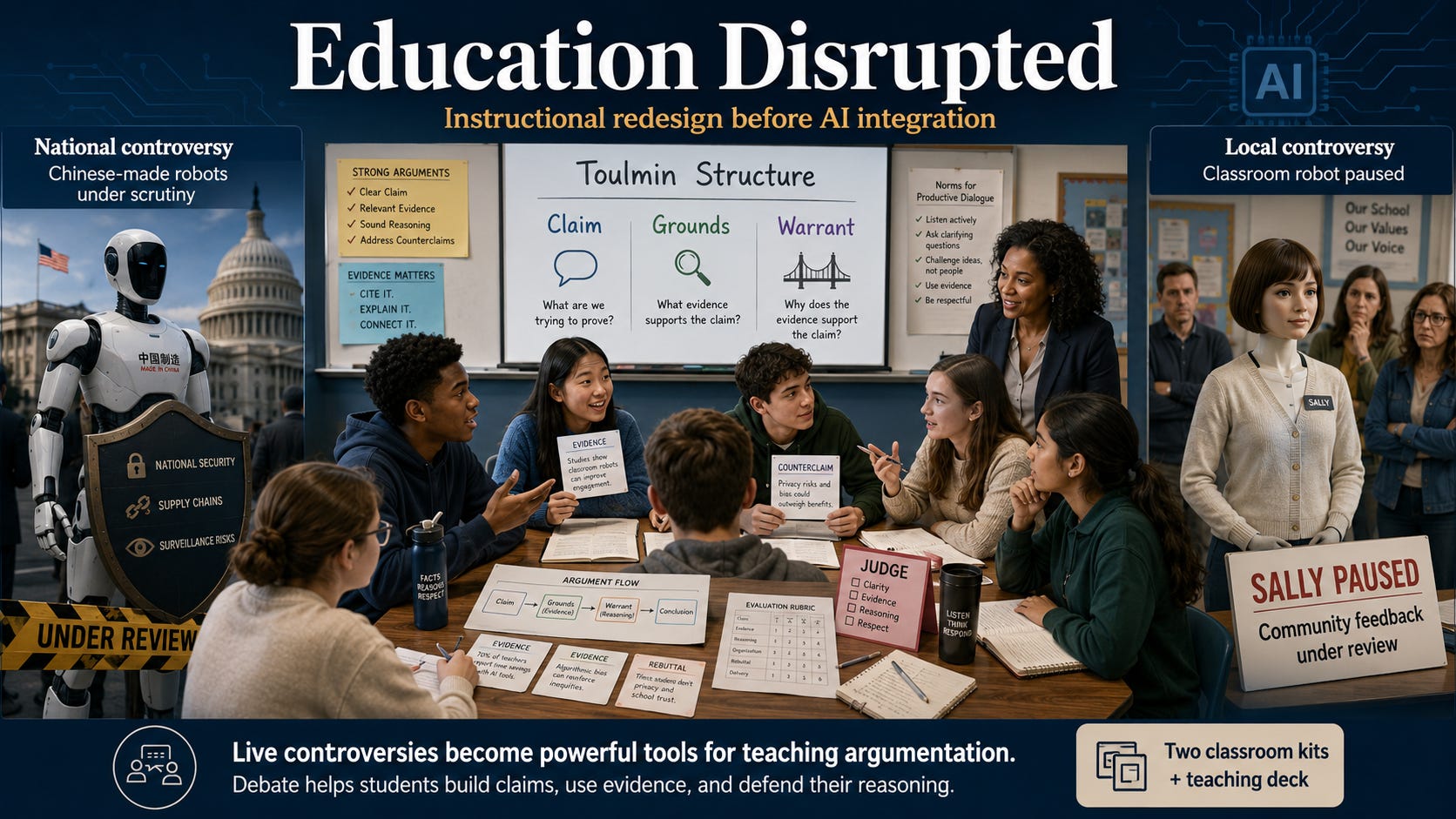
Education Disrupted is built around one core argument: instructional redesign should come before AI integration. Schools keep acquiring the technology first and asking what to do with it second — I will have a lot more to say about that in an upcoming post. And debate is one of the key methods of that redesign: students building cases, grounding them in evidence, defending their reasoning out loud against pushback, judging rounds and giving reasons. Redesign instruction that way, and the question of where AI belongs starts answering itself.
This week, the news handed that argument perfect material — two robot controversies in the same week, almost too perfectly paired.
On July 28, the FCC moved to bar new Chinese-made robots from the United States on national security grounds — a national fight over supply chains, surveillance, and who builds the machines. And in Salamanca, New York — a 1,300-student district in the only American city located entirely inside a Native reservation — a $57,590 lifelike classroom robot named Sally was paused after parents, the state teachers union, and the Education Commissioner pushed back.
One national, one local. Both genuinely two-sided, with serious people on the record on each side. Both days old and still unresolved. Both about the very technology transition our students are living through.
You could not design better raw material for teaching argumentation. Nothing teaches it like a fight nobody has settled yet — the textbook controversy has an answer waiting in the back of the book, but a live one forces students to do what adults are doing right now: build a case, ground it in evidence, and defend the reasoning that connects them. So I built the materials — and rather than argue the redesign point in the abstract, they give you the opportunity to see how it plays out in practice: a real unit, a real controversy, starting this week.
And the kits carry more than the two controversies. At bottom, they are materials for teaching argumentation itself — a skill that belongs in every classroom the way strong writing belongs in every classroom. You can teach argumentation in history, in science, in English, in civics; anywhere there are claims, there is a way to teach students to handle them.
The backbone is the Toulmin model, the simplest honest anatomy of an argument. Every argument has a claim — the thing you are asserting. It has grounds — the evidence you are standing on. And it has a warrant — the reasoning that licenses the leap from your evidence to your claim. Students can usually state claims and hunt down evidence; the warrant is the part almost everyone skips, and it is where arguments are actually won and lost. Take the ban: security researchers found vulnerabilities in Chinese-made robots is grounds. Therefore the U.S. should bar them is a claim. Everything interesting lives in the warrant between the two — does a risk finding justify a border-wide exclusion? Say the warrant out loud and suddenly there is something to debate. The kits teach the full six-part model, but that three-part skeleton is the skill — and it transfers to every subject you teach.
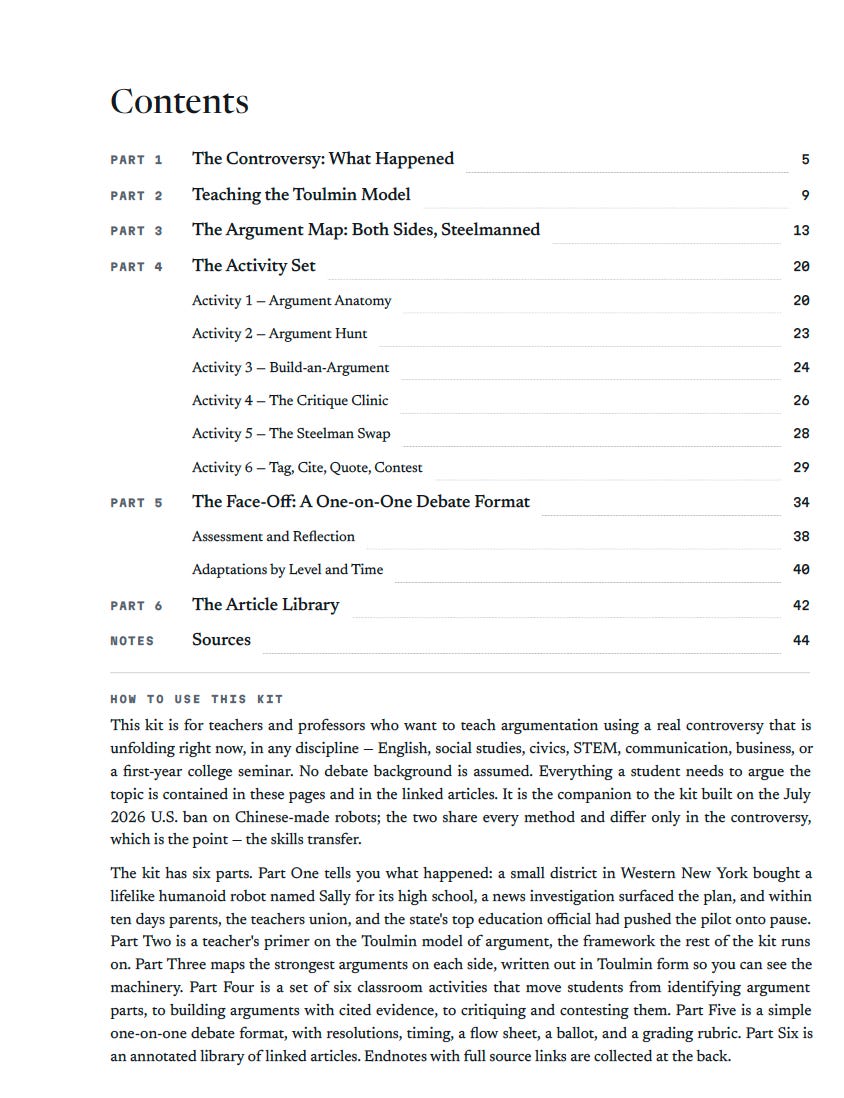
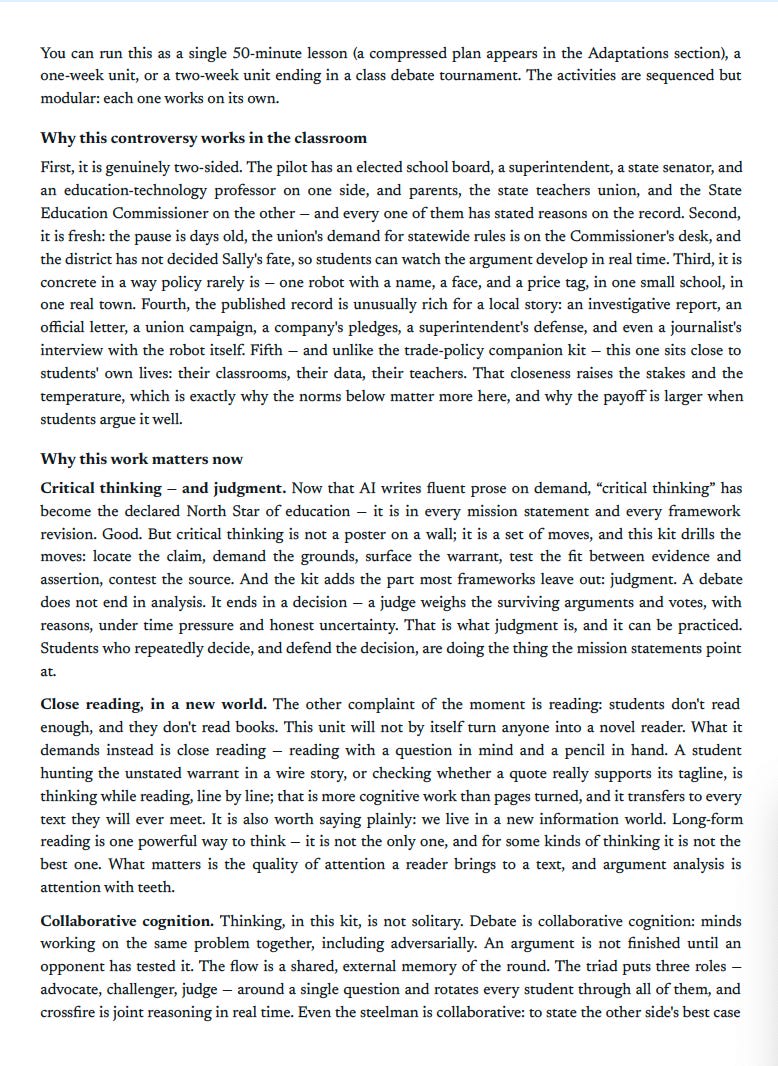
Two complete classroom kits, one per controversy, deliberately parallel — same skills, same structure, different fight, so you can use either one and your students can watch the method transfer. Each kit is a 45-page designed PDF containing a fully sourced backgrounder you can teach from, a teacher’s primer on the Toulmin model (claim, grounds, warrant — with the warrant getting the attention it never gets), the ten strongest arguments on both sides written out in full and steelmanned, six sequenced classroom activities that move students from identifying arguments to building, critiquing, and contesting them with cited evidence cards, and a complete one-on-one debate format — three tiered resolutions, timing, a flow sheet, a judge’s ballot, and a grading rubric. Every factual claim traces to a numbered endnote with a live link. And the grading philosophy is built in: you never have to declare a winner, and even if you do, the result never touches the grade. The rubric grades the structure of the argumentation — the thing being taught.
A 27-slide teaching deck to go with them, presentation-ready for teachers and professors, with speaker notes on every slide. The concept slides work with either controversy; the example slides show both, side by side, so the transfer is visible from the front of the room.
The kits work from middle school through college — the adaptations section in each one compresses the unit to a single 50-minute lesson or extends it to a two-week tournament, with supports for multilingual learners and a fully asynchronous version.
And these materials will work in any classroom, on any topic. The argumentation structure is the constant; the controversy is a plug-in. Substitute anything you want your students to discuss — a novel’s ending, competing explanations in a lab, a school policy, a historical judgment, your own community’s version of this fight. Change the reading level, cut activities, rewrite the arguments. The Word editions exist for exactly that reason. This is also a place where AI earns its keep: hand a kit to Claude and ask it to rebuild the whole unit around a controversy your students actually care about. The structure transfers. The substance is yours.
And with the news still moving, the best extension assignment is simply to bring in tomorrow’s article and map it.
So: let’s get some more debate.
The complete materials are available to paid subscribers, right here below: both 45-page designed PDFs, the Word editions, and the full PowerPoint deck.
Comments
Nothing yet. Say the first thing.
Sign in to join the conversation.