
“So that I die serenely, my own self
Restore to me!”— Mihai Eminescu, “Ode (in Ancient Meter)”
Last night, as I lay dreaming, I found myself walking up the cemetery steps with Domn’ Badescu and my grandfather, walking through the shadows up the hill, up to the old church where both thieves and heroes are buried, now a ruin, glorious in twilight, terrible in darkness. Domn’ Badescu, greatest of the bards, the last mustached son of the Nephilim, began to recount the same old story he always told me about the soldiers of the Great War, German and Romanian warriors who gave up fighting, descended into a cellar, and shot the wine casks with their revolvers. Drinking and making merry, bonding in the blood of the grapevine. Not their own blood, not their own blood. Creating a brotherhood, a brotherhood that would have lasted eons, yet they died in that sweet alcoholic deluge created by their own foolishness, for the holes of the wine casks drowned them. The only thing remaining now is a story, a story that I now sing silently with these electric words.
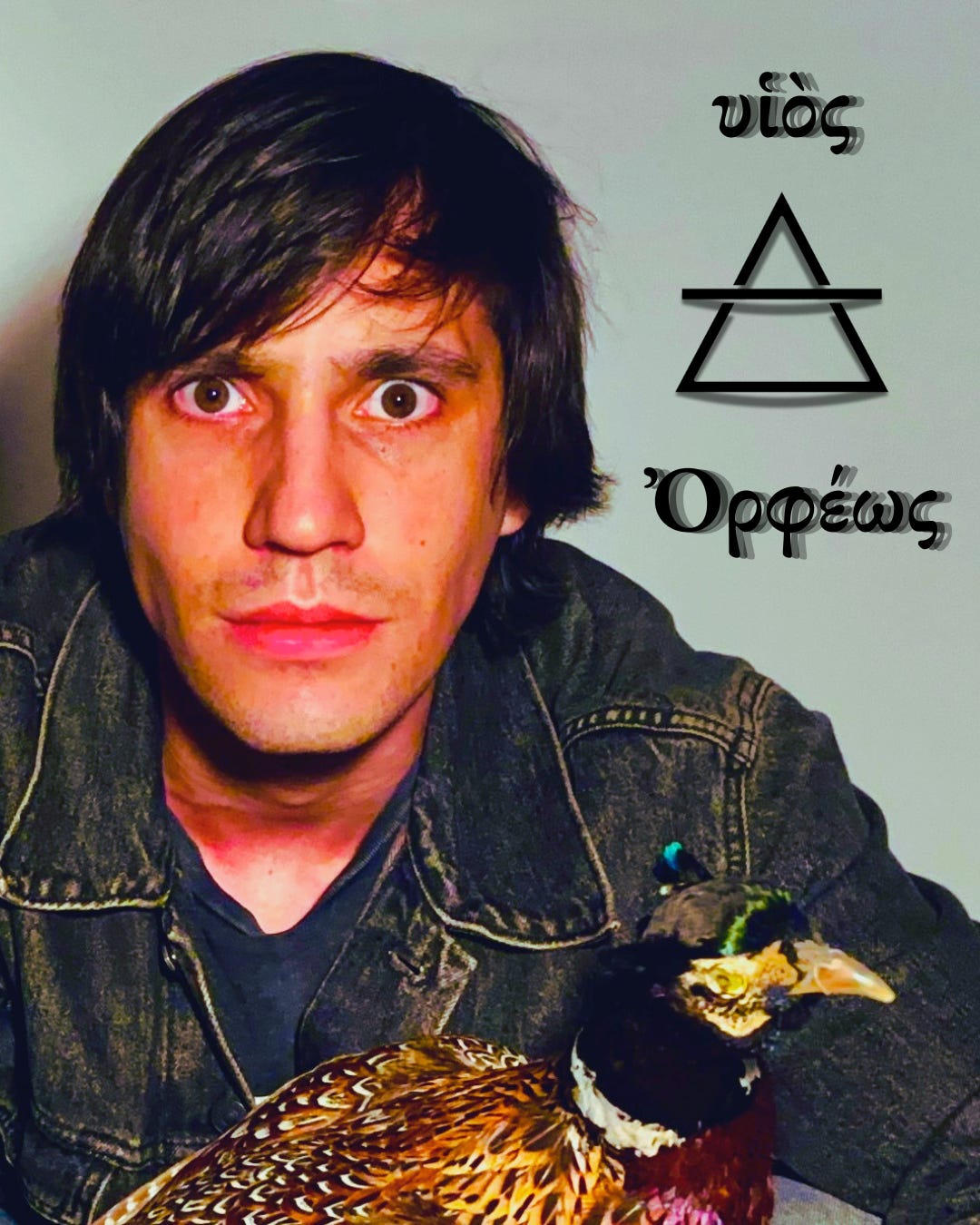
A mute hymn I raise to you, between words, between pages, forefather. Again, after you, son of Thracia, Orpheus, I go. Down, splitting the Longhill Mountains like a ship splitting waves, carving down towards the bowels of the Earth—my spirit a surfboard barrelling to Hades himself, so that I may gain audience with the best drinking buddy the gods of Olympus ever had.
Asking only for the secret signs needed so that the Earth will hear the words that lie dormant here at the gates of the Orient—where nothing can be too tragic because the song, your song, is still with us—the song—the song of our ancestors. Burebista cut the grapevine, yes, he did. Only because he knew your song was still there, still in the air, still sung by the birds, still sung in the trees, in every flinty rock and wild beast, your song was there, forefather.
The Boatman, silent and gloomy, cheerfully smiled that toothless grin when he saw me going down with my black straight locks glistening in the pale nonlight of the Underworld. After searching for a couple of pieces of sigil, bearing the faces of Mihai Eminescu and Miron Costin, placing them into that skeletal palm, the last of the skin was parchment on which all our destinies were casually written on a Wednesday by some ethereal functionary, I turned my collar to the cold and damp, and stepped onto the gondola. Screams and wails formed beneath us, the river of the dead fighting the Boatman’s rudder.
— Back down, ye wretches, drown in the waters of your sorrows, the Boatman spat. This here be a hero, ah, another foolish hero seeking another vain boon, a trifle on the road down here.
— It may be so, dearest Charon, said I, but down I must go nevertheless. The grave spares nobody, but the song is a fire you must steal from the gods.
— Ain’t no gods here, just shadows. And my name’s not Charon, but Bardamu.
— Bardamu, then what of Hades and Persephone, what of Thanatos and Castor and Pollux?
— Mere titanic chieftains, no different from the kings and queens you have up there, the ones who blind your eyes and steal your dreams. They cut your grapevine and say it’s for your own good, then what do they put in its place but slogans and war? Oh, Thracian son, I would gladly go down to your ancestor and spit black wine betwixt his eyes.
— Burebista, whom great Caesar feared? The one whom Pompey himself sought as an ally?
— Yes, that Burebista, the one who feared good ol’ Dionysus, the one who sought a morose priest as his only ally.
— What about Zamolxis, Bardamu? Can I find him here? I’ve only known him as a teacher, like his master Pythagoras before him.
— Grifters, both of them, speaking of the purity of souls and a life eternal. All souls are born soiled, and life is only a bad dream. Good thing it’s not eternal. With these words we parted. I reached the shores of Elysium.
And then I walked through green fields, through valleys of gold, following rails of silver that cut the grass like unmoved serpents, and followed the rivers of cassis to the Temple of the King, reaching it finally after many eons. It was the Year of the Fox. There, headless Orpheus sat on his throne, stroking his lyre. And I sat, and I listened, and I listened well. And I would’ve given you the music keys that I know you starve for, reader, for Orpheus himself said to me:
— Hold on to this melody, tamed by neither harmony nor song.
— Yes, forefather, and I shall keep it with my words and signs.
But that was the last time my words were uttered in vain. On the way back, going for another passage that shall spare the Boatman from my newfound light, I went and met the Bacchantes, their shadows of meat, the insect in the skin of bodies of women, buzzing through the uncertain hours between late night and grey dawn. I opened my eyes, and saw the morning light blessing the pisques and rocks of Piatra Mare, and in the cold sweat I fell into their terrible embrace, feeling them pulling me apart, a wet kiss silencing my mouth, that long tongue reaching into my heart.
— You are the body of Apollo, but the heart of our Lord, oh, how we can taste it.
Their voices spoke vile trifles in my ear, trying to silence the truth of Orpheus, the song he gave, but the song could not die. Chaos, it ate; pain, it savored; filth, it polished. Still, those terrible blood-women pulled me apart, splitting bones to suck my marrow, ripping my muscles to slurp upon my sinew, drinking the wine of my veins.
But the head, they dared not break. They kept it, and they shall keep it, passing through history until all the mountains are turned to dust, and all the rulers shall perish, knowing that there is no point to rule filth that shall be burned by a red, careless star. And then in the Holy Whorehouse, the last of all human institutions, my head shall be on display, watching mutely all the sacred orgies, answering only with a dated prophecy: light versus dark. Oh, that old story…
Comments
Nothing yet. Say the first thing.
Sign in to join the conversation.