
In the desert, on the dunes, cutting across the waste and trailing the ridges of sand, the Messenger sat with the deserters and shared their meal, a ration of stolen rations. They ate camel jerky and sand rat liver. They spoke of the academy and of the initiation ritual. The Messenger chewed slowly, afraid of his duty, afraid of what they might do to him if they saw even a speck of danger in his eyes.
There in the desert, on the dunes, half a dozen young men sat by the night fires beneath the stars, eating and speaking slowly, slowly, until silence swallowed them, until the fire had finished the last of the fuel and their mouths had finished the last of the dinner. The Messenger’s heart trembled before its duty, and he said to them. “Damn, have you no regrets for leaving the service of the Padahar, he who poured out his precious blood for this land?”
Hearing this, they laughed, almost in unison. How could they regret a lie? They reminded him of the law of the sword, a law he knew well. He said that, like everything the Padahar did, it was perfect.
“Perfect, yes, but if it was so perfect,” they asked, “why did it need the amendment of the gun? And if Ephraim was so good, why did the Padahar need more? What more was there to buy among the stars, if not peace upon the land over which he reigned?”
[Extract from the Law of the Padahar]
The Law of the Sword
A brave and obedient people being necessary to the preservation of the Padahar’s Peace, the right of every free son of Ephraim to keep and bear swords shall not be denied, but shall be required.
Every citizen sound in body and clean in lineage shall keep within his dwelling a blade fit for the defense of his life, his house, his kin, his city, and the Peace of the Padahar. He shall bear it in public when called by lawful need, festival, patrol, pilgrimage, oath, feud, or alarm.
No man shall go naked of steel when the Peace is threatened. No man shall refuse the burden of the blade when summoned. For the sword is the old covenant between blood and land, and by the sword the sons of Ephraim shall remember that the Peace was not given freely, but bought by the precious blood of the Padahar.
All firearms, thunder tubes, hand cannons, powder engines, bullet throwers, oil-fed guns, and all other devices by which death is delivered from afar without courage of arm or nearness of heart are forbidden to the citizenry. No hand shall own, carry, hide, trade, repair, or discharge such weapons, for they disturb the old balance of honor and multiply death beyond judgment.
The Amendment of the Gun
As the stars grow restless, and as enemies gather beyond the sight of Ephraim, the Padahar, in his wisdom and sorrow, amends the old Law of the Sword.
A disciplined host being necessary to the extension and preservation of the Padahar’s Peace, there shall be raised from among the sons of Ephraim a sacred militia, to be called the sonowars.
The sonowars shall bear the gun in trust, not as a right, but as an obedience. They shall carry the thunder of the Padahar where the sword cannot reach. They shall serve as army, watch, guard, judge, escort, border, shield, and flame. They shall keep order in the cities, silence rebellion in the citadels, defend the oil fields, escort the starships, and bring the Padahar’s Peace to all lands beneath all suns.
No sonowar shall think of himself. He shall think only of his blood and how he is to spill it. His body shall belong to the Academy, his courage to the host, his obedience to the law, and his death to the Padahar.
Indeed, the Messenger knew the laws of the land. Was he not the Padahar’s mouth, the bearer of his will? And he knew his will in such matters. Still, how could he keep his honor and slay those who had shared their meager meal with him? Were they not his brothers still? The Writ of the Sonowar teaches that the blood of brothers does not die.
“And what do you hope to gain in the desert, O damned ones?” he asked. And with that, they recited their oath. And after the oath, silence.
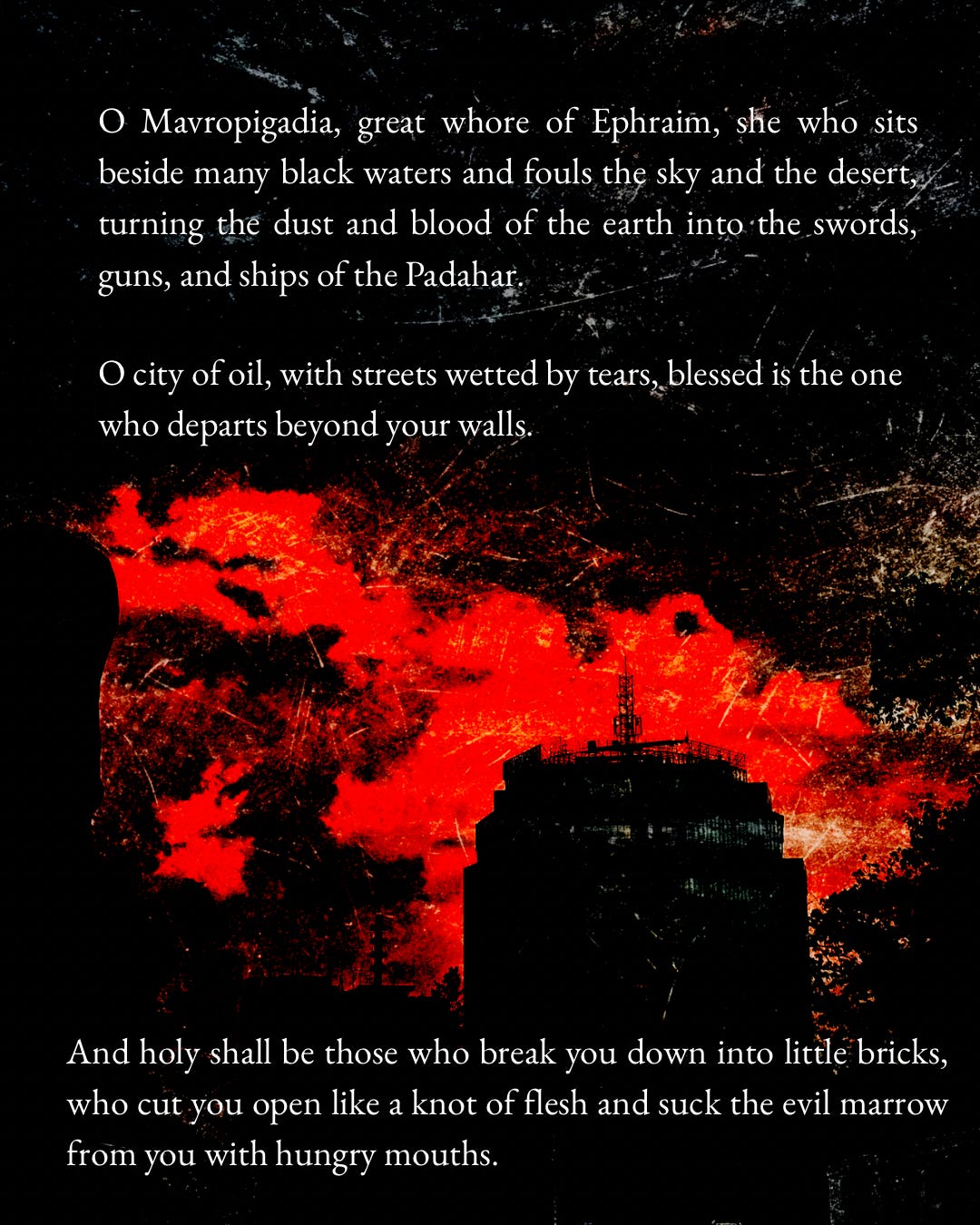
My kingdom is that of dreams, an empire of endless night to which I drift, a horseless ruler buried beneath a crown of steel. Kaplan has made me a bridge, a satellite sent out to bind the past and the future, to bring the knowledge of the Padahar and share the wisdom of the Captain with all beings I encounter. Did he not know that I would rest only on dying worlds, and that silent titans would be my only friends? That I would look into dark eyes as vast as suns and speak with their cruel hearts, finding no solace there, no wisdom fit to be shared with the feeble minds of mortals?

Kaplan, who stays and listens, who stays by the radio day and night, smoking cigarette after cigarette, falling asleep only by the power of spirits, waking with each twitch of his aging body, hoping he shall see me again. And yet I keep silent, for I know that it cannot be done. I cannot change what was set in motion. It cannot be changed, for I know it is not his will, nor mine, that tethers me toward Ephraim.
And it is day, and it is night. He prays to his godless sky, hoping that I shall speak back through the nether. The world has become more like a dream to him, more unreal and oneiric. Oh, to still be capable of human folly and try to reverse my steps, my groundless steps.
Lieutenant Demetrescu knocks on his door, but it is not the knock of other days and other times. It is the rapid knock of one who is chased, chased by time. So when he enters, nothing surprises Kaplan, not even the stranger Demetrescu has brought with him, some form of political prisoner whom Kaplan does not know.
And the plans the lieutenant lays before the good doctor are so strange that the doctor says he might as well be dreaming. Even the dreams of Demetrescu, the dreams of change, give the doctor hope. Hope that I might return.
“A sword sharpens, a sword that thirsts for my blood, and tomorrow somebody shall write my name on a bullet,” said the Padahar, his mouth dry, reaching for the jug of water on his nightstand.
He was covered in sweat, and the Grand Vestis Bella, with tender movements, wrapped him in sheets and coiled around him like a snake.
“Oh, my love, my sweet, fear not. Who shall dare strike against the mark, against the might that sustains all of Ephraim, and shall conquer and shall also bless the stars?”
“I can feel it in my bones. In my marrow speaks the truth that it is written. The prayers of the mystic are still turned out there, by the tombs. The Messenger should have been here days ago.”
“Oh, do you not know how large and vast the desert is, how treacherous the roads of the caravan are, and the roads beyond the caravan?”
“Yes, yes,” said the Padahar. “I trust you, my sweet one. But now that I am ready for everything, even if the sword hungers, it does not mean that it has been satisfied, and the bullet that carries my name is not the first and shall not be the last. I would rather the world run out of bullets, steel, and ore to make new ones than for me to falter.
“My reign is eternal, as is the darkness of the night. The darkness of the night, which always drowns even the shattering sword of dawn,” he said as he watched the sky light up with the cruel sun that covered all of Ephraim.
The priestess stroked him and said the prayer of the dawn, more under her breath than over it.
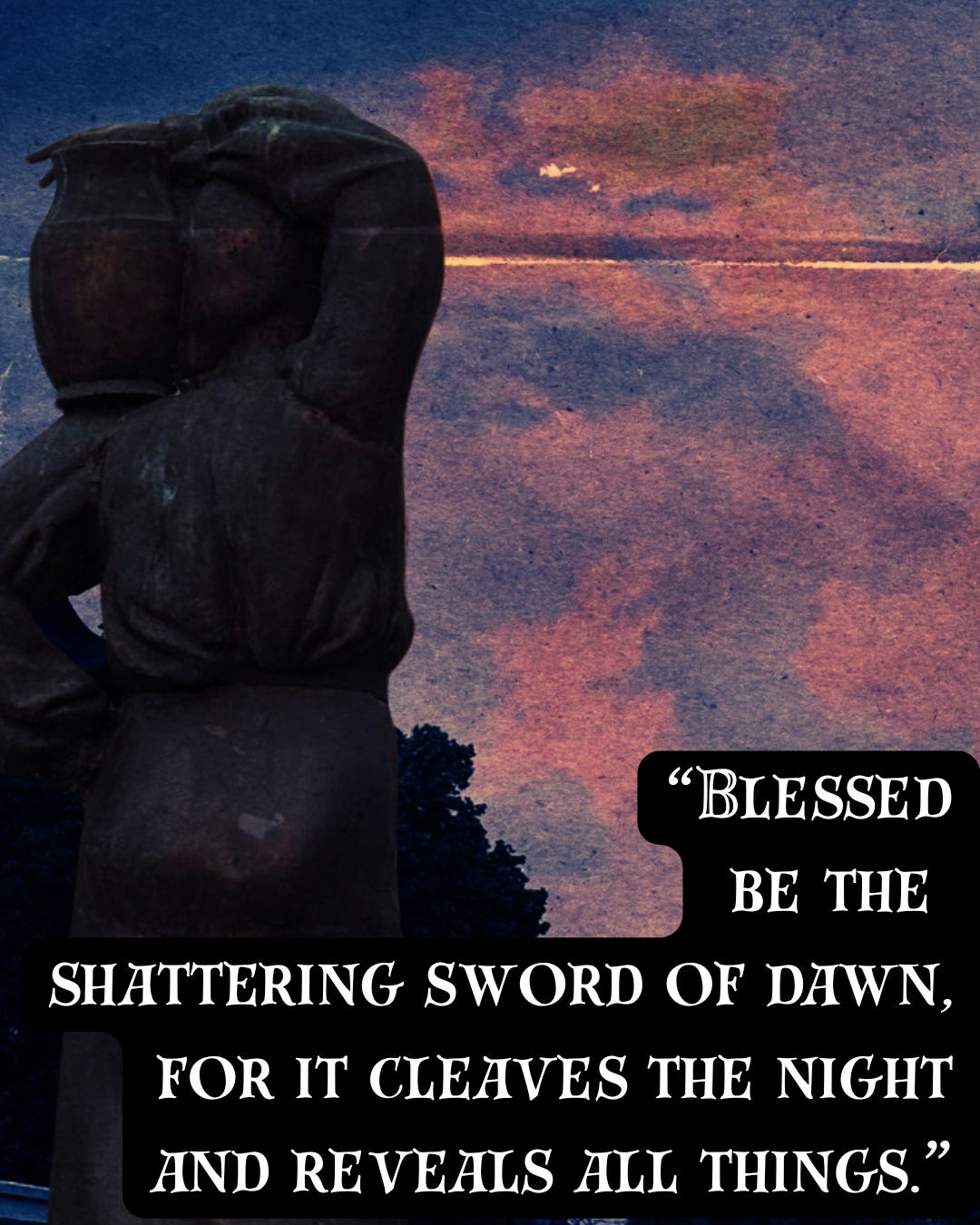
With the dawn, as he always did, at the shattering of the stars, the leader of the deserters woke with a sword against his throat. He saw the Messenger above him, and he smiled.
“So this is your choice,” he said. But the Messenger shook his head and pressed the blade no deeper.
“No, brother,” he said. “Rise, and let us ride to the tombs. We must ask the Mystic whose name is written upon the bullet, for I dreamt of one, and so did the Padahar.”
Many people have influenced this project, but the final shape of this chapter owes a special debt to Jeanne Vessantra. Many writers here inspire me as people, but Jeanne’s pieces are among the few I look up to and try to copy from. Jeanne’s reading of the last chapter surprised me and reopened the text to me. It also reminded me of something easy to forget: trust the reader, for they have the ultimate say. What I am linking below is less a recommendation of one piece than an introduction to the entire Vessantrian artistic project. Each piece feels like an encounter with Jeanne Vessantra.
I must also thank vanechka and Ray Imgrund for inspiring the Law of the Sword, which grew out of something we had been discussing in Notes. Both have been featured here before. I even gave a small lecture on Vanya’s work, and Ray has become one of the major readers of Cosmonautul, so I am publishing it on a Swordstack Saturday.
I wanted to avoid forcing my performance onto the reader and possibly ruining the experience. Partly because there is a legal document, but also because there is a female voice. So, I decided to trust my instincts more as a composer and to lean into the musical side of the production, creating a track that lets the reader enter on their own terms. If you miss my voice acting, let me know in the comments. There will be much more of it in the future, along with some guest voices.
Comments
Nothing yet. Say the first thing.
Sign in to join the conversation.