
The price of electricity has been making big headlines.
For example, back in April, the NYT published a big, splashy piece on the US power grid titled “It’s the Age of Electricity and America Isn’t Ready”. The piece begins by recounting how much electricity prices have risen over the past five years.
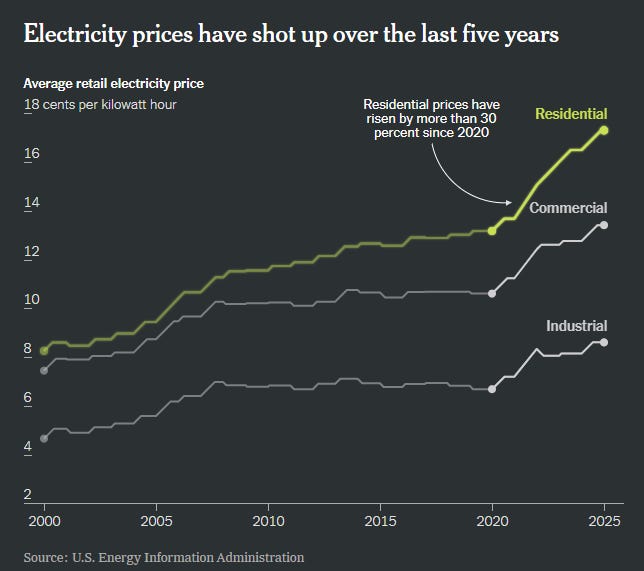
Naturally, the public has been eager to find someone to blame for this state of affairs; and data centers have become the most prominent culprit. Everyone knows data centers consume a lot of electricity; and data center construction is very conspicuously booming at the same time prices are rising. Also, there’s a sizable share of the public with, ahem, “complicated” feelings about all the investment in AI that’s underpinning the data center boom.
Yet clearly this isn’t the whole story, because electricity prices began rising precipitously during the pandemic — along with the price of practically everything else in the economy — which was almost two years before the public launch of ChatGPT.
Moreover, there’s no fundamental reason to believe that a new data center ought to increase electricity prices! In the United States, the price of electricity is highly regulated at both the federal and state level. The price per kilowatt-hour is, fundamentally, a simple function of the total cost of generating kWh and delivering them to consumers, divided by the total number of kWh delivered. That cost includes a return on capital investment deemed reasonable by utility regulators.1 Here’s the basic equation:
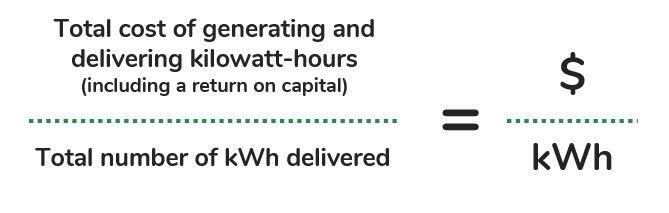
Now consider the impact of adding a new data center into this equation. The most obvious impact is that the denominator will increase, because data centers consume so many kWh. These days, a single large data center could easily increase the total electricity demand for a mid-sized electric utility by 20% or more.
The question is: Can electric utilities satisfy this increase in aggregate demand without increasing their aggregate costs (the numerator of the equation) by an even higher percentage? If so, then the addition of a data center ought to reduce the cost of energy for other consumers in the area.
If there is some slack in the system to begin with, then the answer to this question is probably going to be “yes”. As long as the utility has some spare capacity to generate and deliver more power, then the denominator of the equation ought to increase more than the numerator.
But in many regions today, the power grid is already at capacity — at least, during periods of peak demand — so the answer to the question above is more likely to be “no”. After all, the cost of building new utility infrastructure is much more expensive than the cost of existing infrastructure — which was usually cheaper to begin with and has already been partially depreciated.
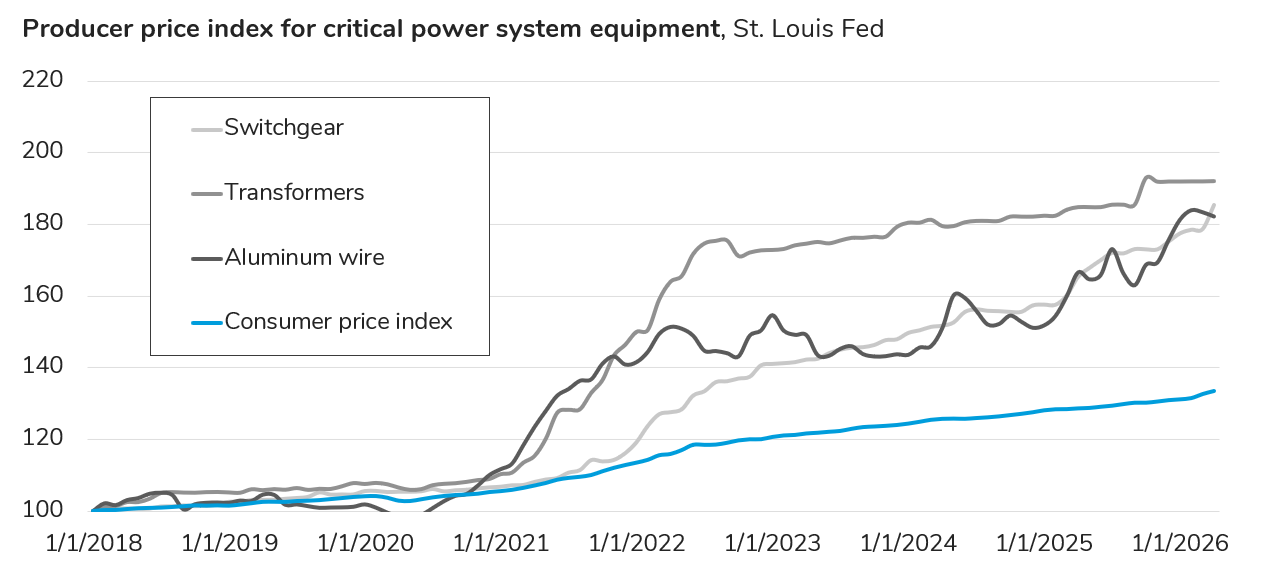
In a recent post, I highlighted just how much more expensive it is to build electric power infrastructure today than it was just five years ago:
Here are some price indeces for a few of the most important inputs to the massive energy delivery system we call “the power grid” — transformers, switchgear, and aluminum conductor. Prices for these components spiked during the pandemic and have remained elevated well above general inflation ever since.
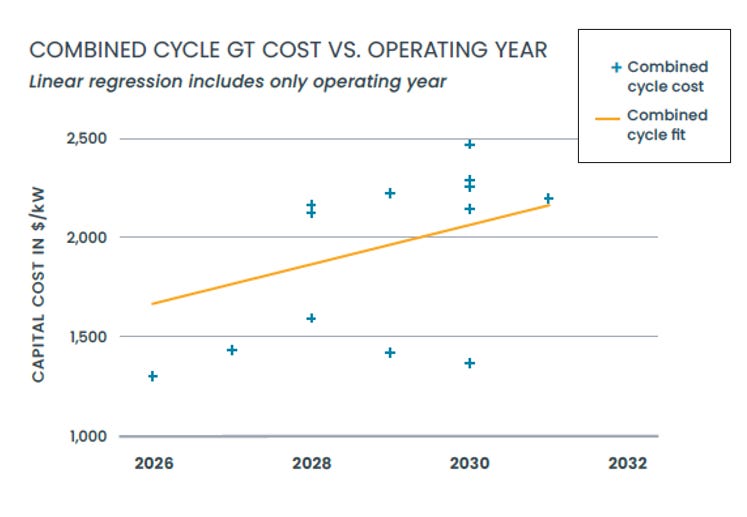
Here’s some data on combined cycle gas power plants in the United States, whose cost has increased by about a third in the span of just a few years.
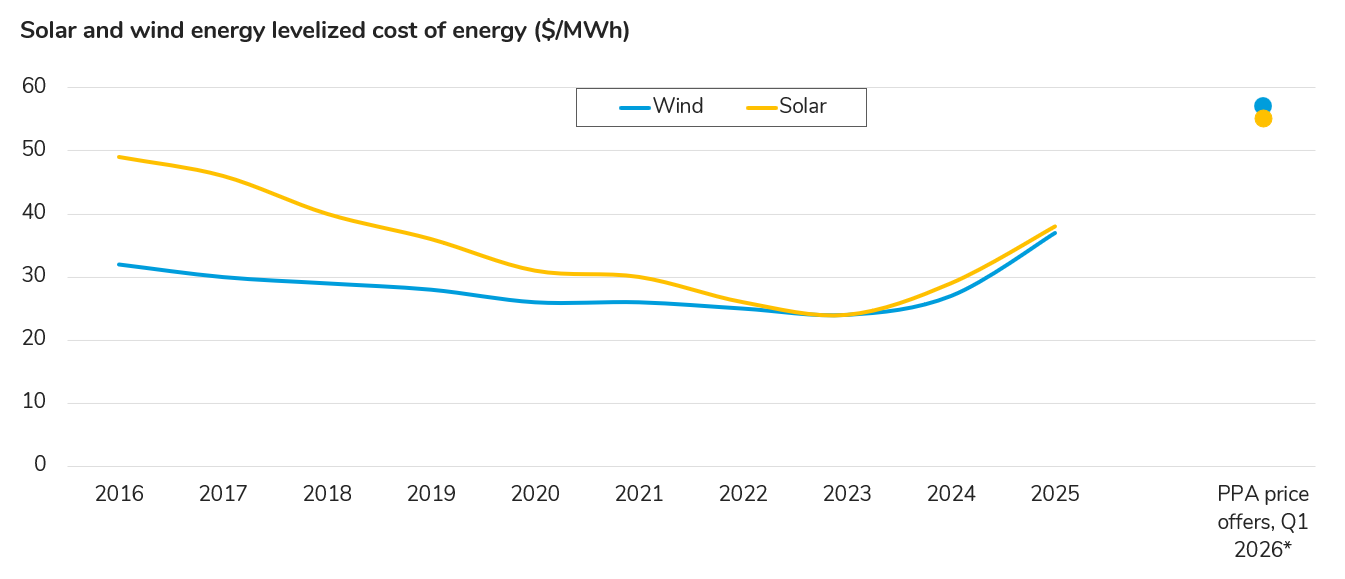
And here’s the cost of solar and wind power in the US, which has been trending upward for the past few years, and appears likely to rise even more through the rest of the decade (according to forward-looking power purchase agreement offers tracked by LevelTen Energy.)
Now, just because a data center project causes the numerator of the local utility’s pricing equation to increase more than the denominator does not necessarily mean that other customers will end up paying higher prices. Although the equation I shared above is an important principle of public utility ratemaking, it’s possible to make exceptions — and data centers are exceptional customers. They’re exceptionally large. They have an exceptionally high willingness to pay for energy. And policymakers hoping to attract more data centers to their states (typically for the sake of economic development) tend to be exceptionally motivated to avoid burdening regular household and business consumers with higher electricity prices.
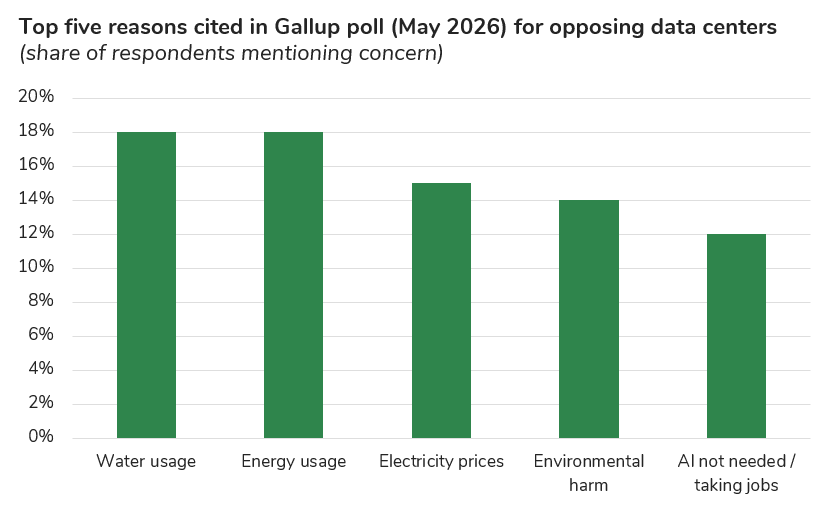
They ought to be, because public opposition to data centers appears to be skyrocketing. And according to a recent Gallup poll, excessive energy consumption and higher energy prices are the public’s second and third most common concerns.
So far, this concern over electricity prices is not particularly well founded. In reality, I’ve seen utilities and regulators going to great lengths to ensure that data center projects reduce rates for other consumers. This generally entails an individually negotiated agreement which stipulates that the data center operator needs to pay for all of additional costs required to serve their new facility… and then some. This strategy can reduce the numerator of the utility’s pricing formula while still enabling consumers to benefit from a growing denominator.
One of the best examples of this approach was pioneered by Entergy, an electric utility whose service territory spans Louisiana, Arkansas, and Mississippi. When it comes to data center development, Entergy has published a set of principles called “Fair Share Plus”, which are intended to “ensure that data centers pay their fair share for the power they use plus produce additional savings or benefits for existing customers on the power grid”. Practically speaking, the company has announced billions of dollars in projected customer bill savings as a direct result of data center development.
This example is consistent with the national trend. Just last month, the Electric Power Research Institute (EPRI) published a new paper, “Have Data Centers Raised Your Electric Bill?”, which concluded through careful analysis that they have not. Instead, so far there is practically zero correlation between data center development and household electricity prices. More importantly, to the extent the authors could uncover a casual relationship, they found that data centers caused residential prices to fall by roughly 6% from 2019 through 2024.
In sum: Utilities are doing a pretty darn good job making sure that individual data center projects pay for more than their fair share of incremental costs, and reduce electricity prices for everyone else.
But this doesn’t mean that the data center boom, in aggregate, is going to lower your electricity bill. In fact, I think the opposite is happening.
There are over two hundred investor-owned electric utilities in the United States, plus hundreds of municipal & cooperative utilities. Each one may be doing a good job individually, at the local level, making sure that data centers in their neighborhood pay their fair share of incremental costs (and then some). And yet, at a systemic level, data centers are clearly a major contributor to an aggregate demand shock that’s causing prices to rise.
The problem is not really data centers. The problem is that the supply side of the power market is inherently so dang “inelastic”... For example:
Supply chains for the most critical inputs to the system have proven to be much less flexible than we need. Some of these supply chains, for example, require highly specialized materials, such as grain-oriented electrical steel (for transformers), and single-crystal superalloys (for turbine blades)… not to mention specialized labor.
Over the past fifteen years, the growth of renewable energy has helped suppress the overall cost of power generation, especially given support from federal tax credits. But now, most of the best sites for solar and wind projects have already been claimed, and the tax credits are set to expire over the next four years.
Most utilities in North America and Europe have grown accustomed to practically zero growth since the Great Recession. Hence, these companies have not been building the insitutional capacity or culture for rapid growth.
There’s a tremendous amount of investment required just to keep the system up and running — especially as the grid has become more threatened by extreme climate events. Over the past five years, roughly two thirds of all capital expenditures on power delivery infrastructure is basically non-negotiable: replacing worn out equipment and hardening the system against extreme weather events. That’s a big share of capex that can’t be spent on increasing the capacity of the system, which we need to do in order to deliver more energy.
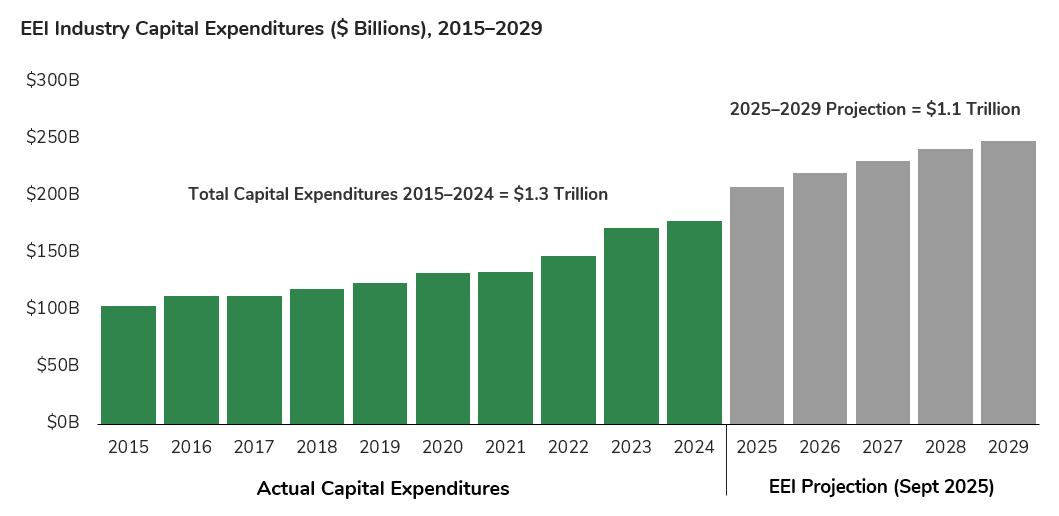
These are some of the reasons the Edison Electric Institute (a trade group for investor-owned utilities in the US) is forecasting such a steep increase in capital expenditures across the country.
So no, “that data center down the road” is probably not responsible for increasing your electricity bill. But “data centers”, collectively, are indeed putting systemic pressure on the cost of electric power infrastructure, and that pressure is probably going to cause electricity bills to increase even more in the years to come.
Financial markets seem to be coming to similar conclusions. Just a few weeks ago, Fitch Ratings lowered its outlook for the sector from “neutral” to “deteriorating”. Their reasoning?
Strong data center demand remains a structural positive for the sector and could help utilities spread fixed costs across a larger customer base, benefiting residential customers… However, these benefits are likely to emerge only over time and may not fully offset near-term bill pressure from elevated capital spending. [Emphasis added.]
The revised outlook to ‘deteriorating’ reflects a more difficult political and regulatory environment for cost recovery, rather than weaker demand fundamentals.
That depends what you mean by “affordability”.
At a macro level — perhaps even at a philosophical level — I’d argue that electricity remains one of the most “affordable” products money can buy.
Consider the concept of “consumer surplus”, which you may recall from Econ-101 is essentially a measure of how much more consumers would be willing to pay for a product than the price of that product. The average price of electricity for US household consumers is about 18 cents per kilowatt-hour.
So what exactly IS a kilowatt-hour?
It’s the only unit of energy whose formula is spelled out right there in the name: a kilowatt of power applied to some task for an hour.
It’s easiest to conceptualize a kilowatt as a measure of brute strength. In fact, one of the earliest common measures of “power” was horsepower — literally the strength that a horse could exert by pulling on a wagon. But of course, horses vary from animal to animal; so the unit of horsepower has been standardized in order to compare various types of engines and motors. Today, one horsepower is equivalent to about three quarters of a kilowatt; conversely a kilowatt is equivalent to about 1.3 horsepower. Hence, you can think of a kilowatt-hour as the equivalent of an extra large horse pulling on a wagon, for an hour… but instead of a regular, old horse that’s only useful for pulling wagons, electricity is a magical horse which you can set to work on anything from the compressor in your air conditioner to the transistors in your laptop.
I imagine most of us would be willing to pay a lot more than 18 cents to summon such an extraordinary force of nature for an hour of service.

In this context, I’d venture to say that electricity is one of the highest “consumer surplus” goods on the planet. It may be second-only to water, which is the only other good I can think which is even more crucial for daily life, even more irreplacable, and consumes an even smaller share of a typical household budget.
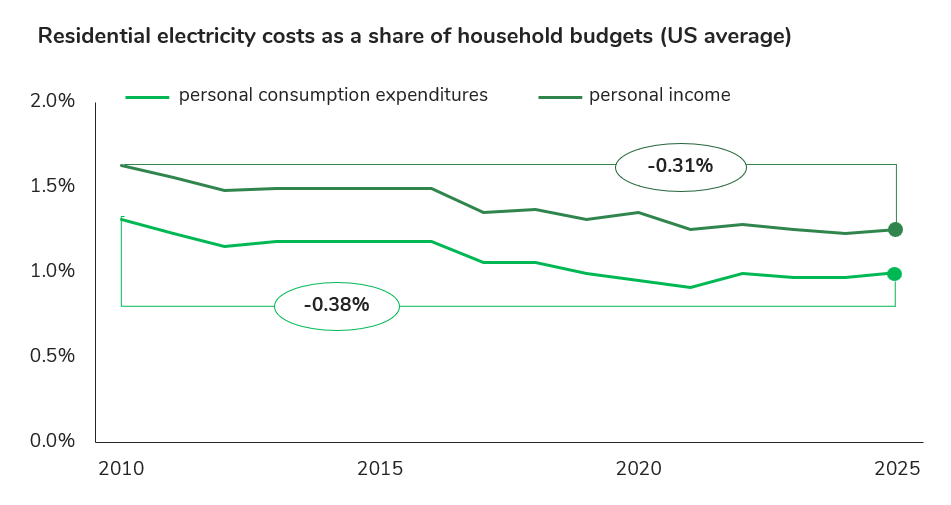
Speaking of which… As a share of an average American household budget, electricity expenditures have actually declined substantially over the past fifteen years. Recently electricity’s “wallet share” has begun to tick back up, but it’s still well below 2% for an average household.
I don’t want to be too glib about this point. In a society with such a high level of economic inequality, focusing on the “average” consumer is kind of missing the point. For lower-middle-income families in America (roughly the second quintile of the US income distribution) electricity is already a meaningful expense, consuming 3-5% of an annual household budget. And of course, for the poorest families, the cost of electricity can be an even higher burden.
And of course, there are other reasons to prioritize low electricity prices. Cheap electricity is valuable for certain electricity intensive industries, which are important for national economic competitiveness and security — e.g. metal refining and chemical manufacturing. Additionally, electricity tends to be the form of energy required by the highest precision manufacturing equipment, such as the Extreme Ultraviolet Lithography machines that are needed to make leading-edge chips. On the other hand, the cost of electricity does not tend to be a meaningful driver of competitiveness in these high precision manufacturing sectors. (See, for example, the semiconductor industries in the notoriously high-energy-cost countries of Taiwan and Korea.)
Of course, if you’re reading Steel For Fuel, you know there’s another reason to prioritize low electricity prices: Because high prices are a deterrent to electrification, and electrification is the most promising path to lower carbon emissions in multiple sectors of the economy: ground transportation, HVAC, industrial heat, and more.
So, to sum up: I don’t think the United States is anywhere close to a crisis in electric affordability. (In the scheme of things, electricity is still a really good deal.) But the current trend is unsustainable.
What can we do?
I want to emphasize that electric utilities are already doing yeoman’s work managing costs during a period of exceptional growth and supply chain pressure. Nevertheless, I can think of a few good ideas for utilities (and policymakers) which, in my opinion, deserve more attention.
Leverage “distributed energy resources”. (If you don’t know what that means, check out my previous essay: “Finally, the right time for Distributed Energy Resources”.) I’m especially bullish on the concept of utilities deploying thousands of small, modular, low-emissions generators and batteries “behind the customer meter”. In this setup, they can be used to reduce the need for building new power plants and transmission lines, while also doubling as a form of backup power supply for their host customers. (EIP portfolio company ERock was a pioneer of this business model, using fast-ramping natural gas engines. One of our newest portfolio companies, Base Power, is following suit with a new class of especially large household batteries.)
Remember energy efficiency. (Remember energy efficiency???) It may seem like old news, because incentives for energy efficient equipment and appliances have been a core pillar of state energy policy and regulated utility programs since the 1970’s. But I’d suggest that this is the right time to double down on efficiency as a truly scalable resource for utility planners. Not just because we now have extraordinary growth to manage, but also because there are new solutions which can deliver a step change in energy savings. One great example is Transaera, another EIP portfolio company whose air-conditioning technology has demonstrated roughly 30% energy savings compared with best-in-class conventional equipment. Transaera’s first product accomplishes this feat without adding any additional weight, taking up any additional space, consuming any additional water, or requiring lots of additional maintenance.
Deploy IND Technology to save money on unplanned grid maintenance, while improving reliability. I recognize that this may appear to be an oddly specific recommendation. (And yes, IND Technology is also an EIP portfolio company.) But there are a LOT of companies making a similar claim: We can help electric utilities simultaneously save money and avoid power outages by doing more “preventative” maintenance. IND Tech is one of very few companies which I’m confident can make good on that promise, using low-cost sensing and analytics technology.
Build more manufacturing capacity! We need a lot more transformers, switchgear, and all the other bits and bobs that make up the power grid. That’s why EIP has invested in companies like Heron Power, which is pioneering a new class of equipment using power electronics to interconnect large generators and loads. And also, why we’ve invested in Ayr Energy, which is mobilizing global supply chains to manufacture large power transformers with greater agility.
In practice, utility rate-making is not so simple. In particular, the way that the total cost of service is translated into rates for different customer classes - e.g. residential, commercial, and industrial — is very complex and nuanced.
No posts
Comments
Nothing yet. Say the first thing.
Sign in to join the conversation.