
You worked. You saved. You earned a warm, paid-for winter in your own home. So why does the arithmetic suddenly feel like it is slipping out from under you? One forecaster saw it coming, owned the calls he got wrong, and left the rest of us a map out.
You know the feeling before you can put a word to it. It is November, and you are standing in front of the thermostat again, running the quiet math you seem to run every year now. A degree lower saves a little. A heavier sweater saves a little more. Nobody sat you down and taught you this arithmetic. You picked it up somewhere across the last few winters, the way a body learns to favor a sore knee without being told.
And all the while the television keeps telling you to relax. Gasoline is easing. The summer scare is fading. The government’s own energy analysts expect pump prices to keep sliding into the fall, and the big banks have oil drifting into the seventies by the new year. The worst, everyone agrees, is behind us.
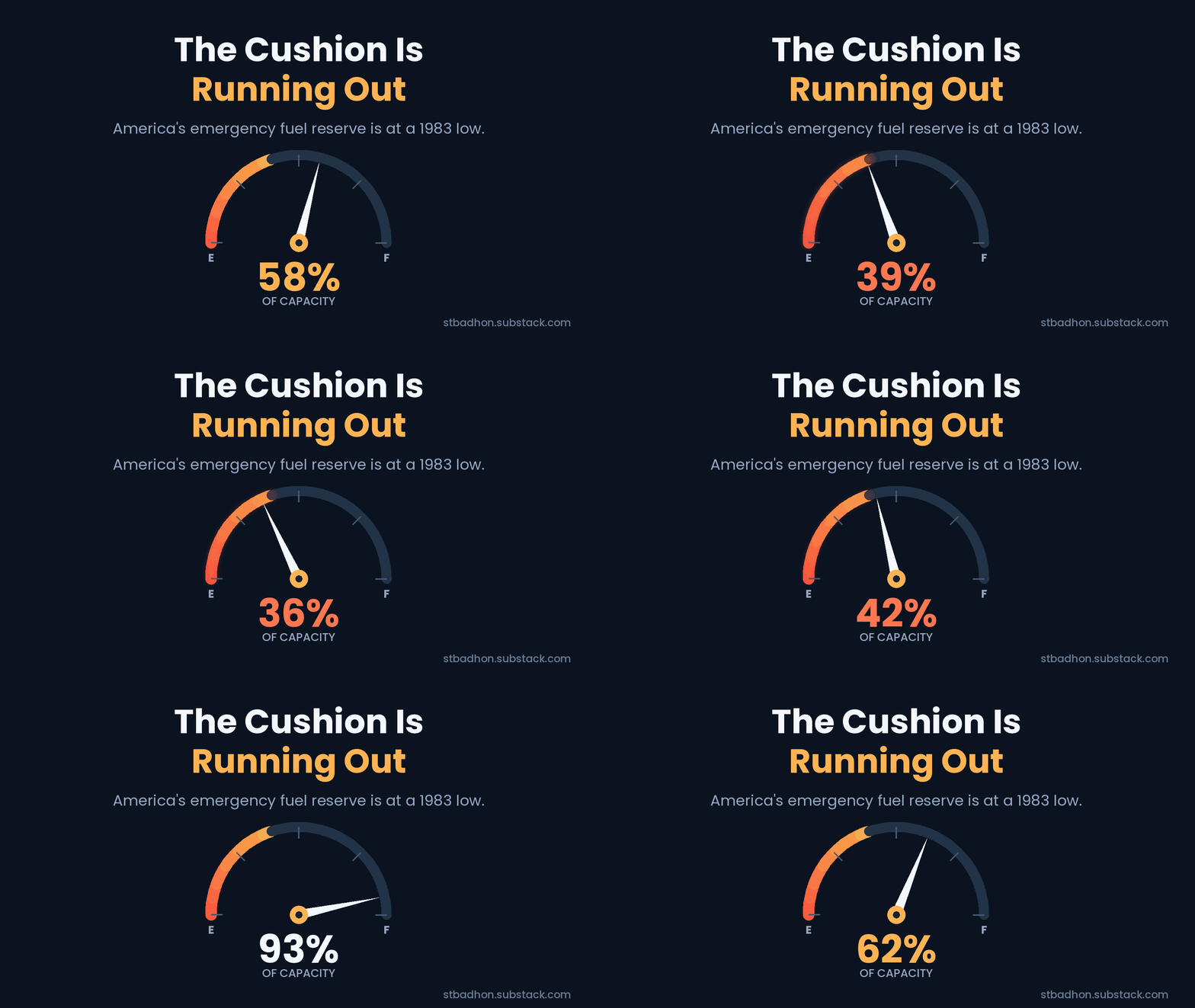
Then there is the line they bury three paragraphs down, the one that made me want to write to you. America’s Strategic Petroleum Reserve, the national emergency tank kept full for exactly the hard winter you are bracing against, just fell below 300 million barrels. Its lowest level since 1983. The country’s shock absorber is thinner than it has been in more than forty years, and it drained away while you were being reassured there was nothing to fear.
I am reading that number too. I am not going to stand here and tell you it is fine.
His name is Peter Zeihan, and he is not a mystic or a doomsayer chasing clicks. He is a former intelligence analyst who has spent a career reading maps and birth rates, and he has been making one deeply unpopular argument, in book after book, since 2014. It is an argument that should have been comforting and turned out to be a warning.
The comfortable, affordable, endlessly connected world you built your later years around was never the natural order of things. It was built. On purpose. After the Second World War, America made the planet a promise no empire had ever made: put your goods on the ocean and my navy will carry them safely to shore, for anyone, friend and rival alike. Distance stopped being expensive. A coat stitched on the far side of the earth could arrive at your door for pocket change, because one country had decided to guard the whole sea so you would never have to think about it.
Zeihan’s claim, unglamorous and now more than a decade old, is that America is quietly walking away from that promise. And when the guardian goes home, distance turns costly again. Everything that traveled a long way to reach you starts to cost what it always truly cost. He warned again this summer that the price shock you just survived is not fading out. It is winding up.
Here is why I trust him more than the cheerful voices, and why you can too. Zeihan shows you his failures. He has been predicting China’s collapse since 2010, and China is still on its feet, and he knows it. In 2023 he did the thing almost no forecaster ever dares: he published a scorecard on his own predictions and admitted, in print, where he got it wrong, from overrating Russia’s army to misjudging a stretch of Canadian oil country. A man willing to grade his own misses in public has earned the right to be heard on the calls he keeps getting right. The pundits who only ever remember their wins have not.
This is where nearly all the coverage goes wrong. You hear the reserve is running low and you picture a fuel tank, and a tank can always be topped back up. But that stockpile was never really the cushion under your life. It was only the sliver of it you could see and count.
The true cushion was the promise. Eighty years of an arrangement where the sea lanes stayed open and the tankers kept moving, quietly, reliably, whether or not you ever gave a single thought to any of it. That promise is the reason a person who did everything right, who worked and saved and paid off the house, could assume that heat in January and food in February would cost about what they cost the year before. That assumption was the floor under your independence. The reserve touching a forty-year low is not the sickness. It is the first symptom that finally shows on the outside. The cushion beneath your winter was woven out of a guarantee, and quietly, thread by thread, the guarantee is being pulled loose.
And I want to be careful and fair here, because you deserve that. This is not the fault of one party or one man in one office. The retreat has been steady and bipartisan for fifteen years, carried on by administrations that agreed on almost nothing else. Both sides looked at the enormous cost of guarding the world’s shipping and decided, each in their own words, that Americans were done footing the bill. This is not about who you voted for. It is structural, and it is bigger than any election.
So where does it lead? Zeihan refuses to hand you a single prediction. Instead he lays out the whole terrain, the way an honest map shows every road and not only the one you were praying for. Look hard at the next few years and four winters are possible. You are already living inside the first.
The first winter is the All-Clear. The shaky deal near the Strait of Hormuz holds together just well enough, prices ease toward those pleasant year-end forecasts, and the headlines take their bow. This is the winter being sold to you right now, gift-wrapped. What the wrapping hides is that the reserve keeps quietly draining beneath the calm, and the tankers near the Gulf keep getting hit, so the relief is real and paper-thin in the very same breath. Every peaceful month simply sets the next blow on a thinner cushion.
The second winter is the Chokehold. One more strike near that narrow water, one round of talks that collapses, and the strait that carries a fifth of the world’s oil clamps shut. Crude leaps past its spring highs, gas clears five dollars a gallon, and the bill lands in January with the furnace roaring and the reserve too hollow to soften it. This is the winter that comes for you all at once, in the coldest month, when you can least afford the surprise.
The third winter is the Long Tightening, and it is the one almost nobody on television will ever name, because it never gives them a single dramatic day to point a camera at. No crash. No spike. Just the price of everything made or grown far from you creeping up and staying up, a little more each year, as the guarantee keeps unraveling across the decade. Your dollar quietly buys less of the fruit that crossed an ocean and less of the medicine mixed overseas. Not a heart attack. A slow bleed you feel in every receipt. The cheap world does not come marching back. It just slips out the side door while your eyes are on something else.
The fourth winter is the one the panic never mentions, and it is the whole reason I wanted you to meet this man. Call it the Fortress. The very same forces tearing at the wider world leave your own country steadier than almost anywhere on the planet. America sits on its own energy and grows far more food than it can eat. Two oceans have kept every serious war a long, safe distance from your porch. In Zeihan’s map, when the tide of globalization finally goes out, the United States is the boat left riding high. That will not spare you every higher price. But it means the ground beneath your feet is firmer than the frightened headlines will ever let on.
Thanks for reading St's Substack! This post is public so feel free to share it.
Those four winters share something the forecasts keep stepping around. Not one of them is really about oil. They are about you. About whether the deal you spent a lifetime keeping still holds up its end.
The fear was never truly a number on a gas pump. It is older and closer to the bone than that. It is the promise you were handed as a younger person and chose to believe: that if you worked hard and kept your word, you would earn the right to be warm and independent and unafraid in your own home when the work was finally done. That is what the cold is testing. And the dread underneath it is not really the chill in the hallway. It is the phone call you never want to make, to a son or a daughter, to admit the winter got out ahead of you.
You should not have to make that call. Understanding what is actually happening is the first thing that keeps it out of your future.
Because here is the part they will not sell you, and it is the part that hands you back the wheel. You do not need to guess which winter arrives. You only need to stop planning for the cheerful average and start planning for the swing. Budget your heating season around a hard year instead of a promised soft one, so a Chokehold winter becomes an annoyance instead of an emergency. Keep your eye on two plain gauges that will tell you more than any panel of experts in suits: whether that reserve keeps falling, and whether the strait stays open. And hold tight to the fourth winter, because it is real and it is yours. Of all the places to be standing when this tide goes out, you are standing in the one built to ride it through.
I did not write this to frighten you. I wrote it because you deserve the map while there is still time to read it, so you walk into the cold with your eyes open and your footing sure, warmer and calmer than every neighbor who only ever heard the All-Clear.
Winter is coming regardless. Whether it catches you off guard is still, even now, up to you.
U.S. Strategic Petroleum Reserve below 300 million barrels, its lowest since 1983; attacks on Gulf refining and tanker traffic near the Strait of Hormuz. Trading Economics, Crude Oil, August 2026. https://tradingeconomics.com/commodity/crude-oil
Retail gasoline expected to ease through the third quarter; production and price outlook. U.S. Energy Information Administration, Short-Term Energy Outlook, July 2026. https://www.eia.gov/outlooks/steo/
Brent crude forecast drifting toward the high seventies by year end. J.P. Morgan Global Research, Oil Price Forecast, 2026. https://www.jpmorgan.com/insights/global-research/commodities/oil-prices
Peter Zeihan’s summer 2026 warning of a deepening oil crunch and constrained Gulf supply. Financial Sense, July 3, 2026. https://www.financialsense.com/podcast/21710/peter-zeihan-warns-oil-crunch-coming-summer
Zeihan biography, books from 2014 onward, his 2023 self-assessment of past predictions, and the long-running China-collapse call dated to 2010. Wikipedia, Peter Zeihan. https://en.wikipedia.org/wiki/Peter_Zeihan
Brent price level, its year-over-year rise, and the June 2026 US-Iran deal context around the Strait of Hormuz. Trading Economics, Brent Crude Oil, August 2026. https://tradingeconomics.com/commodity/brent-crude-oil
Comments
Nothing yet. Say the first thing.
Sign in to join the conversation.