
You have felt it for a while now. The sense that the machinery you were raised to trust has started to grind against itself. The bank that was supposed to be boring, the court that was supposed to be above it all, the news that was supposed to agree on at least the weather. You watched the country you grew up in start behaving like a different country, and you were told, depending on the channel, that it was one side’s fault or the other’s. Neither answer ever quite fit, because the thing you were watching was bigger than a party. It felt seasonal. It felt like weather.
Twenty-nine years ago, two men gave that weather a name and a date.
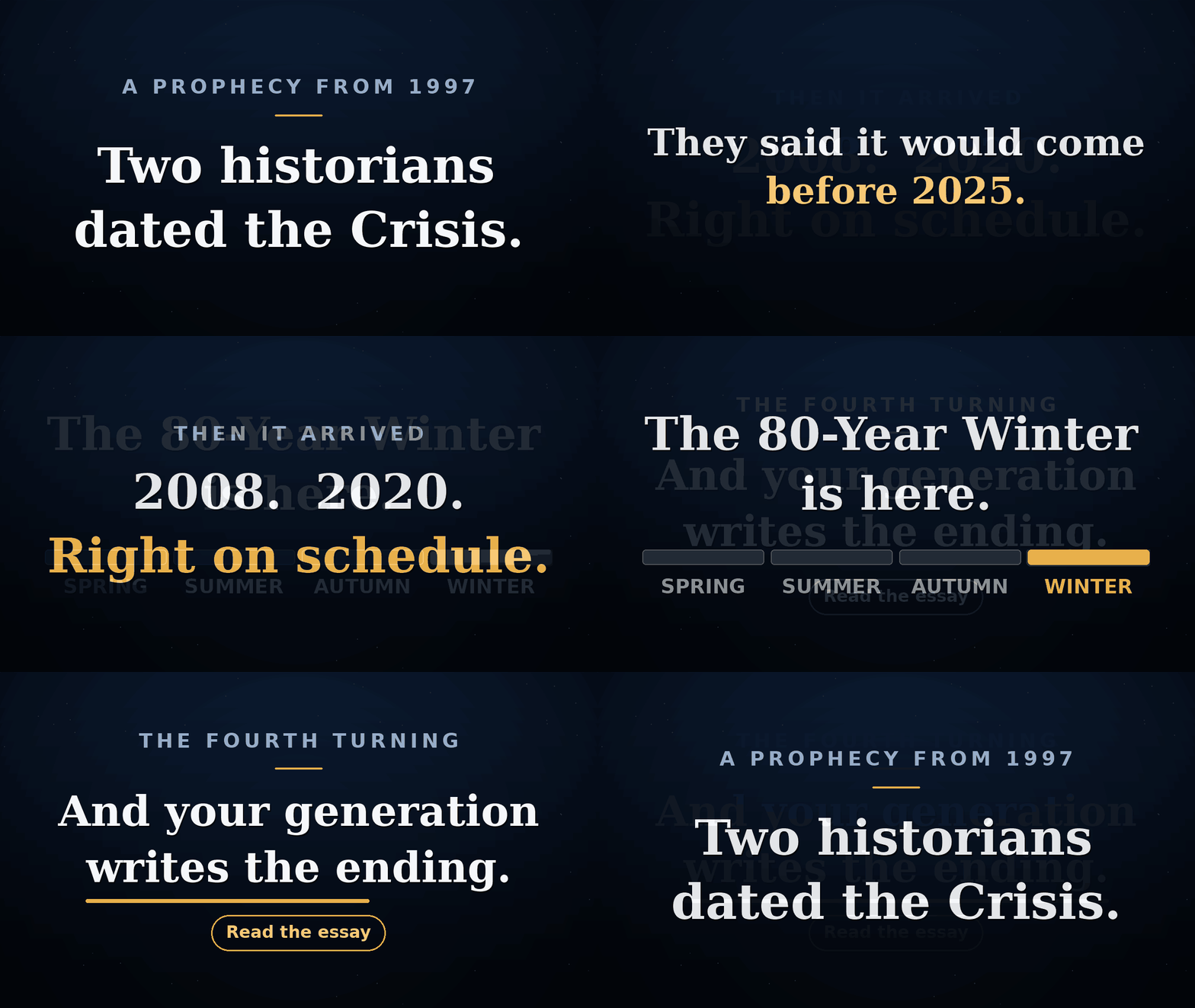
In 1997, a historian named Neil Howe and his co-author William Strauss published a book called The Fourth Turning. Their argument was simple enough to explain at a kitchen table and strange enough that most people filed it under curiosity. History, they said, does not move in a straight line. It moves in a circle roughly the length of one long human life, about eighty to ninety years, the span the Romans called a saeculum. Inside that circle are four seasons. A spring of rebuilding after a crisis. A summer of spiritual and cultural upheaval. An autumn of fraying institutions and rising individualism. And then a winter. A Crisis with a capital C, when the old order breaks down and a new one is forged under pressure.
They opened the book on a chapter called Winter Comes Again, and then they did the thing that makes a forecaster either a prophet or a fool. They put a date on it. Writing in the middle of the comfortable, distracted 1990s, they said that sometime before the year 2025 the country would pass through a great gate in its history, on the scale of the Revolution, the Civil War, and the joined ordeal of the Depression and the Second World War. They warned that the risk of catastrophe would be high. And they said the winter’s trigger would arrive around the first decade of the new century.
The trigger arrived, more or less on schedule, with the financial collapse of 2008. Then a second, harder shock landed in 2020. In 2023, Howe followed up with a sequel arguing that the Crisis which began in 2008 will not resolve until the early 2030s. Which means the coldest, most decisive stretch of the winter is not behind you. It is the ground you are standing on right now.
Here is the part that should give you pause, and it has nothing to do with mysticism.
Ask yourself how much of what you were told in 1997 has quietly come true. Not the drama, the numbers. By the end of 2025, the share of Americans who trust the government in Washington to do the right thing most of the time had fallen to seventeen percent. In 1958, when pollsters first asked, it was seventy-three percent. Gallup, measuring confidence across the fourteen pillars of American life, from Congress to the banks to the press, found the average sitting near a record low, with barely a quarter of the country expressing real confidence in any of them.
Now notice what that decline is not. It is not a story about one man, or one party, or one election you can point to and blame. Trust cratered under presidents of both parties. It fell during booms and busts alike. The rot is in the load-bearing walls, not the wallpaper. This is the single most important thing to understand about a winter, and it is the thing the shouting on television is built to hide from you. The Crisis is a calendar, not a villain. Both tribes are reading lines from a script that was written before either of them chose a costume. When you stop hunting for who did this and start asking what season it is, the noise resolves into a pattern you can actually plan around.
Every previous American winter did something specific to the thing you spent a lifetime accumulating. It repriced it.
In the Revolutionary Crisis, the paper currency people had saved in became a national punchline, worthless almost overnight. In the Civil War, whole fortunes on one side of the country simply evaporated, and inflation ate at the rest. In the last winter, the Depression wiped out savings first, and then the war years rearranged what was left through inflation, rationing, and bonds. Notice the mechanism, because it repeats. Winters rarely knock on the front door and announce themselves to your bank account. They come in quietly, as inflation, as a currency that buys a little less each year, as a slow tax on exactly the people who did the responsible thing and saved.
For you, this is not abstract. A fixed income is a promise denominated in dollars, and a winter is the season that renegotiates what a dollar means. The nest egg you meant to pass down, the house, the account with the grandchildren’s names penciled in the margin, all of it sits inside the season, not safely outside it. I am not going to tell you what to buy, because I am not your advisor, and anyone who claims certainty about the next five years is selling something. But I will hand you the frame the model offers, because it is a frame almost no one your age is being given.
Thanks for reading St's Substack! This post is public so feel free to share it.
Every article written about the Fourth Turning is addressed to the young.
Go build, they tell the Millennials, you are the heroes of this story. And in Howe’s model they are right about that much. The generation now in its thirties and forties is cast as the doers, the builders, the ones who pour the concrete of whatever comes next. So the writers all turn to face the young, and they leave the most important chair in the room empty.
That chair is yours.
Look at where the model actually places you. In a Crisis, the theory says, the Prophet generation enters elderhood. The Prophets are the values generation, the ones born after the last winter into a confident country, who spent their whole lives arguing about what things mean. If you are a senior American reading this, that is almost certainly your generation, and the role the winter assigns you is not spectator. It is author. The young do the building, but the old decide what is worth building. The Heroes supply the hands. The elders supply the vision, the moral terms, the answer to the only question that finally matters in a Crisis, which is what all the sacrifice is for.
That is why I am writing this to you and not to your grandchildren. They are getting plenty of instruction. You are being told to get out of the way. The model says the opposite. It says the ending of this winter is being drafted right now, in the words the oldest Americans choose to hand down, and that a country resolves its Crisis on the vision its elders manage to articulate before the season turns.
I will be honest about the danger in that, because the model is. The Prophet in old age is not automatically wise. It can be rigid. It can be certain in the worst way, willing to burn the house down to win an argument about what the house is for. The elders who authored the last winter’s ending could have pushed it toward triumph or toward ruin, and which one they chose was not fated. It was a choice. The pen is real, and so is the risk of what you write with it.
A winter always ends. That is the one promise the model makes and history keeps. What it refuses to promise is how.
Stand at the gate and you will see three doors, and every one of them has been walked through before. Behind the first is Renewal, the outcome Americans like to assume is guaranteed because it is the one that happened last time. The Depression and the war ended in a rebuilt, confident country and the longest boom in its history. Behind the second door is Diminishment, a Crisis survived but not won, a country that comes out the far side smaller, poorer, quieter, its best possibilities spent. And behind the third is Collapse, the door Strauss and Howe refused to pretend was locked, the one where the nation cracks along its seams or hardens into something it would not have recognized in the spring.
The model does not tell you which door opens. It tells you the door is chosen, not assigned, and that it is chosen in the years you are living through, by people including you. That is not a horoscope. That is a responsibility.
You are a careful reader, so you have already raised the obvious objection, and I am not going to dodge it.
Plenty of serious people call this whole framework a kind of astrology for nations. They point out that if you draw the cycles loosely enough, almost any event can be shoehorned to fit, that the theory is nearly impossible to prove wrong, and that a pattern which explains everything explains nothing. Those critics are not fools, and the honest answer is that they are partly right. You should not treat generational theory as a law of physics, and anyone who quotes it like scripture has stopped thinking.
But here is what the objection cannot wave away. In 1997, when the country was fat and calm and sure the good times were permanent, two men said a great national Crisis would arrive before 2025, triggered in the first years of the century. Then 2008 happened on cue, and 2020 after it. You do not have to believe the mysticism to respect the timing. Treat the Fourth Turning not as a prophecy that relieves you of judgment but as a map that sharpens it. A map can be roughly drawn and still show you which way the river runs. This one has been pointing at winter for twenty-nine years, and the river went where it said.
So what do you actually do, standing at the gate with a pen in your hand.
You do the small, unglamorous things that only an elder can do, and you do them on purpose. You tell the young what a functioning country actually felt like, in specifics, so that renewal stays imaginable to people who have never once seen it. A generation cannot rebuild something it cannot picture, and you are one of the last living blueprints. You hand down a vision that is larger than a grievance, because a winter authored out of resentment opens the wrong door. You steward what you have deliberately rather than fearfully, and you make the plan for your legacy a decision instead of a default. You mentor one person, by name, all the way. You show up for the civic work, the boring local kind, and you insist on judging it by whether it works and not by which tribe it flatters, because that structural habit of mind is the exact medicine a Crisis needs and the first thing it destroys. And you refuse the rigidity the model warns you about, the temptation to spend your last authority winning an old fight instead of ending a new crisis.
None of that requires you to be powerful. It requires you to be present, and clear, and unwilling to hand the pen to the loudest person in the room.
The winter came in on schedule, the way the man said it would in 1997. The gate is here. And the oldest, strangest, most overlooked line in his entire theory turns out to be the one that matters most to you. The ending of a winter is written by the people old enough to remember a country that worked. That is not your grandchildren. That is you. Pick up the pen.
Neil Howe and William Strauss, The Fourth Turning: An American Prophecy (1997): https://en.wikipedia.org/wiki/The_Fourth_Turning
Neil Howe, The Fourth Turning Is Here (2023): https://en.wikipedia.org/wiki/The_Fourth_Turning_Is_Here
Strauss and Howe generational theory, archetypes and the turnings: https://en.wikipedia.org/wiki/Strauss%E2%80%93Howe_generational_theory
City Journal, review of The Fourth Turning Is Here (the 2008 trigger arriving on schedule, resolution in the 2030s): https://www.city-journal.org/article/review-of-the-fourth-turning-is-here-by-neil-howe
Pew Research Center, Public Trust in Government, 1958 to 2025: https://www.pewresearch.org/politics/2025/12/04/public-trust-in-government-1958-2025/
Gallup, Confidence in U.S. Institutions Remains Near All-Time Low: https://news.gallup.com/poll/712436/confidence-institutions-remains-near-time-low.aspx
Comments
Nothing yet. Say the first thing.
Sign in to join the conversation.