
Your belly fat didn’t arrive because you started eating more.
It arrived because the hormone that spent forty years deciding where your body stored fat stopped showing up for work — and the fat went looking for a new address.
By the end of this you’ll know which moves shift this fat, in the order that matters, the single measurement worth watching instead of the scale, and what the research honestly says about hormone therapy — including where it stops working.
You didn’t gain this by failing. The same fat simply moved somewhere you can see it.
You didn’t change what you eat. You might even be doing more than you used to.
The middle kept growing anyway, so you reached the conclusion anyone would: that somewhere along the way you’d lost your discipline.
But the advice you were following was written for a body that still made estrogen. Yours doesn’t, and nobody adjusted the plan for that.
So put the question to the plan that never had to answer for itself: who was “just eat less and do more cardio” actually built for?
Here’s what changed inside you, and it isn’t your willpower.
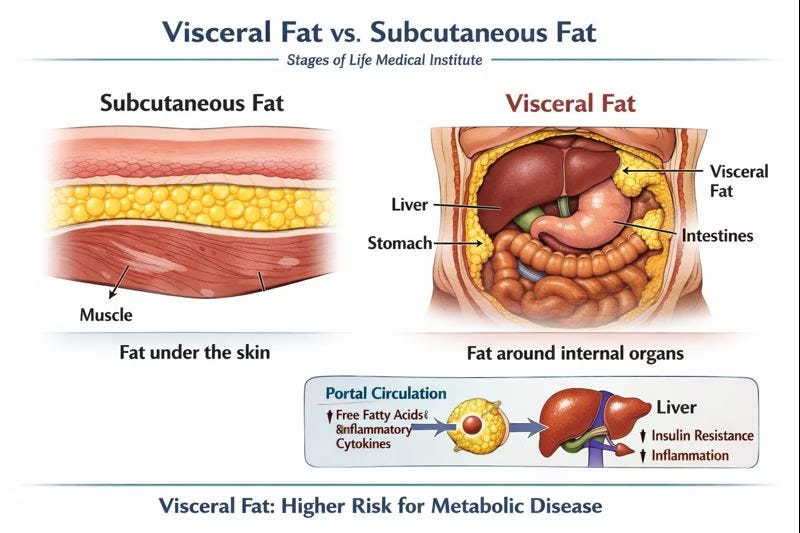
Start with the mechanism, because it has three linked parts and they explain the whole thing. For decades, estrogen told your body to store fat on your hips and thighs — the metabolically quiet places. As estrogen falls through menopause, that instruction disappears, and the fat starts going to your abdomen instead: the visceral kind, packed deep around your organs rather than sitting under the skin.
At the same time, the drop in estrogen raises insulin resistance, which pushes even more fat toward your center. And underneath all of it, muscle is quietly declining — a process called sarcopenia — and less muscle means a slower rate of burning calories all day.
Put the three together and the middle grows even when nothing about your eating changed [Munshi & Garg, “Obesity and Menopause,” J Midlife Health 2025, PMID 40330226].
So is it fixable? Here’s the honest half. In a study of 1,053 women aged 50 to 80, those using menopausal hormone therapy carried less visceral fat and were spared the visceral gain that usually shows up over a decade [Papadakis et al., OsteoLaus cohort, J Clin Endocrinol Metab 2018, PMID 29596606].
That’s real signal that the estrogen side of this is addressable. It’s also an association — a snapshot of women already on therapy, not proof that the therapy caused the difference — and the advantage faded in women who had stopped.
Which is why hormone therapy isn’t simply the answer, and here’s the catch spelled out. That study didn’t prove hormone therapy melts belly fat. It found a link, in women already taking it, that vanished once they stopped. And it’s a genuine medical decision with real trade-offs that only your own doctor can weigh against your own history.
That’s why every lever below works whether or not you ever have that conversation.
Before any of that, two things you can start this week without waiting on a single hormone decision.
Move your protein earlier in the day. Most people save it all for dinner, which leaves the whole morning with nothing to work with. Getting a solid dose at breakfast gives your body the raw material to hold onto the muscle that’s quietly slipping — the muscle whose loss slowed you down in the first place.
Do two short strength sessions this week. Bodyweight is fine, no equipment, no gym. Muscle is the one tissue that keeps your metabolic rate up, so every bit you rebuild works for you around the clock, not just during the workout.
These help on their own. But there’s an order to these levers, a number that tells you whether they’re working, and a hormone question you deserve a straight answer on.
Almost everything you were told to do here chases the scale. The scale is the wrong number for this — it can’t see the fat that matters. Below the wall: the levers that move it, in the order that matters, the single measurement to watch instead of your weight, and what the research honestly shows about hormone therapy — including where it stops working.
The levers in priority order, the one number to track instead of the scale, and the honest hormone-therapy picture.
Tonight, take a tape measure to your waist and your height, and write both numbers down.
Five minutes, and you’ll have the one measurement that tracks this — the one the scale can’t give you. The next section tells you exactly what those two numbers should add up to.
You’ve got the two measurements. Here’s the number they make, and everything that moves it.
Start with the number, because it changes what you’re aiming at. Stop tracking the scale and start tracking your waist-to-height ratio: divide your waist measurement by your height. Under 0.5 is the target.
It works because it sees what the scale and even BMI miss — the visceral fat around your organs, the kind that relocated when your estrogen fell. You can drop scale weight and still carry that fat, or hold your weight steady while your waist shrinks. This number catches what those miss.
Now the levers, in the order their leverage runs.
Resistance training, at least twice a week. This is the master lever, and it goes first for a reason: the muscle loss is the root of the slowdown, so rebuilding muscle is the closest thing there is to addressing the cause rather than chasing the symptom. Every pound of muscle you hold onto keeps your metabolic rate higher and pulls storage away from your middle. If you only have room for one change, this is it.
Protein at every meal, and cut the refined sugar. The protein feeds the muscle the strength work is trying to rebuild, so the two levers compound. Cutting refined sugar blunts the insulin resistance that estrogen’s exit left behind — the same insulin resistance that’s been steering fat to your center. These two move together.
Cardio, around 150 minutes a week at a moderate pace. This one supports rather than leads. It does real work for your heart and helps with overall calorie balance, but it isn’t the tool that rebuilds the muscle or moves the visceral fat, so it sits below strength rather than replacing it — the exact correction to the “just do more cardio” advice that stopped working for you.
Sleep, seven to nine hours. Short sleep tips your hunger hormones the wrong way — the one that says “eat” climbs, the one that says “full” drops — and you wake up fighting cravings you didn’t have to earn. Protecting sleep isn’t a soft add-on here; it’s removing a headwind that works against every other lever on the list.
Stress management. The stress-hormone side drives both the emotional eating and the central-fat storage, so calming it is a genuine lever, not a wellness throwaway. Whatever settles you — walking, breathing, time with people you trust — counts as part of the plan, not a break from it.
And last, held carefully: the hormone-therapy conversation. Here’s what the evidence showed, and its limits, so you can take it to the right person. In the OsteoLaus study, women on hormone therapy kept their visceral fat lower and were spared the usual ten-year gain. But that was an association, it faded in women who stopped, and hormone therapy carries real trade-offs that make it right for some people and wrong for others. This is a question to bring to your own doctor with your own history in hand, not a lever you apply to yourself off the back of a newsletter. Medication is another conversation some people have with their doctor too; the same rule holds — that’s their call to make with you, not mine.
One note if you’re a man reading this: a parallel shift happens to you as testosterone declines with age, the same drift of weight toward the middle. The hormone specifics differ, but the muscle-first levers above are yours too.
If someone you love is blaming herself for a middle that changed overnight — send them this.
It’s free to read.
Next week: the strength lever on its own, and why the muscle you hold onto after 50 protects far more than your waistline.
Comments
Nothing yet. Say the first thing.
Sign in to join the conversation.