
PART 1: The Hidden Health Saboteur
Do you check food labels?
You should.
If you even eat packaged foods at all.
I started at the age of 16 and freaked myself out at realizing the insanity of feeding myself sugars, plastics and chemicals on mass.
Ideally we'd all have home-farms and buy from our neighbors, but that's a pipe dream for city dwellers.
Sure, you may opt for mostly non-processed foods. Even track your steps. Perhaps optimize your sleep routine.
But are you still missing the elephant in the room? Your environment is actively sabotaging every health effort you make.
Most people are fighting a losing battle without knowing it.
They'll spend hundreds on supplements while breathing toxins. They'll track biomarkers while living in biology-sabotaging spaces.
To make the case:
You may be consuming up to 5 grams of plastic weekly—roughly the weight of a credit card. (Microplastics are now found in human blood, brain tissue, and placenta.)
You're probably breathing 2-5 times more polluted air indoors than outdoors.
Your lighting disrupts hormones that control energy, mood, and reproduction.
Your genes evolved with clean air, natural light cycles, minimal chemical exposure.
Modern life gives us the diametric opposite: synthetic materials, artificial lighting, electromagnetic radiation, chemical contamination.
The result is dire: Chronic inflammation, hormonal disruption, poor sleep, low energy, accelerated aging, anxiety without a visible cause.
For millions of people it takes the form of a typical fight for health: Exhausted by 3pm daily, dependent on afternoon coffee, suffering poor sleep and frequent headaches. Attempts at supplements, meditation apps, and expensive superfoods.
Most people treat symptoms while ignoring sources.
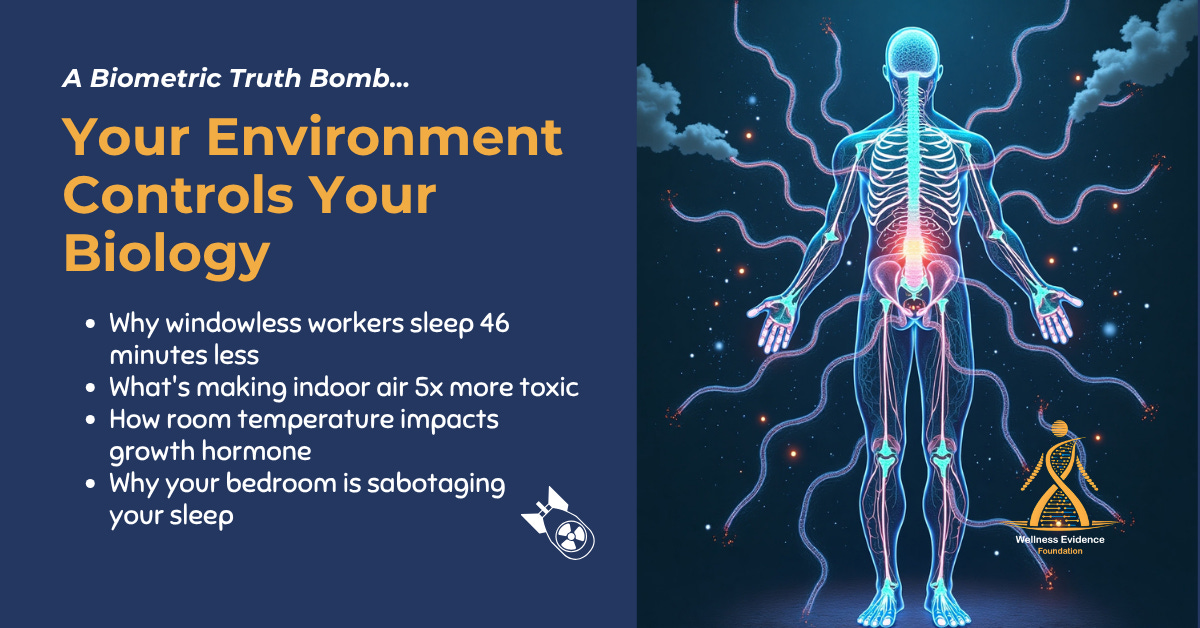
Workers near windows sleep 46 minutes longer per night than those in windowless offices.
Plastic-free living for just 3 days reduces BPA exposure by 66%.
Plants remove 87% of airborne toxins in 24 hours.
Indoor air pollution is 2-5 times worse than outdoor levels.
This isn't theory—it's measured biology.
Fluorescent office lights disrupt circadian rhythm. Plastic water bottles delivering daily hormone disruptors. Synthetic air fresheners overloading detox pathways. A phone charging next to your bed, bathing in electromagnetic fields all night.
Bottom line: Your environment directly controls your hormones, sleep quality, cognitive function, and cellular repair processes.
As a matter of fact: Small environmental modifications can create significant biological improvements. Your body has remarkable healing capacity—you just need to reduce the environmental burden as quickly and as much as possible.
Change your environment, change your health outcomes.
The problem isn't willpower or 'getting through the day'—it's environmental management.
After implementing environmental change you can hope for, or even expect: steady energy until evening, coffee becoming optional, sleep score improving 40%, daily headaches completely gone.
Same you, same body — optimized environmental inputs.
Environmental health isn't just personal optimization—it's cognitive performance enhancement. In an AI-accelerated world where mental clarity and sustained energy determine professional relevance, your physical environment becomes a competitive advantage.
Those who understand their environment as their "external nervous system" will outperform those fighting their surroundings daily.
Subscribe to Human First for weekly experiments in strategic cultural intelligence during the AI transition and more updates as we develop the ReadyPatientOne Environment Protocol.

Thanks for reading Human First! This post is public so feel free to share it.
Part 2 reveals the complete Environmental Health Protocol—specific implementation strategies, measurable improvements you can expect, and how to position this approach within the broader Human First framework.
Comments
Nothing yet. Say the first thing.
Sign in to join the conversation.