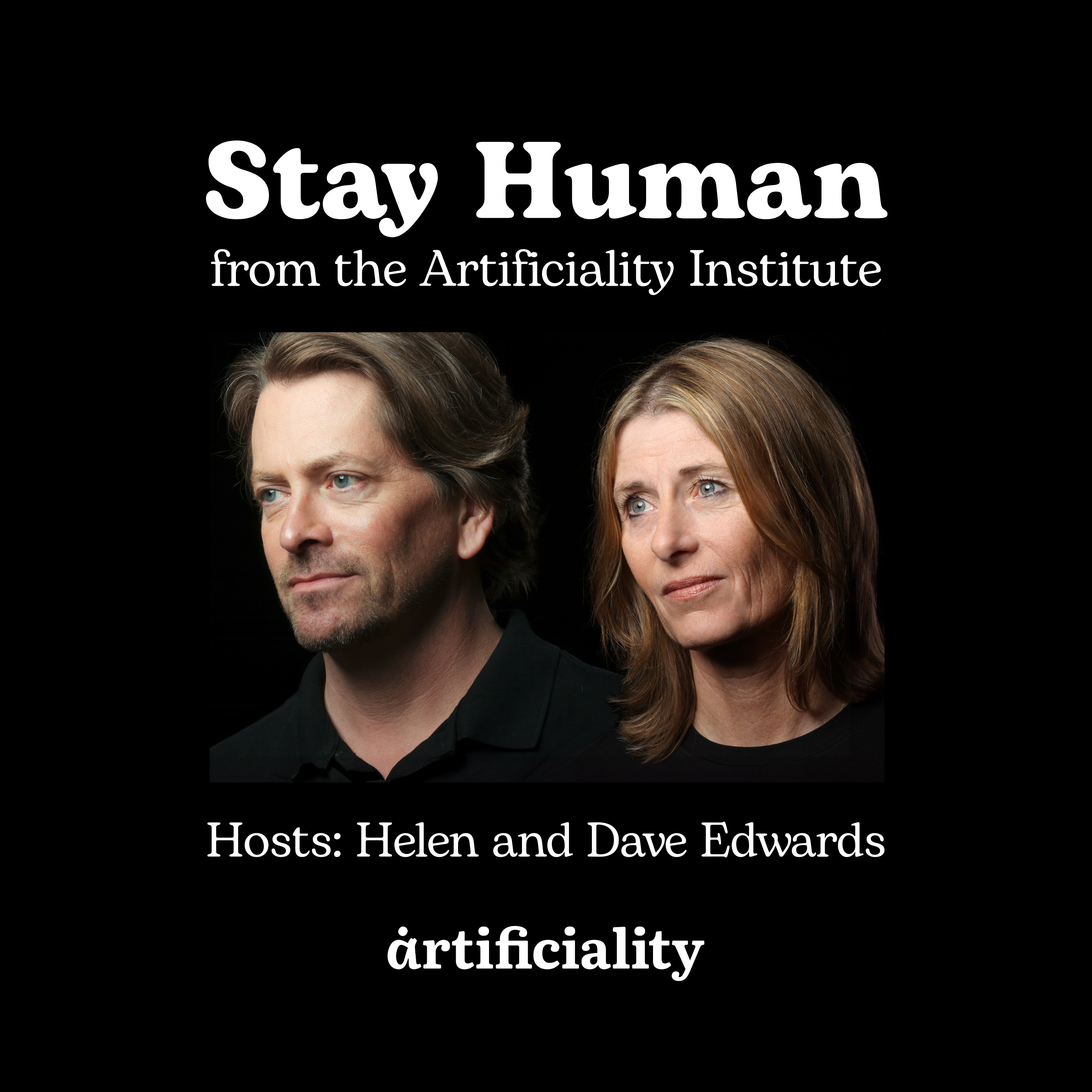
Exploring how AI changes the way we think, who we become, and what it means to be human. We explore how AI changes the way we think, who we become, and what it means to be human. We believe AI shouldn't just be safe or efficient—it should be worth it. Through story-based research, education, and community, we help people choose the relationship they want with machines—so they remain the authors of their own minds.
In this conversation, we explore machine intelligence and human understanding with Christopher Summerfield, Professor of Cognitive Neuroscience at Oxford and author of "These Strange New Minds: How AI Learned to Talk and What It Means." Chris offers a "third way" of thinking about AI—neither irrational exuberance nor dismissive skepticism, but a view grounded in cognitive science that takes both…
In this conversation, we explore the cultural foundations of artificial intelligence with Nina Beguš, Assistant Professor at UC Berkeley and author of "Artificial Humanities: A Fictional Perspective on Language in AI." Nina makes a compelling case for an entirely new field—one that brings humanistic insights into the very creation of technology rather than treating humanities as critical…
In this conversation, we explore the nature of intelligence and life itself with Blaise Agüera y Arcas, VP and Fellow at Google and head of the Paradigms of Intelligence Lab. Blaise discusses his ambitious new book "What Is Intelligence?"—a work that bridges evolutionary biology, complexity science, artificial life, and AI to argue that intelligence fundamentally arises from computation,…
In this conversation, we explore the psychology of conviction with Steve Sloman, Professor of Cognitive, Linguistic, and Psychological Sciences at Brown University and advisor to the Artificiality Institute. Returning to the podcast for a third time, Steve discusses his new book "The Cost of Conviction," which examines a fundamental tension in how humans make decisions—between carefully weighing…
In this conversation, we explore the foundations of artificial intelligence with Ellie Pavlick, Assistant Professor of Computer Science at Brown University, a Research Scientist at Google Deepmind, and Director of ARIA, an NSF-funded institute examining AI's role in mental health support. Ellie's trajectory—from undergraduate degrees in economics and saxophone performance to pioneering research at…
We enjoyed giving a virtual keynote for the Autonomous Summit on December 4, 2025, titled Becoming Synthetic: What AI Is Doing To Us, Not Just For Us. We talked about our research on how to maintain human agency & cognitive sovereignty, the philosophical question of what it means to be human, and our new(ish) approach to create better AI tools called unDesign. unDesign is not the absence of design…
In this conversation recorded on the 1,000th day since ChatGPT's launch, we explore education, creativity, and transformation with Tess Posner, founding CEO of AI4ALL. For nearly a decade—long before the current AI surge—Tess has led efforts to broaden access to AI education, starting from a 2016 summer camp at Stanford that demonstrated how exposure to hands-on AI projects could inspire high…
In this conversation, we explore the philosophical art of embracing uncertainty with Eric Schwitzgebel, Professor of Philosophy at UC Riverside and author of "The Weirdness of the World." Eric's work celebrates what he calls "the philosophy of opening"—not rushing to close off possibilities, but instead revealing how many more viable alternatives exist than we typically recognize. As he observes,…
In this conversation, we explore the challenges of building more inclusive AI systems with John Pasmore, founder and CEO of Latimer AI and advisor to the Artificiality Institute. Latimer represents a fundamentally different approach to large language models—one built from the ground up to address the systematic gaps in how AI systems represent Black and Brown cultures, histories, and perspectives…
In this conversation, we explore how humans can better navigate the AI era with De Kai, pioneering researcher who built the web's first machine translation systems and whose work spawned Google Translate. Drawing on four decades of AI research experience, De Kai offers a different framework for understanding our relationship with artificial intelligence—moving beyond outdated metaphors toward more…