Jobs Down. Benefits Up. Britain Has a Work Problem
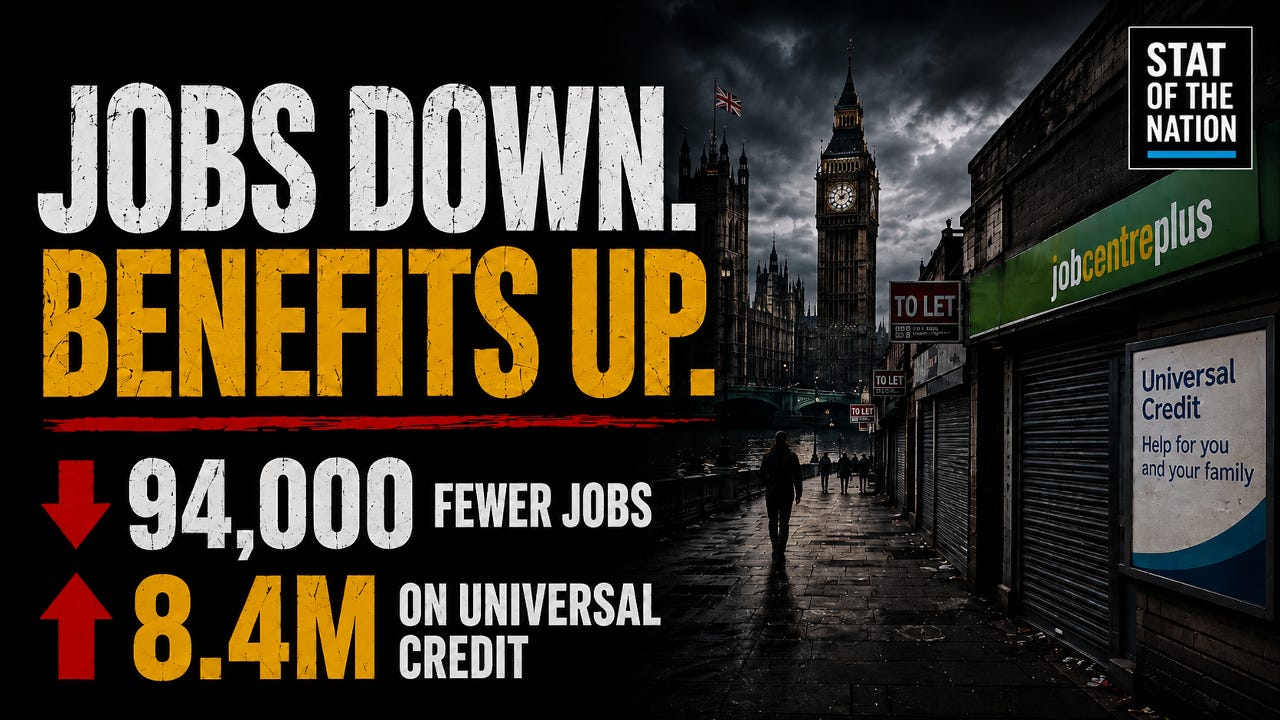
Britain has 94,000 fewer payrolled employees than a year ago, while Universal Credit has hit a record 8.4 million — with 4.3 million now facing no work requirements.

Britain explained through the numbers—independent analysis of politics, the economy and public services from award-winning statistician Jamie Jenkins.
Live Last read · last published · next check
Britain has 94,000 fewer payrolled employees than a year ago, while Universal Credit has hit a record 8.4 million — with 4.3 million now facing no work requirements.
This week with Mike Graham, we discussed the record 230 people crammed into a single Channel dinghy, why public-sector productivity is still below pre-pandemic levels.
Five years of recovery have still not restored pre-pandemic productivity — and healthcare remains 5.8% below 2019.
Private-sector firms have reportedly cut staffing for 22 consecutive months. Official payroll figures also show a sustained jobs squeeze, with younger and entry-level workers most exposed.
Britain’s prisons are 98% full. New cells are being built, but not quickly enough to stop sentencing policy being reshaped around the space available.
This week with Mike Graham, we discussed whether Andy Burnham can turn improved polling into results, and why Britain keeps reviewing problems instead of solving them.
UK winter rainfall was 13% above average. Yet half of England and all of Wales are now in drought, after decades of population growth, delayed infrastructure and rapidly rising water bills.
Labour has caught Reform as former voters return and Green support falls. But Burnham is still enjoying a political honeymoon, and an early election could put Labour’s enormous majority at risk.
Britain’s real-terms millionaire population has fallen to its lowest estimated level since 2008, when the financial crisis struck under the last Labour government.
Andy Burnham is rapidly undoing Keir Starmer’s policies. But reversing failure is not the same as having a plan.