
Much has been written lately about the falling birth rates in the United States. For many of us, this trend is not so surprising. Women still earn just 53-83 cents for every dollar men make, while on average, spending 2.5 times more hours every day on unpaid care work than men. Meanwhile, childcare costs are approximately 40% more than they were just 10 years ago. But as the Trump administration pushes out-of-touch policies like the economically illiterate “baby bonus” and Title X restrictions, they are conveniently ignoring these and other structural barriers that hurt women and families.
How do we get policies and programs that actually address the needs of working mothers? The answer is simple: we must stop making assumptions about moms and start electing them.
As states increasingly determine the policies that shape everyday life – including childcare, education, reproductive rights, healthcare, housing, and labor protections – it is vital that they have leaders who understand the practical realities facing working families.
But the perspectives of mothers with young children are significantly underrepresented in state legislatures all across the country.
According to research from Vote Mama Foundation, among the 7,386 state legislators in the United States, only 582 are moms with children under 18. That means just 7.9% of all state legislators are mothers actively raising young kids, despite the fact that women living with minor children make up 18.2% of the adult population. To achieve proportional representation, we would need to more than double the number of moms of young children serving in state legislatures.
Running and serving while raising small children is uniquely difficult within a political system designed by and for men before women even had the right to vote. Campaign schedules revolve around nights and weekends, which means that candidates with caregiving responsibilities—mostly moms—are often forced to choose between staying home with their kids or doing the campaign work they need to do to win, unless they can get childcare. Legislative sessions stretch unpredictably and often require lawmakers to spend weeks or months away from home. Many capitol buildings still lack basic accommodations such as lactation rooms and adequate women’s bathrooms that most modern workplaces now consider standard, and many legislatures operate without formal parental leave policies or the ability for legislators to vote remotely.
And yet when mothers of young children do gain power, the policy results can be transformative.
In 2022, New Mexico voters approved a constitutional amendment guaranteeing funding for early childhood education and care. The state has since implemented the nation’s first free universal childcare program – a groundbreaking policy that dramatically expanded access for working families while helping stabilize the childcare workforce.
New Mexico has one of the few female-majority legislatures in the country. Women legislators there have consistently elevated issues that American policymakers have long treated as secondary: childcare, paid leave, maternal health, education, and economic security for families.
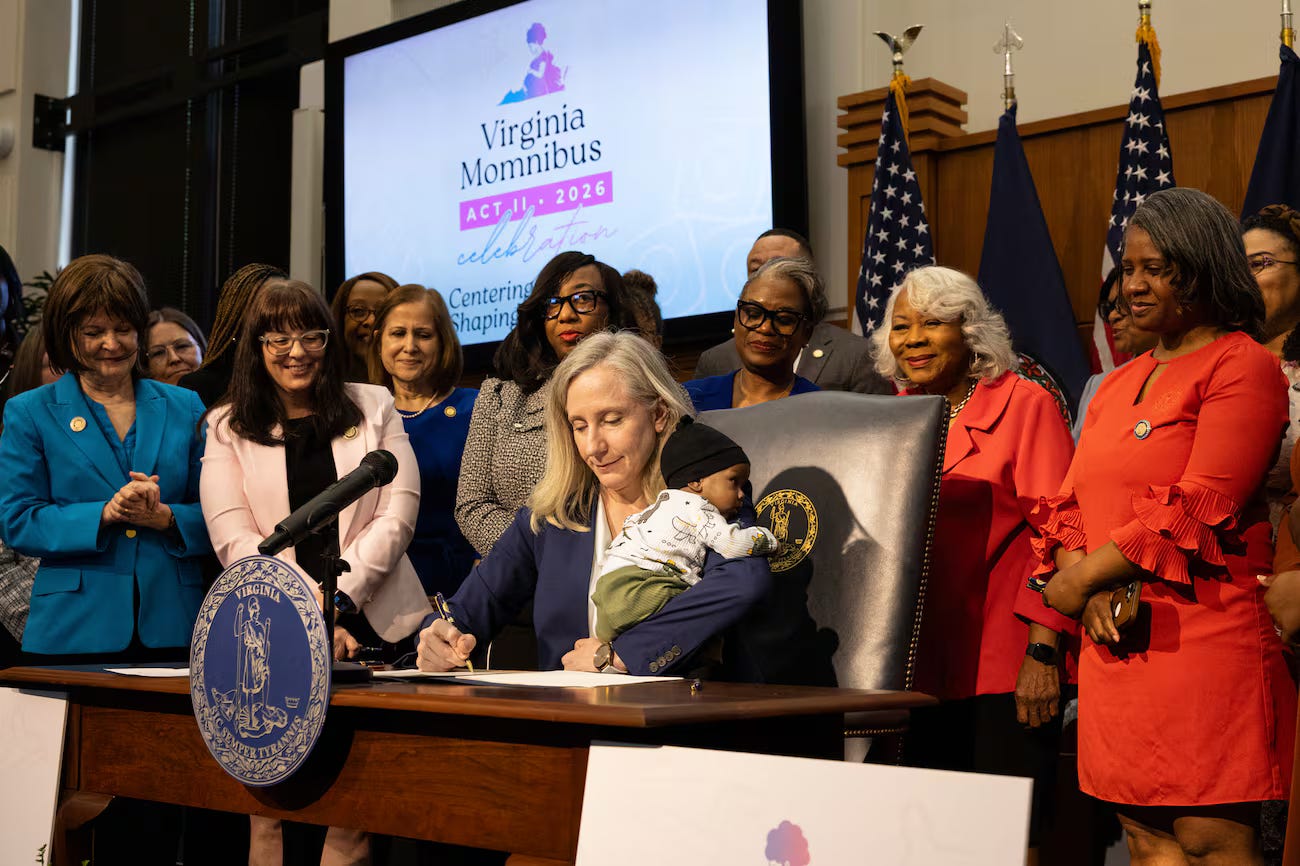
In Virginia, Governor Abigail Spanberger recently signed the “Momnibus” bill package, which includes measures to expand paid family medical leave to 12 weeks,
partially fund a state childcare program, provide training that addresses Black maternal mortality, and require insurance companies to cover postpartum depression screenings.
It’s no coincidence that in 2025, Virginia elected more Democratic women to the House of Delegates than the entire Republican caucus combined, along with the first female governor of the Commonwealth – who also has school-age children of her own.
For decades, America has treated childcare as a private burden to be solved individually rather than a public good that economically benefits our entire country. We lose more than $172 billion a year in economic activity because of the lack of childcare. Mothers of young children understand viscerally how unsustainable this American model of care has become.
If we want better policy outcomes, we need legislatures that better resemble the public.
The irony is that our communities depend heavily on mothers, but our political institutions often make it nearly impossible for them to have a hand in the policies that govern them. Mothers organize communities, volunteer in schools, coordinate mutual aid, manage households, and frequently serve as the connective tissue of civic life. Yet when it comes to formal political power, they remain dramatically underrepresented. This is by design.
Political parties, donors, advocacy organizations, and voters all have a role to play in making elected office more accessible to parents of young children. Campaign Funds for Childcare should be authorized in all 50 states. (Vote Mama Lobby has already gotten this approved in 40 states and DC!) Legislative schedules should reflect modern family realities. Younger mothers should be actively recruited to run.
We do not have a shortage of qualified mothers capable of governing. We have political structures that have failed to embrace them.
Comments
Nothing yet. Say the first thing.
Sign in to join the conversation.