
For a quarter of a millennium, Americans have been in a tug-of-war between democracy and authoritarianism. As our nation’s 250th birthday arrives, we are witnessing the dismantling of the democratic progress of the Voting Rights Act by the modern authoritarian movement.
This contest over access to the ballot box is part of a larger and more fundamental struggle between Americans who seek to expand democracy and citizenship to all that call this land home, and those who exclude most of our families from their definition of a “real” American.
It is a contest over the decision-making process: a pull between concentrated power, where a few people make decisions, and distributed power, where all Americans may have a meaningful say in the decisions that govern their day-to-day lives.
This July 4th sees authoritarian movements on the march – as unaccountable masked agents roam our streets and efforts to distort our elections abound – while little is done to stem the mounting costs on working families. But the longer history of America is also about unrelenting struggles to expand democracy and citizenship for more of our neighbors. That history can be a celebratory reminder that generations before have prevailed against powerful authoritarian movements and expanded our democracy. We can do so again if we are committed to working together.
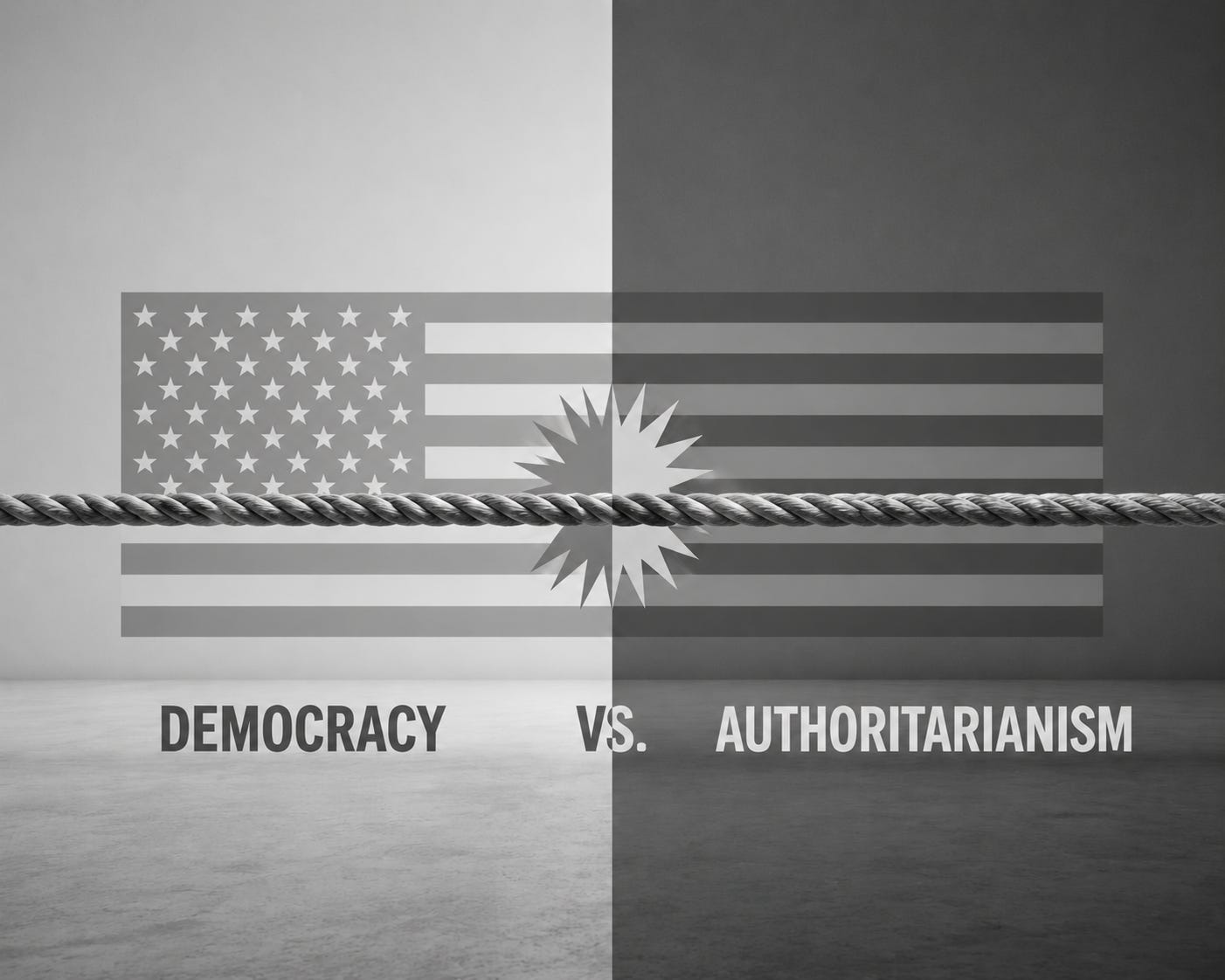
If we want to prevail at this quarter of a millennium, it’s worth rooting ourselves in history through this framework.
The Declaration pulled in the direction of democracy, casting off a king, while the Constitution and the first formal citizenship policies of the nation affirmed plantation authoritarianism and white supremacy. Our earliest ballot boxes saw the most extreme restrictions as Black Americans were treated as subhuman, and citizenship through the Naturalization Act of 1790 was confined to “free white persons.”
For its first century, America had a strong authoritarian pull towards violent racist purges in chattel slavery and policies like the Indian Removal Act of 1830. On the nation’s 76th birthday, Frederick Douglass named how anemic the side of American democracy was in this contest in his famous “What to the Slave is the Fourth of July” speech, wherein he argues for the just value of the Declaration to carry that same democratic aspiration to immediately abolish slavery. It was this abolitionist movement to expand democracy and citizenship, of which Douglass was a prominent part, that would eventually pull towards the passage of the Reconstruction Amendments – 13th, 14th, and 15th – greatly expanding access to the ballot box.
While far from a total win, for a time American democracy inched toward this more expansive vision. Meanwhile, deadly, violent authoritarian efforts persisted – built by Americans who sought to recreate new systems of white supremacy and the consolidation of power and profit. These American authoritarian movements eroded the gains of American democracy little by little, and came to dominate much of America’s second century as well. They limited who could come based on racist ideas and policies like the Chinese Exclusion Act of 1882 and the Johnson-Reed Act, and established the authoritarianism of Jim Crow to exile Americans from the ballot box and participation in public life.
The response from Americans fighting on the side of freedom was fierce. They built movements that powered another significant expansion of democracy and citizenship. July 4th celebrations 60 years ago were held in that moment of expansion. The passage of the Voting Rights Act, the Civil Rights Act, and the Immigration Act of 1965 formed the most comprehensive expansion of democracy and citizenship for those who called America home. This powerful trifecta sought to combat discriminatory practices in voting, use federal power to protect minority rights, abolish the restrictive national-origins quota system that favored Northern and Western Europeans, and much more. These laws passed thanks to the work of Black leaders and Americans of all stripes in the Civil Rights Movement, and they strengthened democracy for everyone with an expansion of rights, freedoms, and citizenship.
The Civil Rights Movement defeated white supremacy as the singular national story and gave Americans something better to work towards: a pluralistic and multiracial democracy where everyone has a voice. That narrative gained more and more support as the decades progressed from the Civil Rights Movement to Black Lives Matter. Over two-thirds of Americans supported the Black Lives Matter movement at its peak in 2020, a higher percentage of Americans than had supported MLK Jr. and the Civil Rights Movement decades before.
At the same time, the forces opposed to civil rights and a multiracial America didn’t retreat: they began to rebuild their movements and forge ahead. Since they couldn’t possibly have conceded to Black power while clinging to white supremacy, they told a different story about a widespread conspiracy to destroy white America. They reframed the rejection of white supremacy as an attack on patriotism. They claimed that naturally occurring demographic change is an intentional act tantamount to “white genocide.” White nationalists used these narratives to implement draconian policies such as DHS’s immigration enforcement and the ban on Muslim refugees and even travelers.
An authoritarian’s most effective tool is to tap into people’s anxieties around demographic change, scarcity, and safety. If our democracy were working as it should, this wouldn’t be nearly as effective. Unfortunately, that’s not the case. Their story says that if you can’t find a job, it must be the fault of immigrants, or that if you work full time but still can’t afford rent, it must be that your tax dollars are going to people who don’t want to work. Their story says we can only survive by thinking about our own needs. This resonates with many people because authoritarian and white nationalist leaders are weaponizing normal anxiety to manipulate outcomes in their favor. They are playing a long game to undo civil rights via the courts, legislation, culture, and education.
In the last year, the modern American authoritarian movement has rapidly advanced efforts to dismantle democracy through the current Trump administration, corporate cooperation, and the alignment of white nationalist networks. Subverting elections is a necessary next step for this authoritarian movement if it is to continue consolidating power. From Shelby County v. Holder in 2013, which weakened the Voting Rights Act, to the insurrection at the Capitol on Jan. 6th, to the recent Callais decision, the pattern holds. The modern authoritarian movement is increasingly reliant on targeting the legitimacy of U.S. elections. In fact, the lead plaintiff in the Louisiana v. Callais case, Bert Callais, was a Jan. 6-er and has a history of promoting false election conspiracies.
The authoritarian movement is operating at the local level, the state level, the national level, and in the Supreme Court. It’s powerfully entrenched and interconnected. We can look to Indiana for one clear example. In December, the Indiana State Senate refused Trump’s call to redraw the state’s congressional maps to help Republicans win two more seats. In its recent primary, 5 of the 7 Trump-endorsed candidates beat their GOP incumbent opponents who had voted against redistricting – an indication of the authoritarian movement imposing its ideas in the mainstream. From the halls of Congress, to podcasts and talk radio, to school board races, town halls, and active clubs, this movement is disciplined, committed, and much bigger than individual elected leaders, far-right influencers, and even the president himself.
The modern authoritarian movement is built upon the white nationalist driven backlash to the three major bills that marked the advance of democratic movements. Since their passage authoritarians have been organizing to once again rapidly shrink the quality of our democracy and citizenship. Their answers to the questions of who can be an American and what America should look like did not then, and do not now, include an expanded view of citizenship, rights, or freedoms.
They fear multiracial democracy precisely because they know it can bring social and economic progress to all of us, not just to a select few. That’s one of the many reasons we owe much to African American civil rights organizers who fought (at significant cost) for a version of America that did not yet exist.
Louisiana v. Callais is in many ways the culmination of this backlash against the pursuit of America’s multiracial democracy. The Supreme Court released its decision on April 29, effectively gutting the Voting Rights Act, and we are already seeing the authoritarian power grab as states across the nation rush to redraw their district maps, often with devastating effects for Black voting power. Much will be contested in the courts over the coming months and years, but we are unlikely to get back even a fraction of what’s been lost.
Our coalitions need to recognize this force as an enemy of democracy and fight for our own ideals and values. The majority of Americans reject the white nationalist agenda and prefer a vision of a pluralistic democracy with rights and freedoms intact. Because we are up against a powerful movement decades in the making, we need to respond with a powerful movement of our own, equipped with strategies that address the present and the future of American democracy.
Now is the time to build that movement, rapidly recruiting our neighbors to pull together on the side of democracy. Overconfident in their leverage, the modern authoritarian movement is pulling too hastily and aggressively against American democracy, and is in danger of slipping. Just as you would in a backyard game of tug-of-war, acting together with a strategic pull can make the other side stumble. Yes, we need to fight for an expansion of American democracy and citizenship regardless, because it is the system where we together can solve the challenges our families and communities face. But we must also realize we are at a strategic moment to catch authoritarians slipping before they plant their feet with a further consolidation of power.
Neither democracy nor the struggle to expand it is a spectator sport. We have to get in there and pull. On this 250th birthday, we should take lessons from our history to remember the perils of authoritarian consolidation and the possibilities of winning an expansion of American democracy. Victory isn’t guaranteed, but the contest is ongoing.
If you and your neighbors are looking for ways to get together to pull on the side of American democracy in this strategic moment as authoritarian forces continue to threaten the ballot box ahead of the midterms, we’ve got a training for you!
Join us Wednesday, July 8th, 6PM CT / 7PM ET for our new training series on building a movement response to the midterms called “Protect Elections. Demand Democracy.”
Comments
Nothing yet. Say the first thing.
Sign in to join the conversation.