

Welcome to the latest edition of ASPI’s ‘State of the Strait’ Digest.
Each week ASPI tracks Beijing’s pressure campaign against Taiwan, including military, economic, and diplomatic coercion, as well as political, cognitive, cyber, and legal warfare.
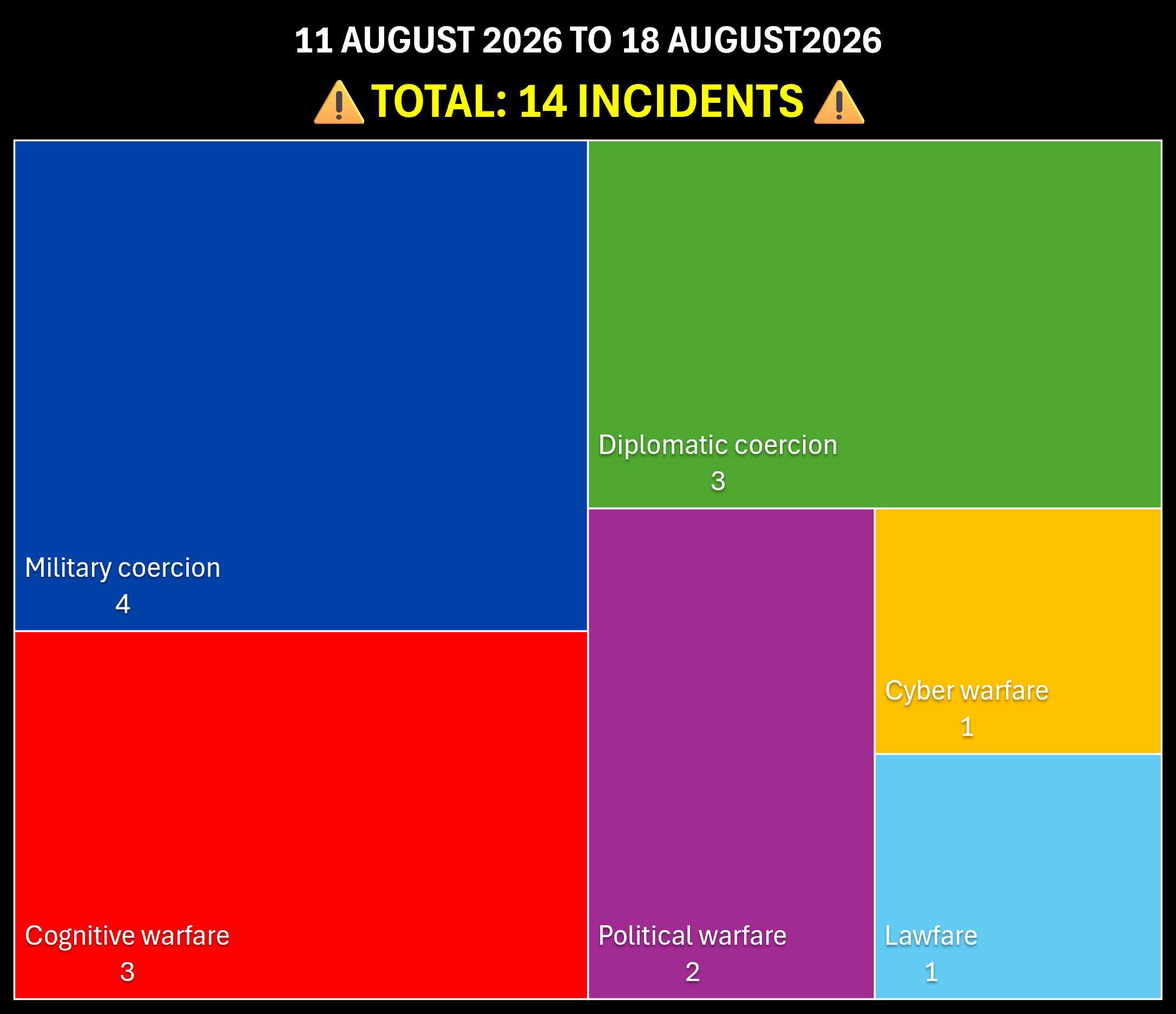
This edition covers the period: 11 August 2026 to 18 August 2026.
Follow the Australian Strategic Policy Institute on X, on LinkedIn, and on Bluesky.

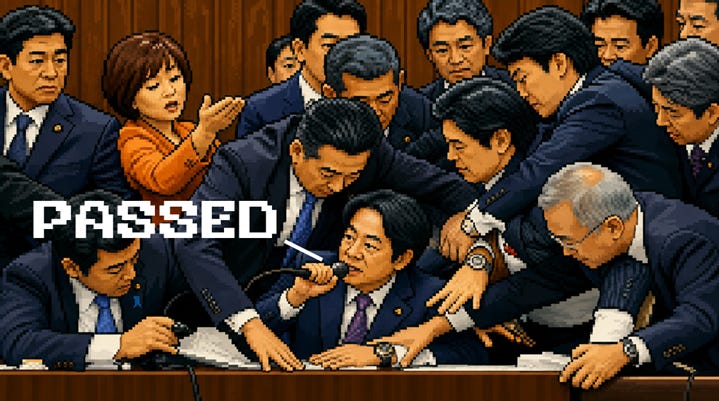
Taiwan’s legislature finally passed the 2026 central government budget on 14 August, ending an extraordinary political stalemate that had left the government without an approved annual budget for more than eight months.
The dispute has formed part of a wider confrontation between the executive and legislature that has paralysed parts of Taiwan’s political system since the DPP retained the presidency but lost its parliamentary majority in 2024.
This dysfunction is itself becoming a national-security vulnerability: Taiwan’s democratic system should increase the political cost to Beijing of coercion and conquest, but prolonged institutional paralysis risks weakening public confidence and slowing preparations for precisely that threat.
The Lai administration submitted the NT$3.034 trillion (A$133.5 billion) budget in August last year and it should legally have been approved by the end of 2025. Instead, repeated clashes between President Lai Ching-te’s Democratic Progressive Party (DPP) government and the opposition-controlled legislature delayed its passage until last week.
The final compromise was less extreme than the length of the dispute might suggest. Lawmakers approved about NT$2.987 trillion (A$131.4 billion), cutting NT$48 billion (A$2.1 billion), or around 1.7 per cent, from the government’s proposal. The opposition Kuomintang (KMT) has pointed to this as evidence that it was scrutinising rather than attempting to cripple government spending. But the significance lies as much in the delay and politically targeted cuts as in the headline reduction.
Defence spending emerged relatively intact from the final negotiations, but only after months of uncertainty. Military equipment and facilities were subject to some reductions, while NT$63.4 billion (A$2.8 billion) in drone-related industrial development and procurement was ultimately passed without cuts. This was an important compromise given the growing importance Taiwan places on inexpensive, mass-produced unmanned systems for asymmetric defence.
But the broader defence-budget dispute remains unresolved. In May, the same opposition-controlled legislature approved only NT$780 billion (A$34.3 billion) of Lai’s proposed NT$1.25 trillion (A$55.0 billion) special defence package, preserving funding for US weapons while excluding domestically produced capabilities including drones. A separate NT$210 billion (A$9.2 billion) proposal to procure more than 210,000 air and maritime drones through 2031 also remains contested, with the DPP and KMT disagreeing over how the programme should be funded and scrutinised.
The episode therefore highlights how Taiwan’s divided government is increasingly turning routine policymaking into prolonged institutional confrontation. Lai has struggled to build support across party lines, but the opposition has also demonstrated that its legislative majority can be used to delay major government programmes for months.

What’s happened so far:
7 August: Taiwan rehearsed continuing operations after missile strikes, including rapid runway repair and Mirage 2000 rearming at Hsinchu, while Thunderbolt-2000 rocket systems practised striking approaching landing forces.
8 August: The exercise moved firmly into joint anti-landing operations. Naval, coastguard, missile and drone units rehearsed attacks on approaching forces, while Kinmen conducted live-fire anti-landing drills.
9 August: Taiwan began transitioning from anti-landing operations towards depth defence. Military Police used Taipei’s MRT to move troops and supplies, while chemical units practised decontaminating vehicles after a simulated chemical attack.
10 August: Taiwan shifted towards depth defence, rehearsing how to contain PLA forces after a landing. Civilian trucks moved tanks from Hualien to reinforce Yilan and defend its ports, while central Taiwan deliberately slowed mobile internet to simulate wartime communications disruption.
11 August: The exercise moved deeper into depth defence and protracted warfare. Military Police rehearsed defeating airborne forces around Songshan Airport, reservists practised mass-casualty treatment, and Matsu tested backup communications to keep command networks operating.
12 August: Fighting moved closer to Taipei. Military Police and Marines rehearsed defeating airborne forces on the Guandu Plain using armoured vehicles and attack drones, while Patriot units practised missile resupply and redeployment.
13 August: Taiwan intensified urban and infrastructure defence. Troops fortified Guangfu Bridge and the approaches to Taipei, practised blocking the Snow Mountain Tunnel, and conducted the first Navy-Coast Guard transfer of strategic supplies from an amphibious ship. Northern Taiwan also repeated the mobile-internet slowdown drill.
14 August: Han Kuang 42 concluded after 10 days and nine nights. Units conducted combat-power reconstitution, inspecting and repairing equipment before returning to their bases, bringing the exercise’s protracted-war phase to an end.

Taiwan drone defences fall short against Beijing’s evolving technology, audit reveals
South China Morning Post
Taiwan’s push to build a modern counter-drone shield has come under renewed scrutiny after an official audit uncovered technical shortcomings and a key procurement programme collapsed following repeated testing failures. The developments have fuelled concerns that Taipei’s efforts to match Beijing’s rapidly evolving drone technology are being undermined by capability gaps, procurement failures and delays in building an integrated counter-drone network. According to a recent report by Taiwan’s Audit Office, the military’s NT$3.55 billion (US$111 million) fixed-site counter-drone programme has significant shortcomings, despite being designed to protect airbases and other key military facilities.
Is China seeking to copy Iran’s Strait of Hormuz blockade around Taiwan?
Al-Jazeera
Taiwan has long prepared for a Chinese military invasion, but wars in Iran and Ukraine are exposing new potential threats. Iran’s closure of the Strait of Hormuz has raised fears China may emulate its tactics in the Taiwan Strait. Beijing has always claimed Taiwan as part of its territory and with the US caught in the Iran war, there are fears they would not come to Taiwan’s aid. A blockade by China would have dire global consequences for a world dependent on Taiwan’s semiconductor industry.
US team sent to Taiwan to train coastguards amid surge in mainland Chinese activity
South China Morning Post
The United States has sent a team of coastguards to train their Taiwanese counterparts as Beijing steps up its presence east of the island. Taiwan’s Coast Guard Administration said on 14 August that its personnel were taking part in a two-week training programme led by US instructors. The training, which started on Monday, includes exercises aimed at strengthening small-boat operations and team coordination. “The US instruction team hopes to deepen the partnership between the two sides through joint training and work together to promote maritime security and stability,” the administration said.
Taiwan says US training coast guard as China ramps up patrols. The Straits Times
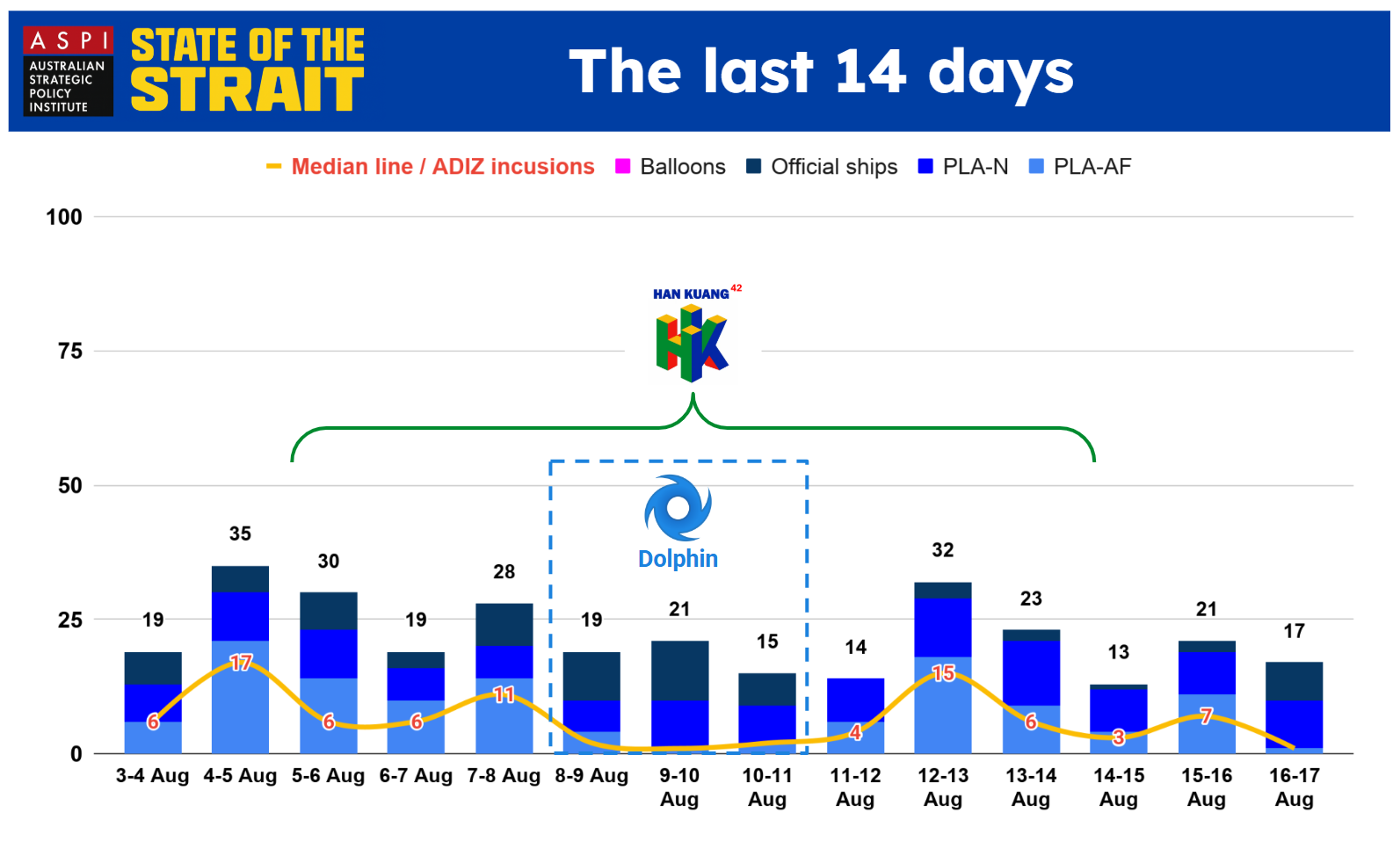
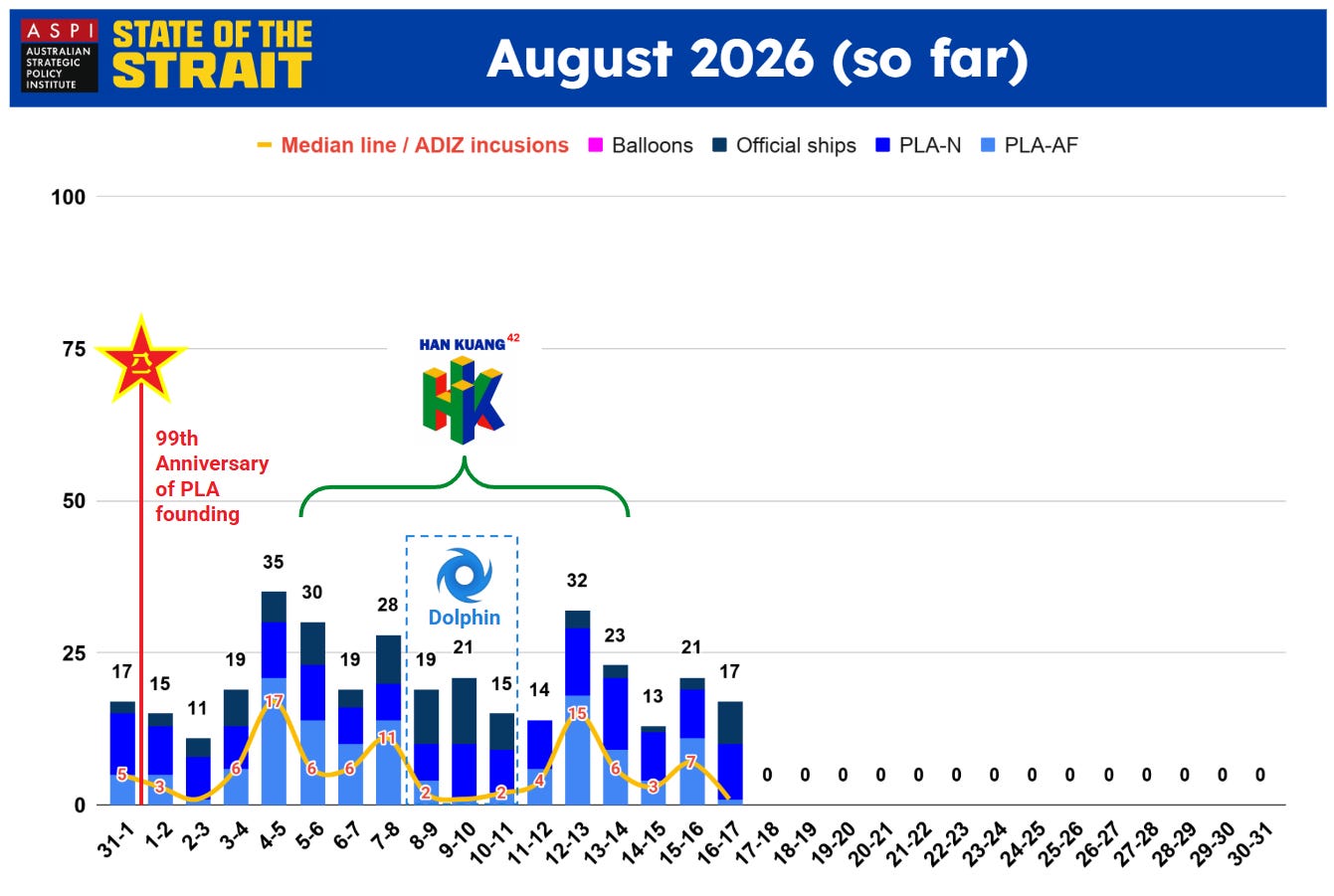
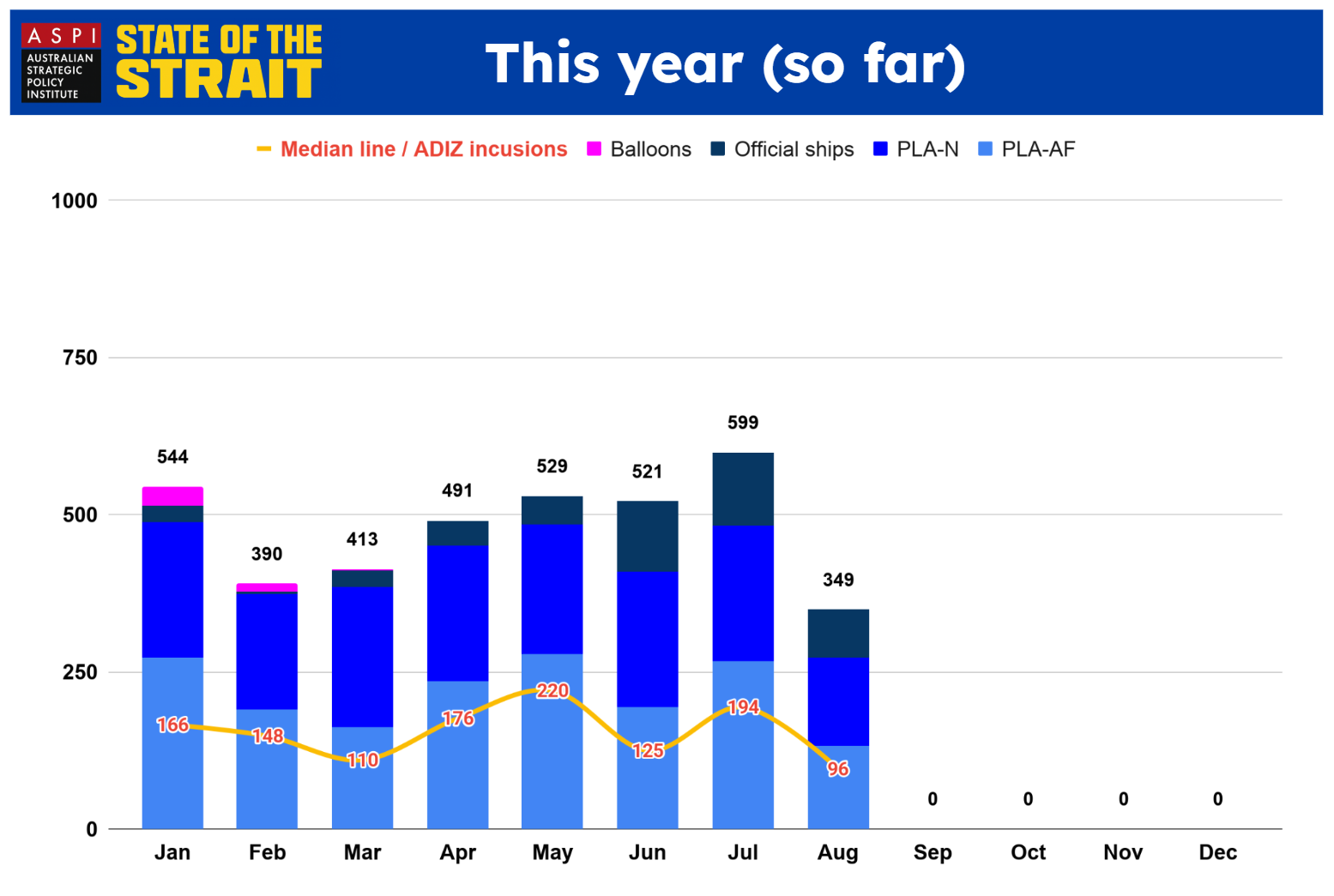
Source for charts: Taiwan’s ministry of national defense monitors PLA-AF aircraft, PLA-N naval vessels and PRC official ships (e.g. coast guard) and high-altitude balloons operating in the waters and airspace around Taiwan. Numbers are recorded daily for the 24-hour period 0600 to 0600 Taiwan Standard Time (UTC+8).

No incidents to report this week.

China wants to block drone bill: source
Taipei Times
The Legislative Yuan is slated to hold cross-caucus negotiations on 14 versions of a draft uncrewed vehicle act on 20 August, amid rumors that Beijing is pressuring some Taiwanese politicians to block passage of a special bill proposed by the Ministry of National Defense to procure military drones and uncrewed vessels. A source in Beijing said the Chinese Communist Party has been using its United Front Work Department and Taiwan Affairs Office to pressure Taiwanese politicians who are friendly toward Beijing, pushing them to block the Executive Yuan’s proposed special act to fund military uncrewed vehicles.
AI could intensify Chinese election interference: DPP
Taipei Times
Beijing has established a comprehensive election interference industry supply chain for Taiwan, using artificial intelligence to target specific groups, impersonate people with highly realistic and tailored language and social media ecosystems with deepfake videos before elections, the Democratic Progressive Party’s China Affairs Department said yesterday. The Chinese Communist Party continues to expand its efforts to influence politics and society in Taiwan by combining economic and military threats, launching cyberattacks and spreading misinformation, the department said.

China calls Taiwan’s annual military drills a ‘wasteful charade’
Reuters
China’s defence ministry on 14 August dismissed Taiwan’s annual Han Kuang military drills as a “wasteful charade” that “stoked war panic”, in the Chinese government’s first official comment on the 10 days of war games since they began last week … The exercises rehearsed various scenarios should China ever make good on threats to try to seize the island by force, including how to break a maritime blockade and, for the first time, slowing mobile internet. “The so-called ‘Han Kuang exercise’ has always been a posturing, wasteful charade,” Chinese defence ministry spokesperson Chen Xi said in a statement. “The Democratic Progressive Party authorities have also recklessly stoked war panic, accelerating efforts to turn cities into battlefields and push ordinary people to the front lines,” he added, referring to Taiwan’s ruling party.
What message do these three New York Times reports send to Taiwan region?: Hai Feng
Global Times
The Democratic Progressive Party (DPP) authorities have long treated statements by US officials and US media reports as gospel. A few words of “praise” or “support” from Washington are enough to send them into raptures, only to be repackaged as so-called “security guarantees” and touted as a so-called protective talisman for its “reliance on the US to seek ‘Taiwan independence.’” However, three consecutive reports published by The New York Times over the past two days have punctured their fantasy … The most dangerous deception by the DPP authorities is leading the people of Taiwan region into a false assumption: the US has formidable military power, so as long as Taiwan region relies on the US, Washington will necessarily have the capability, willingness and resolve to fight a prolonged, high-intensity war for Taiwan region.
Taiwan groups warn of Taiwan Strait security risks due to Japan’s neo-militarism
CGTN
Several Taiwan-based groups have voiced opposition to Japan’s neo-militarism, warning that Tokyo’s push for a greater military role in regional affairs could undermine peace and stability across the Taiwan Strait and throughout East Asia. Their concerns were expressed at forums, seminars and a public gathering held on 14 and 15 August, as 15 August this year marks the 81st anniversary of Japan’s unconditional surrender in World War II. At a forum in Taipei, more than 10 organizations, including the Reunification Alliance Party, brought together scholars and experts from both sides of the Taiwan Strait, as well as from Hong Kong Special Administrative Region, Japan and Australia.
Taiwan groups warn against threat of Japan’s “new militarism” to Taiwan Strait security [台湾团体:警惕日本“新型军国主义”危害台海安全]. Xinhua

Taiwan says it was hit by ‘abnormal’ AI-assisted cyber-attack
The Guardian
Taiwan says it detected AI-assisted cyber-attacks on government agencies that came from overseas last month, a new kind of threat that has been reported as “first-of-a-kind breach”. The Ministry of Digital Affairs said its cybersecurity monitoring units detected the “abnormal attack” targeting government agencies, which began on 20 July. The National Institute of Cyber Security issued a series of warning alerts while it investigated … Chinese cyber-attacks on Taiwan’s key infrastructure, from hospitals to banks, rose 6% in 2025 from the previous year to an average of 2.63m attacks a day, the island’s National Security Bureau said in January, adding some hacks were synchronised with military drills in “hybrid threats” to paralyse the island.

Foreign Ministry urges Pacific Islands Forum Secretariat to uphold the One China principle [外交部:敦促太平洋岛国论坛秘书处恪守一个中国原则]
Xinhua
Foreign Ministry spokesperson Guo Jiakun said on 11 August that China urged the Pacific Islands Forum Secretariat to uphold the One China principle, properly handle Taiwan-related issues, and avoid affecting the healthy and stable development of relations between China and the Forum … Guo said China’s position on the participation of the Taiwan region of China in the activities of international organisations was consistent and clear: such matters must be handled in accordance with the One China principle. He said this was also a basic norm governing international relations, as affirmed by UN General Assembly Resolution 2758, and a general consensus of the international community.
Artists protest Gwangju Biennale’s removal of ‘Taiwan Pavilion’ name
Focus Taiwan
Taiwanese artists and curators on Saturday issued a joint statement protesting what they called the “political censorship” of the Taiwan Pavilion by the Gwangju Biennale, which removed “Taiwan” from its promotional materials and replaced it with NTMoFA, the abbreviation for the National Taiwan Museum of Fine Arts. The statement, signed by 10 Taiwanese artists and curators invited to participate in the biennale in South Korea, accused the Gwangju Biennale Foundation of politically censoring an art exhibition. The artists said the museum had communicated with the organizers under the name “Taiwan Pavilion” since the proposal stage, but “Taiwan” was removed from the official poster released in August without prior notice and replaced with “NTMoFA,” while all other participating institutions and countries were identified accurately.
Indonesia is the latest country to validate China’s claim to Taiwan – unwittingly or not
The Diplomat
On the morning of 12 August, China’s People’s Liberation Army Navy (PLAN) and an Indonesian Navy warship conducted a joint navigation exercise in the waters east of Taiwan. It was the first time China had exercised with a foreign military in these geopolitically sensitive waters. The announcement a day earlier had drawn a swift rebuke from Taiwan’s authorities, which called the exercise an act of political manipulation, “aimed at creating a false impression before the international community that the Chinese communists have jurisdiction over waters east of Taiwan.” The United States similarly called on China “to cease its continuous military pressure against Taiwan.”
Chinese Navy’s Honghe and Indonesian Navy frigate “Rai” successfully complete maritime navigation exercise in waters east of Taiwan [中国海军红河舰与印尼海军“莱”号护卫舰位台岛以东海域圆满完成海上通航演练]. Xinhua

New PRC exit-entry rules: MAC says government must warn of risks [中共出入境新規 陸委會:政府必須提出風險提醒]
Central News Agency (Taiwan)
China’s new State Council Regulations on Exit and Entry Administration will take effect on 15 September. Taiwan’s Mainland Affairs Council (MAC) reiterated today that the government has a responsibility to warn the public about the risks, noting that in previous cases involving Taiwanese people sentenced in China, “they treated Taiwanese people as Chinese nationals.” The Mainland Affairs Council held its regular press conference this afternoon, chaired by Deputy Minister and spokesperson Liang Wen-chieh. Asked by the media whether the government was over-interpreting the risks posed by the new regulations to Taiwanese people entering and leaving China, Liang said the rules were comprehensive and applied to a range of people, including Chinese citizens and foreigners.
Thanks for reading! This post is public so feel free to share it.
For more on how tech, cyber and policy intersect across the region, check out ASPI’s Daily Cyber & Tech Digest.

Every fortnight, ASPI’s Fault Lines monitors actions that shape and contest the international order in Australia’s region.

No posts
Comments
Nothing yet. Say the first thing.
Sign in to join the conversation.