

Welcome to the latest edition of ASPI’s ‘State of the Strait’ Digest.
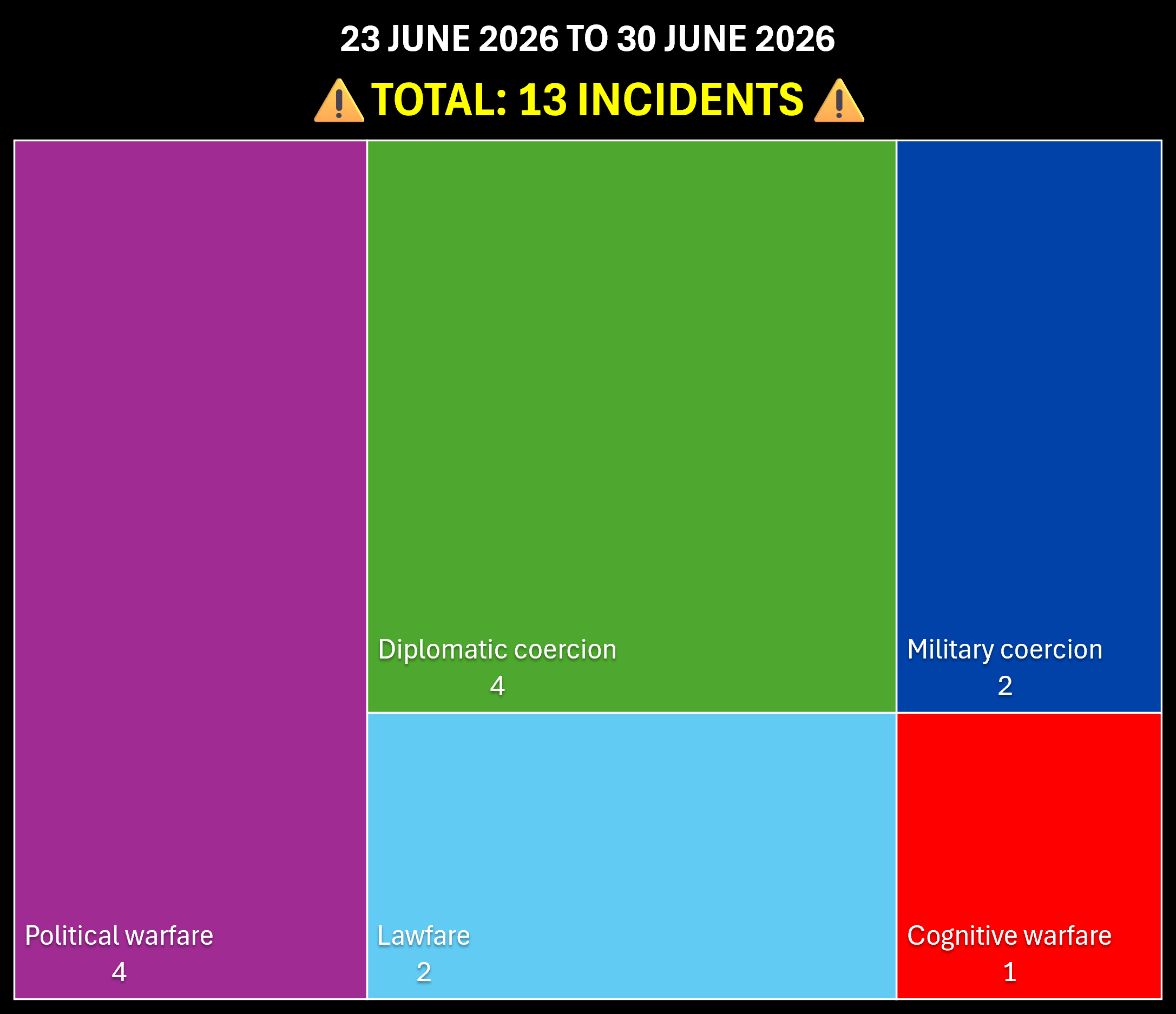
Each week ASPI tracks Beijing’s pressure campaign against Taiwan, including military, economic, and diplomatic coercion, as well as political, cognitive, cyber, and legal warfare.
This edition covers the period: 23 June 2026 to 30 June 2026.
Follow the Australian Strategic Policy Institute on X, on LinkedIn, and on Bluesky.

From 22-26 June, Taiwan conducted a five-day exercise designed to test how quickly its armed forces and civilian agencies could respond if routine Chinese military coercion suddenly escalated into a blockade or attack. The exercise reflected a growing concern in Taipei: that a future crisis may not begin with an obvious invasion, but with a Chinese coastguard or military operation that rapidly turns into a quarantine, blockade or wider conflict.
The exercise culminated on 25 June in a tabletop simulation of a Chinese coastguard-led maritime blockade, including a scenario in which Beijing required commercial vessels travelling to Taiwan to seek Chinese approval and submit to inspection or seizure.
Taiwan’s drills followed a recent Chinese coastguard operation east of Taiwan, which fell short of simulating a blockade but required similar naval capabilities. From 6-10 June, China deployed coastguard vessels east of Taiwan for what Beijing called a “special maritime traffic law-enforcement operation”. Chinese ships questioned passing commercial vessels, asserted jurisdiction over the waters and claimed to have inspected almost 200 ships. Taiwan said at least three merchant vessels were harassed and instructed them to ignore Chinese demands. The operation highlighted Beijing’s use of law-enforcement activity to assert control over surrounding waters and drew public statements of concern from the United States and several European governments.
Beijing is seeking to normalise its authority around Taiwan, creating a maritime status quo from which it could more rapidly implement a quarantine or blockade. By using the coastguard rather than the navy, Beijing can portray coercive activity as domestic law enforcement and blur the point at which other governments should respond. It can test whether commercial vessels comply, collect operational information and assert the claim that China has the right to regulate shipping approaching Taiwan. Such operations may also rehearse elements of a future quarantine while keeping escalation below the threshold of conventional military conflict.
Taiwanese officials described China’s operation as a provocation and a form of cognitive warfare. Taiwan’s exercises reflected Defence Minister Wellington Koo’s warning on 24 June that Taiwan’s warning time is shrinking and that a Chinese patrol or military exercise could become a genuine blockade or attack with little notice.
In its 22-26 June exercise, Taiwan was not only rehearsing a response to a hypothetical military crisis in the strait; it was preparing for a more ambiguous scenario in which Beijing uses coastguard, naval and legal pressure to create facts at sea before Taipei or its partners have time to react. The drills suggest Taiwan is increasingly focused on the speed of escalation, not just the scale of a future Chinese attack.



Taiwan drill simulates maritime ‘quarantine’ by Chinese forces
Taipei Times
Taiwan has held tabletop military exercises to simulate its response to a potential maritime quarantine by China, National Security Council Deputy Secretary-General Lii Wen said at a briefing 25 June. The exercise simulated a scenario in which China, without imposing a full blockade, demands that domestic and foreign vessels using Taiwanese ports complete declarations through its customs system. The drills also envisaged China inspecting or detaining vessels under the guise of law enforcement, disrupting Taiwan’s maritime transport, he said. The disclosure comes the same week that Taiwan holds an island-wide “Immediate Combat Readiness Exercise” to prepare for any full-scale attack by China, underscoring how officials are having to consider multiple potential scenarios for conflict with the country.
Lai reiterates self-defense resolve, says China altering regional status quo. Focus Taiwan
‘Salami slicing’: How China is trying to increase control in the Pacific. CNN
China angered, Taiwan cheered by Western allies’ alarm over Chinese Coast Guard activities. Reuters
Former Pentagon official urges monitoring of China activity east of Taiwan. Taiwan News
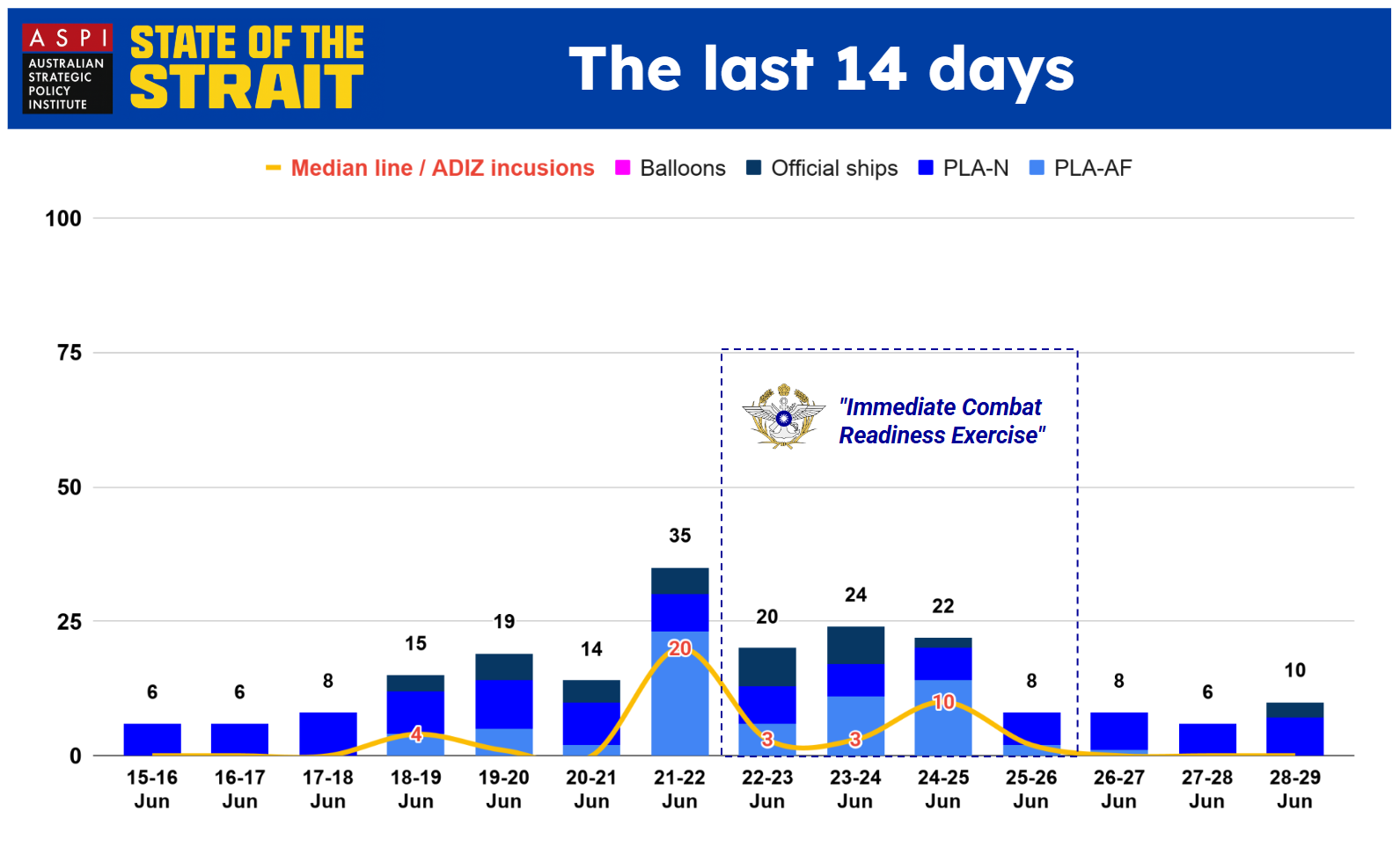
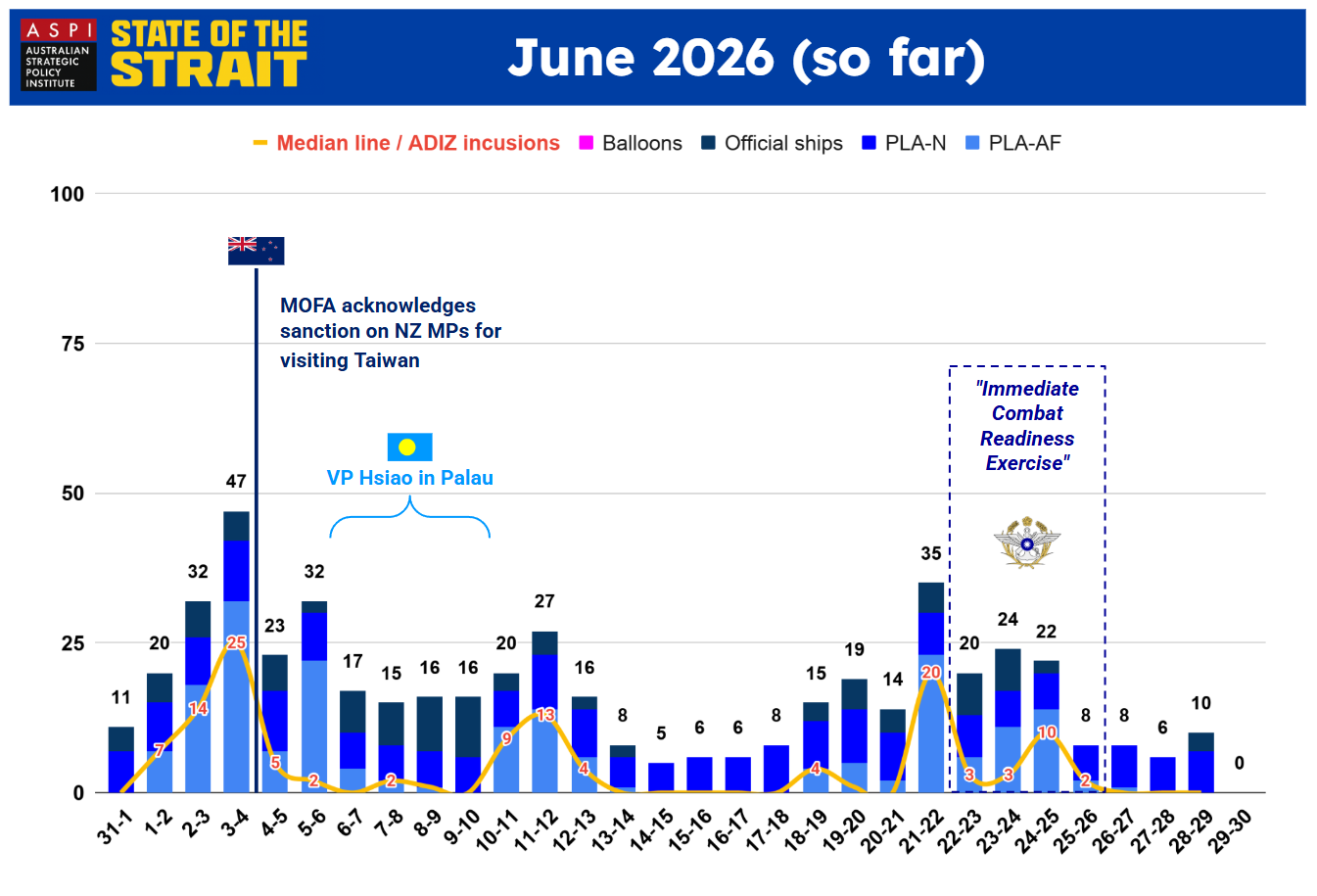
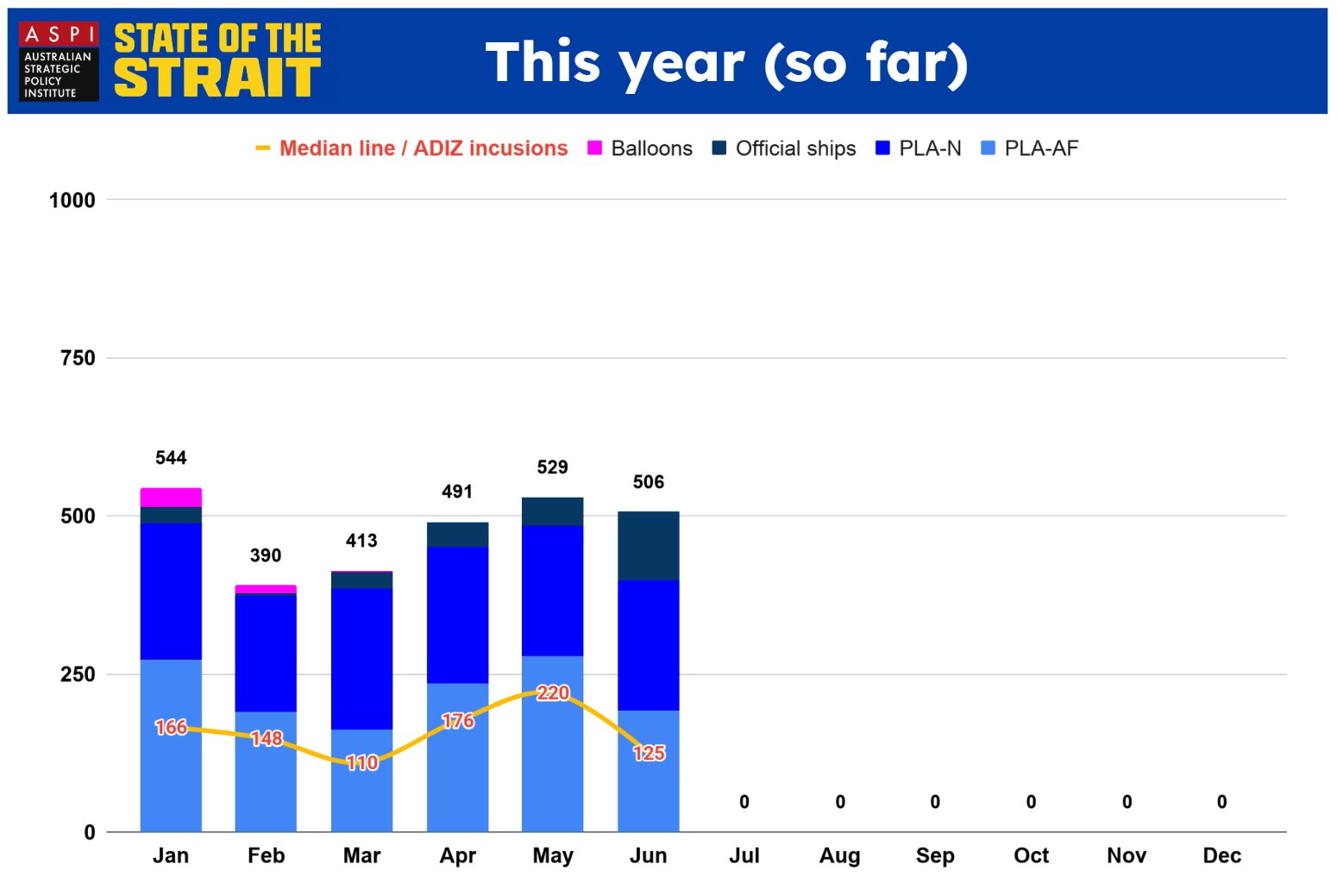
Source for charts: Taiwan’s ministry of national defense monitors PLA-AF aircraft, PLA-N naval vessels and PRC official ships (e.g. coast guard) and high-altitude balloons operating in the waters and airspace around Taiwan. Numbers are recorded daily for the 24-hour period 0600 to 0600 Taiwan Standard Time (UTC+8).

No incidents to report this week.

ASPI Comment: United front work targeting Taiwan is orchestrated by a network of party-state organisations that aim to influence, cultivate, and co-opt key figures within Taiwanese civil society. The Taiwan Affairs Office in China has described united front work as “an important magic weapon for the Communist Party of China to unite people and gather strength”. The CCP claims the right to speak on Taiwan’s behalf and uses united front work to claim legitimacy for annexation of Taiwan into the People’s Republic of China.
ASPI's State of the Strait tracks events that are facilitated by an agency within the united front and are intended to co-opt, exert malign influence, or redefine Taiwan, its people, and its history solely on CCP's terms.
Guangdong Party chief invites Taiwan to seize opportunities
China Daily
he rapid growth of the Guangdong-Hong Kong-Macao Greater Bay Area provides fertile ground and vast space for deepening exchanges and cooperation between Guangdong province and Taiwan, according to Huang Kunming, the provincial Party chief. “The development of the Greater Bay Area has gained momentum and is progressing well, accumulating strong potential energy and possessing robust strength,” he said during a meeting with business representatives from Taiwan in Guangzhou on 24 June … “We hope that Taiwan compatriots and enterprises seize the rare historical opportunity to deeply participate in the construction of the Greater Bay Area,” he said.
Why a speech by Pursuit Of Jade’s Zhang Linghe has divided Taiwan
The Strait Times
For Chinese actor Zhang Linghe, all it took was a greeting of “tak ke ho” – “hello” in the Taiwanese Minnan dialect – to spark rapturous applause from an audience that included many Taiwanese. But his speech that followed, which saw the 28-year-old heart-throb calling for deeper cross-strait cultural and people-to-people exchanges, drew mixed reviews. Fans were delighted to see his surprise appearance at the 18th Straits Forum in the Chinese city of Xiamen on June 13, but there was also scrutiny from Taiwanese critics and officials who labelled the move as political propaganda.
Sixth Cross-Strait Zhongshan Forum opens in Zhongshan, Guangdong [第六届海峡两岸中山论坛在广东中山开幕]
Xinhua
The sixth Cross-Strait Zhongshan Forum opened on 28 June in Zhongshan, Guangdong province, with around 2,000 participants from various sectors across the two sides of the Taiwan Strait, Hong Kong and Macau … In his remarks, Pan Xianzhang [deputy director of the CCP Central Committee Taiwan Work Office and the State Council Taiwan Affairs Office] said that Sun Yat-sen was a great national hero, a great patriot and a great pioneer of China’s democratic revolution. He said compatriots on both sides of the Strait should draw wisdom and strength from Sun’s struggles, shoulder their historical mission, advance together with courage and determination, and strive to realise the great rejuvenation of the Chinese nation.
3 ex-DPP staffers’ China spying sentences reduced, 1 acquitted
Focus Taiwan
The Taiwan High Court on 25 June reduced the prison sentences of three former Democratic Progressive Party (DPP) staffers convicted of passing classified information to Chinese intelligence agents and acquitted a fourth, overturning a lower court ruling issued last year. The High Court sentenced Huang Chu-jung to six years in prison for violating the Classified National Security Information Protection Act and money laundering, reducing the Taipei District Court’s sentence of 10 years.

Taiwan Affairs Office: after peaceful reunification, Taiwan compatriots will share in the country’s dignity and glory [国台办:和平统一后,台湾同胞将共享国家尊严和荣耀]
Xinhua
Zhang Han, spokesperson for the State Council Taiwan Affairs Office, said at a regular press conference on 24 June that after peaceful reunification across the Taiwan Strait, Taiwan compatriots, backed by a strong motherland, would share with mainland compatriots in the dignity and glory of a great country. She said they would have greater standing and confidence internationally, be safer and enjoy greater dignity, and have unprecedented development opportunities. Taiwan’s channels for external exchanges would be comprehensively broadened, and Taiwan compatriots would participate in international affairs as “masters of their own house”. Taiwanese businesspeople and Taiwan-funded enterprises would be deeply integrated into global supply chains and industrial chains, with greater room for development and stronger competitiveness in global markets. Taiwan compatriots overseas would be able to receive support and assistance from the motherland more conveniently and smoothly.

No incidents to report this week.

China commends Honduras for rejecting Taiwan’s false claims, reaffirming one-China principle as international consensus: FM
Global Times
When asked to comment on recent claims by the head of Taiwan’s regional foreign affairs department that the Taiwan authorities are conducting dialogues and consultations with politicians and social groups in Honduras on the so-called restoration of diplomatic ties, as well as a recent social media statement by the Honduran Ministry of Foreign Affairs clarifying that Honduras has had no official dialogue or contacts with the Taiwan authorities and its foreign affairs body will implement national foreign policies in line with existing diplomatic commitments, Chinese Foreign Ministry spokesperson Guo Jiakun said on 25 June that China has noted that the Honduran government has refuted the lies fabricated by the Taiwan authorities. This once again proves that adhering to the one-China principle represents the international consensus, shared aspiration of all peoples and an irresistible historical trend.
China has taken note of Honduras’ clarification of the lies made by the Taiwan authorities regarding the “re-establishment of diplomatic relations” [中方注意到洪都拉斯对台湾当局“复交”谎言作出澄清]. Xinhua
Trump backs ‘Six Assurances’ to Taiwan but no arms sale timeline, US diplomat says
South China Morning Post
The top US diplomat for East Asia sought to reassure Taiwan that Washington stood by its “Six Assurances” despite US President Donald Trump’s earlier dismissal of the policy, but offered no timeline for approving a stalled US$14 billion arms package to the self-ruled island. Michael DeSombre, assistant secretary of state for East Asian and Pacific affairs, told a House Foreign Affairs Committee hearing on Thursday that US policy on Taiwan had not changed, maintaining Washington’s commitment to preserving peace and stability in the Taiwan Strait. Pressed on Trump’s discussion with Chinese President Xi Jinping in Beijing last month over Taiwan, DeSombre said Beijing was “constantly talking to us about their desire for us not to sell arms to Taiwan”.
Taiwan thanks US for warning to governors
Taipei Times
Taiwan on 25 June thanked Washington for addressing state governors in a letter clarifying the US’ policy on Taiwan that denounced Beijing-directed interference aimed at disrupting state-level ties. The US Department of State, Department of Commerce and Department of Agriculture in a joint letter dated Tuesday last week wrote that the US government regularly receives inquiries from state governments about appropriate conduct regarding outreach to Taiwan. The letter was published by the American Institute in Taiwan (AIT) on 24 June
Beijing slams US, European concerns over coastguard patrols near Taiwan
South China Morning Post
Beijing on 25 June rejected criticism from the United States and three European nations over its recent coastguard operations east of Taiwan, declaring the patrols were lawful and necessary to safeguard its maritime rights and regional order. The rebuke came a day after the US, Britain, France and Germany expressed concern over the coastguard deployments, saying the activities “threaten regional stability and the freedom of navigation and safety of international shipping”. Chinese foreign ministry spokesman Guo Jiakun dismissed the accusations, describing Beijing’s actions as a legitimate exercise of jurisdiction.
Four countries try to team up to back ‘Taiwan independence’? Not a chance: Global Times editorial. Global Times

China’s new ethnic unity law vague: MAC
Focus Taiwan
Taiwan’s Mainland Affairs Council (MAC) said 25 June that China’s new “ethnic unity” law, set to take effect on 1 July, contains vaguely defined provisions, and that Beijing has done little to ease international concerns over its extraterritorial reach. China’s Ethnic Unity and Progress Promotion Law contains “very vague” legal concepts, including “undermining ethnic unity” and acts that are “detrimental to ethnic unity and progress,” MAC deputy head and spokesperson Liang Wen-chieh told a regular news briefing in Taipei. Liang argued that those concepts “all lack clear definitions,” leaving people unable to determine what is safe or risky and therefore likely to self-censor.
Lai says China uses enforcement near Taiwan as pretext for expansion
Taiwan News
President Lai Ching-te accused China on Thursday of using law enforcement activities as a cover for expansion. Speaking at the eighth meeting of the Whole-of-Society Defense Resilience Committee, Lai said China has intensified gray-zone harassment and coercion against neighboring countries in recent years, per CNA. He said the committee earlier conducted a tabletop exercise focused on gray-zone threats and high-intensity maritime coercion.
Thanks for reading! This post is public so feel free to share it.
For more on how tech, cyber and policy intersect across the region, check out ASPI’s Daily Cyber & Tech Digest.

Every fortnight, ASPI’s Fault Lines monitors actions that shape and contest the international order in Australia’s region.

No posts
Comments
Nothing yet. Say the first thing.
Sign in to join the conversation.