Welcome to the latest edition of ASPI’s ‘State of the Strait’ Digest.
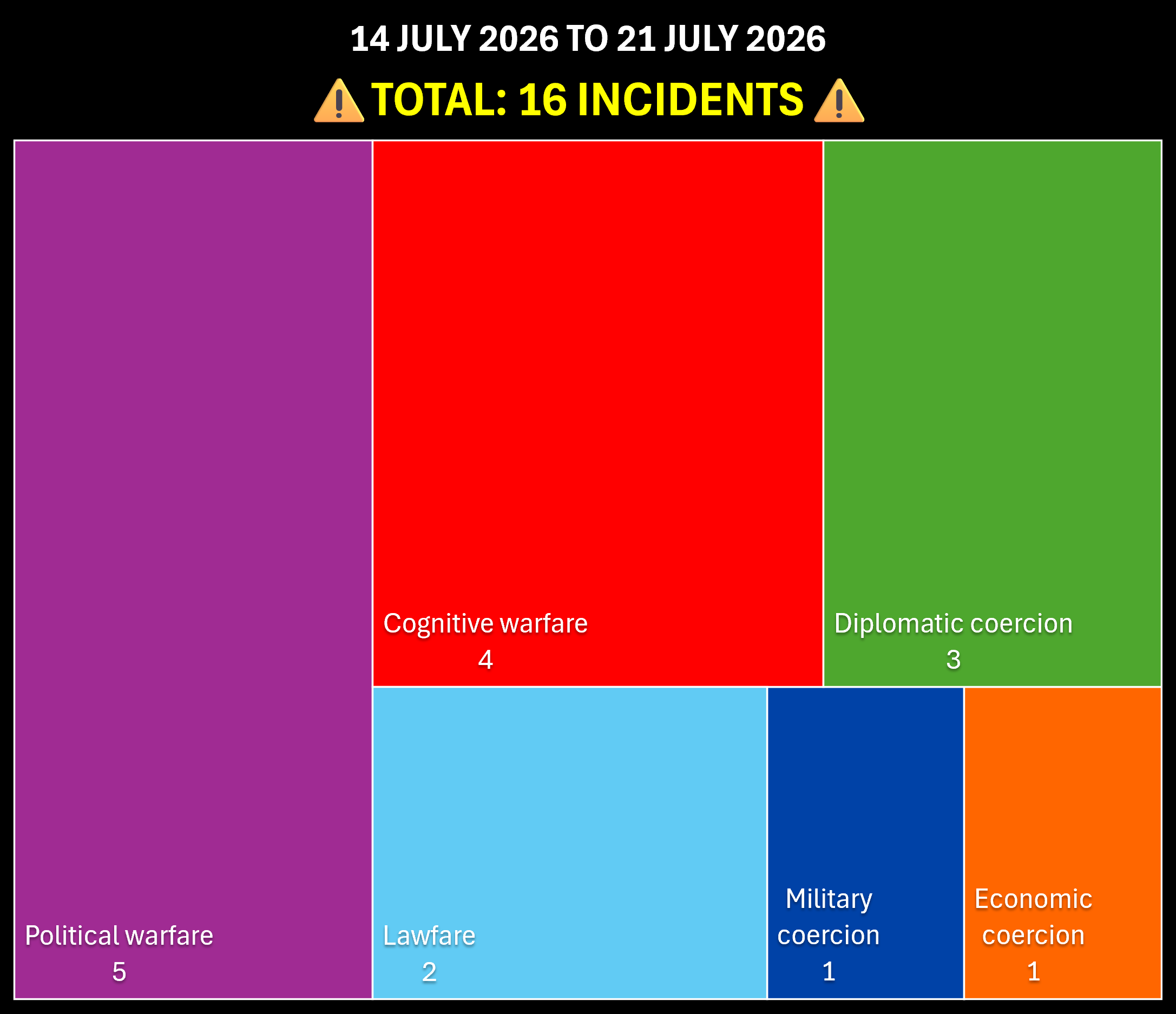
Each week ASPI tracks Beijing’s pressure campaign against Taiwan, including military, economic, and diplomatic coercion, as well as political, cognitive, cyber, and legal warfare.
This edition covers the period: 14 July 2026 to 21 July 2026.
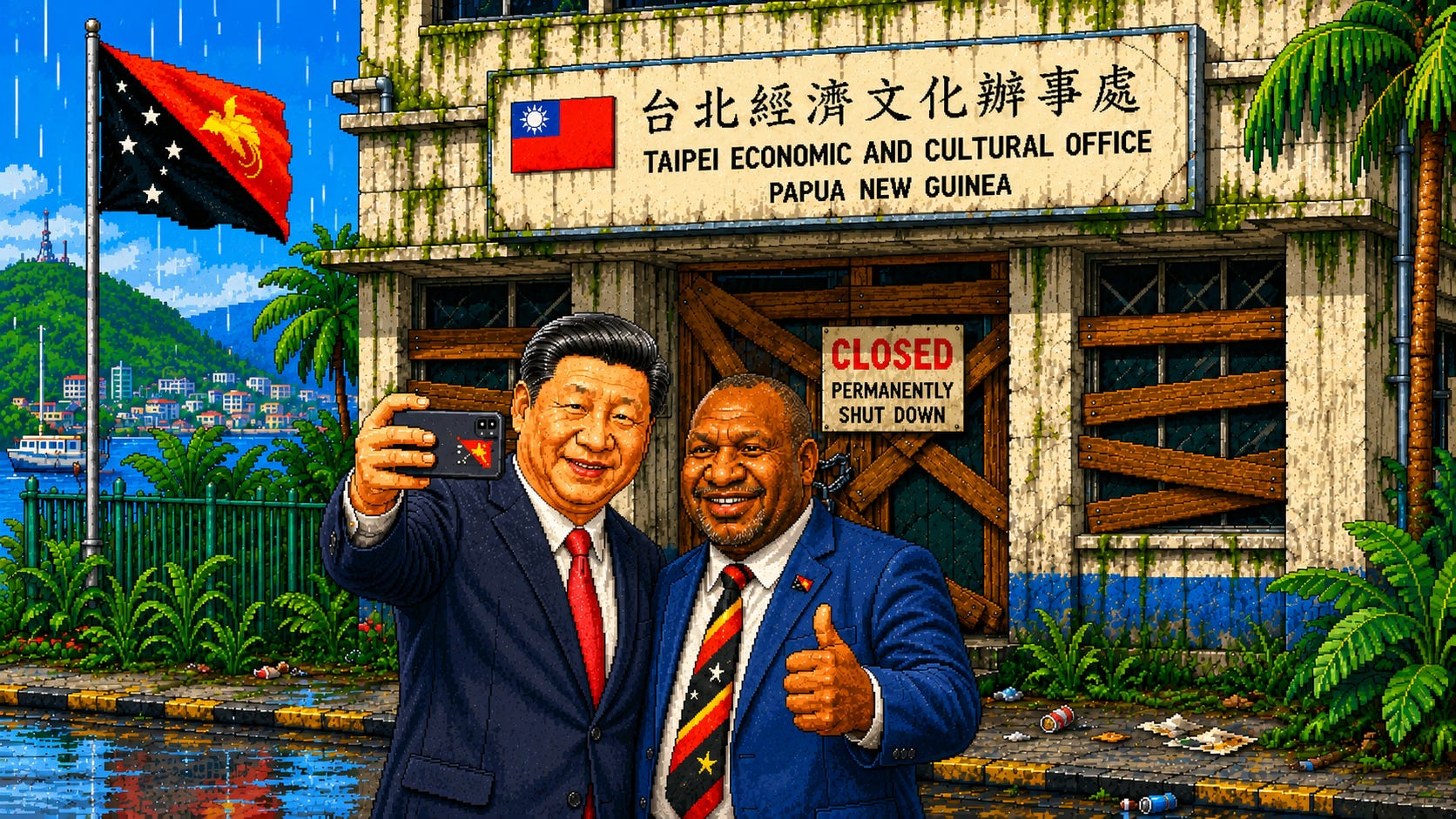
Papua New Guinea announced on 15 July that it will close Taiwan’s representative office in the capital city Port Moresby. The decision represents more than a bilateral dispute over diplomatic protocol. It is part of Beijing’s intensifying effort to make even unofficial engagement with Taiwan more difficult.
PNG foreign minister Justin Tkatchenko said the office would cease operations immediately and that the presence of ‘Chinese Taipei’ was no longer recognised or required. He presented the closure as an administrative action reaffirming PNG’s one-China policy and building trust with Beijing. China praised the decision. Taiwan, which says it was not consulted, rejected the order and said its office would continue operating while it sought talks.
The office had operated since 1990 and was consistent with PNG’s longstanding one-China policy. Australia, New Zealand and most countries that recognise Beijing similarly maintain unofficial ties with Taiwan. Closure was not required by that policy. It instead aligns PNG with Beijing’s much narrower one-China principle, under which Taiwan should have almost no international presence.
In 2026, Beijing has expanded its pressure campaign against Taiwan beyond denying it diplomatic recognition and formal international participation, to obstructing the unofficial channels connecting it to the world. China has sanctioned New Zealand MPs for visiting Taiwan and pressured governments over conferences, visits, overflights and representative offices. The PNG decision pushes that campaign further into the Pacific.
The closure was abrupt, but it did not come from nowhere. PNG had already closed its own trade office in Taipei in 2023, recalling its diplomatic staff and announcing a smaller business-liaison arrangement based in Port Moresby. In May 2026, Beijing and Port Moresby signed a Framework Agreement on Enhanced Economic Partnership, opening negotiations towards a bilateral trade deal. No public evidence ties the closure to a specific Chinese payment or concession, but the sequence suggests a deliberate effort to deepen economic and political trust with Beijing. Whether through direct pressure or anticipatory accommodation, China secured the outcome it wanted.
But pleasing Beijing may carry costs. China is PNG’s second-largest trading partner after Australia, while Taiwan ranks fifth. Taiwan nevertheless has considerable leverage in a critical sector: it imports about 1.2 million tonnes of PNG’s LNG annually. Taiwan’s Foreign Minister Lin Chia-lung has said Taipei is reviewing those purchases alongside its broader bilateral cooperation. Governments should remember that even where China is the larger commercial partner, doing Beijing’s bidding against Taiwan can leave them exposed to targeted economic countermeasures from Taipei.
South Africa received that warning in 2025 after attempting to downgrade Taiwan’s representative office and force it from Pretoria to Johannesburg. Taipei responded by announcing prior-approval requirements covering 47 categories of exports, including semiconductors. It suspended the measures before they took effect after Pretoria requested talks. No settlement has been publicly announced: Taiwan’s office remains open and operating in Pretoria, although South Africa continues to classify it unilaterally as a commercial office. The resulting stand-off, and Pretoria’s rapid request for negotiations, demonstrated the leverage created by Taiwan’s position in critical supply chains. PNG is more directly exposed through LNG.
For Taiwan, responding in this manner carries risks. Economic retaliation could damage its reputation as a reliable partner and reinforce Beijing’s coercive model. Yet absorbing each diplomatic setback without consequence would encourage other governments to conclude that accommodating China is cost-free.
For Beijing, the closure is therefore both a victory and a test. It will watch whether Taiwan and its partners impose costs or allow the issue to pass as administrative housekeeping. A muted response will encourage similar demands elsewhere.
For the Pacific, the precedent should be uncomfortable. Pacific governments have the sovereign right to determine their relationships, but sovereignty also means resisting attempts by larger powers to dictate whom they may engage. Australia should treat the closure as a question of regional order. If democracies want deterrence to remain credible in a future Taiwan Strait crisis, they must defend routine engagement with Taiwan.
For more on Beijing’s intensified efforts in 2026 to constrain Taiwan’s international engagement, see ‘Beijing is testing who will stand by Taiwan’ in The Strategisthere.
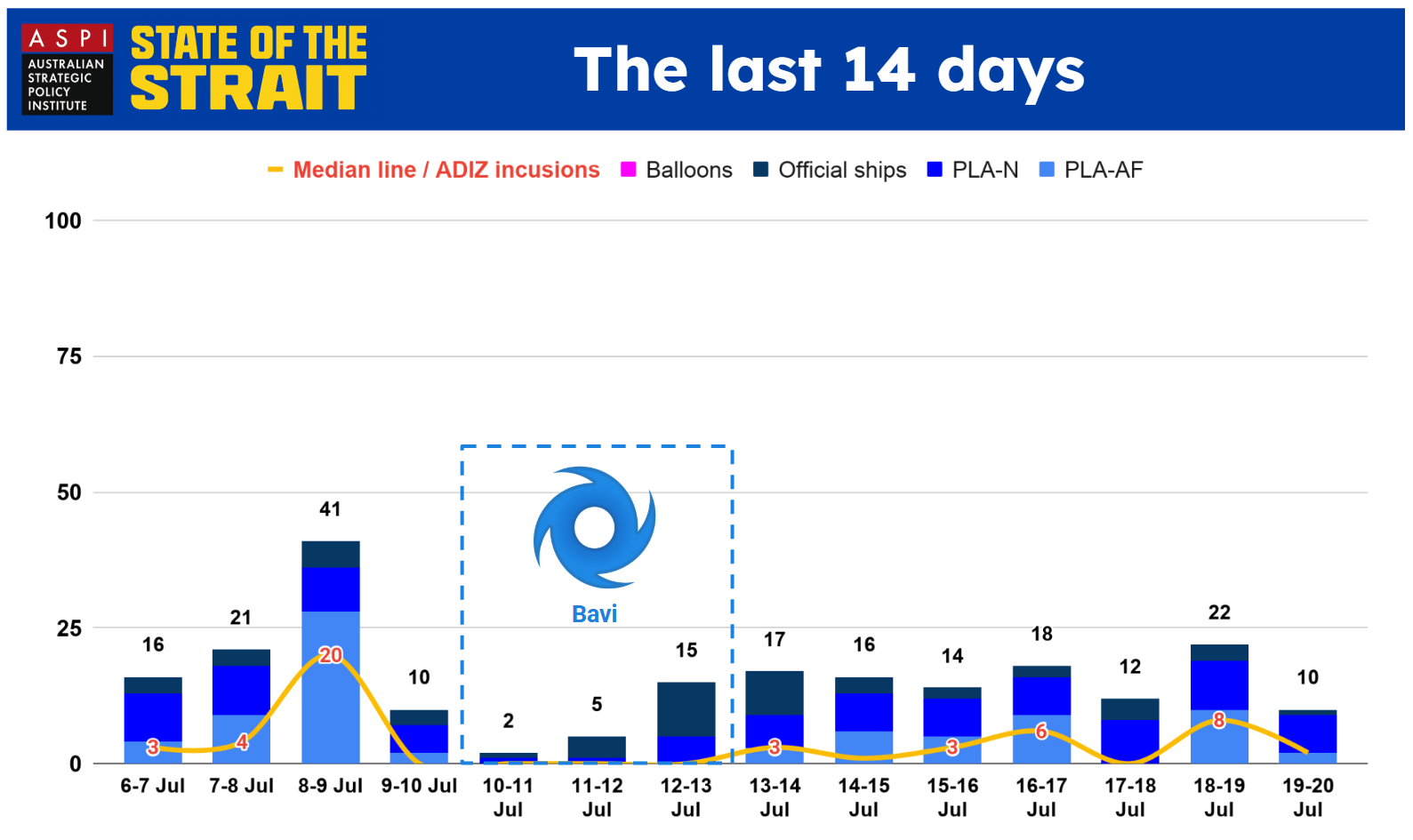
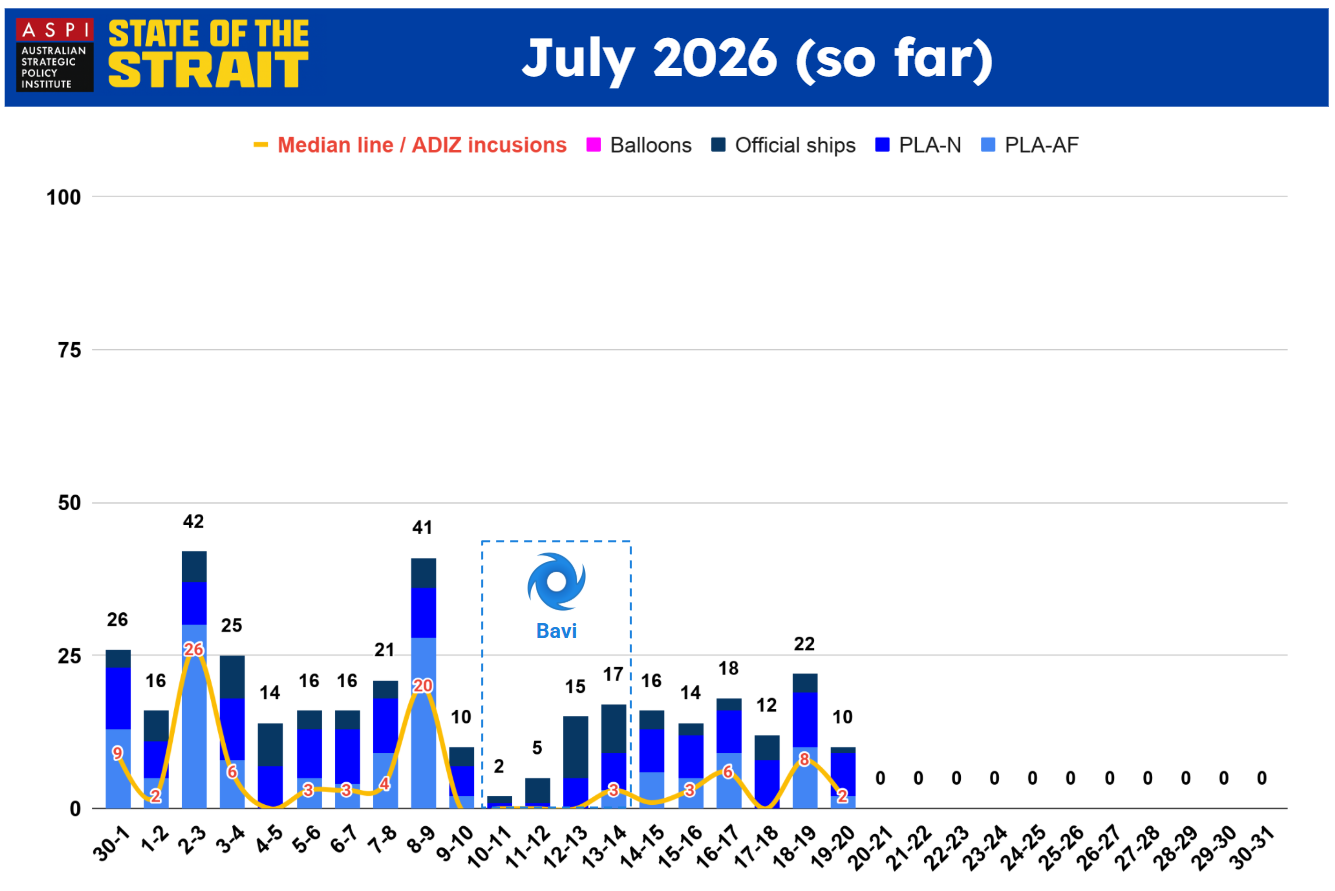
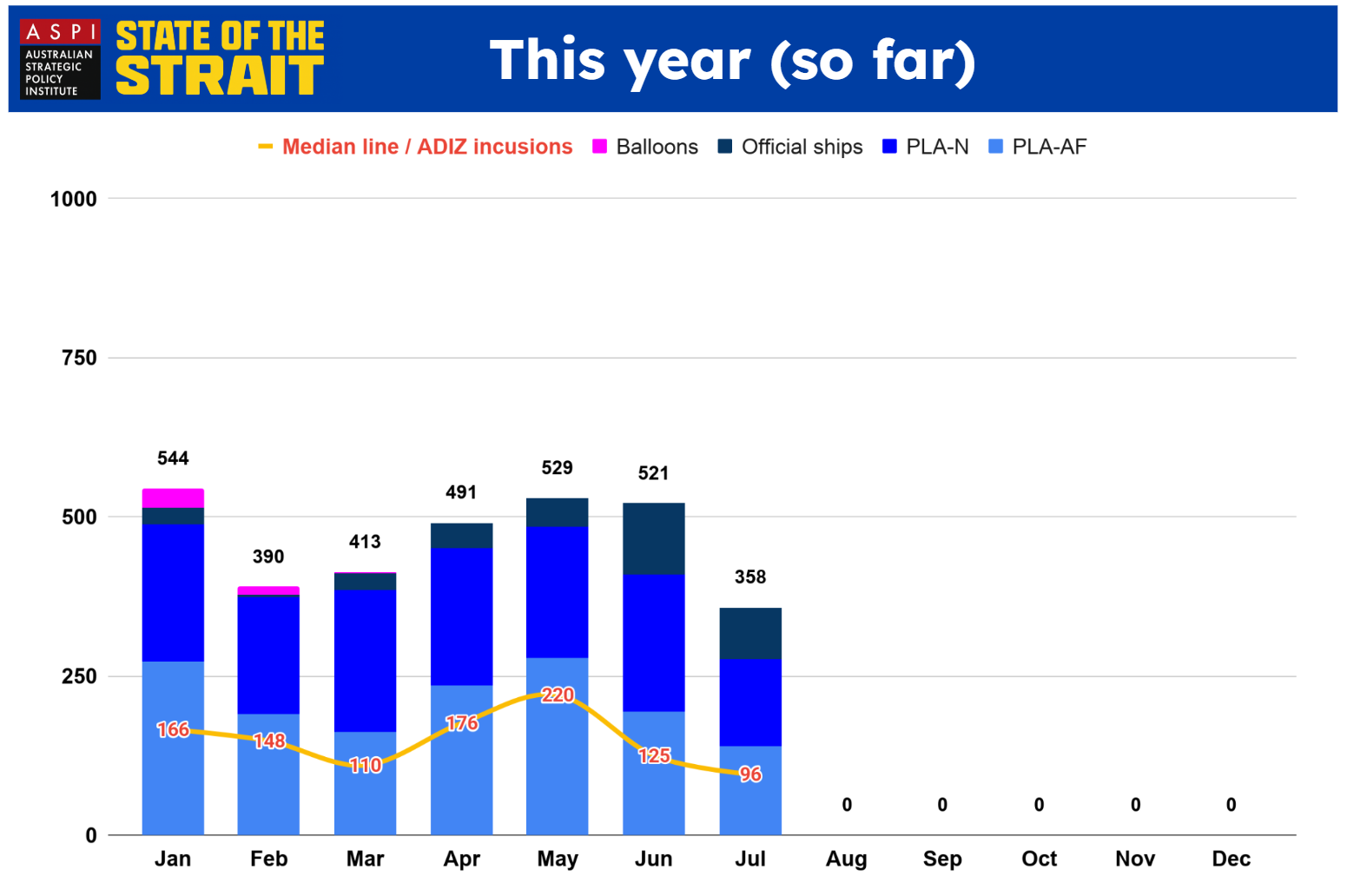
Source for charts: Taiwan’s ministry of national defense monitors PLA-AF aircraft, PLA-N naval vessels and PRC official ships (e.g. coast guard) and high-altitude balloons operating in the waters and airspace around Taiwan. Numbers are recorded daily for the 24-hour period 0600 to 0600 Taiwan Standard Time (UTC+8).
US senator warns about economic blockade Taipei Times US Senator Tammy Duckworth has said that China could be more likely to impose an economic blockade on Taiwan than launch a full-scale military invasion in 2028, adding that such a move could be carried out under the guise of maritime safety. Speaking at a Center for Strategic and International Studies (CSIS) event in Washington on 16 July, Duckworth responded to comments by former Australian Prime Minister Kevin Rudd, who said Chinese President Xi Jinping could seek to exploit simultaneous US and Taiwanese presidential elections in 2028 to attack Taiwan. Duckworth, who serves on the US Senate Foreign Relations and Armed Services committees, said she believed Beijing would be more likely to pursue an economic blockade.
ASPI Comment: United front work targeting Taiwan is orchestrated by a network of party-state organisations that aim to influence, cultivate, and co-opt key figures within Taiwanese civil society. The Taiwan Affairs Office in China has described united front work as “an important magic weapon for the Communist Party of China to unite people and gather strength”. The CCP claims the right to speak on Taiwan’s behalf and uses united front work to claim legitimacy for annexation of Taiwan into the People’s Republic of China.
ASPI's State of the Strait tracks events that are facilitated by an agency within the united front and are intended to co-opt, exert malign influence, or redefine Taiwan, its people, and its history solely on CCP's terms.
Beijing is trying to turn Taiwan’s sea goddess into a Chinese agent Foreign Policy Mazu is worshipped on both sides of the Taiwan Strait, although for decades in China, that worship—like other forms of religion—was repressed under Maoism. In the modern People’s Republic of China, the state has increasingly sought to harness her following for explicitly political ends, framing the religious practice as evidence that Taiwan and China are “one family,” bound by shared ancestors and a shared fate. At the center of that effort is Meizhou Island in Fujian. It is home to the Meizhou Mazu Temple, which Chinese officials and state media promote as the original birthplace of Lin Mo-Niang, the woman who would later become Mazu, and the ancestral temple for Mazu worship throughout the region.
AI from both sides of the Taiwan Strait shares the stage, opening a new chapter in technological and innovation integration [两岸AI同台,科创融合启新程] Xinhua With support from the Cross-Strait Economic and Technological Cooperation Centre, Taiwanese companies have once again participated in WAIC this year as a group. The Cross-Strait Artificial Intelligence Integration and Innovation Exhibition Zone brings together more than 20 Taiwanese AI-related companies, including Foxconn Industrial Internet, MediaTek and ASE Technology, showcasing cutting-edge achievements in fields such as AI chips, servers and smart fitness … As the organiser of WAIC’s cross-Strait activities, the Economic and Technological Cooperation Centre focuses on facilitating economic and technological cooperation and cultural exchanges across the Strait. It also seeks to guide Taiwanese people and companies in integrating into China’s “new development pattern” and participating in what Beijing calls “high-quality development”.
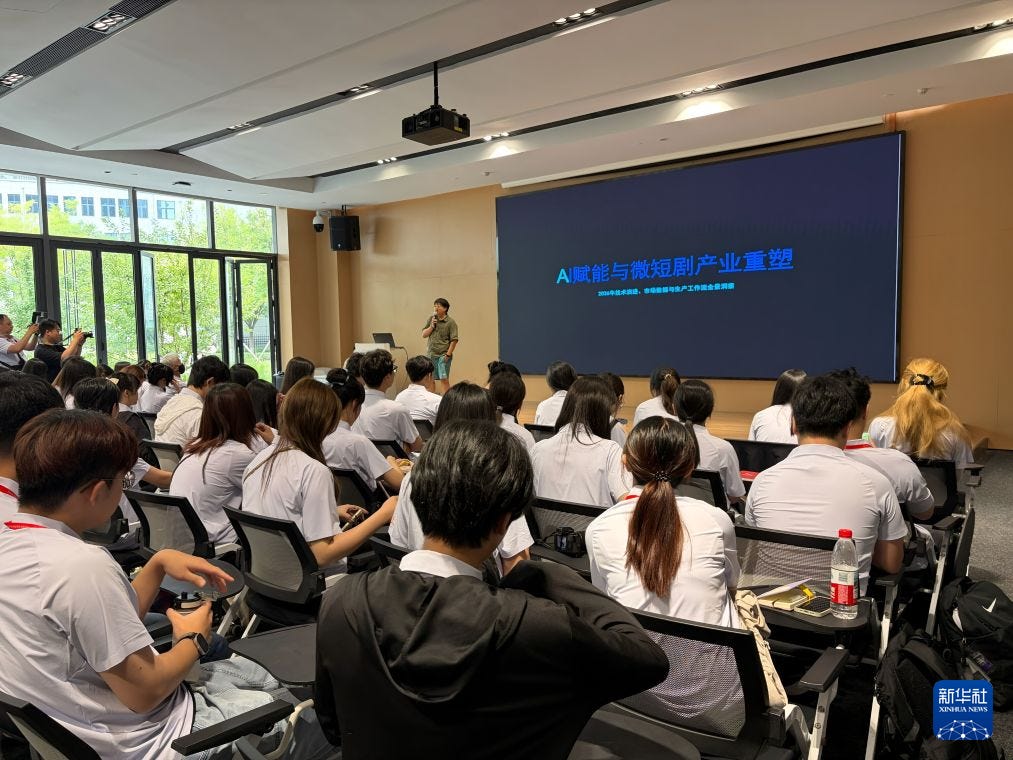
Young people collaborate across the Taiwan Strait [一场跨越海峡的青春共创] Xinhua From 14 to 20 July, the “Together Towards the Future” 2026 Cross-Strait Summer Camp for Journalism Students was held in Henan. Sixty-eight students from three Taiwanese universities and eight mainland Chinese universities ate, lived and travelled together, gaining experience in producing micro-dramas and exploring Henan’s rich history and culture. Focusing on the emerging field of AIGC—artificial intelligence-generated content—for film and television, the summer camp invited several industry experts to give lectures on its opening day. They provided specialist knowledge and shared practical experience on subjects including how AI can empower the film and television industry and the process of creating AIGC micro-dramas. That afternoon, the students were divided into four groups led by four directors and applied what they had learnt to scriptwriting.
On July 14, university students from both sides of the Taiwan Strait listened to lectures by industry experts. (Photo by Ren Zhuoru, Xinhua News Agency)
Taiwan’s opposition TPP launches historic first trip to mainland China The Star The Taiwan People’s Party (TPP) has sent its first formal delegation to mainland China since the party’s founding, seeking to maintain cross-strait peace through dialogue amid heightened tensions with Beijing. The nine-member delegation from the island’s smaller opposition party left for Shanghai on Tuesday for a four-day visit focused on youth exchanges, urban governance, artificial intelligence (AI), technological innovation and entrepreneurship. “The trip aims to build goodwill and mutual trust through pragmatic engagement, reduce misunderstandings across the Taiwan Strait and explore a more stable and sustainable model for exchanges,” the TPP said.
China aims to derail Taiwan’s drone efforts, source says Taipei Times China is orchestrating a campaign to derail Taiwan’s efforts to develop military drones through politicians in opposition parties, a source with knowledge of cross-strait affairs said yesterday, claims that the Chinese Nationalist Party (KMT) called “false and malicious.” Speaking on condition of anonymity, the source told the Liberty Times (the Taipei Times’ Chinese-language sister paper) that Chinese officials and their intermediaries in May and last month gave detailed instructions to opposition politicians to derail Taiwan’s efforts to develop uncrewed systems.
ASPI Comment: Beijing is increasingly employing the derogatory term “Green Terror 绿色恐怖” to criticise the administration and policies of Taiwan's pan-Green coalition, led by the Democratic Progressive Party (DPP), which currently holds Taiwan’s presidency. While the DPP's official colour is green, Beijing's deliberate use of “terror 恐怖” invokes a provocative comparison with Taiwan's historical “White Terror 白色恐怖,” a period of oppressive martial law imposed by the Kuomintang from 1949 to 1987.
Taiwanese political parties and civic groups hold forum criticising ‘green terror’ [台湾政党社团举办论坛批评“绿色恐怖”] Xinhua Several Taiwanese political parties and civic organisations held a forum in Taipei on 15 July, criticising the Democratic Progressive Party authorities for intensifying what they called “green terror”, promoting “de-Sinicisation” and provoking cross-Strait confrontation. Participants said they were expressing the public’s desire for peace and dialogue across the Taiwan Strait rather than confrontation. The forum was organised by the Taiwan Area Political Victims Mutual Aid Association and co-organised by the Taiwan Social Co-prosperity Coalition, Taiwan Labour Party and Cross-Strait Peace and Development Forum.
What role should Taiwan play in ensuring AI remains under human control? Global Times Taiwan already has a strong foundation in advanced semiconductor manufacturing, electronic and information hardware, engineering talent, and precision industrial systems. If these capabilities are tied down by the logic of technological blockades from a single camp, the Taiwan region will ultimately become nothing more than a “blood-transfusion island” that has been politically drained. However, if these capabilities are reintegrated into the broader framework of cross-Straits integration and the overall technological leap forward of the Chinese nation, Taiwan has the opportunity to become a key link in smart manufacturing, advanced computing infrastructure, the implementation of end-user applications, and regulatory coordination.
Students from China’s Taiwan get hands-on with tech in Greater Bay Area CGTN Lu Bingrui is one of more than 130 university students from China’s Taiwan participating in this year’s Guangzhou Taiwan Youth Month internship program. Launched by the city as a flagship platform for cross-Strait youth exchanges, the program has placed them at over 50 companies and institutions across sectors including artificial intelligence, robotics, finance, healthcare and advanced manufacturing … "We hope these students can gain a firsthand understanding of Chinese mainland's advances in energy technology," said Liu Yao, deputy general manager of Zhuhai Hengqin Power Supply Bureau under China Southern Power Grid. "We also hope they can serve as a bridge for future cross-Strait exchanges in science and technology."
Taiwan’s ‘toxic oil’ food-safety scandal continues to escalate, fuelling public anger over the authorities’ failure to govern [台“毒油”食安事件延烧 当局施政失能引众怒] Xinhua Amid mounting pressure from across society for the DPP authorities to apologise and hold officials accountable for their mishandling of the situation, Premier Cho Jung-tai offered only a perfunctory “I am sorry” to the media more than half a month after the “toxic oil” problem emerged. So far, however, no official has resigned to take responsibility … On 17 July, the Kuomintang and Taiwan People’s Party called on the public to attend a rally on Ketagalan Boulevard, outside the office of Taiwan’s leader, on 25 July. They demanded that the DPP authorities apologise and hold officials accountable. Several county and city mayors across Taiwan also called on the public to join the rally and express their anger and dissatisfaction with the authorities.
No incidents to report this week.
PNG ousts Taiwanese officials, seeks to ‘reassure’ China after Australian treaty ABC News Papua New Guinea will close Taiwan’s trade mission in its capital Port Moresby, freezing out its fifth largest trading partner in a major strategic move designed to reaffirm ties with China. In a statement on 16 July, Papua New Guinea’s Foreign Minister Justin Tkatchenko said Taiwan’s presence was “no longer recognised or required” in the country. He said it marked a “vital” step towards deepening trust with Beijing and reiterated his country’s commitment to the One China policy.
Taiwan strips Cambodia of visa privileges over One-China stance Khmer Times Cambodia has been removed from Taiwan’s visa exemption programme, a move an expert views as retaliation against the Kingdom’s endorsement of the One-China policy. In a 17 July statement, the Taiwan Ministry of Foreign Affairs said Cambodia will be removed from both the Guanhong Project, which simplifies visa procedures for tour groups, and the Travel Authorisation Certificate programme, which provides conditional visa-free entry for travellers … The ministry accused Cambodia of echoing Beijing’s statements that undermine sovereignty and of appearing to support China’s potential use of force to achieve unification. It cited public concerns over Cambodia’s alleged connections to cross-border fraud cases as another factor behind the policy change.
US, Taiwan region reportedly advance drone cooperation; expert says military impact limited, island residents bear cost Global Times Song Zhongping, a mainland military affairs expert, told the Global Times on Thursday that the Taiwan region lacks strategic depth, making infrastructure associated with the “node strategy,” including drone bases, command centers and data centers, easy targets for strikes and electronic disruption … Song noted that the entire Taiwan region is within the PLA’s full-range strike coverage. It is therefore unrealistic for the Taiwan regional authorities to develop an “asymmetric warfare capability” by cooperating with the US in fields such as drone technologies, he said, adding that their only way forward is to abandon attempts to seek “Taiwan independence.”
Rise in number of Taiwanese going missing or being detained in China sparks concern in Taiwan The Strait Times The number of Taiwanese people reported missing, detained for questioning, or having their personal freedom restricted in China has reached 385 since 2024, said Taiwan’s Mainland Affairs Council (MAC) on 9 July, as it reiterated its appeal for travellers to assess the potential safety risks when travelling across the strait. The council began highlighting these data points regularly in 2024 after it said that China has stopped proactively notifying Taipei about such cases, unlike in the past. Instead, the council learns of the incidents only after being informed by the relatives of those affected. Alarmingly, the number of such reported cases has surged over time, with cases quadrupling from 55 in 2024 to 221 in 2025. In the first half of 2026, 109 cases were recorded.
Taiwanese police officers questioned while travelling in mainland China; MAC says interrogation lasted six hours [台員警赴陸旅遊被查 陸委會:訊問長達6小時] Central News Agency (Taiwan) A serving Taiwanese police officer and a retired officer were questioned by Chinese Communist Party state-security personnel while travelling in Fujian, mainland China, in June. Taiwan’s Mainland Affairs Council (MAC) provided further details of the case today, saying the two men were taken to a separate location, isolated and interrogated for as long as six hours .. The two individuals were a serving traffic-police squad leader and a retired officer from the Second Special Police Corps. They checked into a guesthouse in Quanzhou, Fujian, at 11.05 am on 24 June and were immediately taken by approximately six or seven CCP state-security personnel to another location, where they were isolated and interrogated.
Thanks for reading! This post is public so feel free to share it.














Comments
Nothing yet. Say the first thing.
Sign in to join the conversation.