

Welcome to the latest edition of ASPI’s ‘State of the Strait’ Digest.
Each week ASPI tracks Beijing’s pressure campaign against Taiwan, including military, economic, and diplomatic coercion, as well as political, cognitive, cyber, and legal warfare.
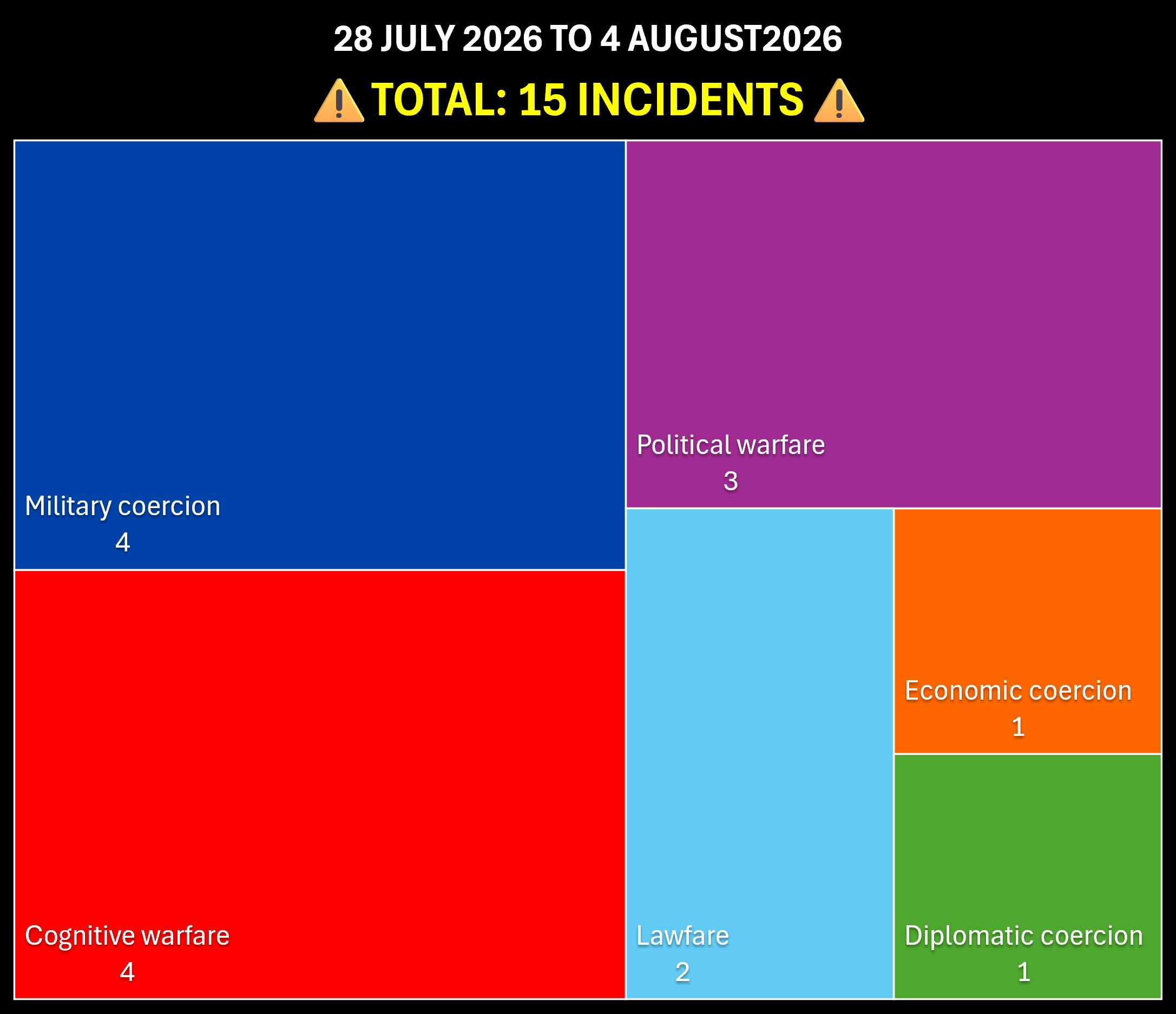
This edition covers the period: 28 July 2026 to 4 August 2026.
Follow the Australian Strategic Policy Institute on X, on LinkedIn, and on Bluesky.

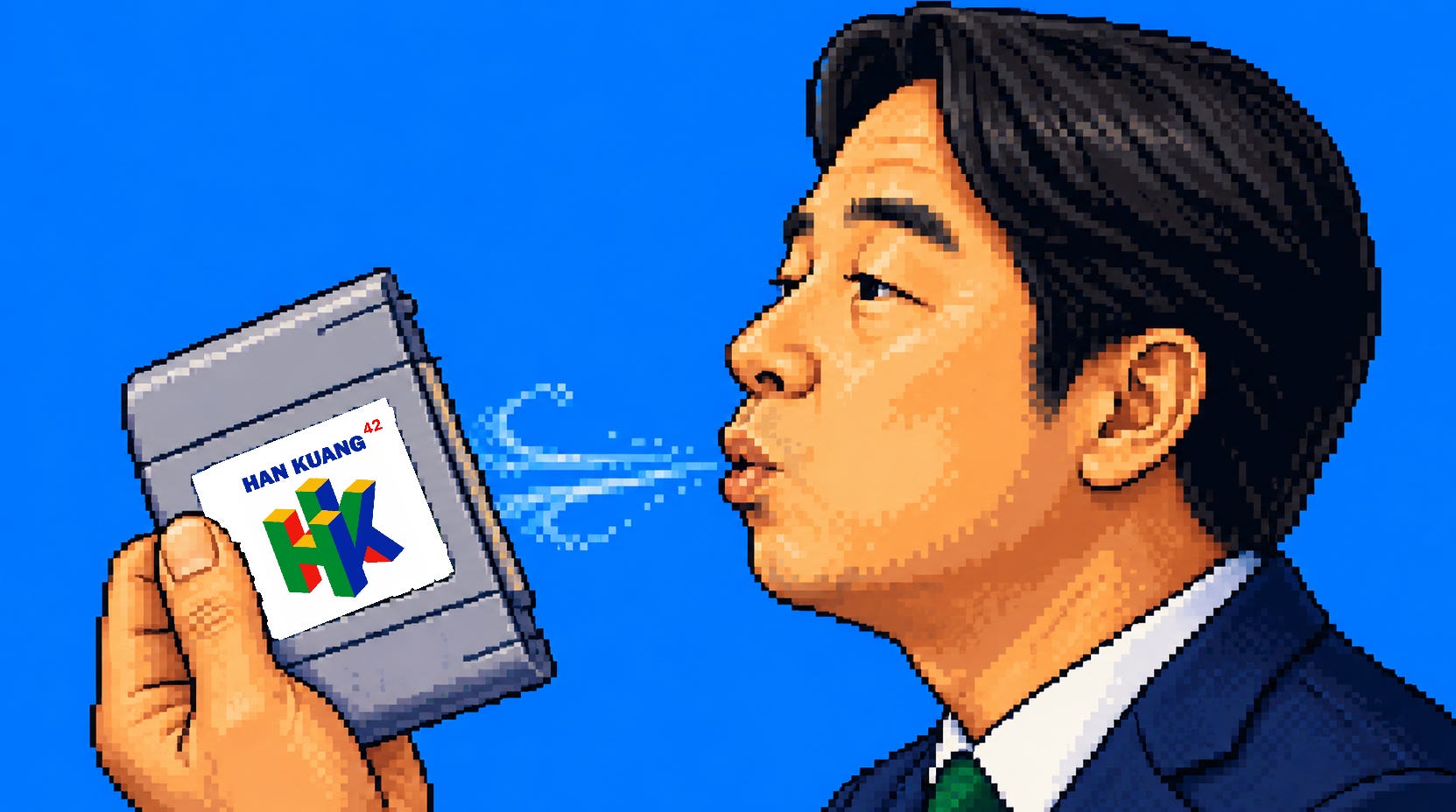
Taiwan will begin its 42nd annual ‘Han Kuang’ military exercise on 5 August, launching ten days and nine nights of continuous drills intended to test how the island would respond if Chinese coercion suddenly became a conflict. The most important development will be the growing emphasis on whether Taiwan can continue fighting after its communications, command centres, ports and defence industry have come under attack.
‘Han Kuang 42’ will run until 14 August and is expected to begin with the rapid transition from routine readiness to full combat operations. The scenario developed during April’s computer-assisted exercise moved progressively from grey-zone harassment to high-intensity conflict, including Chinese forces using exercises around Taiwan to conceal preparations for an attack. Taiwan’s forces are therefore likely to practise dispersing aircraft, ships, missiles and command posts before they can be targeted, while operating continuously under degraded communications and decentralised command.
The exercise should include familiar scenarios: defending ports and airports, countering amphibious landings, protecting Taipei and responding to missile, cyber and drone attacks. However, several elements will go further than previous years. Taiwan will simulate relocating weapons-production lines after factories are struck, including facilities operated by the military and private defence contractors. The objective is to determine whether production can be dispersed while continuing to supply the armed forces during a prolonged conflict.
Taiwan will also conduct its first large-scale test of civilian communications under simulated wartime constraints. Mobile internet speeds will be deliberately reduced across parts of central and northern Taiwan, leaving voice calls and text messages available while testing how the public and emergency services function without normal mobile data. This points to a broader shift in ‘Han Kuang’ from demonstrating battlefield capabilities towards testing national endurance.
Other new features will be more operational. Two brigade-sized reserve formations involving as many as 5,000 personnel will be mobilised, doubling last year’s brigade-level experiment. Units will use US-style “backbriefs”, requiring subordinate commanders to explain how they intend to complete missions rather than simply acknowledging orders. Taiwan’s new Littoral Combat Command will also participate, bringing coastal missiles, mobile radar and unmanned systems under a unified structure.
Beijing will almost certainly condemn the exercise as an attempt by the Lai government to “resist unification by force” and rely on US support. During Han Kuang 41, China dismissed the drills as a “bluff”. Similar rhetoric is likely this year, accompanied by claims that Taiwan’s new weapons cannot alter the military balance.
Beijing’s response is less predictable. The China Coast Guard’s expanding patrols east of Taiwan suggest Beijing increasingly wants to demonstrate not only military encirclement but claimed law-enforcement authority over Taiwan’s maritime approaches.
The central question will be whether ‘Han Kuang 42’ demonstrates more than visible activity. Taiwan is now preparing for a conflict that could begin ambiguously, escalate rapidly and continue for months. The exercise will test whether its forces, and the wider society supporting them, can absorb the opening blow and keep operating.


Will Philippine Sea be the main battlefield for PLA carriers in a Taiwan war?
South China Morning Post
For decades, the Philippine Sea has been seen as the gateway through which US and allied forces would sail to Taiwan’s defence in a war with the Chinese mainland. But with the People’s Liberation Army (PLA) increasingly pushing into the western Pacific, experts say Beijing would seek to place aircraft carriers in the waters east of Taiwan to complicate any intervention. Rather than a gateway, the Philippine Sea could be a critical battleground.
PLA building more Taiwan mock-ups
Taipei Times
The Ministry of National Defense yesterday said it is monitoring the construction of full-scale replicas of military and government sites in Taiwan by the Chinese People’s Liberation Army’s (PLA). The comments from ministry spokesman Major General Sun Li-fang come after a report by the Telegraph on satellite imagery showing replicas of Taiwan’s Presidential Office Building, Suao Naval Base and other sites. Citing satellite imagery and defense analysts, the report, published on Sunday, said that the PLA had built life-size replicas of key government facilities to rehearse military operations under realistic conditions
China Coast Guard conducts regular patrols in waters east of China’s Taiwan Island
CGTN
A formation of the China Coast Guard (CCG)’s Xiushan vessel conducted regular law enforcement patrols in accordance with the law in waters east of China’s Taiwan Island on 31 July, CCG spokesperson Jiang Lue said. Since July, the Xiushan vessel formation has continued to strengthen maritime control in the relevant waters, effectively maintaining the normal order of navigation and operations while safeguarding the legitimate rights and interests, as well as the safety of life and property, of Chinese people, including Taiwan compatriots, Jiang said.
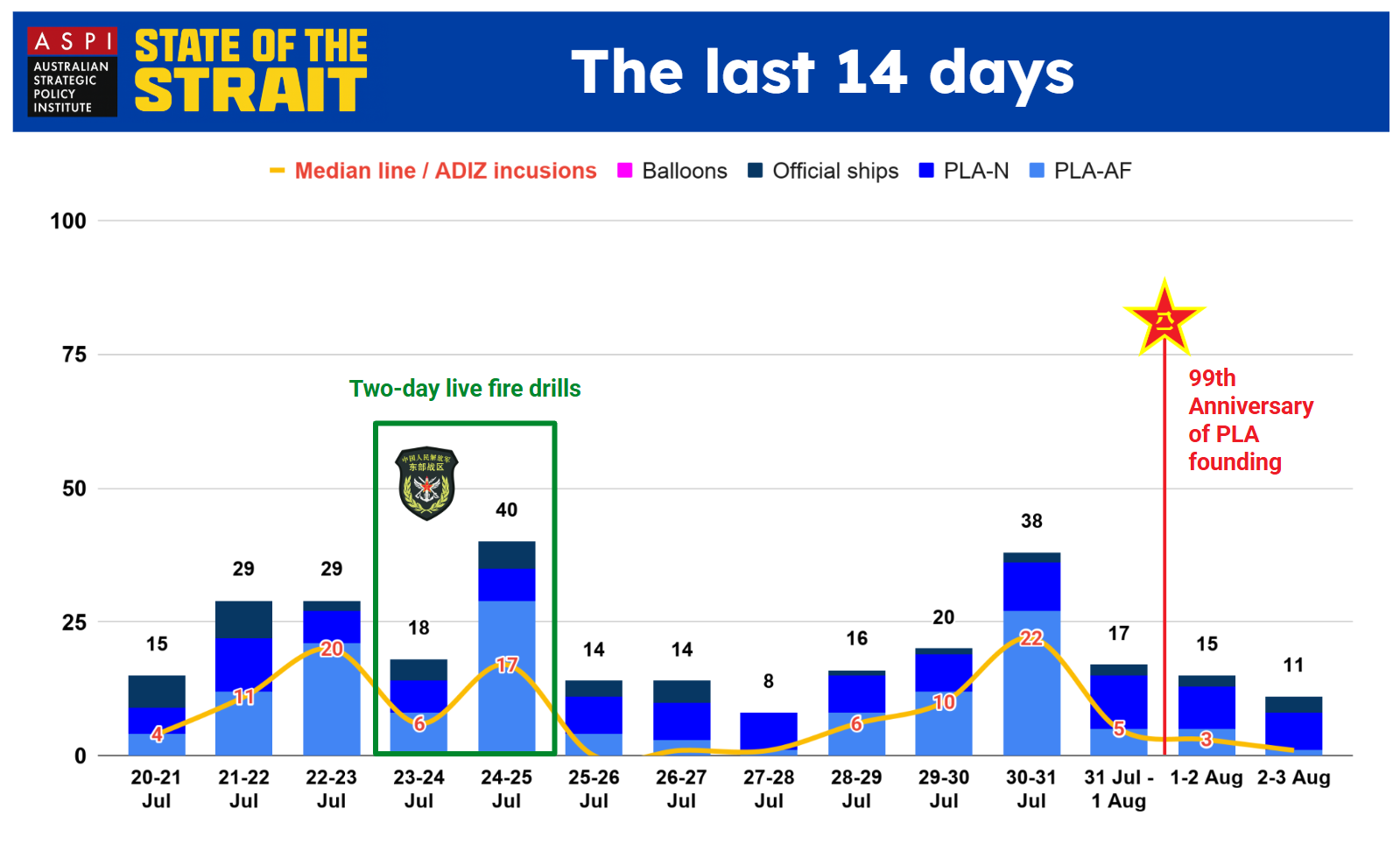
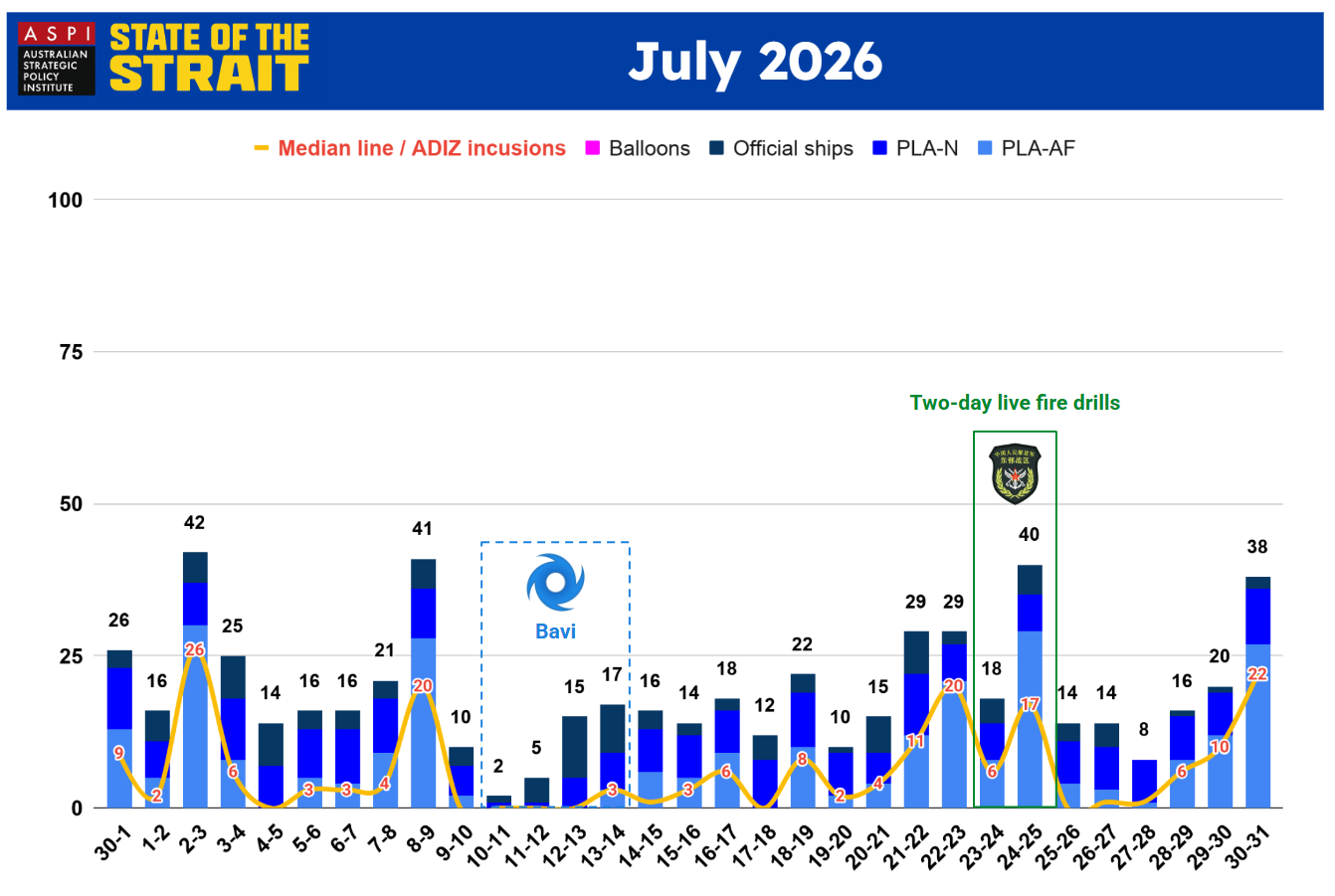
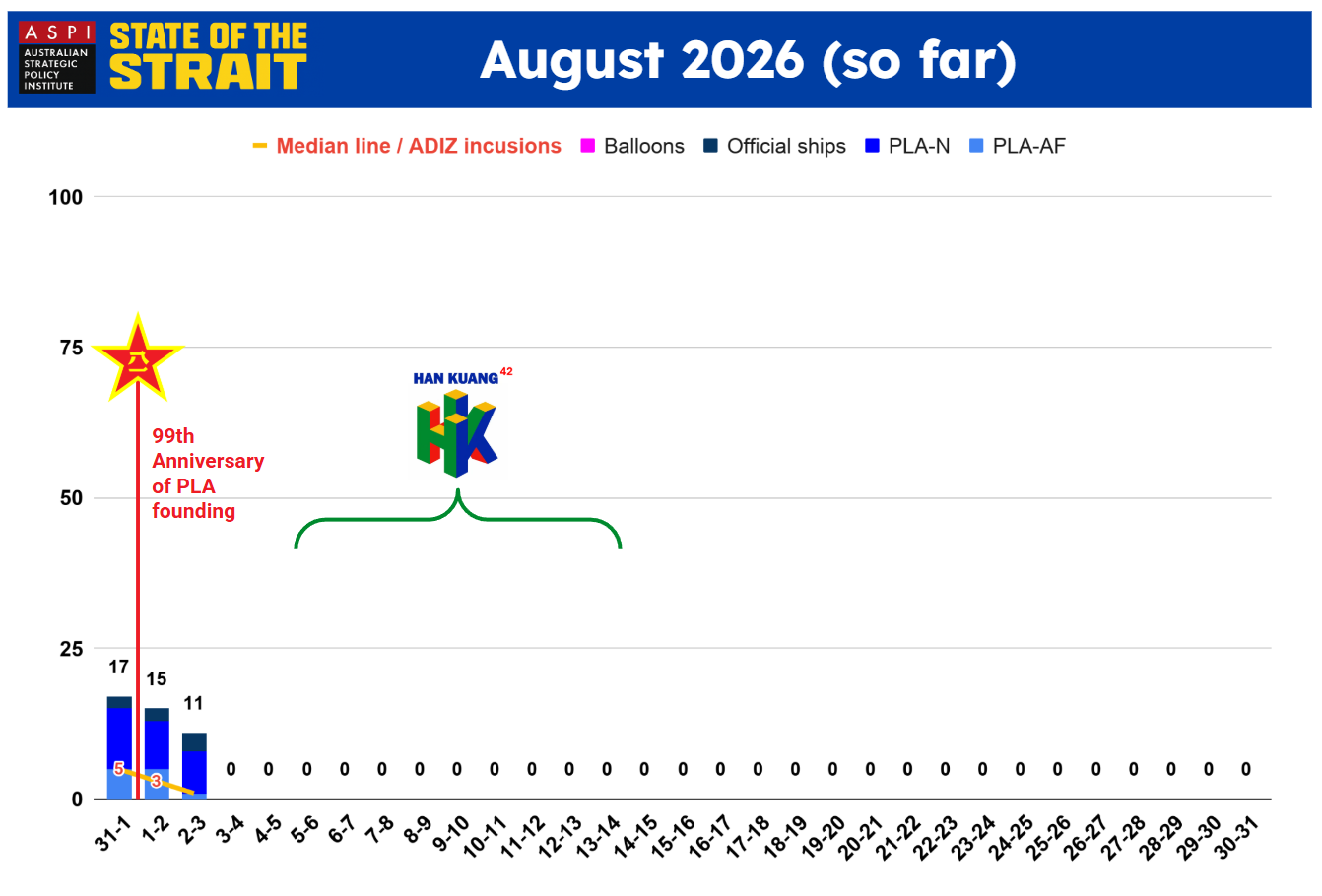
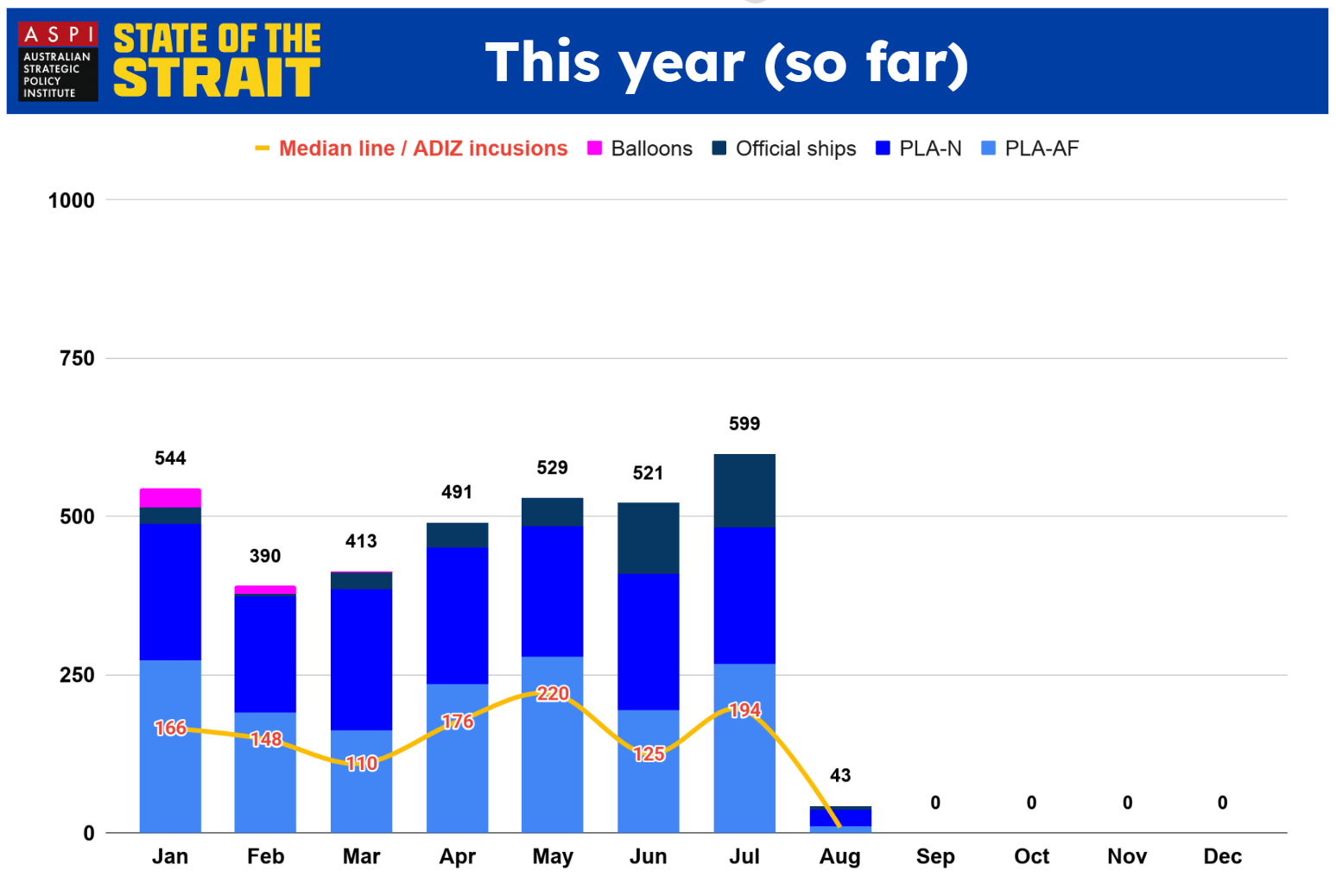
Source for charts: Taiwan’s ministry of national defense monitors PLA-AF aircraft, PLA-N naval vessels and PRC official ships (e.g. coast guard) and high-altitude balloons operating in the waters and airspace around Taiwan. Numbers are recorded daily for the 24-hour period 0600 to 0600 Taiwan Standard Time (UTC+8).

Chinese ICT components slip under radar: report
Taipei Times
Some vendors have falsely labeled Chinese information and communications technology (ICT) products as made in Taiwan for government contracts, the National Audit Office said in a report, calling on the Executive Yuan to improve regulations to prevent such security risks. Government agencies have been following the Ministry of Digital Affairs’ policies on ICT products and could submit suspicious products to the ministry for review, the Executive Yuan said. Agencies revised procedures and required their subordinates to conduct information security checks before procurement to reduce supply chain risks, it added.

ASPI Comment: United front work targeting Taiwan is orchestrated by a network of party-state organisations that aim to influence, cultivate, and co-opt key figures within Taiwanese civil society. The Taiwan Affairs Office in China has described united front work as “an important magic weapon for the Communist Party of China to unite people and gather strength”. The CCP claims the right to speak on Taiwan’s behalf and uses united front work to claim legitimacy for annexation of Taiwan into the People’s Republic of China.
ASPI's State of the Strait tracks events that are facilitated by an agency within the united front and are intended to co-opt, exert malign influence, or redefine Taiwan, its people, and its history solely on CCP's terms.
Expert warns of risks in China exchange programs
Taipei Times
A human rights advocate recently said that a Taiwan youth camp in China could use artificial intelligence (AI) deepfakes to coerce participants into becoming collaborators in China’s “united front” tactics. China is hosting summer camps for young Taiwanese, featuring low-cost food, hotel accommodation and transportation, sources said. The “Chinese culture study camp,” which is to be held early this month, is offering an eight-day, seven-night trip to Chengdu, Dujiangyan, Meishan and Yibin in Sichuan Province for Taiwanese university students, they said … The greatest risk of taking part in such trips is that Chinese authorities could use AI-generated deepfakes to fabricate footage of them visiting inappropriate places or soliciting prostitutes, and use those to pressure participants into becoming Chinese collaborators when they return to Taiwan, [human rights advocate Lee Ming-che] said.
Control Yuan points to imbalance in cross-strait educational exchanges; Mainland Affairs Council calls for stronger awareness of CCP united-front activities [監院指兩岸教育交流失衡 陸委會:強化中共統戰識讀]. Central News Agency (Taiwan)
More than 150 writers from both sides of the Taiwan Strait gather in Xiamen for a literary exchange [两岸150多位作家齐聚厦门共赴文学之约]
Xinhua
The 2026 Cross-Strait Literature Week and the 14th Cross-Strait Literary Writers’ Gathering opened in Xiamen on 31 July. With the theme “Accompanied by Poetry and Books, Enjoying Literature”, the event brought together more than 150 prominent writers, poets, scholars, film and television experts, copyright specialists and youth representatives from both sides of the Taiwan Strait. Using literature as a bridge and the written word as a medium, the event aims to create a new platform for the integrated development of cross-strait literature and the adaptation of literary intellectual property, while promoting a closer emotional bond between people on both sides.
Red panda meet-and-greet suspected of being a united-front activity; Chiu Chui-cheng says it could weaken Taiwan’s vigilance [小貓熊見面會涉統戰 邱垂正:鬆懈台灣]
Central News Agency (Taiwan)
The Taipei City Government had planned to invite a Shanghai delegation to Taiwan to attend a red panda meet-and-greet, but the event was suspected of having a united-front purpose. Taipei Mayor Chiang Wan-an questioned how it was related to united-front work. Mainland Affairs Council Minister Chiu Chui-cheng said the Chinese Communist Party was steadily increasing pressure on Taiwan and that such an event could cause Taiwan to lower its guard against threats from China … At a time when the CCP was steadily increasing pressure and applying maximum coercion against Taiwan, Chiu asked, “Why should we still cooperate with activities of this kind?” He noted that Japan had also sent red pandas to Taipei Zoo, but asked why there had been no comparable meet-and-greet with Japan. “Why does this require a meet-and-greet with a united-front character, and why must the head of the Taiwan Affairs Office attend?” Chiu said. He argued that this was inappropriate and was clearly intended to generate publicity for the event.

China’s defense minister vows to thwart any attempt at ‘Taiwan independence’, external interference on PLA’s 99th anniversary
Global Times
Chinese Defense Minister Dong Jun said on 31 July that the Chinese People’s Liberation Army (PLA) will serve as a steadfast bulwark for China’s national reunification, resolutely thwart any attempt at “Taiwan independence” separatism or external military interference, and fulfill its sacred mission of safeguarding national sovereignty, security and development interests, in a speech delivered at a reception at the Great Hall of the People to celebrate the 99th founding anniversary of the PLA.
The stronger the PLA, the greater the guarantee of peace across the Taiwan Straits: Hai Feng
Global Times
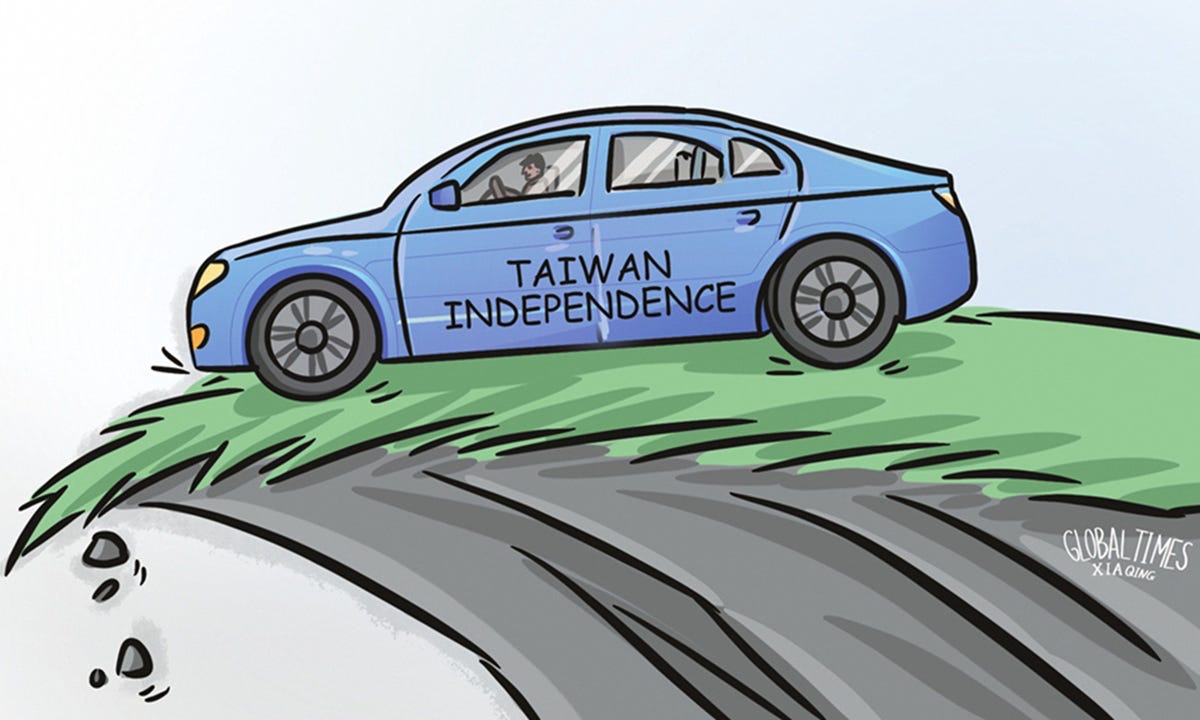
In recent years, some people on the island of Taiwan have repeatedly asked: If the Chinese mainland advocates peaceful reunification, why does it continue to strengthen troop training, enhance combat preparedness, and maintain a strong deterrent posture in the Taiwan Straits? The answer is not complicated: Peaceful reunification represents the Chinese mainland’s greatest sincerity, while strengthening the military and maintaining combat readiness represent the nation’s firm bottom line. The former sets the direction, and the latter secures it. Without a sufficiently strong PLA, peace could be gradually “eroded” by “Taiwan independence” separatist forces and external interveners.
Taiwan regional media hype annual Han Kuang drills; mainland expert dismisses these unrealistic tactical gambits as mere ‘performance’
Global Times
The annual Han Kuang military drills of the Taiwan region are set to kick off on 5 August, with certain media of the island hyping up highlights that they claimed as “the first time.” Yet a mainland military affairs expert said the unrealistic gambits of Taiwan’s regional authorities are pursued unscrupulously with blatant disregard for local residents’ livelihoods, and such tactics are entirely futile … By incessantly stoking war anxiety and provoking cross-Straits confrontation and hostility, they attempt to drag Taiwan’s general public onto the chariot of “Taiwan independence.” Their doomed fate is nothing but the total failure and collapse of the separatist “Taiwan independence” agenda, [Jiang Bin, a spokesperson for the Ministry of National Defense] said.
Taiwan civil-society groups issue joint statement protesting authorities’ petition to dissolve pro-unification party [台湾民间团体联合声明抗议当局声请解散统派政党]
Xinhua
More than 20 Taiwanese civil-society groups, including the Labor Party of Taiwan, the Taiwan Association for Political Victims’ Mutual Assistance and the Cross-Strait Peace and Development Forum, recently issued a joint statement strongly protesting what they described as an abuse of power by the Democratic Progressive Party authorities in seeking the dissolution of the Chinese Unification Promotion Party. The statement said the move was a dangerous sign that the DPP was using the machinery of government to suppress political opponents and conduct political trials. The groups called on Taiwan’s interior authorities to withdraw the dissolution petition immediately.
ASPI Comment: The DPP government says the case targets the Chinese Unification Promotion Party’s alleged conduct, not support for unification itself. It argues that senior figures worked with CCP authorities, facilitated Chinese funding and engaged in influence, election interference and other activities that threatened Taiwan’s national security and democratic order. Taiwan’s Constitutional Court will ultimately decide whether the evidence justifies dissolving the party.

No incidents to report this week.

Chinese embassy in Israel: Claims on Taiwan distort fact and history
The Jerusalem Post
The Chinese Embassy in Israel would like to point out the factual errors we found in a recent Jerusalem Post article entitled “Lessons from Taiwan to win on the 8th Front” and clarify the facts. The author refers to China’s Taiwan region as a “country” and describes the head of the Taipei Economic and Cultural Office in Tel Aviv as an “ambassador.” This exposes his lack of understanding of history and facts, as well as his ignorance of Israel’s foreign policy and China-Israel relations.

Tibetan activists protest China ethnic unity law at bank
Taipei Times
Tibetan and human rights activists on 2 August protested China’s new ethnic unity law outside the Bank of China’s Taipei branch, calling on people around the world to resist China’s authoritarian rule and speak up for oppressed ethnic minorities. 2 August marked one month since Tibetan activist Lobga Rangzen self-immolated in protest, and his family hoped the date would act as a “global action day,” calling on Tibetan communities and human rights groups around the world to take part in coordinated actions.
Taiwan exposes China’s transnational repression
Taiwan News
Less than a week after China’s Ethnic Unity and Progress Promotion Law took effect, Japanese political commentator and former Sankei Shimbun Taipei bureau chief Yaita Akio was attacked in Taichung by a Chinese national from Hong Kong later reported to have links to organized crime. Such tactics are not entirely new. Hong Kong singer Denise Ho was attacked in Taipei on 29 September 2019, before attending the 929 March Against Totalitarianism. Two Chinese Unification Promotion Party members splashed red paint on Ho in an attempt to intimidate supporters attending the pro-democracy rally in solidarity with Hong Kong’s anti-extradition movement. The latest attack on Yaita is a reminder of Beijing’s authoritarian repression tactics. One of its favored methods is outsourcing dirty work to organized crime groups and proxy networks.
Thanks for reading! This post is public so feel free to share it.
For more on how tech, cyber and policy intersect across the region, check out ASPI’s Daily Cyber & Tech Digest.

Every fortnight, ASPI’s Fault Lines monitors actions that shape and contest the international order in Australia’s region.

No posts
Comments
Nothing yet. Say the first thing.
Sign in to join the conversation.