

Welcome to the latest edition of ASPI’s ‘State of the Strait’ Digest.
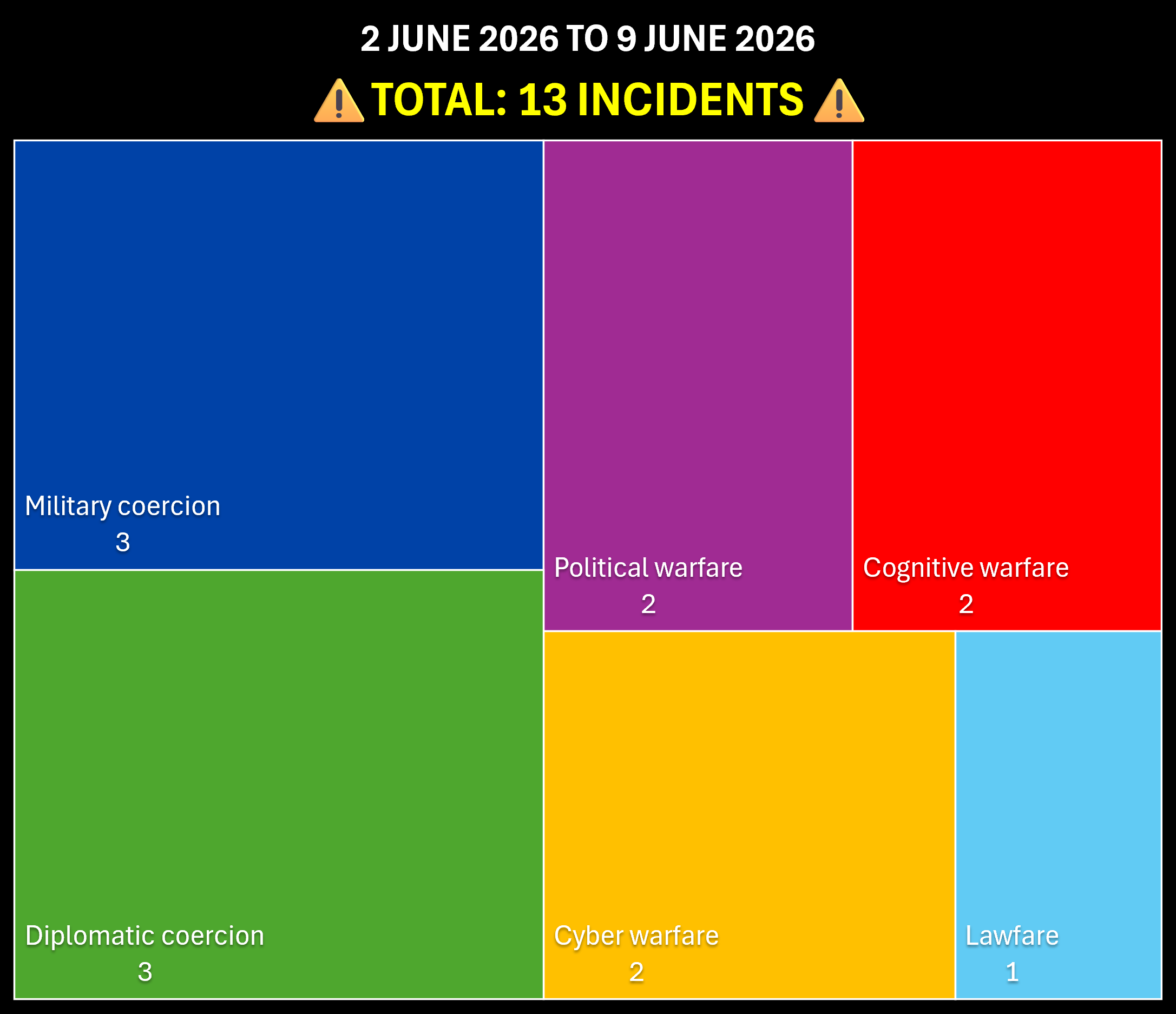
Each week ASPI tracks Beijing’s pressure campaign against Taiwan, including military, economic, and diplomatic coercion, as well as political, cognitive, cyber, and legal warfare.
This edition covers the period: 2 June 2026 to 9 June 2026.
Follow the Australian Strategic Policy Institute on X, on LinkedIn, and on Bluesky.


On 3 June 2026, it emerged that China had imposed a one-year ban on four New Zealand MPs after they visited Taiwan in May. The MPs had travelled as part of a cross-party parliamentary delegation. Beijing’s response was to bar them from entering mainland China, Hong Kong and Macau, reportedly with the possibility that the ban could be reduced or waived if they apologised.
These were non-government parliamentarians participating in a long-running form of informal parliamentary engagement with Taiwan. New Zealand MPs have visited Taiwan for decades. This was not a sudden change in New Zealand policy, nor was it a breach of Wellington’s long-standing position. New Zealand, like many countries, recognises the People’s Republic of China as the sole legal government of China, but it has not accepted Beijing’s claim that Taiwan is part of the PRC. The 1972 joint communiqué says New Zealand “acknowledges” China’s position on Taiwan; it does not say Wellington endorses it.
So why now? Well, it is not that New Zealand changed what it was doing. It is that Beijing has changed what it is willing to tolerate as it continues narrowing the space between formal diplomatic recognition and informal engagement. For decades, many countries have maintained unofficial ties with Taiwan while avoiding formal recognition. That ambiguity has allowed trade, parliamentary exchanges, cultural links and technical cooperation to continue without crossing the diplomatic red line. Beijing appears increasingly less willing to tolerate that distinction and has moved its red line.
That arbitrariness is what makes the episode dangerous. If a practice that has been tolerated for decades can suddenly become sanctionable, then the problem is not the conduct of New Zealand MPs. The problem is Beijing’s willingness to redefine the rules suddenly and unilaterally. That makes engagement with Taiwan more unpredictable, because countries cannot know whether activities considered acceptable today will be punished tomorrow.
New Zealand is a useful target precisely because it is not usually seen as a front-line Taiwan actor. It has a substantial trade relationship with China, including a free trade agreement, a reputation for careful diplomacy, and a comparatively restrained public posture on Taiwan. By sanctioning New Zealand MPs, Beijing is signalling that even small and cautious democracies are now no longer exempt from punishment if their parliamentarians engage with Taiwan. The point is not only to punish these four MPs; it is to intimidate future delegations.
Wellington’s response has so far been careful but firm: it has reaffirmed its One China policy, but also rejected Beijing’s attempt to police parliamentary activity. New Zealand has raised the issue directly with China, and Australia has also complained to Beijing about the ban. That matters because it turns the episode from a bilateral dispute into a broader question about how democracies respond when China tries to impose costs on unofficial engagement with Taiwan.
For other countries, the message is clear: Beijing may increasingly treat unofficial engagement with Taiwan as sanctionable conduct, even when it is carried out by legislators rather than governments. The risk for countries is that silence and capitulation will only invite more pressure from Beijing. The opportunity is that even modest collective pushback can make parliamentary engagement with Taiwan harder to punish.

Zhu Fenglian, spokesperson for the State Council Taiwan Affairs Office, said at a regular press conference on 3 June that the 18th Straits Forum will be held in Fujian in mid-June, with the main forum scheduled for 13 June.


Beijing deploys new missiles matching Patriots opposite Taiwan
South China Morning Post
Mainland China has equipped frontline troops facing Taiwan with a new missile, according to mainland state media. The missile is believed to be an HQ-16F, which has comparable qualities to the US Patriot PAC2 and 3 systems. On 5 June, Chinese state broadcaster CCTV aired footage of the 73rd Group Army’s first operational and live-fire assessment of the missile in the Gobi Desert.
Taiwan says China Coast Guard patrols to its east are ‘provocative act’
Reuters
Chinese Coast Guard patrols to the east of Taiwan are a “provocative act” and the military will closely coordinate with the island’s Coast Guard in responding, Defence Minister Wellington Koo said on 8 June … Late on 6 June Chinese state media said ships had been sent to carry out a “special maritime traffic law-enforcement operation” in the waters east of Taiwan.
Taiwan hits back at Beijing’s ‘cognitive warfare’ after coastguard patrols. South China Morning Post
Chinese flotilla surges east of Taiwan amid spat with the Philippines, Japan. U.S. Naval Institute News
ASPI Comment: The spat is about China objecting to closer Japan–Philippines maritime security cooperation, especially around the South China Sea, Taiwan and nearby disputed waters. Beijing sees this as part of a wider US-aligned effort to contain China, while Japan and the Philippines argue they are responding to China’s coercive behaviour at sea. For Manila the focus is the South China Sea, especially the Scarborough Shoal; for Tokyo it is the broader pattern of Chinese pressure across the region.
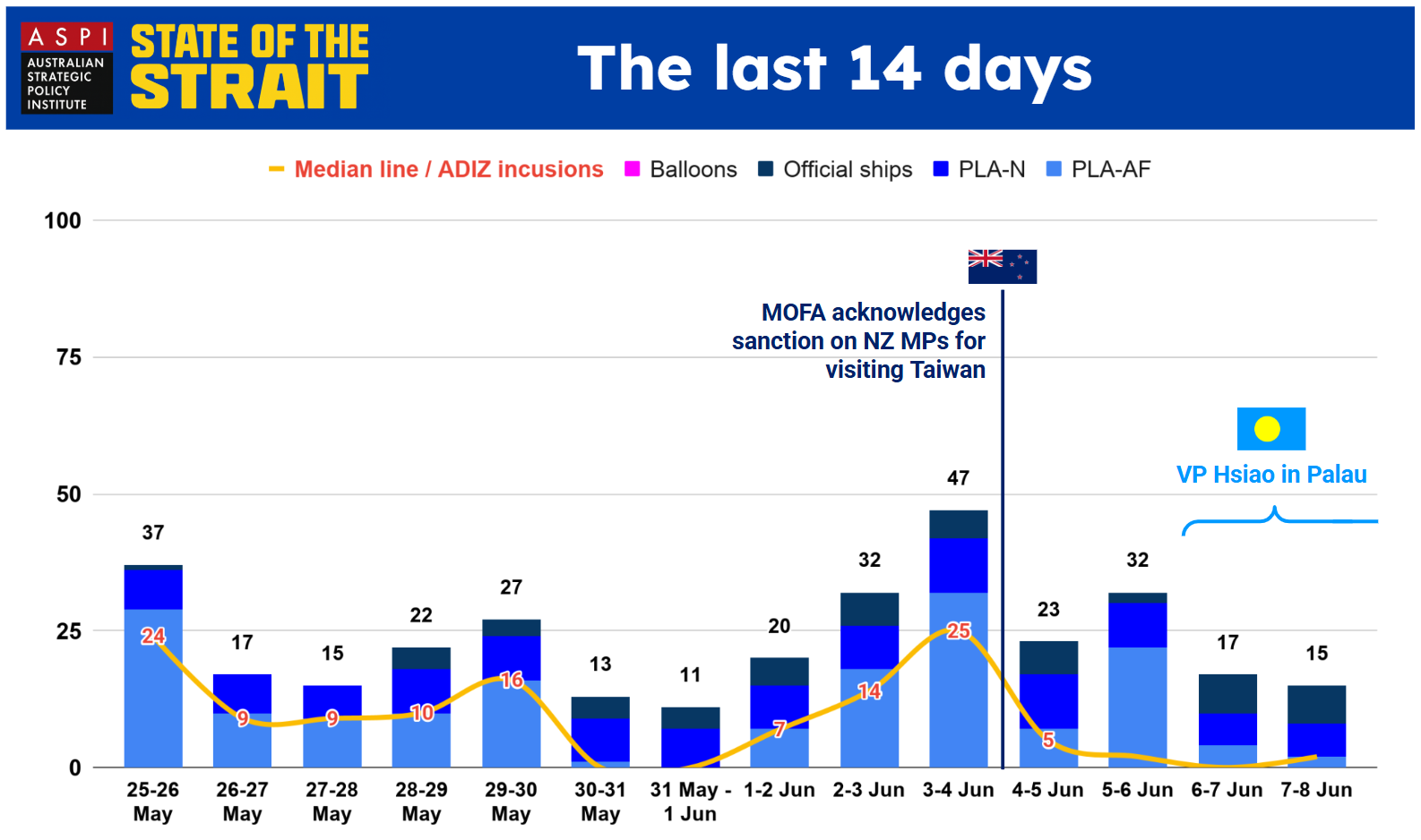
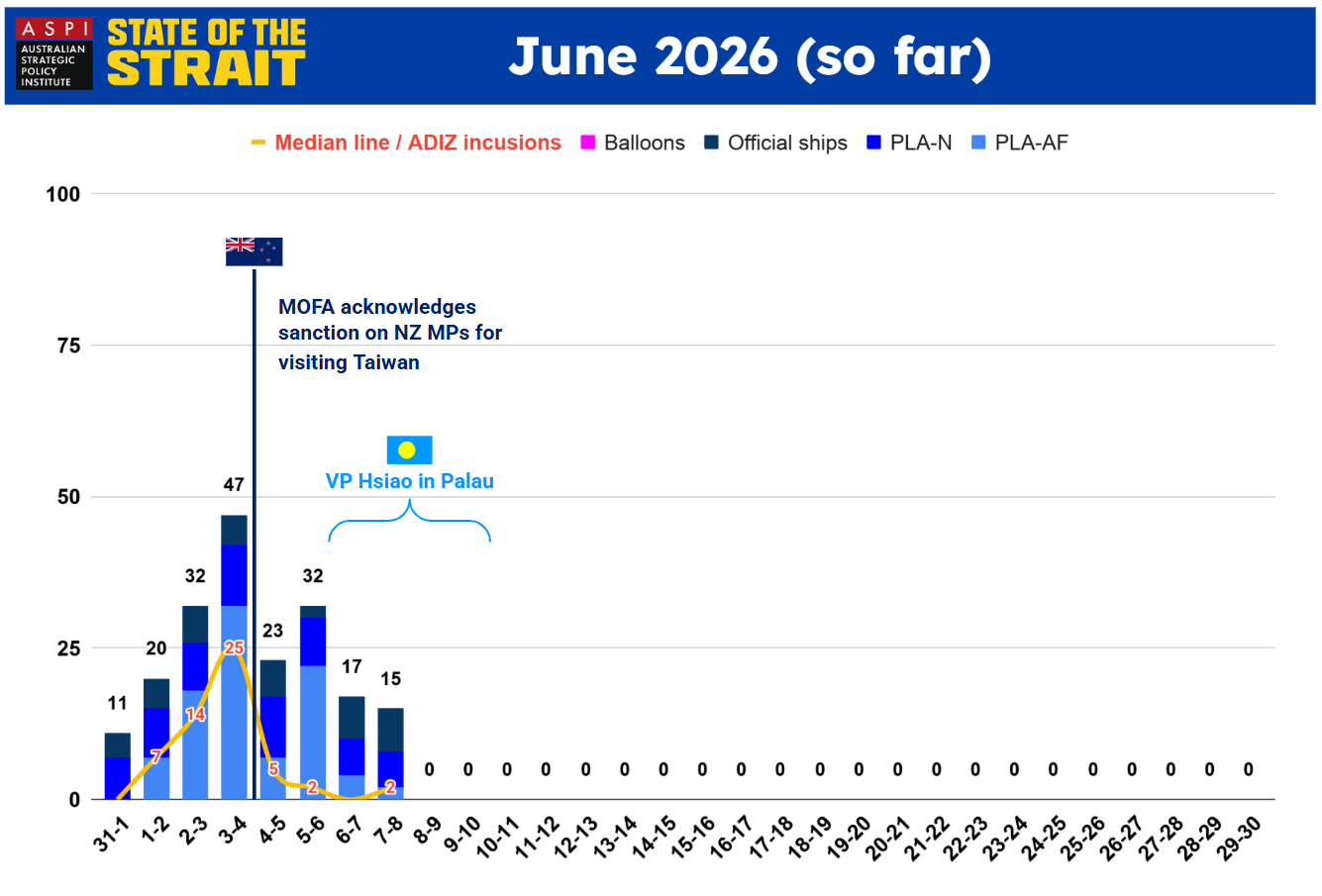
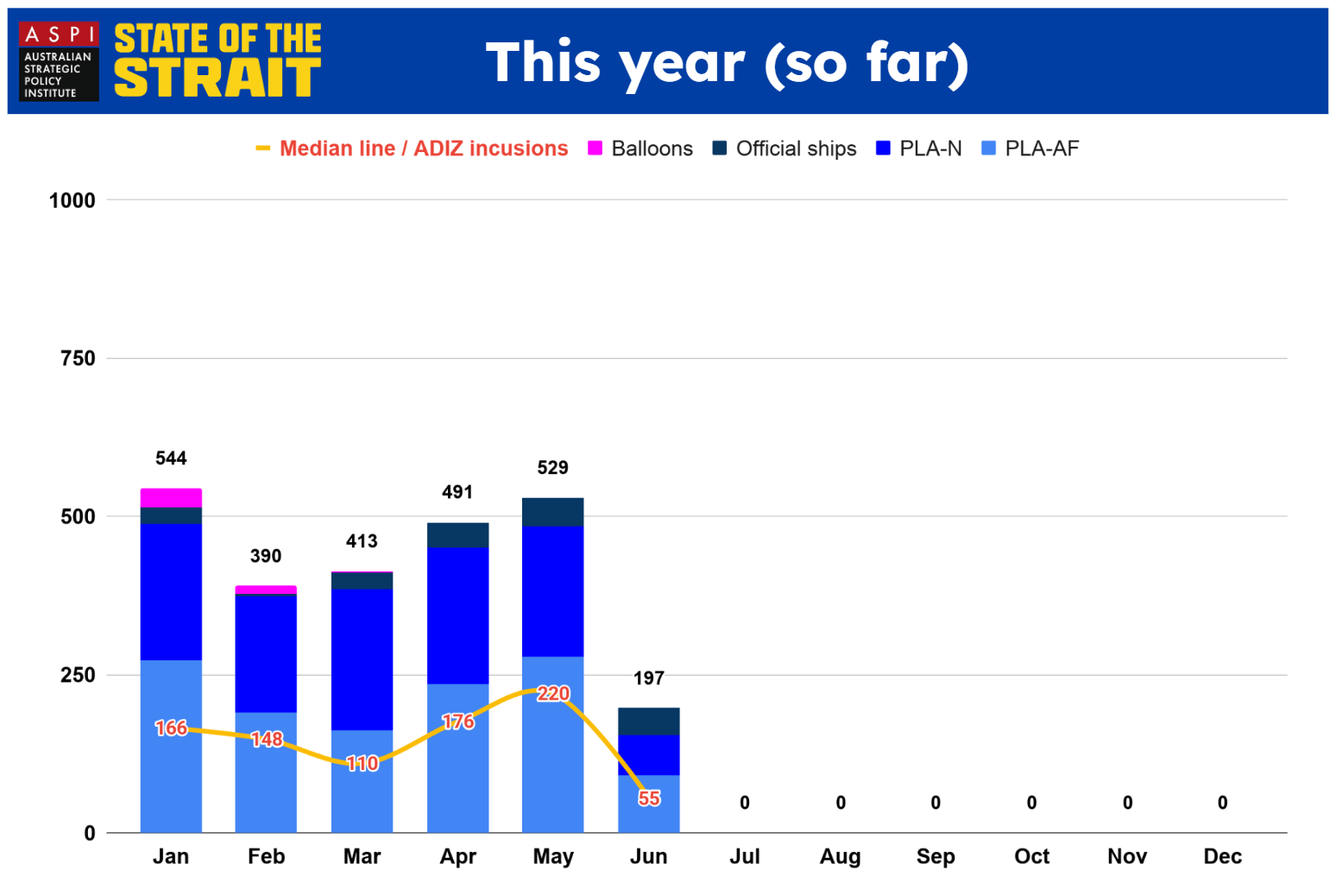
Source for charts: Taiwan’s ministry of national defense monitors PLA-AF aircraft, PLA-N naval vessels and PRC official ships (e.g. coast guard) and high-altitude balloons operating in the waters and airspace around Taiwan. Numbers are recorded daily for the 24-hour period 0600 to 0600 Taiwan Standard Time (UTC+8).

No incidents to report this week.

ASPI Comment: United front work targeting Taiwan is orchestrated by a network of party-state organisations that aim to influence, cultivate, and co-opt key figures within Taiwanese civil society. The Taiwan Affairs Office in China has described united front work as “an important magic weapon for the Communist Party of China to unite people and gather strength”. The CCP claims the right to speak on Taiwan’s behalf and uses united front work to claim legitimacy for annexation of Taiwan into the People’s Republic of China.
ASPI's State of the Strait tracks events that are facilitated by an agency within the united front and are intended to co-opt, exert malign influence, or redefine Taiwan, its people, and its history solely on CCP's terms.
MAC bars central and local officials from Straits Forum
Taipei Times
Taiwan would not allow personnel from either central or local governments to attend the Straits Forum starting on Saturday next week in China’s Xiamen, Mainland Affairs Council (MAC) Deputy Minister Liang Wen-chieh said 4 June. “The Straits Forum serves as the Chinese communist government’s platform for deploying ‘united front’ tactics against Taiwan, whose goal is infiltrating Taiwanese society under the pretext of cross-strait exchange,” he told a routine news conference in Taipei. The move signaled a hardening of the government’s stance that had barred only central government personnel from participating in the summit, not their counterparts in local government.
Experts and industry representatives discuss integrated development of cross-strait new media industries: Making good use of AI to “connect hearts” [专家业者热议两岸新媒体产业融合发展:善用AI“心相连”]
Xinhua
Want Want Group Vice Chairman Chou Hsi-wei and Gao Zhikai, deputy director of the Center for China and Globalization, delivered keynote speeches respectively on the themes “AI Without Borders, Hearts Connected Across the Strait” and “Immediate Success: Both Sides of the Strait Join Hands for the Rejuvenation of the Chinese Nation”. Gao said that both sides of the Strait should rely on digital technology to build consensus among the people and work together to promote national rejuvenation … Participants said that the new media industries on both sides of the Strait each have their own strengths and that there is great potential for integrated development. The mainland has vast market space, rich media application scenarios and a mature industrial ecosystem, while Taiwan has strong content creation capabilities, advanced technology research and development experience, and a broad communications outlook.

Legislature freezes part of Taiwan’s ADB donation over designation
Focus Taiwan
The Legislative Yuan’s Finance Committee decided on Monday to freeze nearly a quarter of the funding Taiwan has proposed to give the Asian Development Bank in 2026 in protest against the bank’s change of Taiwan’s designation 40 years ago … They said the NT$30 million will not be unfrozen until the ADB responds to Taiwan’s concerns over the designation. Though the Republic of China (Taiwan) was one of the founding members of the ADB in 1966, its designation was changed to “Taipei,China” (space after the comma deliberately omitted) in 1986, after the People’s Republic of China joined the bank.
Taiwan Affairs Office: If the DPP authorities dare to sell out national interests, they will be spurned and punished [国台办:民进党当局胆敢出卖民族利益,必受唾弃和惩罚]
Xinhua
Zhu Fenglian, spokesperson for the State Council Taiwan Affairs Office, said on 3 June at a regular press conference, in response to a question, that there is only one China in the world and Taiwan is part of China. The maritime area that Japan and the Philippines have announced they intend to delimit lies east of China’s Taiwan island. Their so-called “delimitation talks” seriously infringe on China’s maritime rights and interests, seriously violate international law and the basic norms of international relations, and are entirely illegal and invalid.

The seabed is becoming a battlefield. Taiwan has field notes
The Strategist
As Australia strengthens the protection of critical seabed infrastructure, it should draw on Taiwan’s frontline experience. Taiwan has been battling this problem for three years … As Australia strengthens its undersea capabilities through AUKUS, Taiwan’s experience offers a separate and complementary source of operational insight. This would require no change to Australia’s policy settings. It would begin with recognising the practical value of lessons already learned.
Taiwan telecom warns of travel eSIM use
Taiwan News
As overseas travel rebounds, Taiwanese travelers are increasingly turning to eSIM services instead of traditional roaming plans, but telecommunications experts warn low-cost options may pose cybersecurity and privacy risks … recent reports have raised concerns that some travel eSIM services route data through Chinese telecommunications networks, potentially exposing users to security risks.

Palau president affirms Taiwan sovereignty during Hsiao’s visit
Focus Taiwan
Palau President Surangel S. Whipps Jr. expressed strong support for Taiwan during Vice President Hsiao Bi-khim’s visit to the Pacific ally, saying on 7 June that failure to recognize Taiwan’s sovereignty would call into question the sovereignty of small countries. “If Taiwan’s sovereignty is not recognized, then who are we to say that we’re sovereign? Might as well eliminate all small countries,” Whipps said at a welcome dinner for Hsiao in Koror, Palau’s largest city. “We have to stand up for freedom. We have to stand up for democracy and we have to stand up for the rule of law,” said Whipps, whose country is one of Taiwan’s 12 diplomatic allies worldwide and one of three in the Pacific.
China bans 4 New Zealand lawmakers after they visited Taiwan
AP News
Beijing banned four New Zealand lawmakers from traveling to China for a year and demanded they apologize because they visited Taiwan on a parliamentary trip, according to a message from the Chinese Embassy seen by The Associated Press on 4 June.
Taiwan welcomes Australia-New Zealand support for Taiwan Strait stability. Taiwan News
Christopher Luxon ‘appreciates’ Australia raising concerns with China over MPs Taiwan trip sanctions. New Zealand Herald
Tokyo-Manila EEZ talks aim to counter China: FM
Focus Taiwan
Proposed talks between Japan and the Philippines on maritime boundaries in areas where their exclusive economic zones (EEZs) overlap are intended to counter China, Foreign Minister Lin Chia-lung said 4 June, adding that Taiwan is in close contact with both countries to safeguard its rights. Lin said China’s military expansion has extended into the western Pacific and into the EEZs of Japan and the Philippines, with People’s Liberation Army (PLA) aircraft and vessels frequently operating near eastern Taiwan, the Diaoyutai Islands (known in Japan as the Senkaku Islands), and Batan Island in the Philippines.

China using ‘lawfare’ to target Taiwan and pro-independence voices, US commission says
First Post
A US congressional commission has accused China of increasingly using legal and judicial mechanisms as political tools against Taiwan, describing the practice as part of a broader “lawfare” strategy aimed at advancing Beijing’s territorial and political objectives. According to the report, China is using legal processes to intimidate, punish and suppress individuals it views as challenging its claims over Taiwan.
Thanks for reading! This post is public so feel free to share it.
For more on how tech, cyber and policy intersect across the region, check out ASPI’s Daily Cyber & Tech Digest.

Every fortnight, ASPI’s Fault Lines monitors actions that shape and contest the international order in Australia’s region.
No posts
Comments
Nothing yet. Say the first thing.
Sign in to join the conversation.