
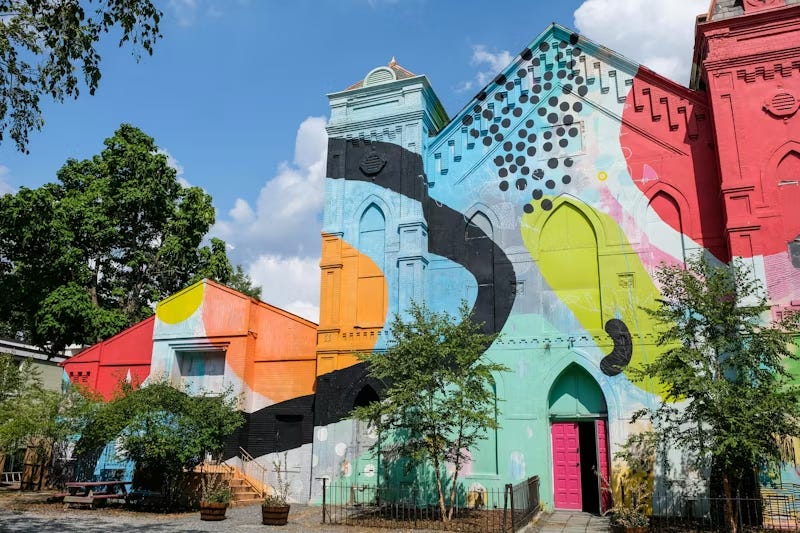
Photo by Sara Cottle
Do cultural districts serve artists and communities, or displace them? New legislation advancing in Illinois, California, and Massachusetts offer promising models to ensure the benefits of these reforms go to the people who make and preserve culture, not just the developers who aim to profit from them.
According to the National Association of State Arts Agencies (NASAA), a cultural district is a state-designated geographic area that utilizes cultural resources to encourage economic development and cultivate synergies between the arts and other businesses.” NASAA’s most recent policy brief identified 19 states with formalized programs sustaining more than 400 cultural districts nationwide. More cultural districts exist at the county and municipal level as well. They’re run by everyone from tourism departments to arts agencies, and they offer a mix of tax incentives, grants, and technical assistance.
According to research published in Profectus magazine, five states (Maryland, Iowa, Louisiana, New Mexico, Rhode Island, and Texas) have the most robust policies, offering tangible financial perks: exemptions from admissions taxes, property tax credits, and income tax deductions for artists. California recently added 10 new cultural districts — bringing its total to 24 — each receiving five years of official designation, $10,000 in funding, and marketing support.
New York just enacted its first cultural district law, taking a notably different approach: rather than a broad statewide program, it designates specific communities. East Harlem (”El Barrio”) was named first, followed by bills for the Harlem Renaissance Cultural District, Little Yemen in the Bronx, and Little Panama in Brooklyn. Each designation requires its own legislative coalition, which is a slower process, but it gives communities more explicit and durable legal recognition. On the flip side, communities without strong political champions remain invisible, while those with effective advocates get written into law.
The logic behind cultural districts is both social and economic, stabilizing the arts businesses already rooted in a neighborhood while signaling to the outside world that a place is worth visiting, investing in, and preserving.
Economic growth. Research across Louisiana, Maryland, Iowa, New Mexico, and Texas found that following designation, employment in core arts and cultural establishments rose roughly two to four percent relative to comparable areas without designation — gains concentrated in existing businesses, not new openings. Cultural districts, in other words, help sustain what’s already there more than they seed what’s new. Maryland alone logged $149.5 million in state GDP, $8.1 million in tax revenues, and 1,185 jobs in a single fiscal year. Property values can also increase. In Lafayette, Louisiana, home values rose about seven percent after designation — a double-edged result, as we’ll get to.
Tourism and visibility. State designation puts a neighborhood on the map, attracting visitors and entrepreneurs and helping cities grow their cultural sector and expand their tax base.
Community and social cohesion. At their best, cultural districts do something harder to quantify: they formally recognize what makes a place distinct. They create shared spaces that foster pride, celebrate local history, and strengthen community resilience, functioning as keepers of neighborhood narrative and catalysts of social cohesion.
Here’s the central irony of cultural districts: they often displace the very artists and communities who made an area worth designating.
Rising property values aren’t just a sign of success — they’re frequently the beginning of the end for the people who created the culture in the first place. Baltimore’s Mount Vernon Cultural District fueled gentrification that pushed out low-income renters. Chicago’s cultural planning benefited more affluent, white residents at the expense of underserved communities. Economic benefits tend to concentrate downtown, leaving outlying neighborhoods — often poorer — to absorb the spillover costs without the gains.
And when original residents and business owners are priced out, the authentic cultural identity that justified the district disappears too. What’s left is often a performance of culture rather than the real thing.
Cultural districts work for artists when they:
Create real paid work with public art commissions, opportunities for teaching, festivals, and performances, curatorial and design control, local residencies and vendor opportunities. Artists need income, not exposure.
Provide affordable space for rehearsal, studios, fabrication, storage, performance and exhibition venues, and housing. If there is no plan for space, cultural district designation can be just a countdown clock to displacement.
Help artists build audiences and local infrastructure. Artists often benefit from clustering with nearby peers, small venues, curators and presenters, technicians, cafes and gathering spots, nonprofit partners, and foot traffic from residents and visitors. This ecosystem can reduce isolation and increase collaboration.
Give artists political standing, including zoning accommodations, capital dollars, preservation of historical spaces, small business protections, arts infused public planning, and recognition as workers and economic contributors. They can be a policy tool and not just a neighborhood identity.
Cultural districts fail artists when:
Artists are used as place branding. Artists move into cheap space, the area gains authenticity and buzz, the city or developers market it as creative, rents rise, and then artists are displaced. Artists’ incomes do not increase as drastically as land values.
Institutions benefit more than working artists. Unpaid work, exposure, community engagement, and occasional and short-term gigs don’t pay the bills or help artists build long-term financial security.
Culture is defined too narrowly. Social practice artists, folk artists, culture-bearers, nightlife artists, Black, immigrant and working class cultural productions and informal cultural economies can all get overlooked. This matters because many of the artists who actually make neighborhoods culturally alive are not always the ones most legible to planning departments.
As Gonzalo Casals of the Cultural and Arts Policy Institute has said: “All neighborhoods are cultural districts.” The folks at Naturally Occurring Cultural Districts (NOCD) take this further, arguing that culture already exists in a place and should be recognized and protected, not manufactured from scratch.
Naturally occurring cultural districts can support artists by valuing existing cultural producers, supporting legacy spaces and local networks, helping investors understand the attributes of the community, and including artists and culture bearers, not just institutions..
Districts paired with land trusts, master leases, subsidized artist live/work space, and long term affordability covenants can be helpful, along with districts tied to small businesses where maker and designer support can be included. And finally, districts should include artists in the planning process, not just in the programming, but in the decisions about budget, land use, public space design, and budgets are all key. Artists need a seat at the decision making table.
The most important recent examples share a common feature: they put real investments and protections behind the cultural district designation, not just a name on a sign.
Illinois SB1833 explicitly targets communities at risk of gentrification. Administered through the Office of Economic Equity and Empowerment, it prioritizes areas with documented economic disinvestment and requires an explicit equity and food justice framework — criteria almost unheard of in comparable legislation.
California AB 812 (2023) links cultural districts to affordable housing: any new low-income housing built inside a designated district must reserve at least 10% for artists and culture bearers. San Francisco’s Artist Space Trust is implementing this on the ground, acquiring properties inside cultural districts and permanently removing them from the speculative market.
San Francisco’s CHHESS Report requirement mandates that each district co-develop cultural preservation, housing stability, and economic strategy in a single binding document — turning cultural districts from honorary designations into active governance instruments. Proposition E (passed in 2018 with 75% of the vote) backs this up with $3 million annually from the city’s Hotel Tax — a self-reinforcing funding loop where tourism revenue funds cultural preservation.
San Francisco’s Transgender District — the first legally recognized trans district in the world — was founded in 2017 by three Black trans women and covers six blocks of the Tenderloin. Its programs span tenant protections, workforce development, arts, cultural heritage conservation, and land use planning. It has been catalytic in spurring identity-based cultural districts across the Bay Area.
Massachusetts has built arguably the most comprehensive statewide system: 58 designated districts, $810,000 in FY2024 grants, and a 2023 Urbanism Award from the New England Chapter of the Congress for New Urbanism — recognition from city planners, not just arts advocates.
The difference between a cultural district that serves artists and one that displaces them isn’t the designation — it’s the design. Before celebrating a new cultural district designation, we should ask ourselves:
How are artists getting paid?
How are artists staying?
Who controls the district? Who decides?
Who counts as culture?
What happens when land values rise? Who benefits?
Mandatory housing set-asides, dedicated tax streams, anti-displacement eligibility criteria, and genuine artist inclusion in planning decisions are what separate a policy tool from a marketing campaign. Success depends heavily on intentional design, appropriate incentives, and plans for sustainability that prioritizes affordability, equity, and genuine community engagement over purely economic development goals.
The question was never whether a neighborhood has culture worth protecting, it’s whether the people who made it will still be there to see it recognized.
It wasn’t so long ago that the government supported art as essential to human flourishing and a healthy democracy, and provided a great model of public policies that treat creative workers as essential workers.
Otis is out with two new reports worth reading, their 2025 Report on the Creative Economy, as well as their analysis of AI’s impact on the creative economy in California. Spoiler alert: they find AI hasn’t destroyed jobs, but changed them.
Josh Kline published a critique and analysis of the conditions undermining art and artists in New York City, and Aruna D’Souza’s published this response.
Demos just published a great new piece on care as essential public infrastructure.
Here’s a helpful summary of the latest news on efforts to expand benefits and organizing rights to gig workers.
Copyright Alliance is leading a new campaign against AI theft of creators’ intellectual property, releasing protest “Silent Albums” and “Empty Books” featuring prominent musicians and authors.
Over 1,000 writers, actors, and directors released a letter on Monday opposing Paramount’s acquisition of Warner Bros. Discovery, outlining the harm it would cause for the industry.
MusiCares is calling on music professionals to participate in its 2026 Wellness in Music Survey, an annual initiative considered the gold standard for understanding the health and well being of the music community. The survey is open through April 17, and responses are entirely anonymous.
The Department of Housing and Urban Development (HUD) has proposed a rule that would expand work requirements and term limits in federal rental assistance programs, putting millions of families at risk of eviction and homelessness, hunger, and adverse health outcomes. CLASP is calling on organizations across the anti-poverty movement to submit a comment opposing this rule on regulations.gov no later than May 1, 2026 to oppose these attacks. We encourage advocates to use the template comments linked here, which are tailored for cash, housing, health, and nutrition advocates, as well as directly impacted tenants.
West Virginia Governor Morrisey signed the state’s new portable benefits law, which allows companies to contribute to portable benefits accounts for independent workers without triggering misclassification liability.
Efforts to eliminate the sub-minimum wage for tipped workers are under attack in Chicago, though the Mayor is standing strong.
Thanks for reading State of the Artist! This post is public so feel free to share it.
No posts
Comments
Nothing yet. Say the first thing.
Sign in to join the conversation.