
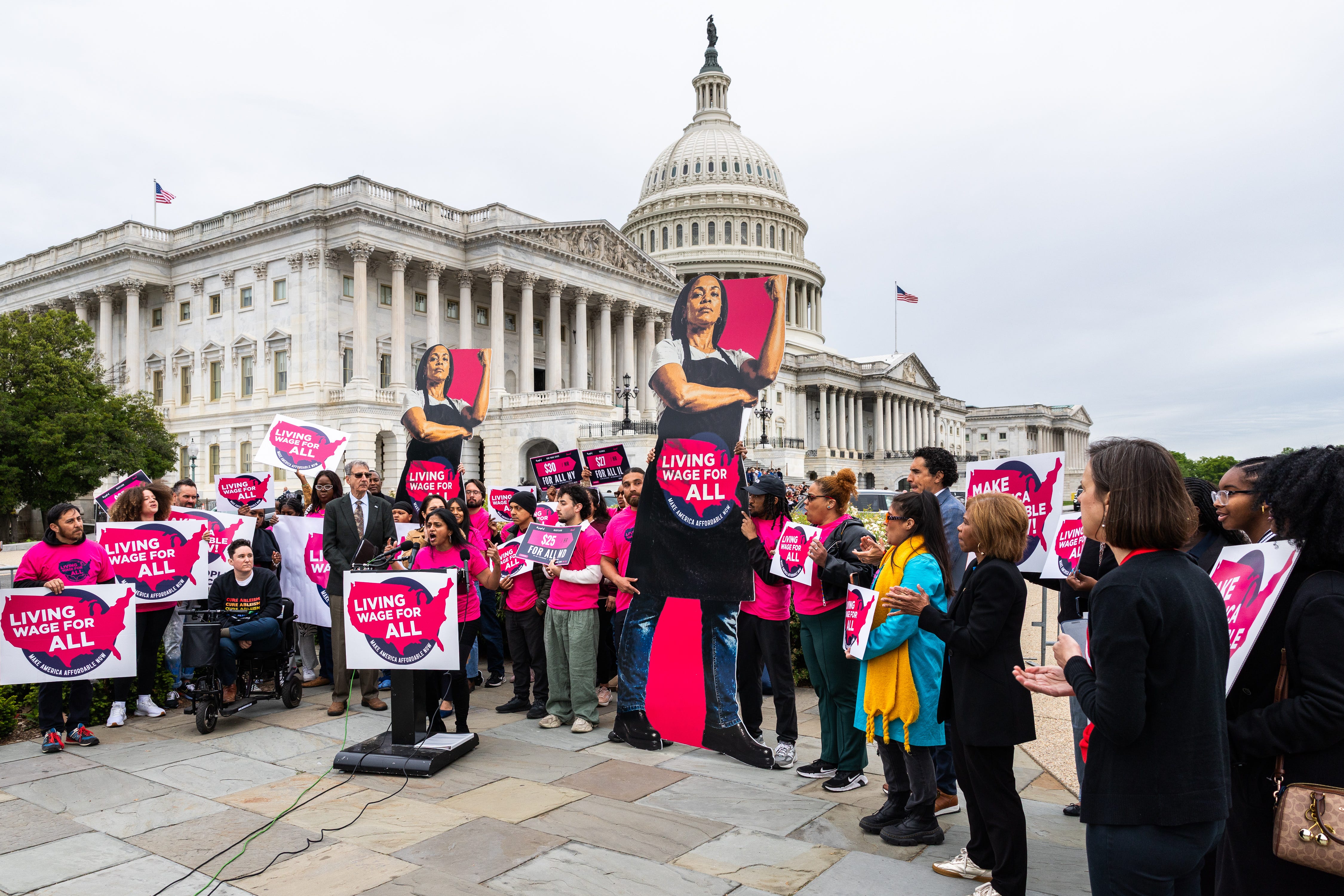
Last Thursday, Senator Chris Murphy (D-CT) introduced new federal legislation that would establish a $25 minimum wage for all, automatically increase over time, and eliminate the sub-minimum wage for tipped workers, incarcerated workers, and disabled workers. The bill is a companion to the Living Wage for All Act in the House (H.R.8555), introduced by Rep. Delia Ramirez (D-IL) in April.
The new federal legislation is the latest achievement of the National Living Wage for All Campaign, which is also leading active state and local campaigns in nine states and Washington D.C. The goal of these campaigns is to establish living wages for all workers nationwide.
Living wages enable all workers to earn enough money to meet their basic needs where they live. Unlike the federal minimum wage, which sets a specific dollar threshold for the whole country (currently $7.25/hour), a living wage starts by calculating the cost of living in a particular place, and estimates what a person or a family living there needs to earn in order to pay their bills. A living wage in a big city will likely be higher than one in a rural town, because the cost of living in the city is higher.
The MIT Living Wage calculator is perhaps the most well-known tool for calculating a living wage in any particular place, but there are others as well. The Economic Policy Institute publishes its Family Budget Calculator, and New York City has its own True Cost of Living calculator, broken out by New York City neighborhoods.
Living wage legislation would also eliminate the subminimum wage, which sets an even lower minimum wage for tipped workers ($2.13), incarcerated workers (under $1), and/or disabled workers ($3.50). The subminimum wage is a relic of slavery, established to avoid paying Black and brown women working in the restaurant industry a fair wage. The subminimum wage has been consistently defended by the National Restaurant Association, though seven states have passed One Fair Wage legislation guaranteeing these workers a full minimum wage. The Living Wage for All campaign builds off these successes.
Living wages are an especially important tool for addressing affordability challenges, because they are responsive to variable economic conditions, like the inflation we’re experiencing now. When prices go up, the living wage increases too.
That’s very different from the status quo, where the federal minimum wage of $7.25/hr has lost 30% of its purchasing power since it was last increased in 2009. The national Fight for $15 campaign was incredibly successful at winning a pay raise for millions of low-wage workers, only to see those gains eroded as the cost of living grew faster than workers’ paychecks.
Today, the affordability crisis is driving the national policy conversation. While some argue increasing the minimum wage could exacerbate affordability challenges, the data doesn’t support that position. Living wage legislation offers a powerful tool to address the affordability challenges many Americans face.
Artists could really use a raise. According to a recent national study, working artists reported a median income of just $15,000 per year from their main job, and 27% earned less than $2,500 in the past 12 months from that job. Fully 57% were worried about at least one form of financial vulnerability – food, housing, medical care, or utilities – and 37% used some form of public assistance.
A CRNY study of New York State artists found roughly 30% of artists report an annual household income of under $15,000/year and another 30% with household incomes between $15,000 and $25,000/year. All told, 85% of New York artists had annual household income of less than $50,000/year. For comparison, median individual earnings in New York State is $70,770/year.
At $25/hour, Living Wage For All legislation would deliver an annual salary of about $52,000/year to full-time hourly workers, a meaningful increase for many artists who struggle to make ends meet. Living Wage for All campaigns in more expensive communities like New York and Alameda County are pushing for even higher thresholds.
And while the legislation only guarantees a living wage to those who earn income via hourly (i.e. W2) employment, the same national study found that 53% of working artists earn income from full or part time work for an organization or person other than themselves, including them in its benefits.
The 48% of artists who earn income via self-employment wouldn’t fall under the legislation, but they would still benefit from upward pressure on wages. For example, when calculating project fees, freelance creative workers could use their local living wage standard to justify their proposed fee, even if the law doesn’t technically apply to them.
Artists are also more likely than other workers to hold multiple part time jobs, many of which are paid hourly. For example, the same national study found that “nearly half of working artists (48%) had at least one temporary job in the last 12 months, while just over three-quarters of working artists (76%) had at least one part-time job over the last 12 months.” More than a quarter (27.5%) held two or more part-time jobs.
As artists combine income from multiple sources, many are likely to take on part-time, hourly work to supplement their income from their creative practice. The common trope of an actor paying the rent by waiting tables is a stereotype for a reason. Living wage legislation helps ensure those side gigs actually pay the bills, making a creative practice more viable for many more workers.
Of course, new living wage legislation isn’t the first time artists have fought for fair pay. Working Artists and the Greater Economy (W.A.G.E.) was founded in 2008 in New York City by a group of visual and performing artists and independent curators. Today, W.A.G.E. publishes detailed rate information for artists working in the nonprofit sector. Their fee calculator is a four-tiered system that sets a floor wage for 15 categories of work, and scales these fees up using a fixed percentage of an institution’s operating budget.
W.A.G.E. certifies institutions who voluntarily adopt their wage standards and provides tools for artists to request institutions commit to their standards through their WAGENCY for artists and art workers. All told, W.A.G.E. has helped artists get paid over $25 million since 2014.
Another important initiative in the arts is Pay Equity Standards, which were developed by a group of organizers in the Chicago theater community. Inspired by organic food certification, the program allows nonprofit arts organizations to obtain certification if they can demonstrate that they meet a checklist of pay equity requirements, which include a commitment to reaching MIT Living Wage standards. The program was launched in January 2022, and is operated by the nonprofit On Our Team.
Other organizations publish crowdsourced data about standard pay rates to help freelance artists negotiate better rates. For example, Dancers Alliance publishes standard rates, Dance/NYC publishes a compensation tool, and the Graphic Artists Guild publishes their Pricing and Ethical Guidelines Handbook. And of course unions negotiate higher wages for their members through collective bargaining agreements.
Prevailing wages are the basic hourly rate (including wages and benefits) paid to workers in a given industry/sector in the same geography. Governments often use prevailing wage standards to set wage floors for work paid for by government contracts (most often in construction, but also in service industries).
Federal law requires federal contracts to pay prevailing wages, and many states and localities have their own prevailing wage laws as well. The National Endowment for the Arts, for example, requires that all grants and contracts adhere to prevailing wage and benefit standards, though this requirement is rarely enforced. You can look up relevant prevailing wage standards here.
The federal rates are prepared by the U.S. Department of Labor’s (USDOL) Wage and Hour Division, under federal regulations, primarily through a survey program of employers administered by the division. Given this methodology, it’s likely that government statistics are less accurate in industries with high rates of self-employment or contract work, like most arts sectors.
That said, prevailing wages are often higher than minimum wages, helping governments set and enforce higher wage and more generous benefit standards in an industry. They are especially helpful in setting higher wage standards in industries with strong unionization rates. W.A.G.E. recently built their Skills Calculator based on the prevailing wage data made available by the BLS.
While of course arts workers should be paid a living wage, it’s important to acknowledge that many organizations that hire arts workers are cash-strapped, small nonprofits themselves. In fact, many of the people who hire artists are artists themselves. Think of a musician who acts as a band leader one night, and a member of the band the next. In a sector that faces constant threats to funding and insufficient support, finding the funds to pay artists fairly can feel like an impossible task, even when we all agree it’s the right thing to do.
Yet there are workarounds. Pay Equity Standards acknowledges the challenges organizations face, and requires them to make and publish a transparent plan to pay MIT Living Wage standards within five years. W.A.G.E. acknowledges that the budgetary constraints of a small nonprofit are different from a large cultural institution, and scales its fee standards accordingly.
The federal Living Wage for All bill recognizes the same challenges, and gives small businesses more time to comply with the new law. While large businesses with 100+ employees/$1B+ in revenue must reach $30 by 2030, small businesses with 25 or fewer employees get a full decade, until 2037, to reach that threshold. It is possible for the arts organizations to pay a living wage, but it may require reorganizing budgets, programming, and operating practices to do so.
Funders also have a role to play. As previously mentioned, the NEA requires all grantees to comply with prevailing wage standards for all the work they fund, yet this requirement is not enforced. Funders in the public and private sectors could require all of their grantees to pay a living wage, and increase their grant amounts to account for those increased costs.
Individual artists have a role to play as well. It’s on all of us, collectively, to reject the starving artist trope and demand fair pay. Fee setting tools like the ones shared above give artists more leverage to negotiate for themselves. Of course, power dynamics and the need for paid work restricts our individual power, but collective advocacy in the public and private sectors helps improve working conditions for all.
Artists and creative workers are joining the fight. For example, the National Arts Policy Alliance (NAPA) officially joined the Living Wage for All campaign in March, bringing the voices of creative workers into the center of the campaign and into alliance with other workers who share their precarious working conditions.
Since that time, creative workers have attended campaign events, planning calls, rallies, and joined the federal bill introduction last week. Experienced narrative and cultural strategists are also helping the campaign build the narrative muscle it needs to win hearts and minds in 2026 and beyond. Teaching artists are involved in the campaign through the National Education Association, and calling for living wages for teaching artists specifically in New York City.
Going forward, there will be many more opportunities to connect artists and artist-led organizations into the state and local Living Wage campaigns happening in New York, Illinois, Maryland, Pennsylvania, Alameda County, Los Angeles, Washington DC, Michigan, Hawaii, and Connecticut.
Are you an artist or an organization who wants to add your voice to the campaign? Fill out this form.
Together, we can ensure that all workers – artists and non-artists alike – can depend on the living wage we all deserve.
New musical software is threatening jobs for musicians on Broadway
Google’s Deep Mind Institute just invested $75 million in independent movie studio A24, with the partnership focused on investing in new AI tools to support film production and distribution
Who will fight for resale royalties for artists when long-time champion Rep. Jerry Nadler of NY retires?
Reflecting on the harms of the One Big Beautiful Bill Act, one year after its passage.
Can we bridge political polarization by rebuilding local power?
New research finds nearly one half of working aged adults had trouble affording health care in 2025.
The House and Senate just passed a landmark bipartisan affordable housing bill, the 21st Century ROAD to Housing Act, which would increase the supply of housing and improve affordability for renters. President Trump is currently refusing to sign the bipartisan measure unless Congress passes his election reform bill.
Newly proposed Office of Management and Budget (OMB) guidelines would further politicize and destabilize federal grant making. The Council of Nonprofits has a helpful overview and guide to submit comments before the July 13th deadline.
The Choreographers Guild won historic new protections for choreographers under the new SAG-AFTRA contract, and this new report delves into the realities and challenges of the profession.
Sen. Bernie Moreno (R-OH) and Sen. Elizabeth Warren (D-MA) have a new bipartisan plan to save Social Security
A new congressional report finds few families benefit from childcare tax breaks that could save them money.
No posts
Comments
Nothing yet. Say the first thing.
Sign in to join the conversation.