
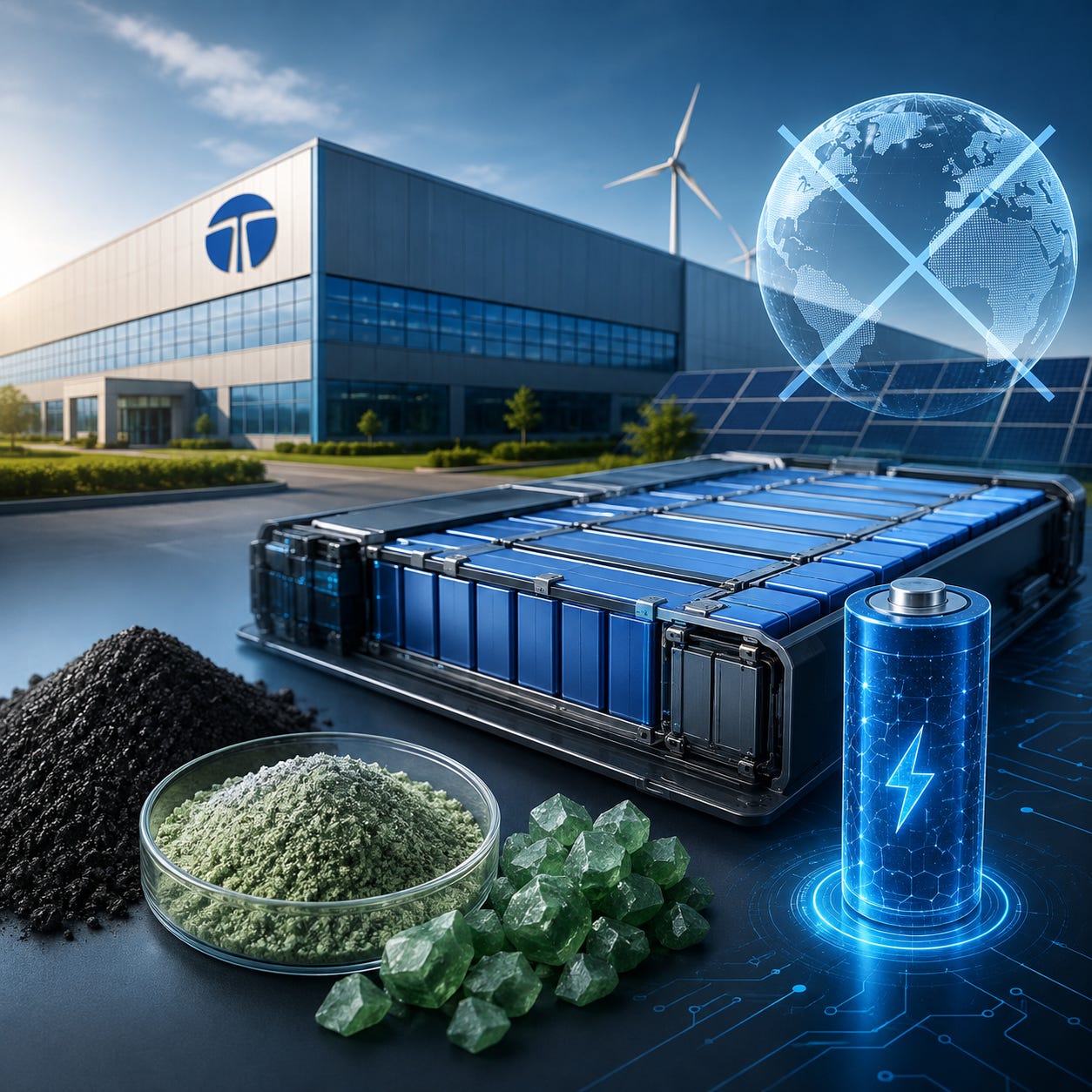
The global race for electric vehicle (EV) supremacy and clean energy transition is undergoing a massive realignment. In a strategic pivot that underscores both geopolitical reality and industrial ambition, Agratas Energy Storage Solutions—the battery manufacturing arm of India’s sprawling Tata Group—has decided to develop its own proprietary lithium iron phosphate (LFP) battery cell technology. This bold move marks a definitive departure from the company’s initial strategy of relying on foreign technology licenses, signaling a new era of self-reliance for India’s automotive and energy storage landscape.
For months, industry insiders and market analysts have watched closely as international supply chains faced mounting pressures. Agratas initially explored partnerships and technology-licensing agreements with established overseas suppliers, particularly in China, to accelerate the setup of its manufacturing plants. However, as geopolitical friction intensified and Beijing introduced tighter export controls on critical battery manufacturing know-how and equipment, the landscape shifted dramatically.
Execs at Tata Group concluded that the feasibility of securing a stable, long-term technology licensing agreement with Chinese firms had dwindled to close to nil. Rather than remaining vulnerable to external export restrictions and bottlenecks, Agratas chose to pivot inward. This decision reflects a broader macroeconomic awakening across major Indian industrial conglomerates—such as Reliance Industries and JSW Group—all of which have encountered similar hurdles in securing foreign tech transfers.
Choosing an in-house development model is no small feat. Developing advanced LFP cell technology completely from scratch inherently increases both upfront costs and development timelines compared to plugging into an existing, pre-packaged commercial platform. Yet, the long-term strategic advantages far outweigh the initial friction. By engineering its own chemistry and cell architecture, Agratas is insulating itself from the whims of foreign policy changes and securing absolute ownership over its intellectual property.
To bring this vision to life, the company is establishing a dedicated pilot production line for LFP cells at its upcoming, mega-scale manufacturing facility in Sanand, Gujarat. This pilot line will serve as the crucible where early cell iterations are synthesized, tested, and fine-tuned before the company scales up to full commercial manufacturing capacity.
To bridge the gap left by walking away from foreign licensors, Agratas has assembled a formidable, cross-border technical team. Engineers and electrochemists from India, South Korea, and China are collaborating closely on the Sanand pilot floor. This diverse pool of talent brings decades of combined expertise in cell fabrication, electrode design, and thermal management, ensuring that Tata’s homegrown LFP cells meet rigorous global performance and safety benchmarks.
The collaborative environment allows Agratas to absorb best practices rapidly while retaining total control over the recipe and assembly processes. By combining international expertise with domestic execution, the company is effectively shortcutting the typical learning curve associated with independent cell manufacturing.
The strategic evolution of Agratas directly impacts its flagship domestic asset: the Sanand battery manufacturing plant in Gujarat. Planned as one of India’s largest cell production facilities, the site is designed to achieve an initial annual capacity of roughly 20 GWh.
Originally intended to rely heavily on imported blueprints, the Sanand campus will now house both the in-house LFP pilot line and scaled commercial production lines. The facility will serve as the heartbeat of India’s domestic EV revolution, churning out high-grade cells locally to feed the rapidly expanding demand of domestic automotive lines and stationary energy storage grids alike.
Interestingly, Agratas is not abandoning foreign partnerships entirely across all chemistry lines; rather, it is executing a nuanced, dual-track technology strategy. While its LFP program is being built strictly in-house, its nickel manganese cobalt (NMC) battery program is taking a different route.
Agratas’s NMC development leverages an established technology licensing agreement with Japan’s Automotive Energy Supply Corp. (AESC), a subsidiary of Envision Energy International. This Japanese partnership has allowed Agratas to bypass early-stage developmental roadblocks for high-energy-density NMC cells, fast-tracking their path to commercialization. Consequently, the Sanand plant is slated to kick off commercial production of NMC cells by early 2027, while the homegrown LFP tech matures concurrently via the pilot line.
Agratas’s ambitions extend far beyond the borders of Gujarat. The company is concurrently building a massive sister facility in Somerset, England, designed to anchor Tata’s European supply chain.
Production at the Somerset plant is scheduled to commence around the middle of next year. Initially, battery cells rolling off the lines in both the UK and India will be funneled directly to high-profile automotive names within the Tata umbrella, including powering luxury icons like the upcoming Range Rover Electric SUV. This dual-continent manufacturing footprint ensures that Agratas can flexibly supply both emerging Asian EV markets and stringent European regulatory zones.
A fundamental pillar of this in-house pivot is Tata’s aggressive capital expenditure into research and development. Beyond the factory floors, Agratas is channeling upwards of $400 million into a state-of-the-art global R&D center located in Bengaluru, India.
Complementing another research facility launched in the United Kingdom, the Bengaluru hub is explicitly tasked with pushing the boundaries of LFP, lithium manganese iron phosphate (LMFP), and next-generation chemistry variants. By fostering deep material science capabilities locally, Tata is ensuring that its batteries are precisely optimized for harsh Indian driving conditions, extreme ambient temperatures, and unique duty cycles.
Lithium iron phosphate has rapidly become the chemistry of choice for cost-conscious, safety-critical EV applications and stationary grid storage. Unlike NMC chemistries, LFP cells completely omit expensive and ethically fraught materials like nickel and cobalt, resulting in significantly lower production costs and enhanced thermal stability.
For India, mastering LFP technology is paramount. It aligns seamlessly with the nation’s aggressive goals for mass-market electric cars, two-wheelers, commercial fleets, and massive renewable energy integration projects. By designing these cells independently, Agratas can iterate faster, customize voltage and form factors to exact client specifications, and avoid the margin-squeezing constraints of paying continuous foreign licensing royalties.
Transitioning from a licensed manufacturing model to an independent developer is fraught with traditional engineering hurdles. Yield optimization, chemical consistency, scalable dry-room processes, and stringent quality validation require years of empirical trial and error.
Industry observers note that Agratas will face intense pressure to fast-track these milestones without compromising safety or structural integrity. However, given the deep pockets of the Tata Group and a calculated willingness to absorb initial development friction, the company is uniquely positioned to weather the transition phase and emerge as a dominant technological titan.
At a macro level, Agratas’s pivot is a monumental win for the Indian government’s flagship “Make in India” initiative and the Production Linked Incentive (PLI) scheme for advanced chemistry cell battery storage. For years, critics argued that India’s green mobility transition would simply trade oil dependency for a new kind of dependency: imported battery cell technology from East Asia.
By choosing to build indigenous intellectual property for LFP cells, Tata is breaking that cycle. The move guarantees that the core brainpower, engineering prowess, and manufacturing know-how remain anchored on domestic soil, fostering a robust local ecosystem of component suppliers, raw material refiners, and specialized talent.
As Agratas pushes forward with its proprietary LFP strategy, the competitive dynamics within the Indian and global EV markets are bound to shift. Automakers that rely on secure, cost-effective, and locally sourced battery cells will find a willing and capable partner in Tata’s energy arm.
Furthermore, as global supply chains fragment and protectionist policies rise across major economies, having a diversified portfolio—in-house LFP technology paired with strategic Japanese NMC licensing—positions Agratas as one of the most agile battery startups in the international arena.
The coming months will be critical for Agratas as the Sanand pilot line fires up and engineering teams validate the first generation of homegrown LFP cells. Success here will validate the bold gamble taken by Tata’s leadership, proving that Indian industry can successfully transition from a technology consumer to a technology creator on the world stage.
With commercial production timelines drawing closer across both its Indian and British facilities, the stage is set for a new chapter in global energy storage. Agratas is no longer just following the blueprint of the global battery revolution—it is aggressively drafting its own.
No posts
Comments
Nothing yet. Say the first thing.
Sign in to join the conversation.