
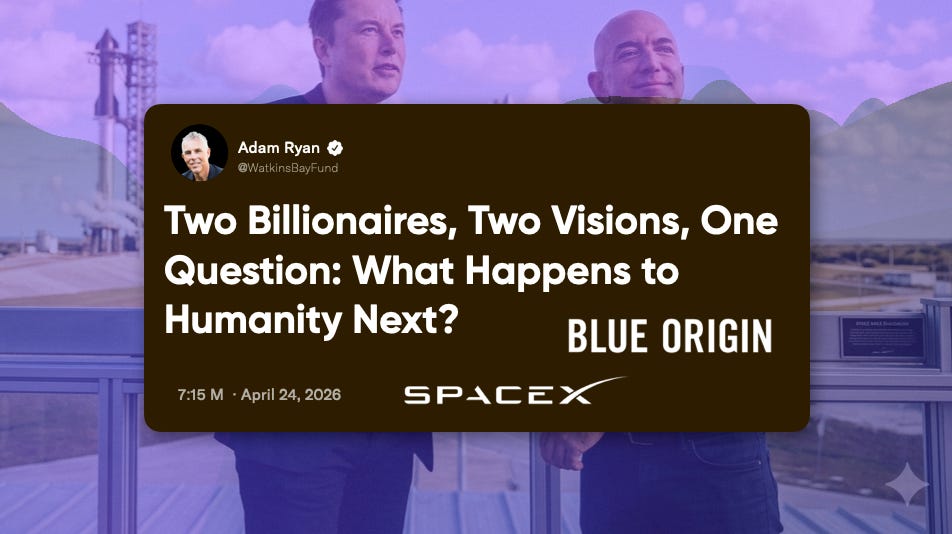
There’s an easy way to tell this story: two billionaires, mountains of cash, rockets everywhere, a bit of Twitter drama, and the occasional celebrity taking a joyride to the edge of space. It’s got all the ingredients of a Netflix docuseries.
That version is real enough. But it misses the part that actually matters.
What Musk and Bezos are building, despite their wildly different philosophies, speeds, and personal brands, marks the biggest shift in space exploration since Apollo. Not because they’re superhuman compared to the engineers who came before, but because they’ve rewritten the rules: who pays, who owns, how fast things move, and what the whole thing is even for.
To really get what’s happening, you have to look past the billionaire rivalry and ask: what problem is each of them actually trying to solve?
Because here’s the twist: they’re not even solving the same problem. And that difference changes everything about what comes next.
Musk’s starting premise is stark. Civilisation as we know it is fragile. A single large-scale catastrophe, an asteroid impact, a pandemic, a nuclear exchange, or an ecological collapse could end human life on Earth. If humanity exists only on one planet, it is, as Musk has put it, a single-point-of-failure species.
In his framing, the solution is to make humanity multiplanetary. And Mars is the target: close enough to reach, large enough to sustain a civilisation, and sufficiently independent from Earth to survive separately.
This is not a businThis isn’t just a business plan wearing a philosophical hat. SpaceX’s entire engineering roadmap starts here. Starship is designed to make launches cheap enough that Mars migration isn’t just a sci-fi movie plot. Musk is talking about the terraforming Mars project so big it makes most startup roadmaps look like weekend chores.t.
It’s a civilisational bet, measured in generations, built on the idea that moving fast might just be the difference between survival and extinction.
Bezos, meanwhile, is worried about a different kind of doom. For him, the problem isn’t that Earth will suddenly explode. It’s that we’re slowly eating it alive. Civilisation needs energy. As it advances, demand grows, but Earth’s ability to supply clean, sustainable energy is limited. Continuing on the current path leads to stagnation, scarcity, and ecological decline, not through catastrophe, but gradual exhaustion.
Bezos’s vision is for Blue Origin to lay the foundation so that “the next generation, or the generation after that, will be able to move polluting industry off Earth, and then this planet will be maintained as it should be.” In this framing, Earth becomes a place to live beautifully preserved, almost like a national park, while the heavy lifting of industry and energy generation happens elsewhere, in space.
Where? Not on Mars. Bezos has expressed his preference for this approach over attempting to travel to Mars, noting that the moon is “three days away, and you don’t have constraints on launch that you have with Mars,” which is only accessible every two years.
His longer-term vision entails something called O’Neill cylinders, enormous rotating space stations, originally conceived by Princeton physicist Gerard K. O’Neill in the 1970s, capable of housing millions of people in Terrestrial conditions. Bezos hopes for a distant future when “a trillion” humans will colonise the solar system, not on celestial surfaces, but in constructed habitats. The cylinders spin to create artificial gravity through centrifugal force. Residents live on the inner surface, looking up at the land instead of the sky.
So, Musk wants a backup planet in case things go sideways. Bezos wants to keep Earth as the main event and move the messy stuff off-world. Two visions, two escape routes, one running from disaster, the other running toward preservation.
These opposing visions lead each to pursue different strategies and timelines, determined by their distinct definitions of humanity’s greatest challenge.
SpaceX operates on a philosophy that has become rare in aerospace: the fastest path to reliable technology is to build, launch, fail publicly, analyse, and rebuild. Fast.
SpaceX tests Starship prototypes frequently, viewing failures as essential learning steps.
By contrast, NASA’s Orion and Artemis programs pursue decade-long certifications, minimising human-rated errors. When a Starship explodes, SpaceX treats it as data for rapid improvement, a philosophy differing sharply from the more risk-averse approach typical in aerospace.
The results speak for themselves. In 2024, SpaceX completed 134 launches with its Falcon rocket family, accounting for more than half of all global launches. By 2024, SpaceX had reused the same Falcon 9 first stage 20 times, and over 60% of all orbital launches globally used reusable technology, a trend SpaceX has largely driven.
The economic impact of reusability is staggering. Where the Space Shuttle cost roughly $1.5 billion per launch, SpaceX’s Falcon 9 launches for approximately $67 million, with costs continuing to fall. Starship promises to drive that number toward $2 million per flight. And here’s the twist most people didn’t see coming: SpaceX is bankrolling its Mars dreams with a satellite internet business. Starlink isn’t the mission; it’s the cash machine that keeps the mission alive. Founders, take note: your business model doesn’t have to be your dream. Sometimes it just needs to pay the bills while you chase the dream.
Blue Origin followed a different trajectory. Founded two years before SpaceX, it reached orbit a decade later. Critics have been merciless, whereas supporters credit its long-term focus on infrastructure, which requires patience.
In November 2025, Blue Origin became the second organisation in the world to demonstrate the reusability of an orbital space rocket, with the vertical landing and recovery of the first stage of its New Glenn heavy-lift rocket. SpaceX achieved this ten years earlier. But the gap is narrowing, and the technology Blue Origin has developed, particularly its BE-4 rocket engine, is powering more than just its own vehicles. The BE-4 engine made its debut during ULA’s maiden launch of its Vulcan rocket in early 2024, and the engines performed flawlessly.
Blue Origin is not only building rockets. It is presenting itself as a supplier of space infrastructure: engines, landers, orbital stations, satellite networks, and, eventually, the kind of heavy-lift capacity required to construct space habitats. Blue Origin has revealed a super-heavy variant of New Glenn that would be taller than the Saturn V rocket and capable of carrying over 70 metric tons to low-Earth orbit.
Blue Origin is betting that slow and steady really does win the race eventually. Whether the market agrees or SpaceX’s breakneck pace leaves them in the dust is still an open question.
This is where the case study gets interesting. Despite their rivalry, which has included legal disputes, public arguments, and competing bids for the same NASA contracts, there is clear evidence of cross-pollination in how each company thinks and evolves.
Blue Origin’s new boss, Dave Limp, seems to have found the fast-forward button. Suddenly, the company is borrowing a few pages from SpaceX’s playbook and picking up the pace. Turns out, you can teach an old rocket company new tricks.
SpaceX, meanwhile, has begun moving in a direction. Meanwhile, SpaceX is starting to look a little more like Blue Origin than it probably wants to admit. Starlink is the first step toward a real orbital economy. Starship isn’t just a Mars taxi; it’s shaping up to be the all-purpose truck of space. And now SpaceX is eyeing the moon, too, which used to be Bezos’s favourite playground. Funny how competition works. Origin’s existence has been genuinely useful to the industry. As one space policy expert noted, “Most satellite providers want to have at least two options for dissimilar redundancy.” The lesson from SpaceX’s own dominance, accounting for roughly 90% of all mass launched to orbit in 2024, is that a single-provider launch market is fragile. Blue Origin’s progress creates redundancy. That redundancy benefits everyone, including SpaceX’s customers, who gain leverage and security from having an alternative.
This isn’t just a billionaire cage match. It’s about making sure the whole industry doesn’t fall over if one company stumbles. Redundancy isn’t just for rocket engines.
To understand what SpaceX and Blue Origin represent, it helps to understand what NASA is and is not.
NASA is the world’s greatest scientific space agency. The Hubble Space Telescope, the Voyager probes, the Mars rovers, and the James Webb Telescope are extraordinary achievements, produced by exceptional people working within a public institution funded by government appropriation. NASA is also, by structural necessity, politically vulnerable, bureaucratically cautious, and expensive in ways that are not always about the engineering.
NASA’s SLS rocket lifts 95 tons to low-Earth orbit at $4 billion per flight. SpaceX’s Falcon Heavy lifts 64 tons at $90 million per flight. That is not a knock on NASA’s engineers. It reflects what happens when a programme is built within a government procurement system that prizes near-zero risk tolerance, political consensus, and the distribution of contracts across congressional districts.
The era of government-led programmes like Apollo and the Space Shuttle, where NASA designed, built, and operated everything, has given way to a new model. Today, the U.S. government acts as a strategic partner and customer for a growing private industry.
This matters for a simple reason: NASA’s budget, albeit significant, is ultimately a political instrument. It can be cut, redirected, or cancelled when administrations change. SpaceX’s revenue is commercial and growing. Blue Origin is funded by one of the world’s wealthiest individuals, who has consistently stated his intent to invest over the long term.
The relationship between NASA and the private companies is now symbiotic rather than competitive. In April 2025, Space Force awarded contracts for FY25-FY29 to three providers: SpaceX at $5.9 billion, ULA at $5.4 billion, and Blue Origin at $2.4 billion. NASA uses SpaceX to fly its astronauts and has contracted both SpaceX and Blue Origin to build lunar landers for the Artemis programme.
NASA provides scientific credibility, mission architecture, safety oversight, and long-term institutional memory. SpaceX and Blue Origin provide speed, cost efficiency, and an appetite for risk that a public institution cannot sustain. Neither model alone is sufficient. Together, they are advancing faster than either might alone.
The significant difference, and it is a real one, is accountability. NASA answers to Congress, the public, and international partners. Private companies answer primarily to their founders. That creates both freedom and risk: the freedom to move fast and take bold bets; the risk that the values and priorities of one or two individuals shape decisions that will affect all of humanity.
If things keep moving the way they are, and there’s plenty of reason to think they will, the next fifty years in space are going to make the last fifty look like the warm-up act.
The International Space Station, humanity’s most expensive construction project, is scheduled for deorbit by 2030. Blue Origin is developing an Orbital Reef commercial space station designed as an “orbital business park” that can accommodate professional astronauts, tourists, or both. The shift from government-owned to commercially-operated orbital infrastructure is not theoretical. It is happening.
Launch costs, which have already fallen dramatically, will likely continue to fall. SpaceX aims to achieve an average cost of less than $100 per kilogram for LEO missions by 2030. At that price point, things that are currently impossible become routine: large-scale in-orbit manufacturing, resource extraction from asteroids and the moon, and regular human presence past low Earth orbit.
Humans returning to the moon, something that has not happened since 1972, looks probable within this decade. Both SpaceX and Blue Origin hold NASA contracts to develop lunar landers. Blue Origin’s $3.4 billion contract includes an uncrewed test mission followed by a crewed Moon landing planned for 2029.
Within 30 years, we might actually have people living somewhere other than Earth, on the moon or maybe in a giant spinning can nearby. That’s not just a milestone. That’s the moment we stop being a one-planet species.
For founders, the near-term impact is less about moon boots and more about what all this space tech means for life down here. Reusable rockets, in-orbit factories, satellite internet, these are already changing how we live and work on Earth, sometimes in ways we barely notice. Starlink is giving internet access to places that used to be digital deserts. And we’re only just starting to see what happens when launching stuff into space gets cheap.
This is where things shift from rockets to what it means to be human. The real difference between Musk and Bezos isn’t just business, it’s what they think civilisation is actually for.
Both billionaires have billed their extraterrestrial pursuits as philanthropic, saying that off-Earth colonies are a form of life insurance that will guarantee humanity’s survival if a natural or human-made catastrophe leaves our home planet uninhabitable. But the paths diverge sharply from there.
Musk’s road points straight to Marsa, a place so inhospitable it makes Antarctica look like a spa weekend. No air, plenty of radiation, and you can only catch a ride every eighteen months. The challenges aren’t just technical. They’re physical, mental, and social in ways we haven’t even begun to figure out.
Bezos, on the other hand, wants to build giant space neighbourhoods, think Manhattan, but floating in a vacuum, spinning to make gravity. No more squeezing into tin cans. In this version, Earth gets to stay beautiful, while the heavy lifting happens off-world. And if you believe the math, there’s room for trillions of people. (Yes, trillions. That’s not a typo.)
Both of these visions are, frankly, wild guesses. The obstacles are huge, and we won’t know if either works for at least a hundred years. Patience required.
What the next hundred years will likely reveal is which assumptions were correct: that humanity is better served through diversifying across planetary terrains, or by building controlled habitats in orbit. It is also possible that both are partially right, and that humanity does both: some communities on Mars, some in constructed stations, and some remaining on Earth.
But the real question, the one that’s worth losing a little sleep over, isn’t just can we do this. It’s who gets to decide what kind of future we build, and whose values shape it.
The choices being made right now in rocket factories, boardrooms, and government contracts are setting up systems that will outlast everyone who made them. The values baked in today will echo for generations.
That’s not a reason to panic. But it is a reason to pay attention.
It’s easy to turn SpaceX and Blue Origin into founder inspiration pornlook at the vision, the grit, the rockets! But the real lessons are less glamorous and a lot more structural.
Business model first: SpaceX using Starlink to bankroll Mars is one of the cleverest funding hacks of our time. The thing that pays the bills doesn’t have to be the thing you care about most. Plenty of founders are building something meaningful, but can’t find the engine to keep it running. SpaceX is proof that you can separate the dream from the cash flow, and that’s okay.
Pace versus patience: Blue Origin’s slow start is a cautionary tale about what happens when you mistake caution for quality. But the last couple of years show that culture isn’t set in stone. Leadership, urgency, and a little discomfort can change everything. Founders, if your company’s culture feels stuck, take notes.
Competition: SpaceX and Blue Origin prove that having a real rival isn’t just good for headlines, it’s good for everyone. Blue Origin’s progress strengthens the entire industry. Founders often forget that serious competition validates your market, sharpens your thinking, and reassures your customers that this isn’t just a one-horse race.
The long game: Musk and Bezos are making bets they’ll never live to see pay off. That’s a kind of freedom most founders never get. Most of us are stuck juggling quarterly targets and five-year plans. But thinking in centuries forces you to ask what really matters, and what’s just noise.
The headline version, SpaceX versus Blue Origin, Musk versus Bezos, is catchy, but it misses the real story.
The real contest isn’t between two billionaires in a rocket-measuring contest. It’s humanity versus its own limits. Whether both companies, for all their differences, are wrestling with the same problem: we’re stuck on one fragile planet, and we’re running out of room to grow. Whether cylinders prove to be the right answer, or whether the answer turns out to be something neither has yet imagined, the work being done right now is building the foundation from which that answer will eventually be reached.
And that foundation, cheaper launches, reusable rockets, orbital infrastructure, a real shot at the moon, is coming together faster than ever before.
Whatever you think of the guys building it, that’s something worth watching.

This perspective is shared by Adam Ryan, a seasoned founder and investor with a deep track record in early-stage ventures, including some that have reached valuations exceeding $5 billion across Australia and California. With multiple startups launched and exited and hundreds more supported through investment and advisory roles at Watkins Bay and Monash University, Adam brings a unique insight into the world of startups and innovation.
Adam now serves as an Adjunct Professor at Monash University, ranked #9 globally for Economics, focusing on the intersection of innovation, startups, technology, start-up simulations, hyper-growth, Capital, and market disruption. One of his significant contributions is as the founder of the Startup Growth Hacking Resource Centre, a hub for emerging founders who want to scale with precision and purpose. This initiative connects him with the startup community, demonstrating his commitment to fostering innovation.
If this sparked some thinking (or challenged a few assumptions), here’s how you can help me help more Founders and Start Up teams:
Follow me on LinkedIn for regular insights on startup growth, founder psychology, venture capital trends, real-world tactics and more
Subscribe to the LinkedIn Newsletter to get fresh, founder-first content in your inbox—no fluff, just the strategies and stories that matter.
Check out the Start Up Growth Hacking Resource Centre – it’s packed with articles, podcasts, curated lists, legal templates, fundraising tools, and proven playbooks for founders ready to start, grow, and scale smarter.
It would be great if you could recommend the Start-Up Growth Hacking Resource Centre and share it with others.

Comments
Nothing yet. Say the first thing.
Sign in to join the conversation.