
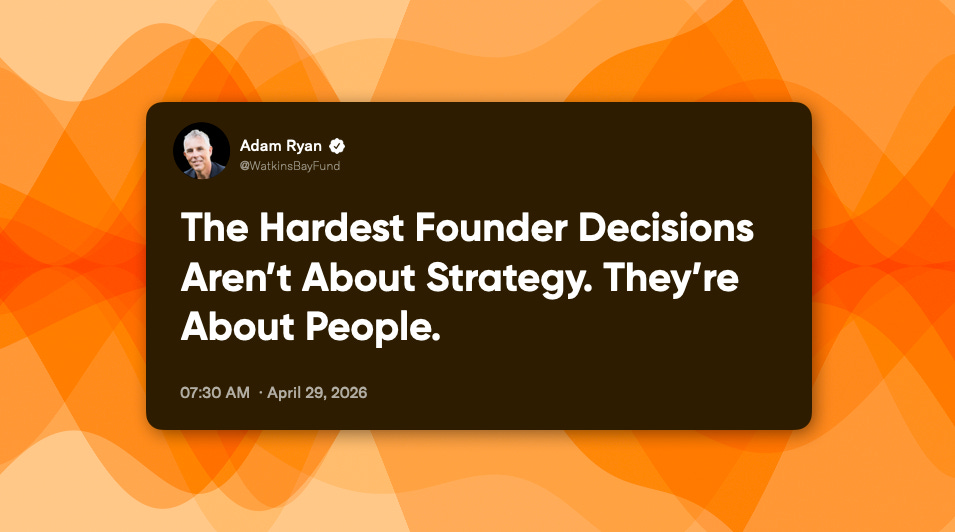
Every founder collects these stories. The hire you were sure about, who turned out to be a square peg in a round hole. The person you kept around six months too long, because letting go felt like tattooing ‘I made a mistake’ on your forehead. The person you let go who didn’t deserve it, but the business needed to survive, and the math refused to care about fairness.
Nobody puts this part in the founder’s job description.
The pitch decks, the fundraising forums, the business books, they prepare you for the market, the product, the strategy. What they don’t prepare you for is the moment you sit across from someone who trusted you enough to leave a good job, and you have to tell them it isn’t working. Or the moment you realise the person you championed internally, defended in board conversations, and restructured a team around was never right for the role. And that part of you knew it earlier than you admitted.
People decisions are where founders get exposed. Not because they’re not smart or committed, but because all the things that make you a great founder, conviction, speed, fierce loyalty, the ability to see potential in people, can quietly turn into liabilities when the context shifts. Your superpower and your blind spot often share a toothbrush.
There is a particular kind of denial that founder-leaders develop around people problems. It looks like optimism. It sounds like loyalty. It dresses itself up in values language: “we don’t give up on people here,” “everyone deserves a chance to grow,” “the culture is built on trust.” All of those things can be true and still be used as cover for the decision you know you need to make and haven’t made yet.
The cost of a wrong hire rarely shows up as a single, dramatic explosion. It’s more like a slow leak. Decisions that should take three days now take three weeks. The team’s energy shifts every time a certain person walks in. The talented people start to quietly check out not because of one big thing, but because the standard you claimed to hold has started to sag. And then there are the meetings where the unspoken truth sits in the corner like a piece of furniture nobody is allowed to move.
The most expensive people decision you’ll ever make isn’t the exit. It’s the four months before the exit when you already knew
One of the more humbling discoveries, after you’ve been through this a few times, is how often your gut was right from the start. Not always context and growth really do change what’s needed. But most of the time, there was a tiny moment early on: a decision made at a funny angle, a reaction under pressure that didn’t quite fit, a conversation that technically went fine but left a faint residue of unease.t went fine, but left a faint residue of unease.
You file it away. You keep going. You tell yourself you’re being too demanding, too hasty, too much of a perfectionist. By the time you’re ready to say it out loud, the problem has already seeped into the culture like coffee into a white shirt.
People’s decisions are where your values either show up or quietly fall apart. Not in the mission statement. Not in the all-hands. In the room, in the moment, when the decision is uncomfortable, and the business case for waiting is right there, waving its hand.
The lesson isn’t ‘never let anyone go.’ It’s that these decisions deserve the kind of honest diagnosis they almost never get. Is this really a person problem, or is it a system problem? Is it a capability gap, or a role design gap? Are they actually failing, or did you set them up in a way that would make most people stumble?
And if, after all that, it really is a person problem, then acting with clarity and speed is also a way of living your values. Holding on when you already know the answer isn’t loyalty. It’s just passing the cost on to everyone else.
Founders rarely get permission to say this out loud, so let’s just say it: firing someone you like is hard. Not ‘debugging a gnarly bug’ is hard. Hard way loss is hard. The person across from you trusted you. They rearranged their life around a vision you sold them. They probably gave you more than the equity and the salary ever captured. They gave you their belief.
That weight is real. Founders who pretend it isn’t aren’t tougher or better at this; they’ve just found a way not to feel it, which is a different skill entirely. The ones who acknowledge it are usually the ones who make the decision cleanly, with dignity, and in a way the other person can actually process and move forward from.
There’s a kind of compassion that protects both sides. It means having the conversation early enough that the person still has time to land somewhere good. It means being specific about what isn’t working, not vague and ‘nice’ in a way that leaves them confused and unable to fix it. It means keeping their dignity intact while being honest about reality, which often means saying, clearly, that the business and the role have changed, and the gap between what you need and what they can deliver is real and structural, not a verdict on their worth.
What this looks like. This pattern doesn’t disappear as the business grows. It just changes shape. The early hires who built the thing with you become the people you have to ask, quietly, if the role has outgrown them. The managers you promoted because they were brilliant individual contributors become the ones you have to assess honestly as leaders. The senior hires you brought in to fix a gap become the people whose cultural fit you’re quietly questioning six months later. Every stage comes with the same uncomfortable question: am I seeing this person clearly, or just the story I built about them?
I have used a 4C framework that I built, in part, because founders need a structure that removes some of that personal charge from the assessment. Capability rather than “is this person smart”, but “do they have the specific capability this role requires, at this stage, now?” Capacity not “are they trying hard enough” but “are the structural conditions in place for them to succeed?” Cohesion, not “do I like working with them”, but “are they genuinely integrated into the way this team makes decisions and builds together?” Culture: not “are they a good person,” but “are the behaviours they’re modelling consistent with the standards the rest of the team is watching for?”
Those four questions, amongst others, asked honestly, change everything. They make the assessment less personal, more useful, and a lot less likely to end in regret for either side.
The founders who handle people decisions well don’t dodge the discomfort. They just get better at living with it. They named it earlier. They have the direct conversation sooner, with more specifics and a real commitment to helping the person through whatever comes next. They act when the signal is clear, not when it’s blaring. And they hold two truths at once: this is hard, and it still needs to be done.
Building a high-performance team isn’t about nailing every hire. It’s about seeing clearly when something isn’t working, having the guts to name it, and the courage to act with both clarity and care. Those qualities don’t come from a framework. They come from choosing, again and again, to be honest when comfort is nowhere to be found.
You can revise. You can tweak the strategy on a random Wednesday afternoon. People’s decisions are more difficult. They carry cost. And if you get them right, they carry everyone’s trust as they watch how you handle them.
Three phases. Five techniques each. Built for founders who want practical tools, not platitudes.
The decisions you make before someone joins are always cheaper than the ones you have to make after. These five techniques are designed to slow down the part of the process everyone wants to rush.
Before you write a single line of a job description, articulate four things in writing: the specific outcomes this role must deliver in the next twelve months; the decisions this person will own independently; where their authority ends and escalation begins; and the two or three moments in the next year where their work will make or break something important. If you cannot write those four things down clearly, you are not ready to hire. You are ready to design a role.
Most bad hires are made into poorly designed roles. The person arrives to negotiate structural ambiguity that should have been resolved before their first day.
Write the role brief in outcomes, not activities. What does success look like after 90 days? After 12 months? If you can’t answer both, you’re not ready to post the role.The interview question “what would you do if…” selects for articulate people who can construct plausible answers under pressure. The question “tell me about a specific time when…” selects for people who have actually done the thing. Get specific. What was the decision? Who was in the room? What did they actually do, or what does the best version of them wish they’d done? What went wrong, and what did they learn? The gap between a polished candidate and a capable one almost always shows up in the specificity of their real examples.
Founders are pattern-matchers. A confident hypothetical answer can trigger false recognition, “that’s how I’d think about it,” when you’re actually evaluating presentation skill, not capability evidence.
Prepare three role-specific past-behaviour questions. Commit to remaining in the specific, not the general, for each answer. If a candidate can’t give you a real example, that is the answer.Two candidates: one who meets your specification perfectly but has plateaued; one who is slightly below your ideal but is growing fast, self-aware, and operating at the edge of their current capability. In most early-stage contexts, the second candidate will outperform the first within eighteen months. The slope of the line matters as much as where it starts. Questions that surface trajectory: What are you working to get better at right now? Where has your thinking shifted most significantly in the last year? What would you do differently in a role you’re proud of?
A high-specification hire who isn’t growing will be a culture tax on every ambitious person around them within a year.
Add a “what are you currently learning” thread to your process. Low-trajectory candidates give polished answers about completed learning. High-trajectory candidates give specific, current, slightly uncomfortable ones.Founder-led hiring is susceptible to a specific bias: you hire people whose thinking pattern mirrors yours. They’ll feel like great culture fits because they process problems the way you do. Build a process where at least one assessor is someone who thinks differently from you, a different function, a different communication method, a different way of weighing decisions. Their read will surface things yours won’t. If two people who see the world differently both say yes, you have more signal than if five people who think alike do.
The hires that hurt most are rarely obvious mismatches. They’re the people who were brilliant mirrors and whose blind spots were identical to yours.
Identify one person in your current team whose judgment you trust, although who regularly sees things differently from you. Make them a standing part of your senior hiring process.Reference calls from a provided list tell you what the candidate wants you to know. The reference call you make to someone who isn’t on the list, a former colleague you found yourself, a mutual contact, someone who worked alongside them rather than above them, tells you something closer to the truth. The question that matters most on any reference call: “Would you hire this person again for a demanding role? Why, or why not?” The quality of the hesitation before the answer is often as informative as the answer itself.
Most reference calls are social practices. The call the candidate didn’t arrange is an actual signal.
For every senior hire, identify at least one reference who wasn’t provided. At the end of any reference call, ask: “Is there anyone else I should speak with who knows this person’s work well?”The first ninety days reveal more than the entire interview process. These strategies help you read what’s actually in front of you, not the story you told yourself when you made the offer.
Most people can perform well in structured contexts, such as all-hands meetings, strategy sessions, and one-on-ones with the CEO. The signal is in the unstructured moments: how they handle a setback on a project they own, manage a disagreement with a peer, and respond when something they’ve built is challenged. Create low-stakes pressure environments early, a difficult problem to work through with a team member, a real piece of feedback to give or receive and watch what comes back. That is the person you’re actually working with.
Interviews test performance. The first 90 days are a test of character, and a character under light pressure is a leading indicator of one under real pressure.
Assign a real, ambiguous problem to a new senior hire in their first thirty days. Not to evaluate the output to observe how they manage the uncertainty.A common failure in probationary assessment is that the person being evaluated is managing upwards well, while the people working alongside them are already feeling the friction. Build structured feedback loops that include peer-level input from the first 60 to 90 days. Not an annual review mechanism, a lightweight, direct question: “How is working with this person going? What’s one thing that’s working? One thing that’s creating friction?” Peer feedback patterns are almost always more predictive than manager assessments at this stage.
People who aren’t working out often manage upward beautifully and laterally with difficulty. You’re measuring the wrong relationship if you only ask the people above them.
At sixty days, ask three peers of a new hire (separately and informally) for one specific observation, positive or concerning, about how the induction is going.Before you conclude that someone isn’t working, ask four questions honestly: Do they have clarity on what they own? Do they have the decision rights they need to be effective? Do they have the information they need, when they need it? Have you given them feedback specific enough to act on? If you cannot answer yes to all four, you do not yet have a person problem. You have a system or a leadership problem. The diagnosis matters because the intervention is completely different, and exiting someone from a broken system for failing is equally unfair and expensive.
The single most common and costly mistake in early-stage team management is misjudging a structural problem as a talent problem.
Run the four questions as a literal checklist before any performance conversation. Which ones can you genuinely answer yes to? Which ones can’t you? The honest answers tell you what to fix first.Vague feedback protects the person giving it. “I’m not sure it’s the right fit”, or “they’re not quite at the level we need”, are not feedback; they are cover for the discomfort of being specific. Specific feedback sounds like: “In the last three weeks, I noticed this specific behaviour in these specific contexts, and the impact was this.” Only specific feedback can be acted on. If you cannot give specific feedback about what isn’t working, you are not yet ready to make a final assessment. You need more observation, not less.
Abstract feedback leads to abstract improvement or none at all, because the person doesn’t know what to change. Specificity is a kindness, not a cruelty.
Before any performance conversation, write out the specific observable example of what you saw, when, and what the consequence was. If you can’t write it in those terms, the feedback isn’t ready to give.Founders often wait for a moment when it is impossible to explain away a clear failure, a serious mistake, a visible breakdown. But the more reliable early signal is often quieter: the slow withdrawal of peer engagement, the topics that consistently get avoided in one-on-ones, the small decisions that keep getting rerouted around someone, the pattern of things that take slightly longer than they should. That quiet evidence is almost always more honest than the dramatic moment, and it almost always arrives earlier.
The dramatic moment isn’t the problem; it’s the accumulated evidence of a problem that existed long before. The earlier you read the quiet evidence, the more options you have.
Build a habit of noting, not just reacting to, the small signals. A simple private log “noticed this, date, context” surfaces patterns before they become crises.Done well, an exit is not a failure; it’s clarity. These techniques are about doing it honestly, with care, and in a way that allows both parties to move forward with dignity intact.
Most founders wait too long. The internal calculus is understandable: the cost of acting too early feels higher than the cost of waiting for more evidence. But in practice, the cost of waiting is almost always higher. Every week after the signal is clear, the team watches you tolerate something and calibrates their standards to the gap between what you say and what you do. When you are genuinely certain the situation is not resolvable, the most humane and culturally protective thing is to act. The extra months do not close the gap. They distribute the cost.
The team knows before you announce. They’re watching how long it takes you to act once the signal is visible to everyone. How long you wait is itself a cultural signal.
Ask yourself: “If I knew for certain this wasn’t going to change, what would I do?” If the answer is clear, the question of whether it might change is no longer doing the work you’re using it for.The most compassionate exit conversations are not the vaguest ones. They are the clearest ones. The person you’re letting go deserves to understand what didn’t work, not as a verdict on their character, but as an honest account of the gap between what the job required and what the match was. “The role has changed significantly as the company has grown, and the gap between what we need now and what you’re positioned to deliver has become too large” is honest. “This isn’t working” is not. Specific accounts give people something real to learn from and move forward with.
Vague kindness protects the person delivering the news, not the person receiving it. They will reconstruct this conversation for months. Give them something accurate to reconstruct.
Write out the two or three most specific and honest things you can say about why this isn’t working. Then, in the conversation, actually say them clearly, without cruelty, and without softening them into meaninglessness.One of the most underused tools in exit conversations is the explicit separation of the person’s worth from the specific mismatch being described. “This is not a comment on your capability in general; it is a specific account of what this role necessitated and what the fit was in this context” is a sentence worth saying. It matters because most people catastrophise feedback, translating a role mismatch into a global comment on their competence. You can interrupt that translation if you’re deliberate about it, and doing so is both honest and genuinely kind.
How people feel about leaving shapes how they talk about leaving. And how they talk about leaving shapes your employer brand, your future recruiting, and the morale of the people who remain.
Script the sentence that separates person-worth from role-fit before you go into the conversation. It will feel awkward to say out loud. Say it anyway.The exit conversation is the most visible one. But the communication to the team in the hours and days that follow is what shapes the cultural consequences. Be honest without being detailed. Be respectful without being evasive. “We’ve made the decision that [name] is moving on. It was a considered decision, and we’re grateful for what they contributed. We’ll share more about how we’re thinking about the role when we have more to share,” and then actually communicate more when you have it. The team does not need the details. They need to know you make decisions with integrity and communicate them with respect.
The team is watching how you treat the person leaving. They are deciding, in real time, whether they can trust you with their own vulnerability.
Prepare two communications: one for the direct team and one for the wider organisation, before the exit conversation. Don’t improvise either. Prepare both.Every departure, voluntary or not, is a data source. What did the hiring process miss? Was the role well-designed? Was the onboarding adequate? Was feedback given early enough and specifically enough? Was the support appropriate? Was the culture the person arrived in the one you intended to build? The exit diagnostic is not about blame. It is about systemic learning, extracting insights that boost future decisions. The founders who build consistently strong teams don’t just make better hires. They learn more from hires who didn’t work out.
Repeated exit patterns almost always indicate an underlying problem, such as hiring, onboarding, culture, or role design that no individual replacement will solve.
After any significant departure, set a 30-minute debrief with yourself or a trusted co-founder: What did we miss, and at which point? What would we do differently? Write it down. Actually use it next time.Founders Resources
We Were Taught the Wrong Definition of Value
·
Apr 21

The startup that never quite got there. The athlete who trained for a decade, only to find the finish line kept moving. The musician who poured years into their craft, then watched someone with less skill and better timing ride the wave they had been waiting for. The founder who did everything right, except the market blinked, the funding dried up, and the moment slipped away.

This perspective is shared by Adam Ryan, a seasoned founder and investor with a deep track record in early-stage ventures, including some that have reached valuations exceeding $5 billion across Australia and California. With multiple startups launched and exited and hundreds more supported through investment and advisory roles at Watkins Bay and Monash University, Adam brings a unique insight into the world of startups and innovation.
Adam now serves as an Adjunct Professor at Monash University, ranked #9 globally for Economics, focusing on the intersection of innovation, startups, technology, start-up simulations, hyper-growth, Capital, and market disruption. One of his significant contributions is as the founder of the Startup Growth Hacking Resource Centre, a hub for emerging founders who want to scale with precision and purpose. This initiative connects him with the startup community, demonstrating his commitment to fostering innovation.
Start Up Growth Hacking Resource Centre
Comments
Nothing yet. Say the first thing.
Sign in to join the conversation.