
Friends and Families
On January 10, 2026, I made a pilgrimage to RV Capital’s Annual Gathering in Engelberg, a ski resort near Zurich, where like-minded investment managers and allocators come together to celebrate long-term investing. This year marked the tenth anniversary of the first Gathering organized by Rob Vinall. As many of you know, our Present Value of the Future Summit was modeled after Rob’s Gathering. As you also know, the Japanese are very good at copying great ideas.
Among the many impressive guests was Ernie Garcia, the CEO of Carvana. Rob and Ernie had been through an extraordinary—and highly volatile—journey together. Carvana’s share price collapsed from a peak of $376.83 in August 2021 to below $3.55 in December 2022, a decline of more than 99%, before rebounding to $473.31 as of January 2026.
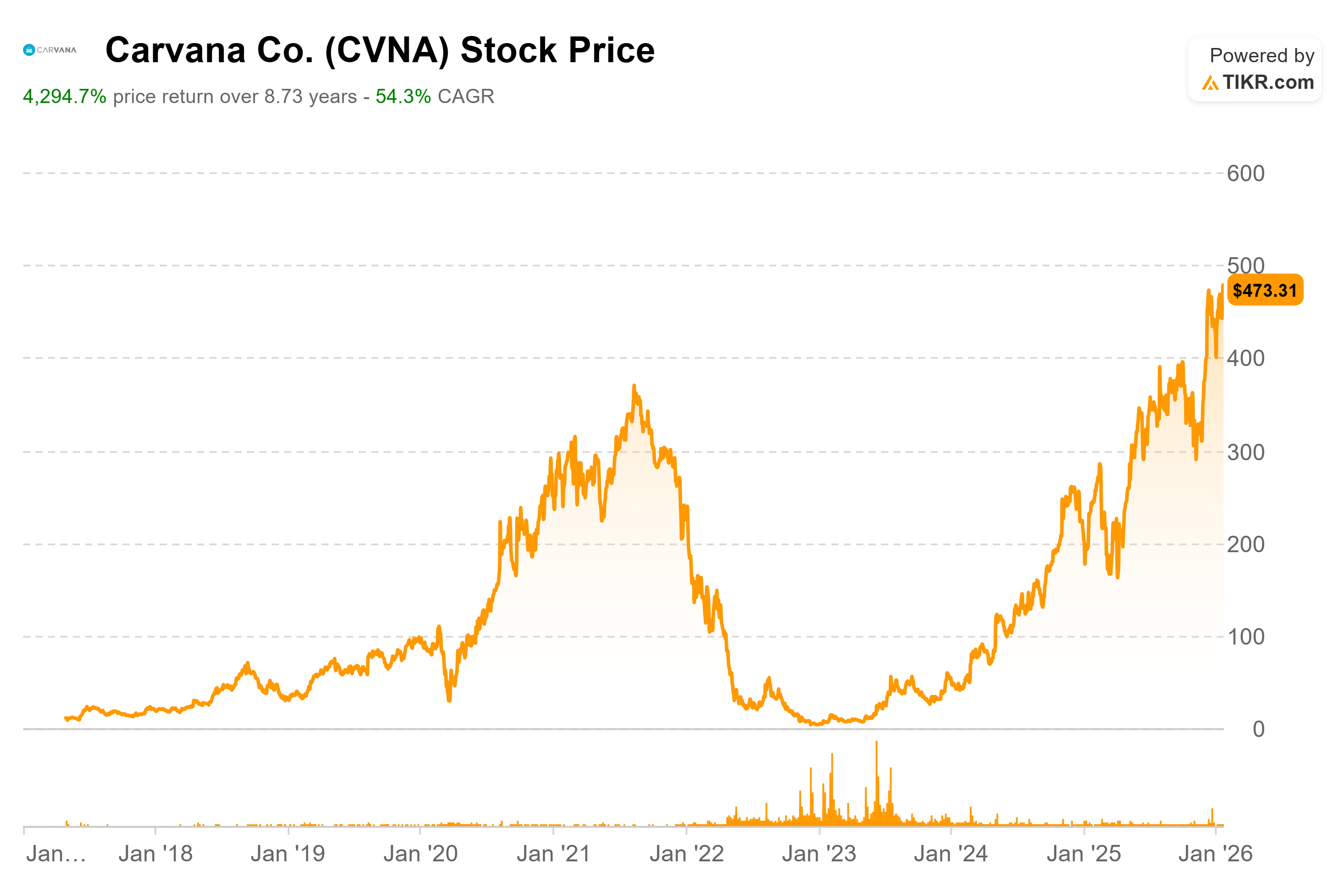
At the depths of that collapse, many believed Carvana would run out of cash and fail. The stock price certainly suggested as much. Very few investors stayed with the company, and even fewer added capital as the shares approached their lows. In hindsight, Rob’s decision to remain invested appears heroic—but at the time, was it brave, reckless, or simply a disciplined application of value investing?
It is dangerous to generalize from such an exceptional outcome. Still, I found it important to reflect on why Rob was able to stay in the game when almost everyone else walked away. We cannot know his full reasoning, but one thing is clear: Rob invested in Ernie, not in a stock certificate.
Warren Buffett famously said,
“I try to buy stock in businesses that are so wonderful that an idiot can run them. Because sooner or later, one will.”
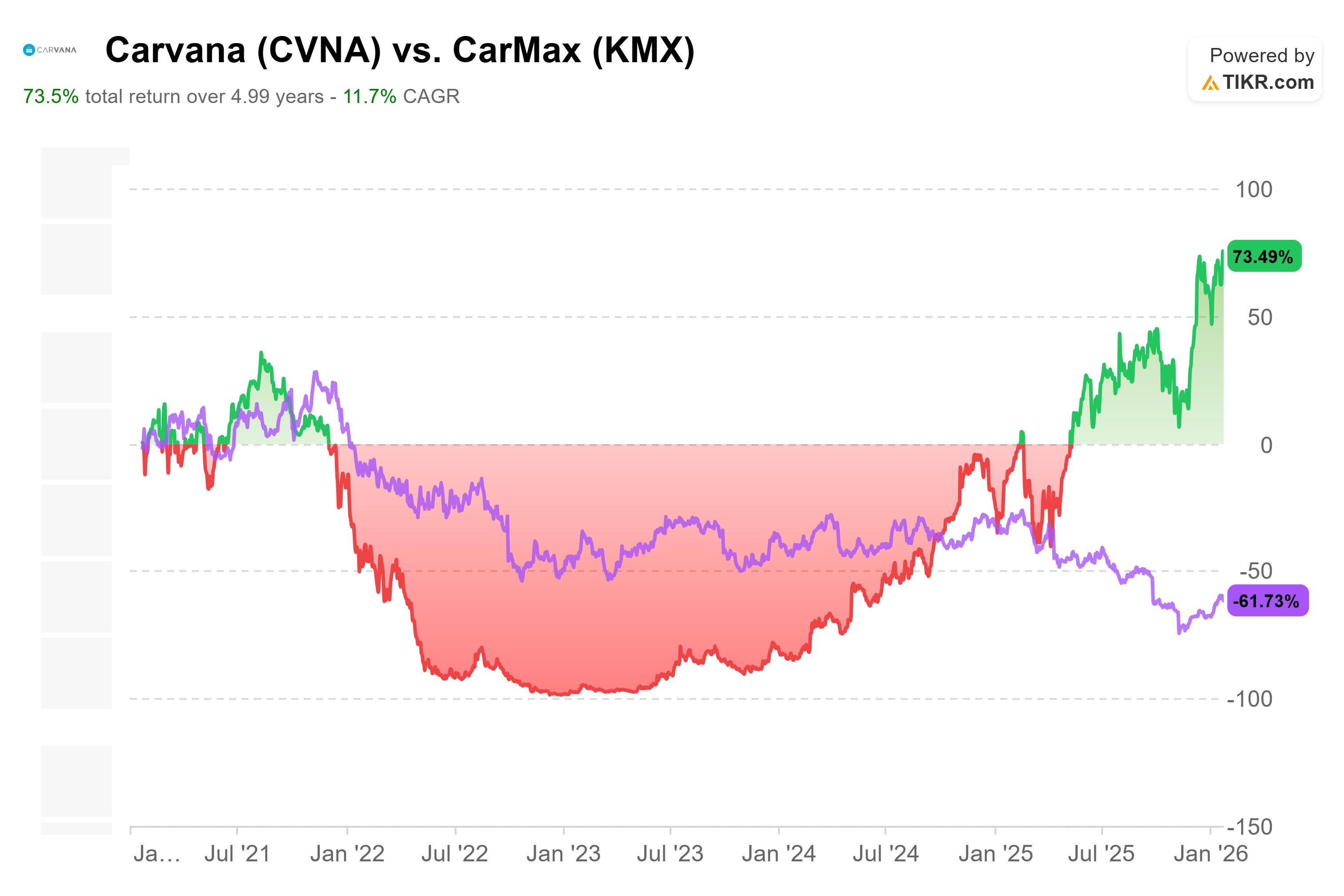
Carvana, clearly, would not be where it is today if it had been run by an idiot. At the same time, I doubt Buffett himself would feel comfortable owning a business like Carvana. This makes the comparison with CarMax—an incumbent Buffett once owned briefly—even more instructive. Over the past five years, CarMax’s shares declined by 62%, while Carvana’s shares rose by 73%, leaving CarMax’s market capitalization at roughly one-tenth of Carvana’s today.
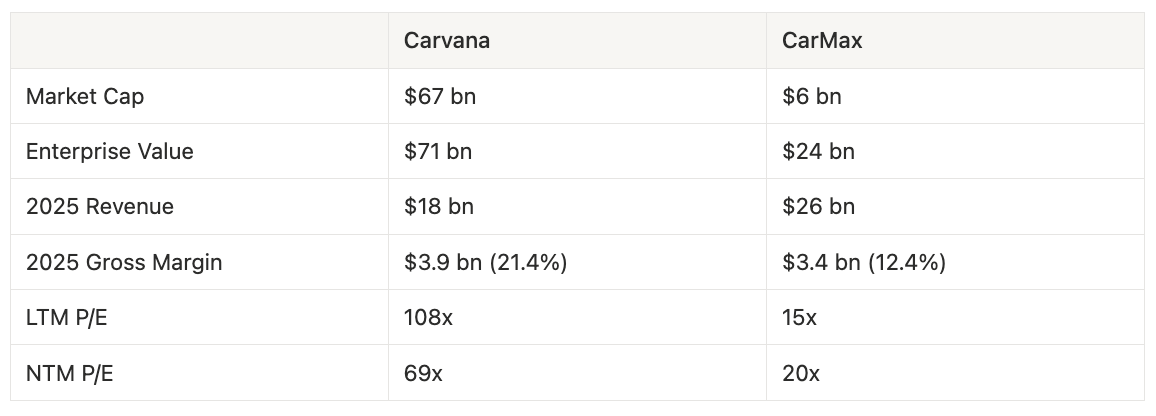
Data as of January 26, 2026
Carvana is still only marginally profitable, but it enjoys meaningfully higher gross margins than CarMax. Its business model appears structurally superior. The company did not merely survive turbulence; it emerged stronger.
The underlying explanation is not a spreadsheet—it is people.
Contrary to Buffett’s quote, I believe human beings can sustain far longer time horizons when we invest in people rather than in businesses alone. That distinction—subtle but powerful—helps explain why some investors can endure volatility that others cannot.
I will share another example below.
On the second day of the Annual Gathering, Rob invited Robert Miles, the author of The Warren Buffett CEO: Secrets from Berkshire Hathaway Managers. Miles shared many intriguing stories drawn from his long relationship with Warren Buffett and others within the Berkshire circle. Yet it was one seemingly unremarkable comment that stayed with me.
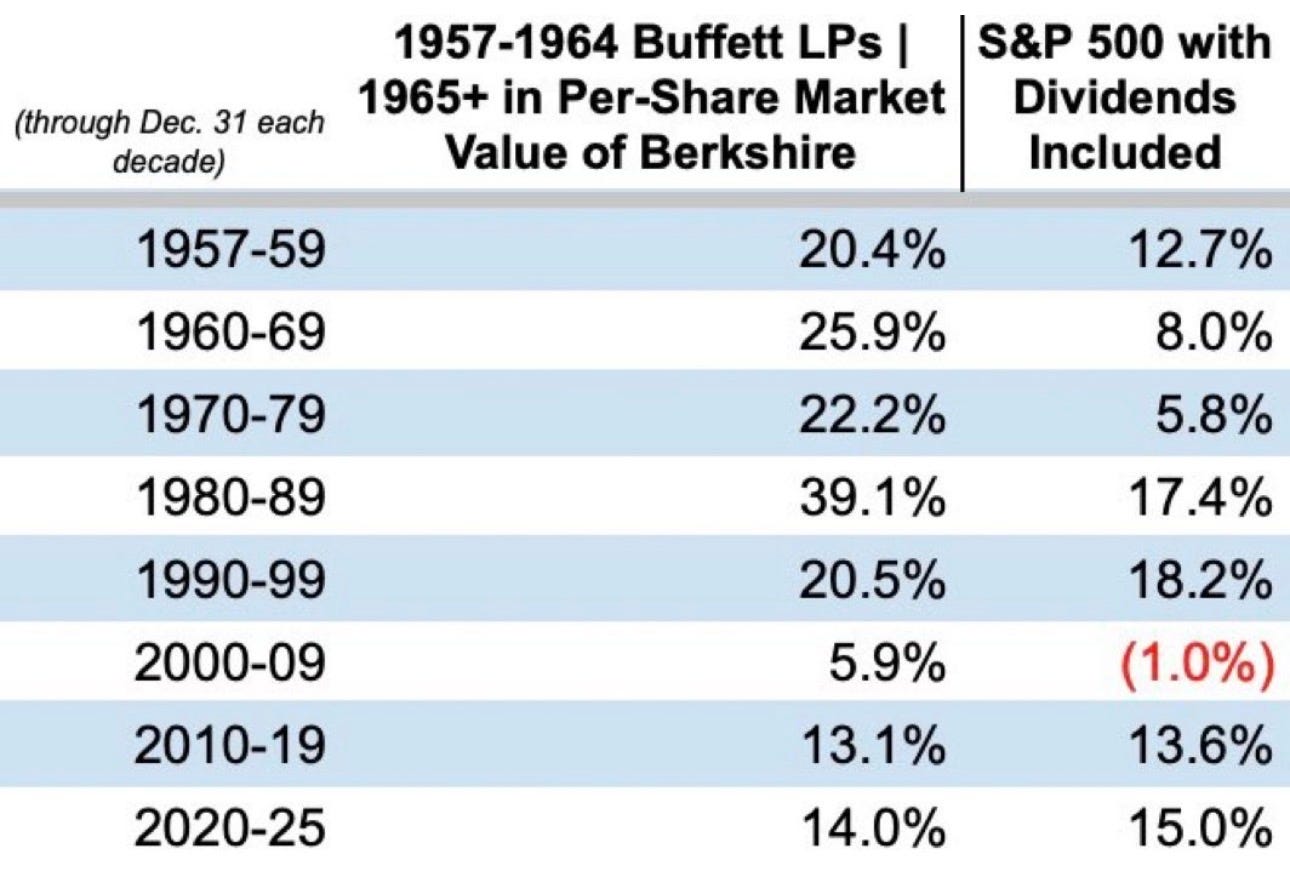
Miles mentioned that he had been a long-term shareholder of Berkshire Hathaway and had never sold his shares. Over roughly twenty-five years, his investment compounded at about 10.9% annually. The first dollar he invested became approximately thirteen dollars. By any standard, this is an excellent outcome.
But over the exact same period, the S&P 500 generated an annualized return of around 10.2%. A dollar invested passively in an S&P 500 ETF became roughly eleven dollars. That is meaningfully lower than Berkshire’s result—but not by much. As a passive investment, it is far from disappointing.
And yet, the perception could not be more different.
I know many people who became wealthy by owning Berkshire Hathaway for decades. They speak with deep admiration for Buffett and for Berkshire. But I know very few people who describe themselves as having made a fortune by holding the S&P 500. Statistically, there should be many legendary investors whose outcomes were nearly as good—simply by owning the index. They exist, but they are rarely celebrated.
The paradox deepens when we examine Buffett’s own track record. Since around 1990, Berkshire has only marginally outperformed the S&P 500. By Buffett’s own historical standards, this period could be described as mediocre. And yet, admiration for Buffett has not faded—if anything, it has intensified.
Why? Part of the answer lies in investor behaviour.
The SPDR S&P 500 ETF Trust, is the most widely owned and actively traded ETF in the world. Its market capitalization today is roughly USD 700 billion—only about 1% of the total market capitalization of the S&P 500 constituents. Yet SPY’s typical daily trading volume is USD 30–40 billion, while the combined daily trading volume of the underlying S&P 500 companies is approximately USD 500–700 billion.
In other words, investors trade the index far more frequently than they trade the businesses that make up the index—despite ETFs having been designed for long-term ownership.
John Bogle, the creator of the index fund, understood this tension well. He famously warned: “ETFs are fine for long-term investors—but they are a temptation to trade.”
And temptation is the enemy of compounding.
When investors buy an ETF, they are buying an abstraction. There is no face, no steward, no narrative. The result is a constant urge to act—to rebalance, to time, to respond. Trading creates the illusion of control. More often than not, it produces the opposite outcome.
Berkshire Hathaway is different. Investors are not buying an index; they are buying a person. Or more precisely, they are buying judgment. By anchoring capital to Buffett, investors naturally adopt a longer time horizon. They trade less. They endure volatility. They allow compounding to work. Many succeed not because Berkshire’s returns were dramatically higher, but because they stayed invested.
This is what makes long-term investing genuinely difficult: resisting the urge to intervene.
We entrust capital to external investment managers because we believe they are better investors than we are—but just as importantly, because they create distance between us and the market. Distance reduces temptation. If we retain constant access to trading platforms, we will trade. That is human nature.
This observation leads to an uncomfortable conclusion. Staying invested is not primarily a function of intelligence, information, or even conviction. It is a function of structure. Most individual investors fail not because they lack good ideas, but because their investment setup allows—and even encourages—constant intervention. Access creates temptation. Temptation leads to action. Action, over time, destroys compounding. The advantage of institutions and endowments is not superior insight. It is distance. Distance from prices. Distance from noise. Distance from the impulse to act. Once this is understood, long-term investing stops being a question of temperament and becomes a question of design.
Relationships must be long-lasting, not transactional. We regard both our families and our investment managers as partners. For this reason, we do not refer to our families as “clients,” nor do we describe the investment managers we work with as “funds.” Those terms imply transactions, not partnerships.
Structurally, we are an investment advisor and do not manage capital on a discretionary basis. Our work is entirely advisory. We help families think through what kind of portfolios they should build and manage, but more importantly, with whom they should build those portfolios. We do not advise families when to buy or sell funds. That is not our business.
Selecting the right investment managers is therefore critical—but not in the conventional sense. We do not invest with managers simply because they have delivered the strongest recent performance, even when those results appear spectacular. Nor do we seek the safest or most predictable managers; taking risk is unavoidable if we aim to compound capital meaningfully. Instead, we invest with managers where there is strong alignment of interests and a reasonable expectation of durable returns over the next ten to twenty years.
Our objective is straightforward: to generate 5–8% inflation-adjusted returns over the long term, accepting volatility while avoiding permanent loss of capital.
We embrace long-term relationships because we are not investing in who our managers were ten or twenty years ago, nor only in who they are today. We are investing in who they will become. We believe that good investors can improve over time—through experience, maturity, deeper understanding, and, increasingly, the thoughtful use of artificial intelligence.
People are not static. More importantly, people learn.
Investment mistakes are inevitable. When they occur, the critical question is not whether mistakes were made, but whether learning followed. If a manager internalizes errors and improves judgment and process, the relationship often becomes more valuable over time. In such cases, we have paid tuition. Quitting precisely at that moment would be irrational.
The challenge is that learning takes time to verify. The feedback loop in investing is long and noisy. This is why we require a minimum of three years before concluding that a relationship itself was a mistake. In private markets, this horizon is even longer, often spanning a decade. Patience is therefore not optional—but neither is ongoing evaluation.
A relationship that’s not working out turns into a game of Katamari. Your friend complains about being in a bad relationship. If you ask, “Why don’t you just break up?” they’ll frequently say, “Because I’ve put so much time into trying to make this relationship work.” Sometimes, they’ll even say, “I put my heart and soul into it.” The more time they put in, the less likely they are to break it off, which leads to them investing more time to get it to work. That makes them even less likely to break up. And so on. No wonder that once you have this talk with a friend, you end up having it over and over again. Their dysfunctional relationship keeps rolling up mass—living arrangements, friends, pets, consumer purchases, property—until they’re ripping rainbows out of the ground. Annie Duke, “Quit”
If building long-term relationships is one side of the discipline, terminating relationships is the other.
Persisting with underperforming investment managers for too long is not patience; it is a capital allocation error. A portfolio weighed down by too many such relationships will fail to meet its objectives.
The hidden cost is not only performance. It is attention.
The House of the Mulans consists of seven people, including three dedicated to investing. We do not believe that adding more investment professionals would improve outcomes. On the contrary, it would dilute relationship depth. Every investment manager we recommend is known by the entire investment team. This creates a dense relationship web. As that web expands, it thins—and judgment deteriorates.
In practice, a single investment analyst can deeply lead no more than ten relationships. With three of us, that implies a natural limit. Adding new relationships therefore requires ending others. This constraint is unavoidable—and emotionally difficult.
Ending relationships is often harder than starting them. Time invested, trust built, and friendships formed all create inertia. The most difficult distinction is between underperformance that is cyclical and underperformance that is structural. The line is rarely clear in real time. When long-term relationships work, however, the rewards can be extraordinary.
One of our relationships recently reached its tenth anniversary. Over that period, the manager generated approximately 15% net annual returns, turning an initial dollar into roughly four. We invested early, long before scale or recognition, and grew alongside the business. Today, that trust allows for clearer communication, better alignment, and a more durable partnership. And yet, trust never replaces evaluation.
No relationship—no matter how long-standing or successful—is exempt from scrutiny. Past success earns respect, not permanence.
This is the paradox at the heart of relationship management in a family endowment office: the patience required to benefit from long-term partnerships must coexist with the courage to reassess and, when necessary, to quit—often before it feels comfortable. Relationship management is not a soft skill. It is the core discipline.
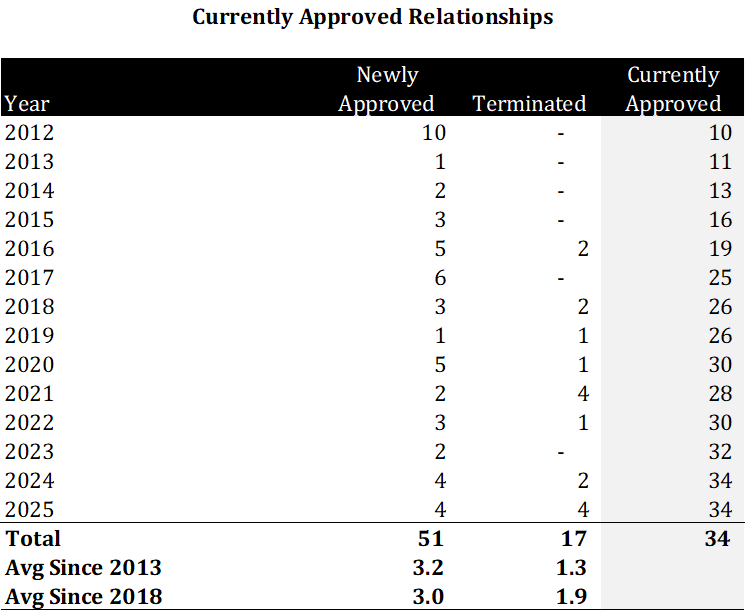
In 2025, we “quit” four investment-manager relationships. This was the highest number of terminations since our inception—matching the level in 2021—while we added four new managers during the same year. We do not attempt to time terminations, and candidly, we are not particularly good at them. Our bias has always been to give relationships more time than is strictly necessary.
Since inception, we have had 51 investment-manager relationships, with an average duration of 6.9 years. Relationships with our currently approved managers are slightly longer, averaging 7.1 years, compared with 6.6 years for managers we no longer work with. As Star Magnolia Capital continues to operate, we expect this gap to widen gradually, stabilizing around a 10–12 year average relationship length.
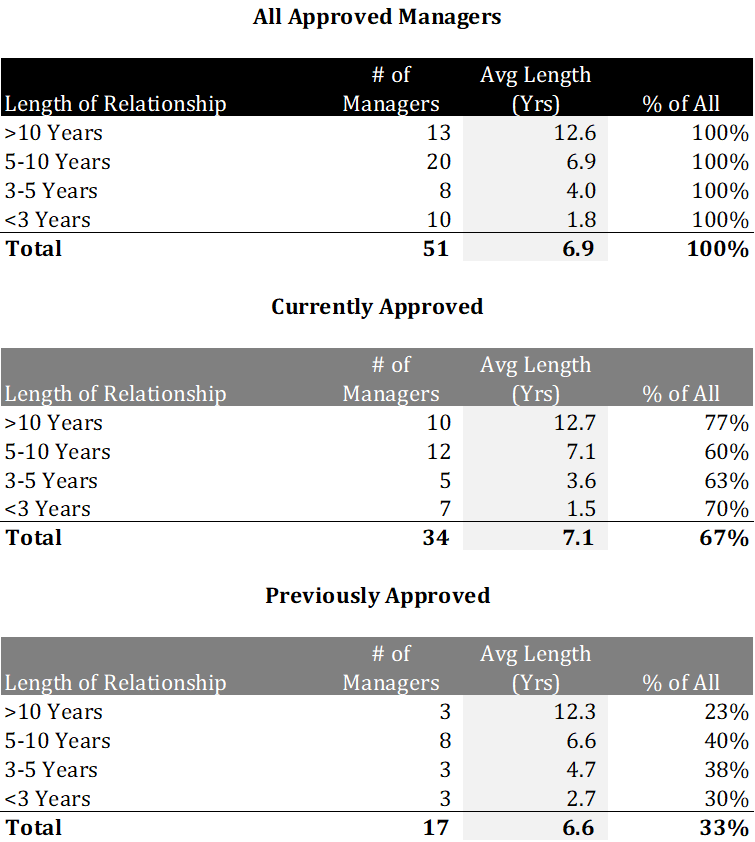
It is also worth noting that we have had 13 relationships lasting longer than ten years, and we continue to maintain ten of them, implying a retention rate of 77%. We expect this retention rate to remain high as we navigate market cycles alongside our managers and build trust over time. That said, we do not expect any relationship to last forever. There are valid—and unavoidable—reasons to quit.
Over the thirteen years since we began operations, we have terminated sixteen investment-manager relationships, an average of roughly 1.3 per year. Broadly speaking, these terminations fell into four categories. The most common reason was underperformance (nine cases), followed by involuntary terminations (three cases), asset-size constraints (three cases), and style drift (one case).
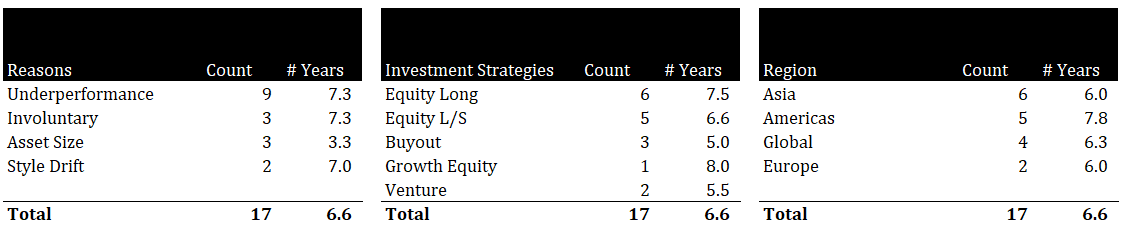
We have often said that we do not terminate relationships because of underperformance. That statement, while directionally true, is incomplete. In reality, we did terminate relationships following prolonged underperformance. What mattered most, however, was the cause of that underperformance. In several cases, the underlying issue was asset growth or style drift—factors that we believed would lead to further deterioration. These explanations are not contradictory. We did not terminate relationships because returns were weak in isolation; we terminated them because we concluded that the conditions required for recovery no longer existed.
Three terminations were involuntary. Two were due to health issues, and one resulted from a regulatory incident involving an employee. While the investment manager itself did not violate any regulations, the firm chose to stop managing external capital altogether.
There is no scientific formula for explaining why investment managers underperform. Nearly all the managers we backed had exceptional track records prior to our investment. Some portion of that performance was skill; some portion was luck. During bull markets, it is notoriously difficult to distinguish between the two. When conditions worsen, that distinction becomes clearer.
Skills can also erode. Managers age. Incentives change. Financial success can dull competitive intensity.
Among the nine underperformance-related terminations, we attribute three cases to our own misjudgment—we overestimated the managers’ capabilities, and they underdelivered. Three cases reflected complacency: as assets stabilized or grew, competitiveness declined. Two cases involved a genuine loss of edge, despite continued effort and discipline. The final case was what I would describe as mental fragility. Faced with market volatility, the manager adjusted positioning too frequently and too aggressively, resulting in repeated whipsaws.
In most of these cases, we acted too slowly.
Terminating relationships due to underperformance is an admission of error—but that does not mean the timing of the decision was necessarily correct. Tracking post-termination performance is difficult, but based on our limited observations, at least two managers we exited due to underperformance subsequently recovered and performed well. Conversely, one manager we exited due to style drift eventually shut down entirely.
There are no clean outcomes in this process.
Quitting is difficult. But in investing, as in relationships, quitting too late is often more damaging than quitting too early.
The challenge is not knowing how to quit.
It is knowing when—and having the discipline to act before it feels comfortable.
The House of Mulans had another busy and productive quarter, continuing our commitment to deep, thoughtful research and long-term relationship building.
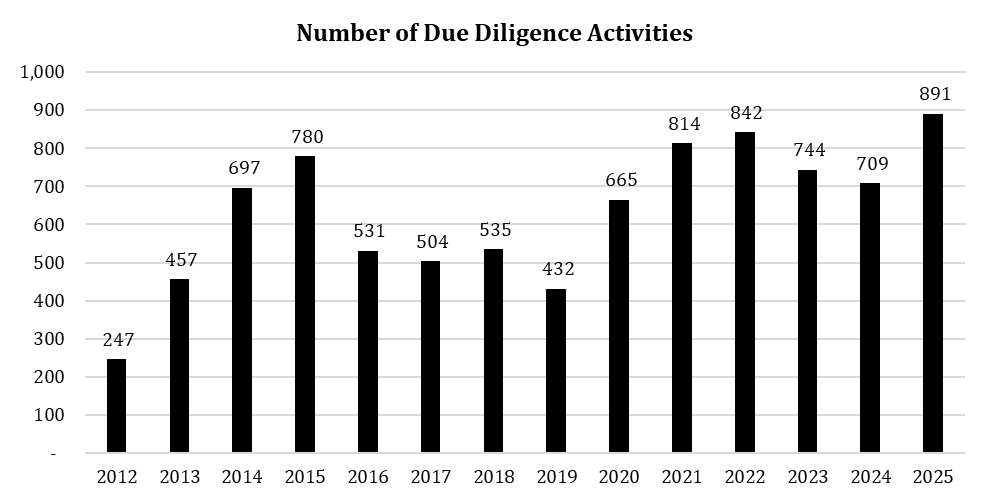
In 2025, we conducted 891 due diligence activities, including 746 meetings and calls, alongside numerous reference checks and sourcing activities.
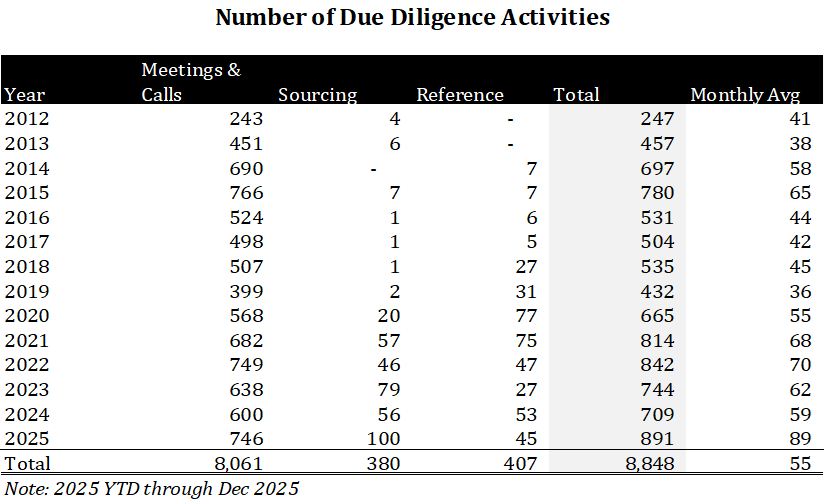
Maintaining globally diversified relationships are critical for us. The number of the investment managers focusing on Asia and Europe has been increasing thanks to our conscious efforts to diversify our geographic exposures away from Americas where we believe the market valuation is frothy. We believe that this trend will continue for awhile.
We also published a new thematic research piece - European Shareholder Activism: You Don’t Develop Rome with a Wrecking Ball - on Oct 14, 2025. In this piece, we discussed the history and developments of European activism investing as well as nuanced differences between the approaches between Europe and the United States, including some technical differences that impacted the activism investing in Europe.
This past quarter, our investment team traveled extensively across both the Americas and Asia.
Shinya and Tiffany spent time together in New York, Boston, Charlotte, and Miami, before continuing on to Mexico City. Our visit coincided with the Day of the Dead, a moment that offered an unexpectedly vivid cultural perspective. As many will remember from Pixar’s Coco, Mexicans commemorate death not with mourning, but as a celebration of life. Experiencing this tradition firsthand was a powerful reminder of how cultural attitudes shape societies far beyond what economic data alone can capture.
Following our time in the Americas, Chan Yong, Shinya, and Tiffany traveled across China, visiting several cities—including Changsha and Shanghai—alongside other family offices as part of our Research Trip. These visits allowed us to exchange perspectives with local partners while observing how regional ecosystems continue to evolve on the ground.
During the peak of annual general meeting season, Tiffany also visited Jakarta and other cities in Indonesia to deepen her understanding of the country’s regional dynamics. Indonesia is the world’s fourth most populous nation. While many investors remain cautious—citing modest near-term growth and complex policy frameworks—we continue to view the country’s long-term trajectory constructively.
Shinya also visited Shenzhen, where Star Magnolia Capital organized an educational visit for our families to Tencent’s headquarters, alongside meetings with several promising early-stage companies. To conclude an exceptionally active travel period, we spent time in Bangkok.
Travel is a central part of our research process. We place great value on meeting people, walking local streets, and sharing local food. These firsthand experiences offer insights that no dataset can provide, grounding our judgments in lived reality rather than abstraction.

Investor Education
On the investor education front, we organized the fourth Present Value of the Future Summit in Shanghai, bringing together more than sixty participants. Over the past two years, we have continuously refined the format, and we now believe we have arrived at the right structure. The next Summit is scheduled for April 24–25, 2026 (See here).
As the community matures, with more returning participants and word-of-mouth referrals from past attendees, the registration process has become increasingly competitive. The quality of participants is essential, and we remain committed to maintaining a high standard.
In parallel, we organized a research trip focused on understanding China’s consumer landscape. This trip was designed primarily for ourselves and a small group of close families, with the objective of continuing our own learning rather than creating a public-facing program. We also organized a dedicated Shenzhen visit, along with several smaller roundtable discussions in Singapore, to facilitate deeper, more focused exchanges.
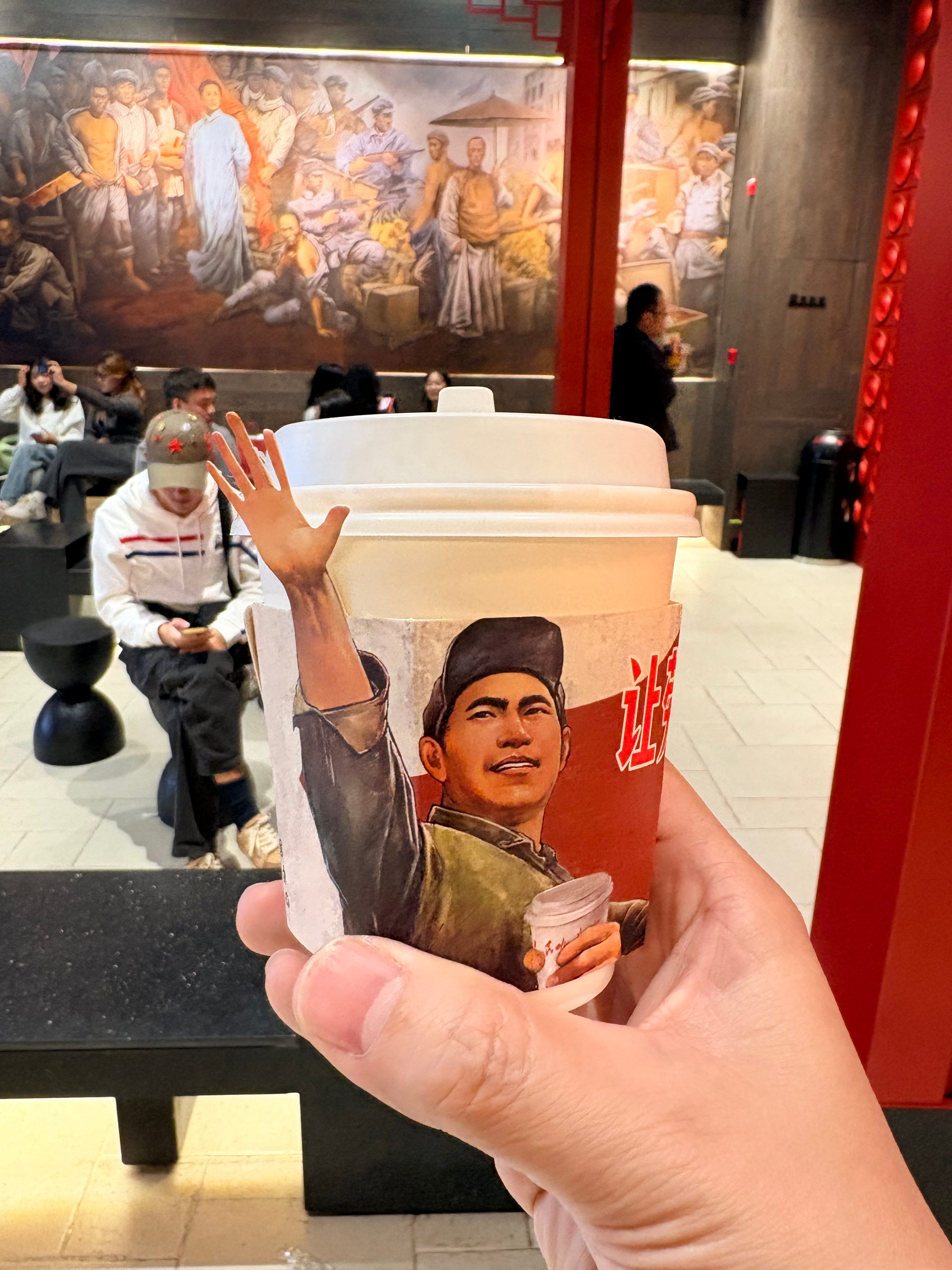
Olivia Zhang completed her probation period and formally joined the House of Mulans in October. Olivia recently graduated from University of Portsmouth after spending a year in the United Kingdom. As the youngest member of our team, she will assist across many areas, with a particular focus on family relations and investor education.
We have been impressed by her dedication, work ethic, and optimism—qualities that are increasingly rare among China’s often involuted younger generation. Olivia was also a member of the Next Gen Investment Office, operated by the Next Gen Investors Endowment, where she demonstrated her early passion for investing. She will be based in Shanghai.
Thank you very much for your continuous support. If you have plans to visit Singapore or Shanghai, please don’t hesitate to send us an email anytime. We would be delighted to take you to our favorite local spots to enjoy delicious (and affordable) cuisines while sharing great food and conversation.
Comments
Nothing yet. Say the first thing.
Sign in to join the conversation.