

A monthly dispatch from Terry Bartley
So much of our lives is controlled by corporations. There is this expectation that we take what we’re given and we have to be satisfied with it. There’s no fighting it, they’re always going to win.
I vehemently reject that narrative. This is our world and we’re allowed to build it for ourselves. That’s what the Starlight King Herald is about, and it’s the whole point of indie art. I’m hoping this first issue can be a bit of a blueprint of how we can start to do that for ourselves.
Whether you’re funding your own projects, telling your own story, or picking what game to play with your friends, this issue has you covered. Cody Walker publishes his work without anyone telling him he can. Lily Allen created a vulnerable, tell-all album, regardless of how anyone perceives it. And Dimension 20 chose to play with a system not controlled by a publicly traded company. Small decisions can lead to big consequences. Reading this newsletter is one of them.
Craft and industry, in conversation
Cody Walker has run more Kickstarters than he can count, at least ten, probably more, and his first one barely cleared its goal. Four thousand five hundred dollars was the target. Four thousand six hundred is what came in. By his own description, that’s “the bare minimum of success.”
He’s telling me this like it’s funny, and honestly, it is. But it’s also the thing that makes everything else he says about crowdfunding worth listening to, because Cody isn’t speaking from some position of having figured it out early and ridden that wave. He’s speaking from a decade-plus of iteration, failure, adjustment, and showing up again with a new project and a realistic goal.
Here’s what stuck with me.
Set your goal at the floor, not the ceiling. Cody aims for around $1,500 per campaign, enough to cover a cover artist, editing, printing, and shipping, with a little buffer for the unexpected. He told me that when he’s pushed toward $2,000, things get harder and he gets more stressed. The logic is simple: hit your number fast, put the campaign to bed, move on. There’s no glory in a tense final week when you could have a comfortable funded campaign and your energy back. This is especially worth hearing for authors who set aspirational goals because they want the money to feel meaningful. The goal isn’t a statement about your worth. It’s a budget.
Only promise what you’ll actually deliver. Early on, Cody would throw stretch goals and reward tiers into campaigns that sounded good in the moment, a one-shot RPG adventure set in his noir city world, that kind of thing, and then find himself not wanting to do it once the campaign was over. He’s cut that out entirely. Now his add-ons are things he genuinely enjoys: custom poems, because writing a poem about whatever a backer wants is fun for him and doubles as creative fuel for future collections. If you can design your reward tiers around things you’d do anyway, you’re not adding obligation, you’re just redirecting energy you were going to spend regardless.
Finish the project before you launch. This sounds obvious until you’re excited about an idea and the Kickstarter dashboard is right there. Cody’s only failed campaign, the Everland comic anthology, went up in December, which he’ll tell you is the worst possible month to ask anyone for money. But the deeper issue was that he was still waiting on pages from collaborators when he launched. The lesson he took wasn’t just “don’t launch in December.” It was that crowdfunding a project that isn’t done yet is crowdfunding a promise, and promises are harder to keep than products.
Your core audience is smaller than you think, and that’s okay. After years of campaigns, Cody has identified roughly thirty people who back him every time, no matter what. Thirty. That’s his reliable floor, and he’s made peace with it, because those thirty people, plus his Patreon regulars, give him a foundation to build from rather than starting from zero each time. The algorithms that used to surface Kickstarters organically have been replaced by systems that bury them unless you pay to promote. Cody’s adjusted by leaning into genuine community rather than reach, which means showing up consistently, being a person people actually like, and not pretending the campaign is something other than what it is.
That last part he put better than I could: “I think it mostly comes from being a nice, likable person who says, can you please give me money for this book? And people go, he’s nice and likable. I suppose I will give him money for this book.”
There’s real craft in making it look that easy.

Cody Walker is the author of the Everland series, the supernatural noir Work from the Pin Hook, and the forthcoming Olympia, Arkansas — a Hercules retelling set in the rural Midwest. You can find him and support his work at patreon.com/popgunchaos.
On artificial intelligence, writing, and what it means to teach
It started with RAM prices.
I was building a gaming computer, I’ve been wanting to play Dragon Age: The Veilguard for a while and my current computer just can’t do it, and while pricing out parts, Claude flagged something: storage and RAM costs were significantly higher than they should be. The reason, once I looked into it, was exactly what you’d expect. AI infrastructure build-out has been quietly driving up the cost of the same components the rest of us need for everything else. Data centers get the RAM. Gamers and everyone else get the markup.
That sent me down a rabbit hole about the AI bubble, specifically, whether and when it bursts, and I ended up somewhere more interesting than I expected: a genuine argument about whether boom-and-bust economics actually produce the innovation they’re supposed to.
Here’s the version of that argument you’ll hear from Marc Andreessen and Peter Thiel. Some bubbles are good. The dot-com bubble, the railroad bubble, these produced real infrastructure, real innovation. The pain was worth it because something lasting came out the other side. The housing crash, by contrast, produced nothing. Bad bubble. The distinction matters because it’s the intellectual scaffolding for tolerating the AI boom’s excess: yes, it’s chaotic, yes, people are getting hurt, but trust the process because that’s how innovation works.
Elizabeth Warren’s A Fighting Chance pushed back on that framing for me in a way I haven’t been able to shake. Her argument isn’t really about bubbles specifically, it’s about what we gave up when we normalized boom-and-bust as the expected rhythm of economic life. For much of the 20th century, union protections, pensions, and stable housing prices meant that people’s lives didn’t oscillate between “my retirement is fine” and “my retirement just evaporated.” That stability wasn’t the enemy of innovation. It might have been the condition for it.
The technologies we associate with the last thirty years of disruption, the internet, GPS, the touchscreen, mobile phones, weren’t invented by venture capitalists in Silicon Valley. GPS came from a Defense Department program in 1973. Touchscreens were developed by a researcher at a British institute in the 1960s. The mobile phone was a Motorola project, also 1973. The transformer architecture that underlies most modern AI was developed by Google in 2017, but built on foundational work from Warren McCullough and Walter Pitts in 1943 and Frank Rosenblatt’s perceptron at Cornell in 1958. The smartphone is GPS plus touchscreen plus mobile phone plus internet, four technologies developed through universities, government programs, and established private companies, assembled into one device. None of it came from the VC-fueled move-fast-and-break-things model.
Ezra Klein and Derek Thompson make a related point in Abundance: measured against what the previous equivalent time period produced, recent technological progress looks modest. We think of LLMs and smartphones as extraordinary, and in some ways they are, but they’re extraordinary assemblages of prior work, not the kind of from-scratch fundamental invention that produced commercial air travel, synthetic materials, and space flight during the era of relative economic stability that preceded Reagan.
So when Andreessen and Thiel argue that we should endure the boom-and-bust because it’s the price of innovation, I find myself asking: compared to what? The historical record suggests the opposite: that the periods of stability produced more transformative innovation, not less. Venture capital didn’t create AI. Venture capital threw money at AI until it looked like something.
And here’s where it lands for me as a teacher, because this is always where it lands: if the cost of the AI boom is that a generation of students outsources their thinking before their thinking has fully developed, we are not trading discomfort for innovation. We are trading the next generation’s capacity to innovate for a technology that, by the companies’ own admission in their earnings calls, doesn’t yet have a coherent path to profitability.
We’ve been here before. Uber was venture-subsidized into ubiquity, disrupted the taxi industry, and then raised prices once the subsidy dried up. The people who couldn’t afford cabs because Uber was cheaper now can’t always afford Uber. If AI follows the same arc, and the ad rollouts and tiered service degradations suggest it might, then the people who’ve come to depend on it will find it expensive at exactly the moment they can least afford to rediscover thinking for themselves.
What I want, and what feels increasingly scarce, is the SMART goal version of this conversation. Specific. Measurable. Achievable. Relevant. Time-based. What exactly are we being asked to sacrifice, what exactly are we getting in return, and when? “Trust the process” is not a goal. It’s a way of avoiding accountability for the cost of the process.
The 20th-century technologies that changed the world were built to become products, things people would buy, use, and build their lives around in ways that justified the investment. Right now, AI is a technology in search of that justification, and the people footing the bill, in productivity losses, in job displacement, in atrophied student cognition, in elevated RAM prices, are not the ones who’ll collect when the justification arrives.
If it does.
Get a glimpse of my rougher cuts
Before the world of Galevyn formed, four enormous asteroids across the galaxy were charting a course to converge. These asteroids were all that remained of four great ancient civilizations. In each civilization, once their people became adept at magic, a great war would break out to decide who would control it. Ultimately, one group of magic users would decide they knew best and perform a ritual that would destroy their world. However, because this ritual was so powerful, the remnants of these planets contained a strong concentration of this magic. One group destroyed their world with the elements, one group spread a deadly plague that made everything on the planet shrivel and crumble apart, another group channeled ancient magics that was said to only be able to be wielded by gods to shatter their world, and finally, the last group allowed nature to consume their planet until the roots grew so deep they tore the planet apart.
The true nature of gods can only really be theorized. No one who isn’t a god can even begin to fathom where gods come from and why they take a vested interest in the planet of their formation. However, it is known that whenever powerful magic is subjected to a strong enough catalyst, it sets in motion a series of events that make a planet hospitable to a god. There is much debate in the magical community that this magic is what actually coalesces into a god. Others believe that the god has always existed, and this magic allows it to cross over into the realm. What is known is that the gods built the planet Galevyn as we know it. While little is known about the four ancient civilizations that crashed together to form Galevyn, what is known is that the massive magical energy of this collision created a planet so dense with magic that it paved the way for four separate gods from the planet’s very beginning. These are the first four initial gods.
Hwedo, the Dragon-God of Life: The first god to emerge from the ashes was Hwedo, the Dragon-God of Life. He most often presents himself to his followers as a large, snake-like reptile with broad, rainbow-colored wings. Anyone who claims to see him has said they could not describe how large he was because they had never seen anything so vast in this world to compare him to. The first species to inhabit the planet of Galevyn are the Hwedo, who, who channeled the elemental magic of the planet to create four distinctly different kinds of dragons. One type of dragon for each element (water, fire, air, earth). The dragons helped Hwedo shape the planet into something more livable for other creatures. The water dragons filled the oceans. The earth dragons shaped the planet into the mountain structures that still exist to this day. The fire dragons heated the planet’s inner rock to make it molten, which provides a source of heat. The air dragons worked together to generate a strong current that would create the wind system. Hwedo is also responsible for creating the other dragonic species on Galevyn, the Dragonkin and the Kobolds.
Quietus, the Goddess of Death: It is impossible for four magical civilizations to fully collapse without an aspect of death emerging. Quietus presents herself as a humanoid coyote to those who have reason to visit her. Quietus guides her followers to respect death in all its forms. She believes that death is beautiful and works to find the most appropriate use for each individual in the afterlife. Quietus does not find necromancy disrespectful to the dead; she believes that it can provide a purpose for the soulless vessel remaining on Galevyn. On the newly formed island of Yokuatsu, Quietus created a race of humanoid animals called the Yokai. The Yokai are especially adept at magic and were instructed to help those near the end of their life. Later, when it became clear that some were trying to pervert the domain of Quietus, she created a species that could keep the planet in check. A race of Changeling assassins settled on the hidden island of Aristogen. Quietus would note leaders responsible for large populations to an early death and directly instruct the Changeling Collective to remove the target.
Kawma, the God of Nature: In great tragedy, there is also great love. Kawma emerged from the intense feelings of grief and compassion that had become a part of the four asteroids. Kawma used this love to create beauty on the newly formed planet. Grasses sprang throughout the fields, flowers bloomed across the planet, and strong trees sprouted out of the ground. Kawma knew that there would need to be people who could be caretakers of this magnificence. He created the strong orcs as caretakers of the trees. They were instructed to keep them trimmed and ensure their roots could continue spreading. Kawma also created the goblins. The goblins were instructed to use the flowers and roots scattered across the globe to find productive uses for them. The goblins learned how to create potions for healing, recreation, and enhancement.
Estel, the Goddess of Balance: Over time, it became clear that the humanoid populations of Galevyn were not equal. Estell emerged from this injustice. The orcs and dragonkin were incredibly physically strong. The Yokai had disproportionate magical aptitude. The goblins were much smarter than the other humanoids. Estel decided that something had to be done. She created a species called humans. Humans were given abilities that were exactly average compared to those of other species. They had the potential to be physically strong, magically adept, and mentally smart. However, each skill would need to be developed. Estel scattered the humans across every continent. They used their highly adaptable skills to quickly become part of the other civilizations.
Lovelace, the God of Science: As the humans continued to spread across the planet, the people of Galevyn started to feel a sense of balance. This period of peace paved the way for exploration. The goddess Lovelace emerged from this growing sense of curiosity. Lovelace provided the tools for all species to learn more about their world. She created the magics of Identification and Destruction. This allowed Galevyn researchers to break things down to their smallest components and learn their secrets. For this magic to reach its full potential, Lovelace also created a people called the Dwarves. Using her destruction magic, they were able to dig tunnels into which they built vast civilizations within the mountains.
Papugan, the God of Chaos: This new destruction magic not only inspired those seeking knowledge but also allowed those with ill intent to bring their harmful visions to life. The god Papugan emerged to stoke this chaotic nature present in all the people of Galevyn. He reveled in the destruction caused by people with evil in their hearts. He also created a new kind of wild magic that inspired a different sort of person to spread chaos across the planet simply for the sake of chaos. This empowered the people of Galevyn to stand against those who sought to disrupt the balance. By this time in the history of Galevyn, this excess of new magical energy had drawn the elves from the Fey realm to this world. Papugan despised the order the elves brought with them, but loved the gnome farmers they involuntarily relocated to the world. He embraced them as his own and created illusion magic so they could pull tricks on their elven overlords.
Wilrob, the God of the Arts: There was so much happening in Galevyn that there were those who wished to tell its story. This desire for a historical record rose around the god Wilrob. Wilrob inspired writers, musicians, actors, and artists to create art inspired by the world around them. Wilrob also empowered his worshipers with the same charm magic used by the elven colonizers. This allowed them to move freely across Galevyn to observe all the important stories. Wilrob honored his worshipers by transforming them into a new species, his chosen. The horns and tails of these Mascara allowed them to be easily recognized as artists passing through.
Christie, the Goddess of Innovation: The final Goddess of the Galevyn pantheon, Christie, became frustrated at the people studying and reporting on the oppression of the people of Galevyn who weren’t doing anything to stop it. She sought to empower the Dwarves to proactively use their knowledge to change things. While some of them were swayed by her new barrier magic that could provide a level of protection, the vast majority of Dwarves refused. They were too conditioned to study and had no desire to step into the conflict. This drove Christie to create a new species, the Roedor. The Roedor are built to seek knowledge and, additionally, to apply that knowledge to seek justice. Ultimately, the Roedor served as inspiration for the humans, and they flocked to the elven nation of Anglachel to find their place there. These humans eventually overpopulated the city so much that the elves were forced to return to their Fey home.
One article worth your time, and why
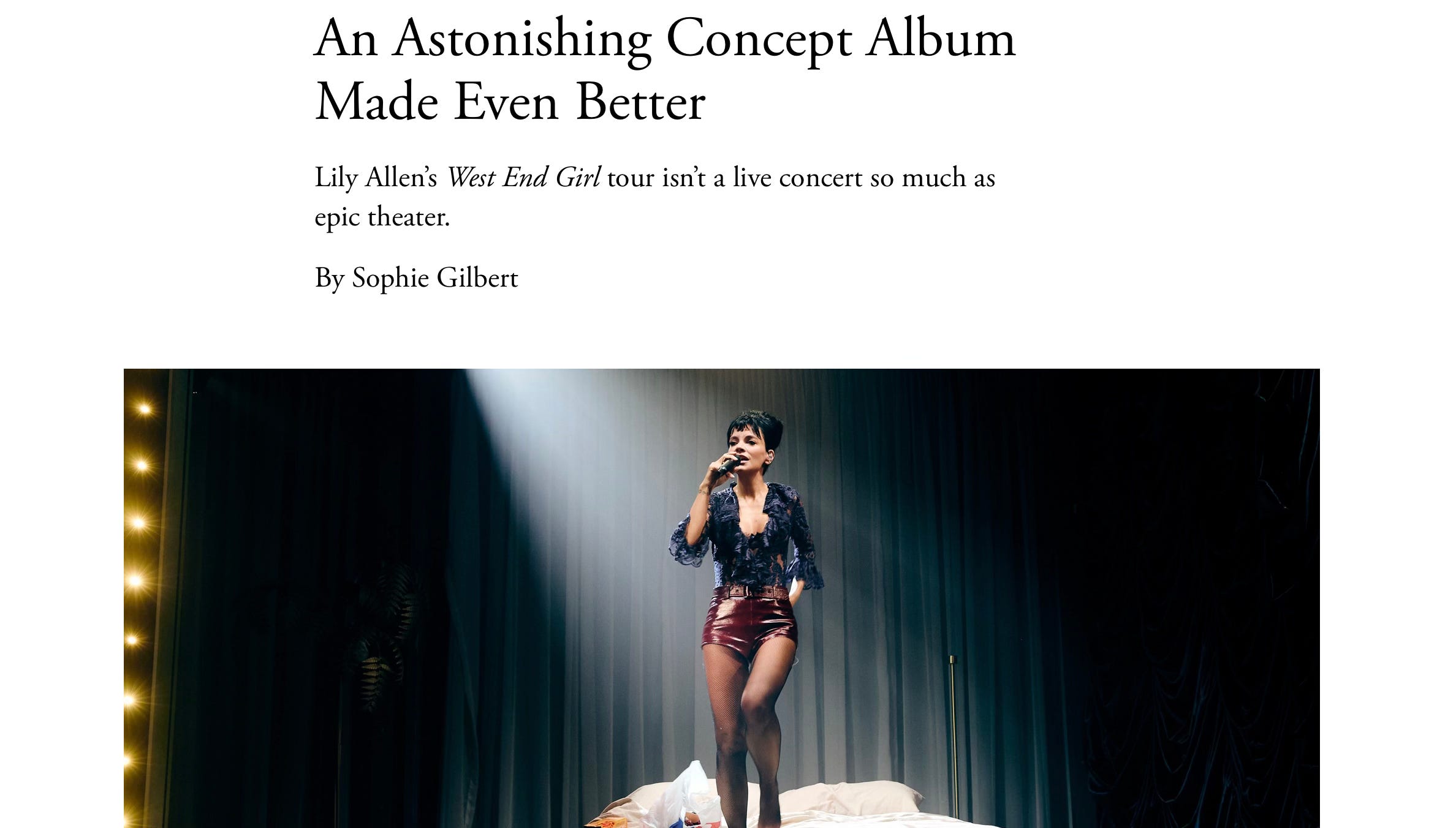
Whenever I first listened to Lily Allen’s most recent album, West End Girl, I was taken aback at just how much vulnerability she imparted into her music. I went to college in the early 2000s, so Lily Allen’s music has always been a part of my developmental DNA, but this album felt different. She was telling the story of living through a crumbling marriage through the lens of an unreliable narrator. To process pain in this way is nothing short of genius. Which is why I was so shocked from the media’s reaction to the album. Many, many people were chalking this album up to tabloid fodder, because it details her high-profile divorce from Stranger Things star, David Harbour. But that is missing the point, and it’s giving mid-2010s Taylor Swift discourse that we all agreed was misogynistic in hindsight. That’s why I found it so refreshing to read “An Astonishing Concept Album Made Even Better” by Sophie Gilbert. It allowed me to revisit West End Girl without all of the baggage the sexist narrative threw at her.
From the actual play table to yours
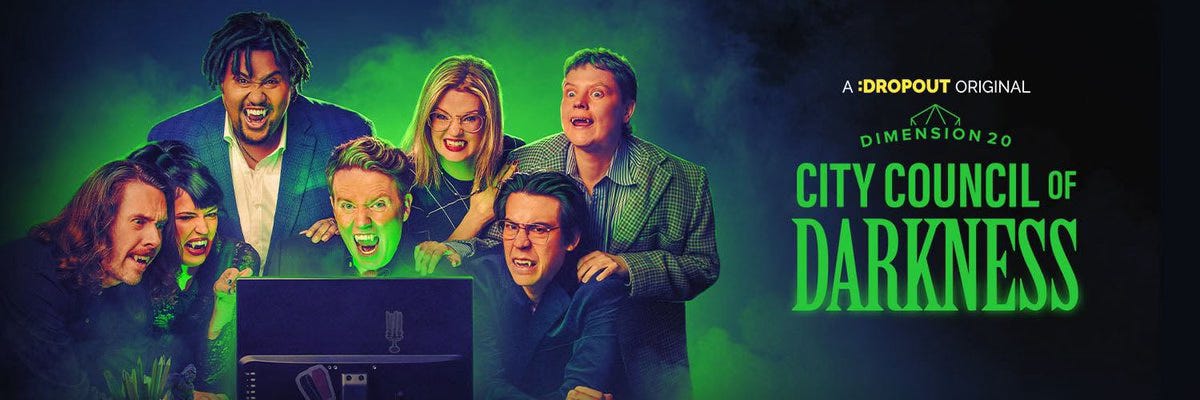
Whenever Wizards of the Coast threatened the livelihoods of a large group of online TTRPG creators and commentators with the OGL controversy, I expected a mass exodus of players from Dungeons and Dragons. What has ended up being a much slower trickle, has now reached what I consider to be a turning point in Dimension 20’s latest campaign, City Council of Darkness.
Dimension 20 has shown less obligation to use D&D for campaigns over the years compared to other streamers. A Court of Fey and Flowers showed us a hybrid D&D campaign with slight Good Society diversions. Misfits and Magic showed us what a non-D&D campaign could look like with a shift to Kids on Broom, though that did feel more setting-specific. Then we’ve seen them experiment with developing their own systems in Misfits and Magic season 2, Never Stop Blowing Up, and last season’s Gladlands. But City Council of Darkness is the first Brennan Lee Mulligan-led campaign with the Intrepid Heroes using a non-D&D system.
And to see them use a system this major in the TTRPG space as World of Darkness, and specifically the Vampire the Masquerade variant of it, is a really refreshing change. I feel like players have been so averse to shifting away from the security blanket that is D&D mostly because of the perception of how hard it is to learn a whole new system. But watching these players we’ve seen learn how to play D&D in front of our eyes tackle a completely new system is incredible evidence that it’s not as hard as we convince ourselves it is.
I hope this leads tables to be a bit more adventurous when picking a system to house your game. Not everything has to be D&D, and in some settings, D&D can actually limit the play experience. If you’re at all curious of playing a game with more of a specific focus on monstrous players and horror aesthetics, check out Dimension 20’s rule explainer video about Vampire the Masquerade. It might be just the scaffolding your players need to try a system that wasn’t created by Gary Gygax.
News from the imprint
If you’ve made it this far down the newsletter, it will be no surprise to you that the most major announcement Starlight King Press has is that we’ve launched our own online magazine, The Starlight King Herald. We wanted a space to showcase all of our work and interests in one package. We hope you’ve enjoyed it.
To celebrate the launch, we're running a monthly giveaway exclusively for Herald readers. One subscriber wins a signed physical copy of their choice from the Galevyn catalog every month. Enter at this link.
Otherwise, Terry’s upcoming novel, Destined for Greater Things, has been in the final stages of editing. Expect more announcements soon.
This week Most Writers Are Fans will be returning after a month-long hiatus. Our next episode will be an Ink Over AI episode that explores where the millennial hope comes from. The following week, we’ll have a new interview episode with romance author, Rae Shawn about writing diverse characters, how to write them authentically, and who should write them. It’s honestly one of my favorite interviews. Make sure you check it out.
A question, a request, something to send back
This issue has been circling a question about how much of ourselves we as creatives hand over to corporations and how much we keep for ourselves. What sacrifices are worth making.
For the past few months, I’d decided that enrolling my books exclusively with Amazon through their Kindle Unlimited program was one of those sacrifices worth making. A reader who’s never heard of me is more likely to try a book through a subscription they’re already paying for than to buy it outright from a stranger. That logic held for a while.
It doesn’t anymore.
Two of my books, I’m A Princess Who Ran Away To A Magical World and Me and My Best Friend Became Adventurers in a Fantasy World, don’t have reviews. I didn’t run ARC campaigns for them because they’re novellas pulled from the pages of my first book, Tyranny of the Fey, and running a review campaign for them felt dishonest. That scruple has cost me. No reviews means no sales, and no sales means Amazon’s algorithm treats them like they don’t exist.
Amazon gatekeeps free book promotions to authors enrolled in Kindle Unlimited, and my enrollment expires June 5th. I’m setting my books to free for as long as I possibly can before I walk away. Let’s game the system on the way out the door.
I don’t want to keep helping Amazon build their indie publishing monopoly.
Here's what I'm asking. Go request a free ARC copy for the light novels or Tyranny of the Fey before May 31st. When the free Kindle window opens that day, grab the official copy. It'll cost you nothing. Leave an honest review. Good, bad, or complicated. That's the sequence. That's what actually helps.
No posts
Comments
Nothing yet. Say the first thing.
Sign in to join the conversation.