
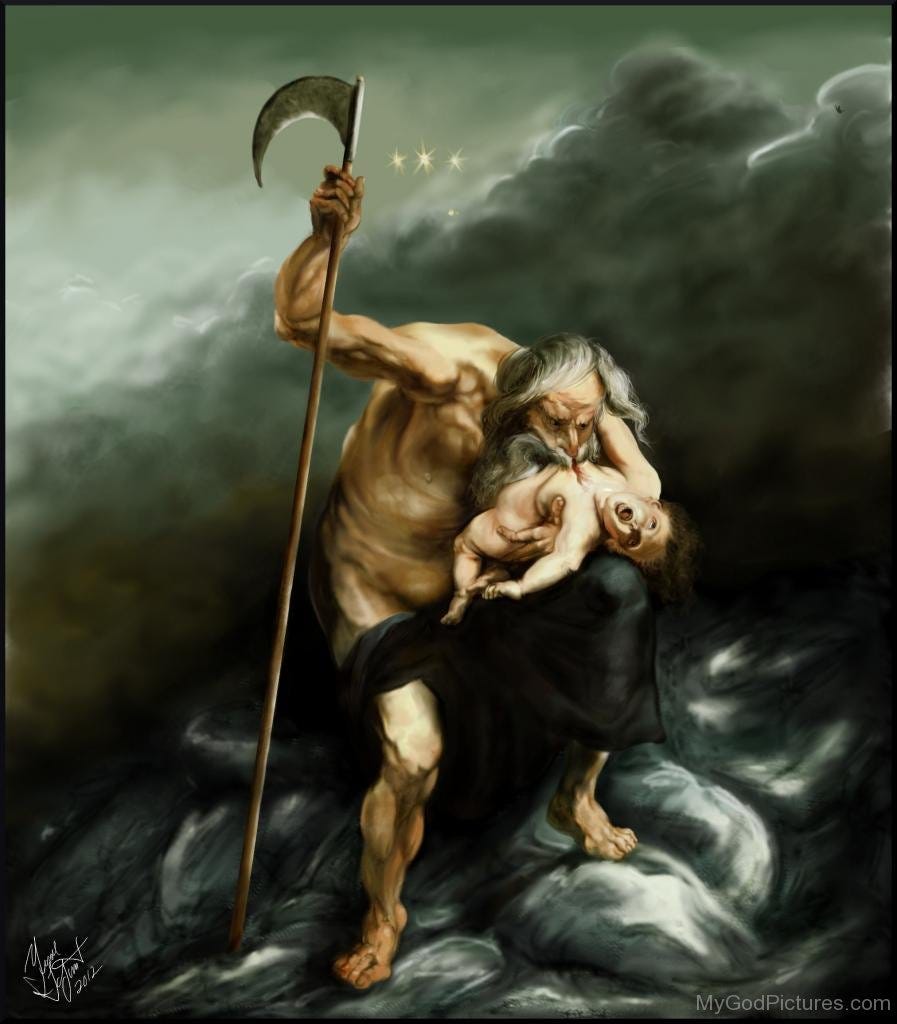
Art by Peter Paul Rubens
Poor ol’ Saturn, a misfortunate being whose dour melancholy has earned him the title the Enemy of the Soul, the Grim Reaper, Old Father Time and … Satan. I’d like to address whether there is any truth that the Ringed Elder of the Chaldean order, the one Rome called the Sower and the one set at the furthest edge of the visible sky, became Satan when the Church syncretically absorbed many astrological tenets into spiritual texts. After all, not only does a name travel a long road through language, Empire, and the councils of men deciding what counts as gOd or the devil, while your ear may catch the close tonal kinship of Saturn and Satan, and your mind, ever hungry to seek out patterns, reaches for the phonetic resemblance and sets to work making Saturn the enemy of lOve.
Where does the resemblance between these two names come from? Does it lie in the roots of the words themselves, in Hebrew, Latin and Greek, or did the association emerge much later, shaped over centuries by Church Fathers interpreting pagan gods, medieval astrologers classifying them as malefics, and generations of thought building upon what came before?
The Bible actually records, in the Book of Amos, a ‘Saturn’ in the form of Kiyyun, the Mesopotamian star god. This article places that encounter alongside the layers that gathered around it over time: the demonology of early Christian theologians, the malefic Saturn of pre-modern astrology, and the more recent online mythology that has fused the planet with Satan into a single figure, tracing how one association has gathered meaning upon meaning across the centuries.
Linguistics
The name Satan comes from the Hebrew root ś-ṭ-n, meaning to oppose, to accuse, or to plot against, giving the noun śāṭān, adversary or accuser. This term passed through Greek Satanas and Late Latin Satan into the Septuagint, the Vulgate, and eventually English as the name of the ‘Great Adversary’ of humanity.
The earliest books of the Hebrew Bible use ha-satan to describe any angel sent by God to obstruct or test human action, a role most clearly described in the books of Job and Zechariah. In Job the Adversary enters the heavenly council among the sons of God, questioning the depth of Job’s righteousness only with divine permission. Zechariah places the same figure beside the high priest Joshua, acting as Accuser until rebuked by the Lord. In both contexts, the role is strictly that of a heavenly prosecutor, fundamentally distinct from the later Christian Devil.
The name Saturn traces a completely separate linguistic path, stretching back to the Latin Saturnus and its roots in the agricultural verb serere, ‘to sow’. Originally a deity of the old Roman order, Saturn was only later, through the cultural syncretism of Rome’s expansion into the Hellenic world, identified with the Greek Titan, Kronos.
Consequently, academic consensus views the phonetic resemblance between these roots as a pure etymological coincidence, regardless of how closely they align in Hebrew, Latin, Greek, and modern English. The resemblance is especially persuasive in modern English because both words passed through successive Greek and Latin forms before reaching their present pronunciation. Over time, words with entirely different origins can acquire an uncanny likeness in sound, even when their histories have no connection.
The Bible does mention Saturn
Nevertheless, the historical record contains a paradox because hidden within the Hebrew Bible is a direct condemnation of a god whom academics identify with Saturn. Is it possible that this ancient scriptural grievance is the true seed of the misconception?
Amos 5:26 condemns Israel for carrying Sikkuth your king and Kiyyun your star-god through the wilderness—a warning later echoed in Acts 7:43 as ‘the star of your god Rephan.’ While the original Hebrew text of Amos uses Kiyyun, the Greek Septuagint renders it as Kaiwan, a designation that morphs once more into Rephan by the time it appears in the New Testament.
According to the International Standard Bible Encyclopedia, Rephan stems from a Babylonian name for the planet Saturn; indeed, some modern translations render the verse directly as ‘Saturn, your star-god idols.’ Older commentaries expand this web, linking Chiun with Chevan (the Arabic and Persian name for Saturn) and tracing the Egyptian forms Rephan and Remphan back to the same celestial deity. This line of interpretation stands as robust comparative Semitic philology. Kaiwān served as the standard Akkadian astronomical term for Saturn, meaning the prophetic polemic in Amos was aimed squarely at actual Mesopotamian astral worship that had bled into early Israelite practice.
From beginning to end, this passage focuses strictly on idolatry. It brands the deity as an artefact destined for exile alongside its worshippers. While this condemnation of foreign astral religion shares a thematic tone with later Christian denunciations of so-called pagan practices, framing the devil as an illegitimate rival to God, the scriptures maintain a strict boundary. Throughout Amos, Acts, and their respective manuscript traditions, Kiyyun-Saturn is kept under his own name, completely distinct from ha-satan. They remain separate categories: one is a physical idol awaiting discard, the other a legal function within the heavenly council
The appearance of the name Rephan in Stephen’s speech remains a subject of intense scholarly debate, given that Amos preserved Kiyyun and the Septuagint rendered it as Kaiwan. While scribal corruption during Egyptian transmission, variant textual traditions, and phonetic shifts have all been proposed as explanations, no universal consensus exists. Crucially, this uncertainty concerns only the linguistic transmission of the name itself, not the underlying identity of the deity, which remains consistently tied to the planet Saturn throughout the ancient Near East.
Between Scripture and Christianity: The growth of the Adversary
In the centuries separating the Hebrew Bible from early Christianity, the figure of Satan rapidly gathered the attributes that would define his later persona. Works such as The Book of the Watchers (1-36), Jubilees and the writings preserved among the Dead Sea Scrolls gradually expand the adversary from heavenly prosecutor into leader of rebellious spiritual powers standing in opposition to the Divine Order.
Unfolding entirely within Jewish apocalyptic thought, this transformation draws upon angelic rebellion, cosmic warfare and eschatological expectation. Throughout this development Saturn remains absent from the narrative. The Adversary evolves through his own theological history, while the planetary god continues to inhabit the separate world of Mesopotamian astronomy, Roman religion and astrological symbolism. By the opening of the New Testament these two inheritances remain every bit as distinct as they had been in the days of Amos.
Early Christian apologetics, like Justin Martyr, Origen, and Tertullian, encouraged the view that the pagan gods were fallen spiritual powers receiving the worship that should only belong to God alone, naming them demons. Saturn fell more heavily beneath this judgement than most classical deities because of the longstanding association between Kronos-Saturn and child sacrifice in Carthaginian and wider Punic religion. Diodorus Siculus records noble children offered to Kronos in Carthage, Plutarch describes the fiery bronze image receiving them, and Tertullian states plainly that children were once openly sacrificed to Saturn in Africa and that the practice continued in secret in his own day, a claim echoed by Augustine and Lactantius.
This history gives Saturn, among the classical gods, an unusually direct association with the demonic in Christian polemical writing, growing from the Fathers’ settled theology that all pagan gods were in fact fallen angels or demons operating under invented names, Saturn’s sacrificial cult offering one of the more vivid examples available to cite.
This correlation represents the closest historical convergence between the planet-god and the Christian Devil. Yet, their shared demonological category was achieved through broad theological methods and euhemerist reasoning applied to paganism as a whole, relying on a sweeping classification of foreign gods, as opposed to any scriptural link or nominal equation between the two names.
The astrological layer: Saturn as Greater Malefic
Separately, the Hellenistic and medieval astrological tradition, inherited by the Arabic Picatrix and later by Cornelius Agrippa’s Three Books of Occult Philosophy, classed Saturn as the Greater Malefic, the planet of restriction, melancholy, old age, and death, set opposite the benefic influences of Jupiter and Venus. The most influential astrological authority of antiquity, Claudius Ptolemy, wrote about Saturn in altogether different terms. His Tetrabiblos describes the planet according to its natural qualities of coldness and dryness, attributing to it old age, endurance, and the sober disposition born of long experience. Saturn is described as a cosmological principle rather than a moral one, governing the rhythms of nature instead of personifying evil. This distinction remained foundational throughout much of the astrological tradition, even as later centuries gradually clothed the planet in darker symbolic garments.
Robert Hand notes in his foreword to Liz Greene’s Saturn: A New Look at an Old Devil that Hellenistic, Jyotish, and medieval astrology alike held that good and bad planets existed, later termed benefics and malefics, Saturn ranking as the greater of the two malefics and Mars the lesser. Greene’s own title directly reflects this cultural pattern: Saturn gathered a devil-like reputation within the medieval and Renaissance imagination. He became synonymous with the sickle, the aged devouring father, and the grim spectre of death, even as serious astrological and theological writers of the period consistently maintained Saturn and Satan as two distinct figures. The Picatrix itself drew condemnation from the Church and a place on the Index for its magical content generally, further feeding the planet’s sinister reputation. Even here, the two figures draw closer through symbolic association and moral colouring, while retaining their separate identities throughout.
Even here, the historical picture reveals greater subtlety than the title Greater Malefic alone suggests. Hellenistic astrologers also entrusted Saturn with agriculture, endurance, contemplation, philosophical withdrawal, old age and the patient maintenance of boundaries, qualities reflecting the ancient Roman sower whose name remained attached to the planet. The melancholy associated with Saturn belonged less to moral evil than to weight, duration and the gravity accompanying long experience. Renaissance Platonists, particularly Marsilio Ficino, revived these subtle dimensions, presenting Saturn as patron of philosophy, contemplation and inspired solitude, a planetary intelligence capable of ripening wisdom through sustained reflection. Evidently, even among the scholars who honoured Saturn’s deepest esoteric meaning, the planetary intelligence and the Christian Devil remained conceptually worlds apart.
Where this leaves the question
In short, the answer is no!
The Bible keeps Saturn and Satan apart at the level of name and origin: two roots, two histories, the Hebrew Bible’s actual engagement with Saturn taking the form of a separate, well-attested condemnation of Mesopotamian astral idolatry (Kiyyun/Kaiwan/Rephan in Amos and Acts), running alongside the developing figure of ha-satan as courtroom adversary and later cosmic enemy, each keeping to its own lane.
Scripture aside, four broad movements encouraged a convergence between the two figures. Patristic theology gathered Saturn beneath the wider category of pagan demons, largely on account of his association with sacrificial cults. Certain second-century Gnostic systems identified the planetary governor of Saturn with Yaldabaoth; this bound the planet to an altogether different theological imagination. Medieval and Renaissance astrology deepened Saturn’s association with mortality, melancholy, and limitation, while contemporary online esotericism has gone further still, asserting a direct identity between Saturn and Satan on little more than phonetic resemblance and symbolic association.
This internet mythology relies heavily on visual pareidolia, specifically the ‘Black Cube of Saturn’. Triggered by modern satellite images of a persistent hexagonal jet stream at Saturn’s north pole, online theorists project a cube, the three-dimensional translation of a hexagon, backward through time. They claim this geometric feature proves that ancient civilisations secretly worshipped a Saturnian matrix, pointing to objects like the Islamic Kaaba or Jewish Tefillin as evidence of a hidden, sinister cult, and in doing so, inserting later astrological and occult symbolism back into scripture as though it had stood there from the start.
It seems history has preserved two independent streams whose waters occasionally run beside one another through the centuries without ever merging into one river. Only when the successive layers of interpretation are allowed to settle one upon another does Saturn begin to resemble Satan. Remove those layers, and the resemblance dissolves, leaving two names, two histories, and two entirely different traditions.
References
The Holy Bible. Amos 5:26; Acts 7:43.
Ptolemy. Tetrabiblos, Book I. English translation via LacusCurtius.
https://penelope.uchicago.edu/Thayer/E/Roman/Texts/Ptolemy/Tetrabiblos/1B*.htmlJustin Martyr. Second Apology. (Referenced via Saint Shamoun.)
https://saintshamoun.com/index.php/2025/11/02/justin-pagans-gods/Diodorus Siculus, Plutarch, Tertullian, Augustine and Lactantius. Classical and patristic references concerning Kronos-Saturn, Baal Hammon and child sacrifice. (Collected citations.)
https://www.rebuildspirit.com/post/from-goat-to-sun-disk-the-ancient-continuum-of-saturn-worship
Reynolds, B. H. “Understanding the Demonologies of the Dead Sea Scrolls: Accomplishments and Directions for the Future.” Religion Compass (2013).
https://compass.onlinelibrary.wiley.com/doi/10.1111/rec3.12038“The Logic of Planetary Combination in Vettius Valens.” (On Aristotelian physical qualities underlying the malefics.)
https://arxiv.org/pdf/2205.07616The Marginalia Review of Books. “The Secret Life of Saturn: Melancholia and the Warburg Institute.”
https://themarginaliareview.com/the-secret-life-of-saturn-melancholia-and-the-warburg-institute/
Etymonline. “Satan.”
https://www.etymonline.com/word/SatanAbarim Publications. “Satan: Meaning and Etymology.”
https://www.abarim-publications.com/Meaning/satan.htmlEncyclopedia.com. “Satan.”
https://www.encyclopedia.com/philosophy-and-religion/christianity/christianity-general/satanInternational Standard Bible Encyclopedia (via GotQuestions). “What is the Star of Remphan mentioned in Acts 7:43?”
https://www.gotquestions.org/star-of-Rephan.htmlintertextual.bible. “Amos 5:26 / Acts 7:43.”
https://intertextual.bible/text/amos-5.26-lxx-amos-5.26-acts-7.43StudyLight. Amos 5:26.
https://www.studylight.org/bible/eng/n95/amos/5-26.htmlBibleStudyTools. Amos 5:26.
https://www.biblestudytools.com/nas/amos/5-26.html
Expedition 44. “Was ‘Satan’ in the Old Testament?”
https://expedition44.com/2023/01/17/was-satan-in-the-old-testament/Scribes of the Kingdom. “Satan, the Serpent, and the Myth of the Rebellious Angels.”
https://scribesofthekingdom.com/2020/03/24/satan-the-serpent-and-the-myth-of-the-rebellious-angels/The Historic Faith. “Early Christians on Fallen Angels and Demons.”
https://thehistoricfaith.com/early-christian-beliefs/fallen-angels-and-demonsStudyJesus.com. “Origen’s Demonology.”
https://studyjesus.com/Religion_Library/Johannine_Studies/04_Origens_Demonolgy.htm
The Spiritual Social. “The Meaning of Malefic Planets in Astrology.”
https://the-spiritual-social.com/2024/01/05/the-meaning-of-malefic-planets-in-astrology/Via Hygeia. “Marsilio Ficino: From Three Books on Life — A Little Sampler.”
https://via-hygeia.art/marsilio-ficino-from-the-three-books-on-life-a-little-sampler/gsnsp.com. “Picatrix: Medieval Grimoire, Astrology, Magic and Rituals.”
https://www.gsnsp.com/picatrix-medieval-grimoire-astrology-magic-rituals/
The Outline. “The Sadness of Saturn.”
https://theoutline.com/post/2382/the-sadness-of-saturnPatrick Ryan. “Saturn Worship: The Hidden God Behind Law, Money, and Power.” Medium.
https://medium.com/@patrickryan333/saturn-worship-the-hidden-god-behind-law-money-and-power-a43b0aa3ecfc
First draft completed on the 2nd of August 2026 at 07:32 am BST
Completed on the 25th of August 2026 at 21:02 BST
No posts
Comments
Nothing yet. Say the first thing.
Sign in to join the conversation.