
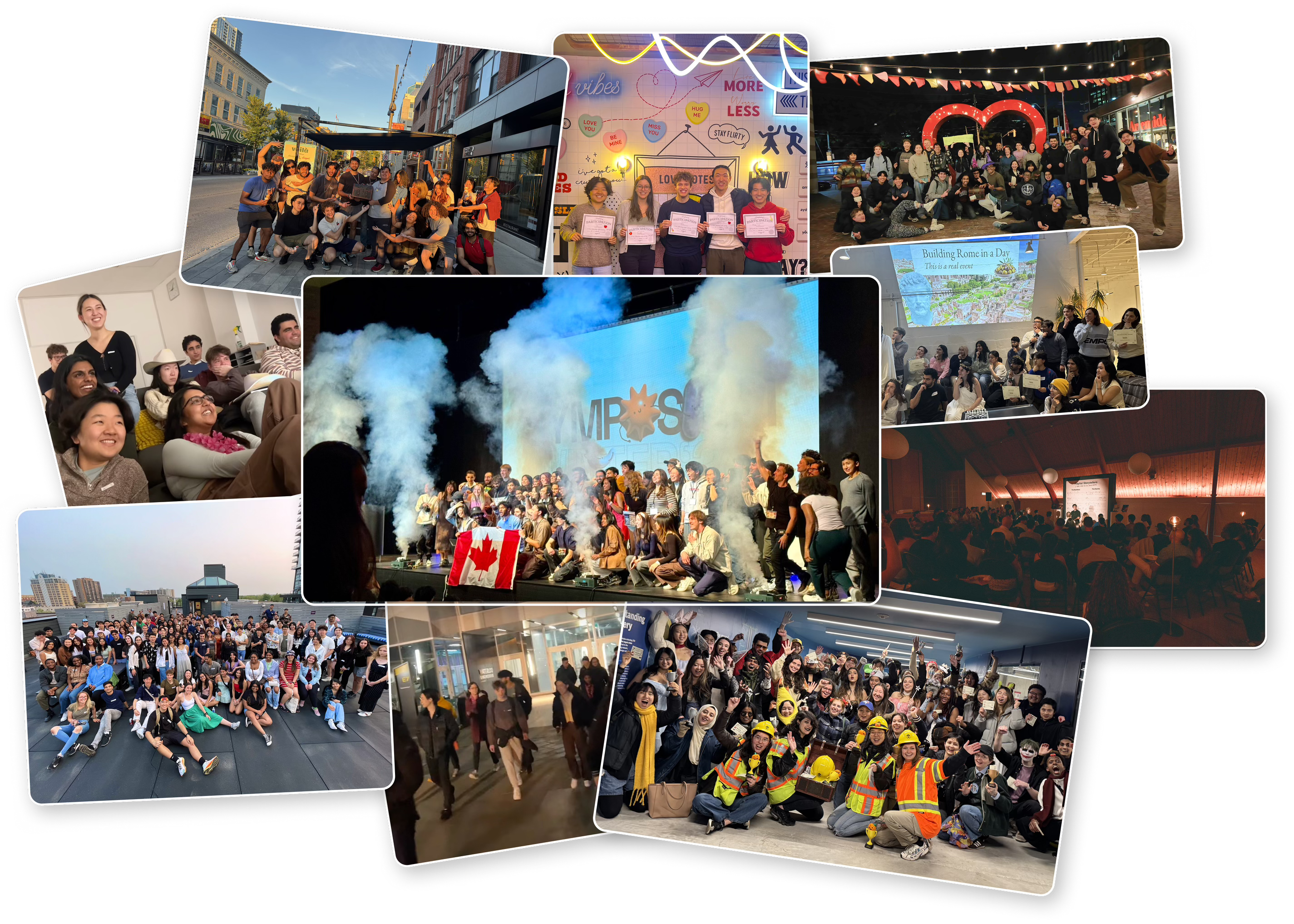
The loneliness epidemic is among the best-documented public health crises of our time (so much so that the Surgeon General has named it). Eventbrite reports 79% of 18-35 year-olds plan to attend more in-person events this year. Concert tickets regularly trade at $400. Run clubs overflow the streets. People spend thousands to be in a room with strangers who care about what they care about.
Demand is not a problem. It’s not even a question.
The real problem is a bit of an oxymoron; the humans who build for belonging have themselves been left feeling like they don’t belong. The organizers hustling to inspire storytelling nights, maker workshops, recurring dinner series, and scavenger hunts that fill city parks on Saturday afternoons; the people propping up everyone else, are themselves propped up almost entirely by sheer force of will. Two people, a spreadsheet, and an Instagram account. No economic rails, no portable track record, no peer network, no way to survive a venue falling through or a sponsor going dark. They burn out quietly, and what follows, without much warning, is a community that collapses. Not because people stopped coming. Because the organizing team couldn’t hold it together any longer.
We are thrilled to announce our investment in Wygo, the company building the economic infrastructure that the next wave of leaders need to meet the rising demand for in-person community. We’re proud to be investing in Wygo’s $1.56M Pre-seed alongside our friends at Garage Capital, N49P, Good Future, and notable angels such as Shopify CEO Tobi Lütke, Backbone, and Zero21.
The People Building for Belonging in Real Life
There is a special kind of person who cannot help but lead. Student council presidents. A favoured camp counsellor. The group project team lead who everyone trusts to keep everyone together. The person holding the pen for their fantasy football league. The friend who organizes every group trip, and who, when they spot someone standing alone in the corner, walks over and brings them in.
They are skilled at something real (and something that is becoming more valuable in a world dominated by AI). Carefully reading rooms and shock-absorbing social discomfort, these folks are hardwired to optimize for the feeling of belonging, turning a group of strangers into a group of people who feel they are part of something. After university, many of them tuck this aptitude away as they no longer find a mechanism to invest and reap the rewards of their emotional intelligence in the workplace. Some of them start communities on the side, genuinely extraordinary ones, but do so with duct tape: Eventbrite for ticketing, Stripe for payments, Google Sheets for attendee management, Instagram for discovery, word of mouth for everything else. This fragmented stack caps out around $30-50K per year, produces no compounding identity or track record, and burns people out on admin. When they inevitably hand off a community or move on to start a new one, they begin from ground zero once again.
Supporting Eventrepreneurs: Wygo is Building for Builders
Wygo’s belief is that community organizing is about to professionalize, the same way content creation professionalized between 2010 and 2020. Substack didn’t create the desire to write; it gave writers economic rails, distribution, incentive, and ultimately the infrastructure, to do what they were already doing, sustainably, at scale. Shopify didn’t invent the entrepreneur; it lowered the threshold for transforming creative energy into a real business. Both recognized and capitalized on an underlying aspect of human psychology that indicated supply would explode when tools are built to enable it.
Wygo is building the equivalent stack for people with a passion who care about sharing it with others. Operations and ticketing tools that eliminate administrative overhead, a feedback and coaching layer embedded into the platform trained on the practices of top community builders, and an identity and attribution layer so that organizers build a portable track record across every community they create and eventually hand off. A peer network with verifiable experience and track records so organizers can share what they know with the ones just starting out. And a sponsor and venue ecosystem so that a single cancelled partnership can’t eliminate something people love and need in their life.
The unit of value here isn’t an event (which alone differentiates Wygo from any competitor on the market). Instead, it’s the power organizer — the natural lifeblood leaders of a community who will found and steward multiple spaces for people to find belonging across their lifetime, carrying their audience and their reputation forward each time.
A Lifelong Obsession with Building Communities That Last
There are founders who understand their customer deeply. And then there is Joss. :)
At 16, she built a 100-person volunteer organization across 16 schools in the Waterloo region, fundraising, running a hiring process, architecting the org structure, and then deliberately engineered herself out of the leadership role once it was stable. In university she co-founded UW Startups alongside YC-backed Anson Yu, merged it into Socratica, and became a founding figure in what grew from a Sunday morning co-working session into a global community with nodes in over 40 cities (on every continent but Antarctica).
Joss watched hundreds of community organizers succeed and fail, developing a muscle that went far beyond simple pattern recognition. She understands not just what works but exactly when and why things break. She sees, and intimately understands, when organizers can’t admit vulnerability to their own communities because of how it can influence the magic that has been built. She has watched them burn out after years of building something people loved and depended on. She experienced acute loneliness herself after moving to the US for work, unable to find a single space where she could just show up and feel included, and came home with conviction that solving this problem – supporting both the people who need community and the strained network of people who build it – is what she wanted to dedicate her life to.
What strikes us most about Joss is not the decade of experience, though that is rare. It’s that she is absolutely incapable of not solving this problem. She doesn’t study community organizing from the outside. She is the customer, with more depth and more specificity than many founders we’ve met. Everything she’s ever done to this moment has been to solve this problem, and everything she will probably do from this point forward will also be to. That kind of founder — drawn to a problem not only because it is large, but because it is theirs — is exactly who StandUp Ventures wants to back.
Her technical co-founder Chris is a truly brilliant fellow Waterloo Systems Design Engineer grad with a passion for communities and the arts, bringing a deep intuition for user experience research, product design, and full-stack development. Alongside his engineering degree, he solo-built websites for several creative collectives that reached over a million visitors. He’s reliable, skilled, strategic, and has frequently been cited as “the smartest guy Joss knows”.
Together they are a complete team.
They were on the same floor freshman year. Over 5 years, they’ve been friends, engineering capstone project partners, roommates, hockey teammates, and now co-founders. They lead with a humbleness, maturity, and wisdom that feels far beyond their years. They’re optimistic, curious, deliberate, intelligent, and kind. They only seek recognition when it benefits the mission that matters deeply to them. They only surround themselves with people who are aligned with their values, and are unilaterally oriented towards the good.
Why Now
Several things are converging at once. Eventbrite is losing users and was acquired. Luma has shown 5x growth, validating that demand for community infrastructure exists, while at the same time leaving significant whitespace for a platform that from day one is solving a different (and more existentially important) problem than just event logistics. AI-related job precarity with young people is accelerating the search for income and belonging outside the traditional job market, making in-person community building an increasingly compelling path for exactly the type of skilled, entrepreneurial person who takes initiative and would thrive as a professional “leader”.
And GenZ, being raised on structured extracurriculars rather than unstructured play, deeply familiar with purpose-built group experiences, willing to spend on live events even when they describe them as unaffordable, is the most natural cohort of community-hungry attendees any platform could ask for. The demand is clear. The supply of these special people exists. What’s missing is Wygo..
We are so proud to welcome Joss and Chris to the portfolio. The communities that come from this company will quietly change the trajectories of the people inside them. The person standing alone in the corner who gets walked over to, who stays, who comes back, and who eventually starts something of their own. And it repeats.
Building belonging is work that Canada and the world desperately needs. We couldn’t be more excited to be part of it.
Warmest of welcomes to Standup, Joss and Chris.
Till next time,
Katie
No posts
Comments
Nothing yet. Say the first thing.
Sign in to join the conversation.