
There is a lot of buzz about the President’s latest Executive Order on a “Gold Standard Childhood Vaccine Recommendation.” Here are the 3 biggest takeaways:
The Order makes it clear states are in control. Over and over we see the White House urging states to update their laws to reflect a “policy of less” when it comes to vaccine mandates.
The White House doesn’t like mandates. It stresses the point that our “peer” countries rely on trust, not mandates.
It recommends single doses, not combination shots, and it directs federal agencies to make it happen.
We know there is a lot to unpack in this EO. We know the issue of some states not having religious exemptions is a big deal, and people are wondering what this EO will do in that arena. Let’s dive in.
On August 10, 2026, President Trump issued an executive order named “Delivering Gold Standard Childhood Vaccine Recommendations for Americans.” Why did he do that and what does it mean? We’re all about to find out.
Since 2025, we’ve watched the childhood vaccine schedule shrink and grow and shrink and grow like it’s Alice in Wonderland. One moment there are 18 illnesses targeted for universal vaccination, then 17, and then we’re down to 11, and then maybe back up but no one seems to be sure. After the announcement that the U.S. was going to stop being the only country mandating so much and instead get aligned with other countries, there was quite the uproar. Many medical devotees and policymakers weren’t interested in putting “settled science” on the exam table and removing the bad growths. Remember, before Secretary Kennedy, the schedule only grew exponentially. (Some of you might be wondering about rotavirus - that was removed temporarily and replaced quickly…read Health Freedom Institute’s “Shining a light on Rotavirus” or pick up a copy of our book The Vaccine Decision for the hidden motive there).
The American Academy of Pediatrics (AAP) quickly announced it was sticking to the “safe and effective” schedule as is, and launched a campaign to convince as many people as possible to stick with it too.
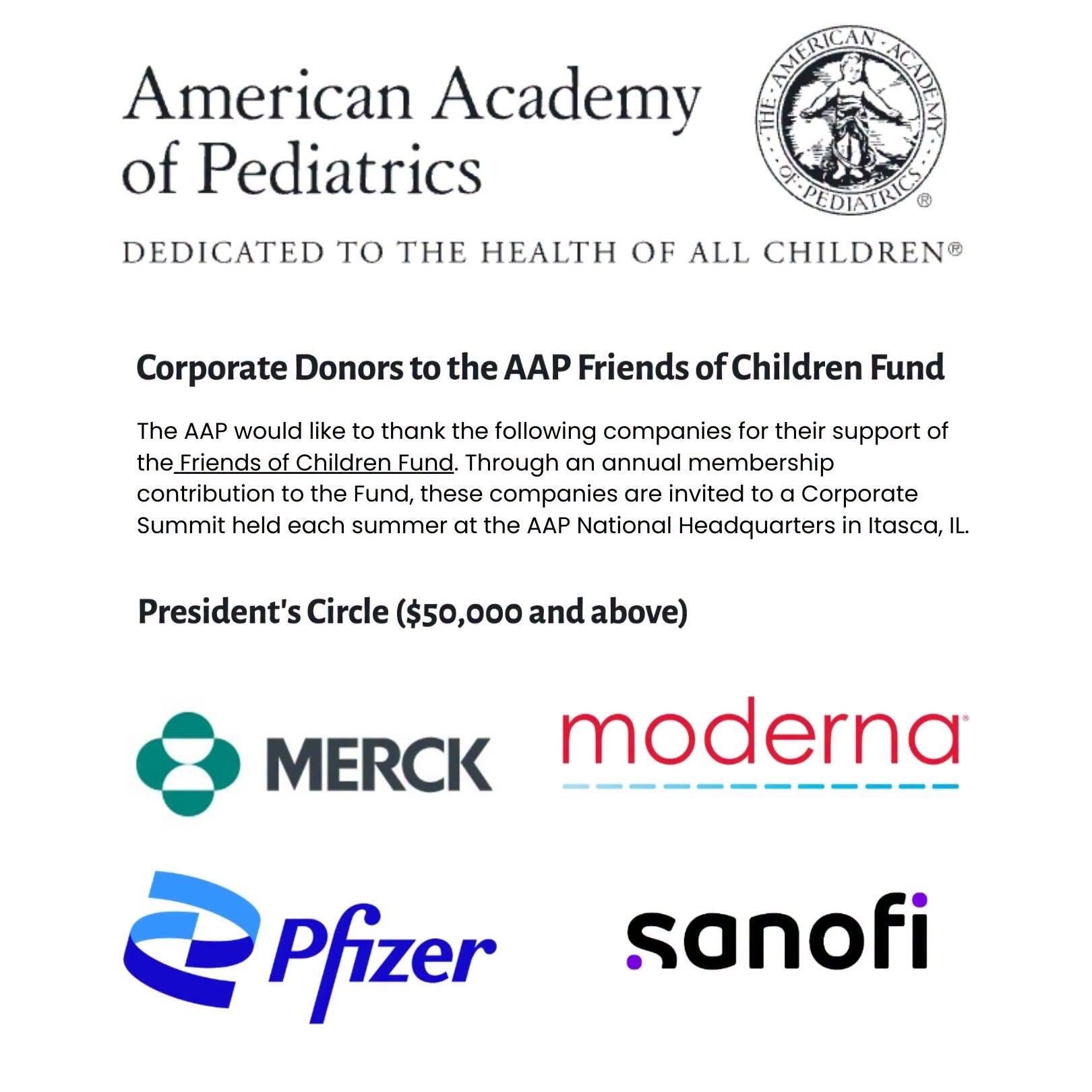
The AAP had already been leading the charge to get as many shots into as many kids as possible. One of its strategies unveiled years before this administration is to work as an organization to get all religious exemptions eliminated. So it’s only natural that the AAP sued the federal government over the schedule. The premise of the lawsuit centers on their assertion that Secretary Kennedy wasn’t using an “evidence-based” approach when he shook up the Advisory Committee on Immunization Practices (ACIP) and since the schedule starts with ACIP, they claim it wasn’t legal.
Let’s just take a moment and reflect on what’s happening in a bigger picture: a group of licensed professionals is fighting to make the government do their jobs for them by making one-size-fits-all recommendations for medical interventions given to healthy children. Could you imagine that? Like if you want to put dinner on the table for your family and instead of deciding what will nourish your family, you’re begging the federal government to make the menu for you.
AAP isn’t confined to kneeling at the throne of federal public health policy. It has also led the charge in statehouses, accompanied by the American College of Obstetricians and Gynecologists (ACOG) and the American Academy of Family Physicians (AAFP), to change state law to follow the professional groups’ vax-maxxed schedule instead of reviewing the science and outcomes alongside the CDC. Twenty-eight states passed a law to change state policy.
The White House has promised the changes to the recommendations will not affect the “Vaccines for Children” program that ensures eligible children get vaccines for free, so the recommendations are not limiting vaccine access for parents who want them for their children.
Health decisions belong as close to home as possible, so we’re encouraged that this EO acknowledges that power squarely in the states.
May 23, 2025 – EO to restore “Gold Standard Science.”
May 27, 2025 — Secretary Kennedy removes routine COVID-19 recommendation for healthy children and pregnant women before ACIP meeting.
June 9, 2025 — Kennedy removes all 17 sitting ACIP members.
June 11, 2025 — New ACIP appointments begin.
June 24, 2025 — Guzman v. West Virginia Board of Education begins after a child’s religious exemption, initially issued by the state health department under Gov. Patrick Morrisey’s January executive order, was rescinded by the local school superintendent. The case centers on West Virginia’s 2023 Equal Protection for Religion Act (EPRA) and the state’s compulsory vaccination law.
July 7, 2025 — American Academy of Pediatrics et al. v. Kennedy et al. challenges the Kennedy administration’s changes to ACIP and the childhood vaccine schedule.
July 24, 2025 — West Virginia judge grants preliminary injunction for religious exemptions: ruling that three children may attend school with religious vaccine exemptions while Guzman proceeds.
August 21, 2025 — HHS Office for Civil Rights (OCR) tells West Virginia health departments participating in the Vaccines for Children program that they must comply with applicable state religious and conscience protections.
September 4, 2025 — HHS OCR expands the position nationwide, telling Vaccines for Children Program participants that they must respect applicable state religious and conscience exemptions.
September 19, 2025 — The new ACIP unanimously recommends that COVID vaccination for people six months and older be determined through individual-based decision-making, rather than a blanket recommendation.
November 26, 2025 — West Virginia judge issues statewide ruling favoring religious exemptions in Guzman, finding that the state’s refusal to accommodate religious objections violates religious freedom.
December 2, 2025 — West Virginia Supreme Court immediately blocks the religious-exemption ruling while the appeal proceeds, meaning the kids can’t attend school while the case is ongoing.
December 5, 2025 — ACIP votes to end universal Hepatitis B birth-dose recommendation for infants of HBV-negative mothers.
December 5, 2025 — In a Presidential Memorandum: “Aligning United States Core Childhood Vaccine Recommendations With Best Practices From Peer, Developed Countries” President Trump directs HHS/CDC to compare the U.S. childhood schedule with those of peer developed countries and revise U.S. recommendations if the foreign approaches are determined to be superior.
December 8, 2025 — The U.S. Supreme Court vacates a Second Circuit decision upholding New York’s elimination of its religious exemption to school vaccine mandates, and tells the circuit court to look at it again, in light of a SCOTUS ruling upholding parental rights and religious freedom in Mahmoud v. Taylor. (This is an important development because it puts state religious vaccine exemptions directly back into the Supreme Court pipeline.)
January 5, 2026 — HHS/CDC implements the “peer nations” vaccine-schedule directive by reducing recommendations to 11 “core” vaccines, and adopting a new framework dividing childhood vaccines into recommendations for all children, high-risk, or shared clinical decision-making.
February 25, 2026 — In Connecticut, Spillane v. Lamont, litigation continues over whether Connecticut’s Religious Freedom Restoration Act (RFRA) includes religious objections to the state’s school vaccination requirements, despite the legislature’s 2021 repeal of the statutory religious exemption.
March 16, 2026 — Federal judge blocks Kennedy’s new vaccine schedule and ACIP. The ruling means the administration cannot simply proceed through the reconstituted ACIP to implement the January schedule. This becomes important to the later presidential actions.
April 8, 2026 — The Fourth Circuit addresses the West Virginia religious-exemption issue in a second active RE case, Perry v. Marteney. The Fourth Circuit distinguishes West Virginia’s vaccine mandate from Mahmoud v. Taylor, holding that medical exemptions do not necessarily require religious or conscientious exemptions merely because they are exemptions.
April 9, 2026 — HHS/CDC publishes a revised ACIP charter, changing the committee’s structure and emphasis.
April 27, 2026 — Connecticut enacts legislation amending its RFRA to expressly provide that the statute does not apply to immunization requirements for schools, higher education institutions, and child-care facilities, ending the Spillane case.
May 18, 2026 — The revised ACIP charter renewal is withdrawn because CDC/HHS failed to comply with the applicable notice and timing requirements. The administration must address the charter process again.
May 29, 2026 — Executive Order: “Realigning United States Core Childhood Vaccine Recommendations With Best Practices From Peer, Developed Countries”
President Trump issues the first actual executive order in the three-part vaccine-schedule sequence. It directs HHS, CDC and ACIP to continue moving the U.S. childhood schedule toward the peer-nation, 11-disease framework.June 25, 2026 — New ACIP charter is released, changing the committee’s description and responsibilities while the litigation over the committee continues and they cannot meet.
June 29, 2026 — Supreme Court declines a second and separate New York vaccine-religious-discrimination case involving New York’s vaccine requirement for healthcare workers, leaving the Second Circuit’s ruling intact.
June 30, 2026 — After the Supreme Court’s Mahmoud-related remand, the Second Circuit again rejects the Amish plaintiffs’ challenge to New York’s elimination of religious vaccine exemptions.
August 10, 2026 — Executive Order: “Delivering Gold Standard Childhood Vaccine Recommendations for Americans.” President Trump issues the second actual executive order and third presidential action in the vaccine-schedule sequence.
The executive order encourages states to review their school mandates and align them with the “Gold Standard.” This term comes from his May 2025 Executive Order, “Restoring Gold Standard Science” “to ensure that federally funded research is transparent, rigorous, and impactful, and that Federal decisions are informed by the most credible, reliable, and impartial scientific evidence available.”
The schedule has changed structurally from one of a laundry list of universal recommendations to a 3-tiered filing cabinet - First, there are still 11 vaccines the U.S. HHS deems “core” (measles, mumps, rubella, diphtheria, tetanus, pertussis, polio, Haemophilus influenzae type B, pneumococcal disease, human papillomavirus, and varicella). Second, there are some that are only recommended for high-risk situations (RSV monoclonal antibodies, hepatitis A, hepatitis B, meningococcal B, meningococcal ACWY, and dengue). And third, there are some recommendations that you “talk to your doctor” about just like you would for any other pharmaceutical you see on TV (hepatitis A, hepatitis B, rotavirus, meningococcal disease, influenza, and COVID-19). After fifty-plus years of vaccine administrations, we have the data for the “post-market” experiment that is the rollout of a vaccine. It’s reasonable to take action on that and proceed with precaution rather than abandon.
The May 2026 change to the schedule was never fully implemented at doctor’s offices across the nation.
Many states pushed through bills to hitch their horse to the AAP schedule, which stands firmly for the maximized, malignant schedule.
Payments aren’t planned to change in the “Vaccines for Children” program, which provides federal funding for no-cost shots for children in low-income families, American Indians, and Alaska Natives. ACIP is tasked with determining which vaccines and how many doses are covered.
“Together, there could be a possibility they’re quite lethal and separately, uh, it looks like they are not at all lethal but just very effective. So the MMR, we want to have separate visits, separate times. The vaccine being broken into three separate single doses and vaccines being administered in separate visits, for example, at one year, you should have five separate visits for vaccines rather than getting them all in the same day.”
At this point, there are no single shots for measles, mumps, or rubella licensed in the U.S. by FDA, so industry is going to have to catch up to the president’s expectations. He said, “We want it in three separate vaccinations, given at separate times.” The WHO recognizes single shots for use in different countries, and maintains standards, so we’re not starting from scratch here, despite rumors you may have read that it could take a decade. In fact, the WHO just put its stamp on a measles-only vaccine in February 2026.
Again, we have to stop and reflect on how far this health freedom movement has come - in 1998 Andrew Wakefield was made Public Health Enemy No. 1 for suggesting the very same thing the President of the United States just urged in policy and practice. This win has taken three decades of fearless, persistent, hard work by people willing to risk everything for the safety of our children. MAHA took up the mantle of giants and health freedom is in the national spotlight.
The President also revived a special HHS Task Force on Safer Childhood Vaccines that was abandoned in the late 1990s, and he said the order had “to do with many subjects, but including autism in particular.” He said he wants to “find out what’s going on with autism.” So this order goes beyond spacing out the MMR vaccines, it also calls for the Task Force to “assess the ideal timing and sequencing of all core childhood vaccines and adjust the Federal childhood and adolescent vaccine schedule as appropriate based on gold-standard science.” This is great news, and something advocates have been calling for for decades. In fact, the lawsuit SHF filed with Drs. Paul Thomas and Kenneth Stoller against the CDC pointed out the cumulative effect of our childhood schedule has never been studied, and we need that information to protect our children. Safety studies have been woefully lacking and put our children in danger.
The president has urged shots to be given one visit at a time, and no doubt Big Public Health has its panties in a twist over this. We have combo shots and wellness checks for one reason - get more shots in more kids. The more touchpoints a family has to go through, the lower the “compliance” with shot recommendations. Ain’t nobody got time for that! This is a well-studied dogma for maxx-vaxxers.
“[I]nstead of implementing vaccination mandates, most peer nations maintain high childhood vaccination rates through public trust and education. In the United States, by contrast, individual States set mandatory vaccination requirements that children must meet to attend school.”
So as far as what your child’s school will require in the fall, it depends entirely on your state policy and what your child will get is your decision.
In May, the White House made a statement with the Executive Order promoting the 3-tiered reduced schedule. In essence, it said, we see the court is blocking us and we’re going to figure out how to get where we want to be. In August, the White House made that plan as operational as it can, with very careful language about Constitutional boundaries. Of course, people who have been suffering in states without a religious exemption to school mandates are hoping this means relief for their families. The White House wants to help, but has to balance that help with Constitutional limits.
Your heart may have skipped a beat when you heard President Trump say: “[T]his executive order directs the Attorney General to advance legal challenges against states that violate children’s rights to religious or medical vaccination exemptions, for the exemptions.”
Sounds like the gloves are off. So what now?
The Department of Justice has been given the green light to “further” or “advance” legal actions challenging state laws that eliminate religious exemptions. “Further” and “advance” were words that were chosen very strategically. Why? The DOJ cannot simply sue a state because it doesn’t have a religious exemption to school mandates. In order to bring a lawsuit, a party must have “standing,” and one of those requirements is legal harm. Parents and children are affected by the lack of religious exemptions and can suffer harm, but a federal agency cannot. So if the DOJ is going to get involved, someone has to get the ball rolling first. In other words, parents will have to initiate a complaint or lawsuit before DOJ may be able to lend a hand. And that’s not a bad thing.
Have you ever heard the quote about the “nine most terrifying words in the English language,” which are, “I’m from the government, and I’m here to help.” Well if you just nodded or chuckled along, you know that the federal government isn’t typically someone you want on your doorstep.
But this is what well-meaning parents are calling for in pushing for federal intervention in state vaccine law. We know there is a pain point in certain states without religious exemptions to mandates, but if the federal government helped by throwing out state law, the help could do more harm than good. Public health policy belongs to the states and is constitutionally protected. If we let (or ask for) the federal government to cross that line, the line is gone and we’re not getting it back. Suddenly there would be precedent for the federal government to override state public health law decisions. How would that have gone during COVID?
To do a deeper dive on states’ rights, read these resources: Stand for Health Freedom teamed up with NVIC and HFDF to send a letter to the Religious Liberty Commission standing against sweeping federal actions on religious exemptions. We recently reiterated the position in another letter to the RLC, which is having a meeting August 17, 2026, where we expect a finalized report from the commission.
A DOJ lawsuit could put all 50 states’ public-health authority into the hands of the federal courts, threatening existing religious exemptions and other public health policy decisions. A case brought by the U.S. government, rather than a suffering family, to force New York or California to recognize a religious vaccine exemption would necessarily require a court to decide not only whether religious liberty protects an individual exemption, but whether the federal government has authority to compel a state to change its public-health law. This is different than what happened when Mississippi had its religious exemption restored in federal court because the plaintiffs were parents and children harmed by the state law.
The safer path for health freedom is to defend religious liberty through the states themselves—state legislatures, state constitutions, and state or county law—rather than surrendering the underlying power to make public-health policy to the federal government. Once state authority is ceded to the federal government, it is unlikely ever to be returned to the states.
One last note about the other fear surrounding the order: could it mean removal of federal funding? The order directs federal agencies to “review the Gold Standard Childhood Vaccine Recommendations and take any appropriate steps to advance them, to the fullest extent allowable by law.” What does this mean?
Clearly, the biggest fear is that HHS would stop Vaccines for Children (VFC) grant money to states without religious exemptions. A “Dear Colleague Letter” earlier this year from HHS to state departments of health gave that impression for many.
However, the relevant VFC law states: “The provider will provide pediatric vaccines in compliance with applicable State law, including any such law relating to any religious or other exemption.” (42 U.S.C. § 1396s(c)(2)(B)(ii)). If a state doesn’t provide an exemption, the VFC law doesn’t require it. If the state has a specific law reinforcing religious rights, like a “Religious Freedom Restoration Act” (RFRA), or “Equal Protection for Religion Act” (EPRA), that’s the first place to look for a potential violation. The next place to look is the state constitution - and that wouldn’t jeopardize VFC funding, it would examine whether the lack of a religious exemption is consistent with the state’s constitution, and if not, restore the exemption.
There is a big distinction of course, between the carrot-and-stick approach with funding vs the DOJ suing states (if they can) over their constitutionally protected public-health policies. For something like VFC, the states have voluntarily taken money from the federal government, and strings are attached. That’s the way the federal government affects policy in places where it doesn’t have a legal in, like the way a vampire needs to be invited.
We can’t say the fear is completely unfounded that a state could lose its funding, but that would likely be an extreme last resort after a long legal process where a state chooses not to comply with federal orders. HHS doesn’t automatically flip a switch and terminate all of a state’s VFC funding upon finding noncompliance. Typically there would be an investigation, notice/finding, an opportunity for corrective or voluntary compliance, and then whatever programmatic or legal remedy the governing statute permits. HHS can also refer appropriate matters for further enforcement.
This is a tremendous shift, but there is work to be done to see lasting change.
Federal leadership can change the national conversation. An Executive Order can open doors. But families ultimately experience freedom, or the lack of it, in their doctor’s office, their child’s school, their state legislature, and their own home. What happens next depends on implementation.
And this is exactly why Stand for Health Freedom exists.
SHF has spent years building the state-level infrastructure necessary to turn moments like this into durable policy. In collaboration with Health Freedom Defense Fund, we have been hard at work developing model legislation designed to get to the heart of the issue: no mandates. And through our network of 46 state-level health freedom partners, we have advocates across the country ready to help carry that work forward.
The opportunity for real, transformative change is here. Now we have to capture it.
And that will take all of us.
Make sure you’re receiving SHF emails, and share this article with 10 friends and ask them to join SHF too. Opportunities to take action are state-specific, and when those opportunities come, we need people in every state ready to make their voices heard.
Together we are stronger.
No posts
Comments
Nothing yet. Say the first thing.
Sign in to join the conversation.