
If you want to get rid of hair—and usually, we’re talking about facial hair here but sometimes that also means body hair here and there—for good, you’re definitely not alone. Permanent hair removal is the single most common medical procedure that transfeminine people get, and not by a small margin either. According to the 2022 US Transgender Survey, only about 4% of all transfeminine people don’t want permanent hair removal.
And it makes sense. Facial hair especially, but also body hair, are some of the most visible effects of going through a puberty that ran on testosterone, and it’s one of the main things that gets people misgendered. Transmasculine people early in their medical transitions sometimes even use minoxidil—that’s the stuff people use to regrow hair they’ve lost to “male-pattern” baldness (which really isn’t male-pattern at all, because over 50% of cis women experience it too. It’s just what happens to hair when your estrogen levels are too low for too long)—to encourage their beards to come in a little early. Meanwhile, transfeminine people have to use color correcting makeup and some pretty heavy concealer to hide theirs. And then, some transmasculine folks who want testosterone but don’t want the facial hair that comes along with it end up in the chair right next to their transfeminine sisters.
It can be kind of a real problem.
Because it tends to be one of the very first things that people do in transition, often before they can do anything else, permanent hair removal can be a pretty urgent need for people who need to start tamping down their dysphoria. There’s a lot of sketchy information out there, and a lot of products that… well, I won’t call then scams outright, but whether they do much of anything is, shall we say, up for debate.
When we talk about permanent hair removal, there are three options that folks talk about: IPL, laser, and electrolysis.
Regardless of whether we’re talking about laser, IPL, or electrolysis, our goal is the same: to cause something cause apoptosis, which is a fancy word for “programmed (this just means “part of the body’s natural processes) cell death,” in the cells of your hair follicles. How the different methods we’re talking about do this, and how effective they are, however, are super different.
Right here we’ve got a diagram of a hair follicle, thanks to some Creative Commons sharing from Idowu et al. There’s a lot going on here, and a lot of really technical language. Let’s cut out all the stuff we don’t need to pay attention to, and swap the technical language out for something a little more readable.
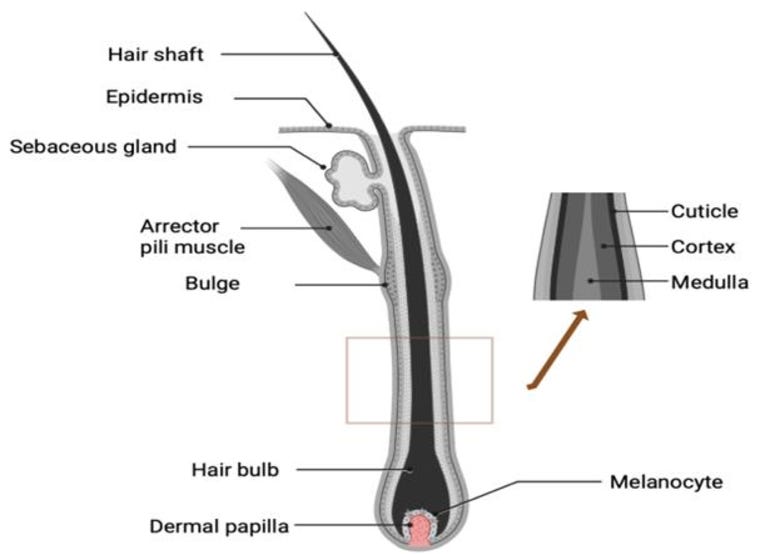
There we go. Much better.
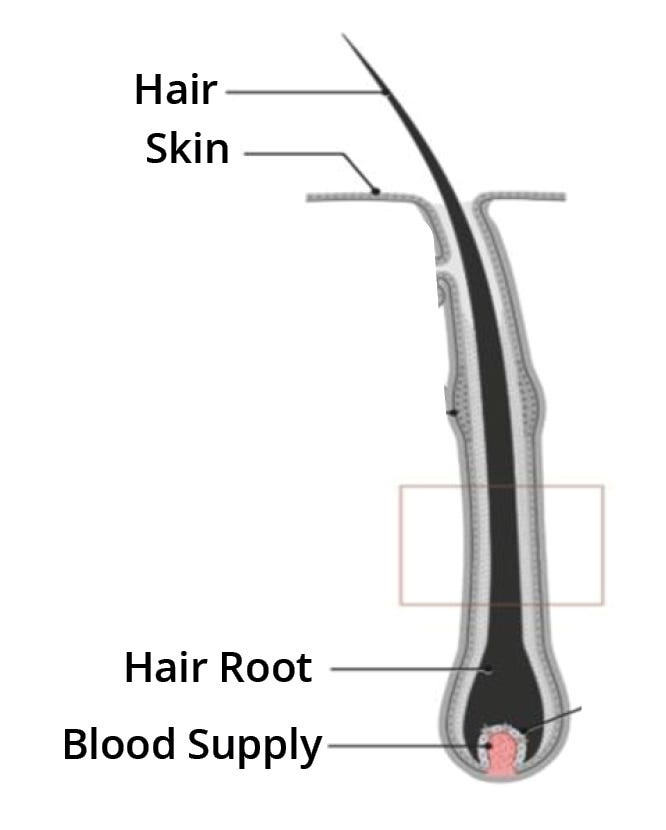
The stuff I cut out is important, but it’s stuff that, for instance, gives your hair its color, or helps squeeze the hair out once you’re shedding it (which is a normal and healthy part of the hair growth cycle, and is why you always see hair at the bottom of your shower); none of it has anything to do with permanent hair removal, so we’re just gonna ignore it today.
What you need to understand here is a lot of what you already know: a lot of your hair is beneath the surface of your skin, your hair grows from the root, and that root is fed by a little nodule called a papilla, which is where it gets all its blood and nutrients from. That papilla is what we need to kill, and every method of permanent hair removal aims to kill it permanently.
Oh, and one last things, which turbo-sucks: at any given time, between 1/5 and 1/4 of your living hair follicles aren’t actively producing hair, because they’re in something called telogen phase, where the follicle just does nothing, producing no hair, for about 3 months at a time.
Which means that even the most thorough hair removal in the world can’t possibly get everything in a single go. Ever.
And it also means you’ll be chasing straggler hairs for a while, no matter how good your hair removal professional is.
Laser hair removal is the gold standard for getting rid of hair quickly and affordably—but it needs to be said up front that it’s hair reduction, not complete removal. What do that mean by that difference? Well, hang on to to that for a moment—let’s talk about how it works, and then why it’s only considered reduction will make a lot of sense.
Laser hair removal works by shining a sudden blast of extremely high-power and tightly-focused laser light into your hair follicles. Each blast lasts less than a second, but carries so much power that it superheats your hair follicle, which causes the water inside the hair all the way down to its root to instantly turn into a tiny blast of steam. This explosion (it’s a tiny explosion, but it’s still an explosion) pops the hair like a popcorn kernel, and the escaping steam cauterizes the papilla that supplies blood and nutrients to the hair. Once it’s cauterized, the papilla can no longer feed any hair growth in the follicle, so you don’t grow any hair there anymore.
Now, there’s a couple of big asterisks to laser! If you’re sitting there reading this and wondering why the hair explodes but the cells of your skin don’t, it’s because laser hair removal assumes that the person’s hair is a darker color than their skin—and because dark-colored stuff absorbs heat and energy quicker than light-colored stuff, which reflects more of that energy, the skin gets a very minor sunburn from the less-than-a-second laser blast, while the hair goes kablooey.
And if you’re thinking, “hey, what about Black folks and people with blonde hair?” Yep. That’s a huge problem. Designing technology that inherently works better for white people than Black people is some bullshit.
Now, it should be said that things have been getting better lately in that regard. One of the new types of laser—we’ll get to that in a moment—is safe to use for folks with any skin tone, and new lasers are better at working on lighter hair too.
But laser will never work on the palest blonde hairs, very fair red hair, or white hairs, and that last bit is why laser is and will only ever be hair reduction, not complete removal. Everyone’s got a few white hairs here and there, even teens. Without coloration in the hair, most of the laser’s light just gets reflected.
There are three general categories of laser hair removal devices, and these are all big honkin’ machines that live at a clinic, not at your home. Just ask what type of laser device a clinic you’re thinking of going to has, and they should be able to tell you; if they won’t say, don’t go to that clinic.
It should take 7-9 laser treatments, usually with about 6 weeks in between each treatment, to clear an area of hair. Price can vary widely, but most of the time the best devices, best-trained personnel, and the cheapest prices can be found at plastic surgery clinics, and sometimes medspas. Be cautious around big chains with lifetime prices; they’re usually dramatically more expensive than session-by-session costs. My face clear was less than half the on-sale price at That Big National Laser Hair Removal Chain You’ve Heard Of, meaning it was a quarter of the retail cost.
The first, and oldest, design is diode lasers. Just like the name suggests, it’s just a big ol’ laser diode, same as you’d see in most other commercial or industrial uses, just calibrated to work on your hair. They work well if you’re fair-skinned and have dark hair, but they’re the least effective type of laser, and most good clinics have replaced them by now.
Under no circumstances should you be treated with a diode laser if you have dark skin. It can cause serious burns.
Alexandrite lasers focus a laser beam through a special crystal, called alexandrite. Alexandrite is very special because it’s got chromium in its crystal structure, meaning that it changes color depending on what wavelength of light is getting passed through it—which makes it perfect for lasers that need to change what kind of light they’re shining to fit most different skin tones and hair colors. Most modern clinic lasers are alexandrite lasers.
If you have dark skin, you’ll need to talk with the clinic about the type of laser machine they have; advanced alexandrite lasers work on even the darkest skin tones safely, but not all alexandrite lasers have the proper technology—some places cheap out, or have older machines.
This one’s a mouthful. The acronym stands for “neodymium-yttrium-aluminum garnet,” which means that the focusing crystal of these lasers is made of a garnet crystal that’s got a much more complex chemical structure than typical garnets. Why the complexity? Because that makes the laser into a really long wavelength, and that makes Nd:YAG lasers the safest lasers on the market if you’ve got dark skin. Nd:YAG lasers are the newest design out there, and while they’re not as effective at popping those hair follicles as alexandrite lasers are if the patient is white, they’re definitely the safest type on the market, so a lot of places prefer them. Most importantly, they’re the most effective type of laser out there if you’re Black.
Intense Pulsed Light (IPL) is supposed to work the same way that laser hair removal does—it’s just nowhere near as good at doing it. Instead of using a laser, which has incredibly intense, pinpoint light, it uses a super-brilliant flash of light itself to try and pop hair follicles the exact same way that laser does it. And, in fairness, when the hair you’re going after is pretty fine, it can get the job done. But IPL is almost completely ineffective on facial hair, and absolutely won’t work at all if you’re not white.
To be absolutely frank: this is technology that was developed to sell to middle-class white cis women who want hairless legs, but who think real laser is too expensive.
As a result, there are a lot of borderline-scammy handheld, use-at-home devices you can buy, some of them even from name brands, that will do very little at most for anyone who’s had much testosterone in their body. As a general rule with these home devices: if they don’t come with special safety glasses and a really strict eye safety warning, they’re too weak to do anything other than flash. Even then? They cannot clear your facial hair, and it’s dangerous to try. You can really damage your eyesight if you mess up.
Mostly, I’m mentioning IPL devices here because some less-reputable med clinics will advertise that they do laser hair removal when all that they have is an IPL device. Again, sometimes they can work… but mostly they don’t, and especially not for facial hair. We’re talking reductions of as low as 5% of total hair volume here, meaning as little as 5% of your hair can even be dealt with this way if you're even a candidate. Again, clinic-based commercial devices do work, but the absolute minimum effectiveness percentage for laser hair removal is six times higher than the minimum for IPL, and the ceiling for laser is as high as the low 80%’s.
Don’t waste your money on IPL, either devices or clinics. And if they don’t want you freshly clean-shaven for a “laser” treatment? It’s an IPL device. Leave.
Electrolysis is the only treatment cleared by the FDA as permanent hair removal, because it’s a process that kills each and every hair follicle dead, regardless of what color it is. Because of this, it’s pretty much always the type of hair removal that bottom surgeons require to get ready for bottom surgery. Almost always, though, electrologists will tell you to get as much out of laser as you can before starting electrolysis, including for bottom prep. Why?
Because it’s incredibly slow, and that means expensive. Incredibly slow. Think: they can cover an area about the size of a quarter in an hour’s work.
It has to be slow, because how electrolysis works is that a trained electrologist uses a magnifying glass to stick a little needle probe into a hair follicle. Then, they trigger the device attached to that needle probe—we’ll talk about the two ways it works in a second—for a couple of seconds, after which they gently remove the hair with a pair of tweezers. A skilled electrologist can do one hair follicle about every 10 seconds, depending on how often they have to adjust their position and stuff like that.
Seems great, right?
Well, an average face of hair has around 15,000 hair follicles. Without breaks, assuming no mishaps, and that they never have to re-do a follicle because the first treatment didn’t quite take, which happens, that’s nearly 42 hours to clear a face. The reality, unfortunately, because of how hair growth cycles work, is usually much, much more. Since electrolysis can bill at $100 an hour or more… well, you see the problem in terms of cost. The average electrolysis clear costs 4-6 times as much as laser does, because of all that time.
To speak plainly: if you’re preparing for bottom surgery, it usually takes 1-2 years to completely clear all the skin you need to clear for surgery. Get started as soon as you know it’s in your future, okay?
Anyway, all this is why you want to get as much laser as you can, if you can, before starting electrolysis. It’ll save a lot of trouble and more than a couple of bucks.
That said, there’s two types of electrolysis, and then an approach that uses them both at the same time. I’ll explain how each works, but galvanic electrolysis is definitely the way to go—the combined approach is fine—if someone offers it.
Oh, one more thing: electrolysis hurts. A lot. Most folks say it hurts much more than laser. Think “angry kitten made of electricity and fire clawing your face.” So, uhh… be ready for that, especially if you’re getting work done downstairs.
Thermolysis works the same way laser does: superheat the hair until it explodes and the steam inside cauterises the papilla. It does it by flash-heating the tip of the thermolysis needle quickly. The main advantage here is that because of how it works, thermolysis is the fastest way to do electrolysis, and by a fair margin. The downside? It’s the least effective; 20-40% of all thermolyzed hair follicles grow back and need to be redone.
If you’ve got no other options—for instance, you live in a rural place, and this is all the local clinic has—it gets the job done. That said, if you have any choice at all, you want galvanic electrolysis.
No joke, this one’s kinda cool.
Galvanic electrolysis works by running an electric current through the bottom of your hair follicle. This electrical current causes the chemicals in the papilla to react with each other to produce sodium hydroxide, more commonly known as lye. That lye chemically burns the papilla into apoptosis, killing it dead for good. Galvanic electrolysis is so effective because that chemical reaction keeps working after the electrologist moves on to the next follicle, making it much more thorough. The downside? It’s a fair bit slower than thermolysis, on a per-follicle basis.
If you’re sticking a needle in a hair follicle to zap it full of electricity, there’s no reason you can’t flash-heat it too. That’s the principle behind combined electrolysis; might as well pop the hair while you’re in there and cauterize the papilla from the outside while you’re chemically burning it from the inside. There’s honestly not much more to say about it than that.
Most modern electrolysis machines can do either thermolysis, galvanic, or combined types, but ask your electologist which they do to be sure. Mostly, it depends on where they were trained; some schools only really teach thermolysis.
There’s one last thing worth mentioning: there are a few places here and there that do what they call “large volume hair removal” electrolysis. Some very few do this under general sedation, but the cost is astronomical; most try to do it using injected lidocaine nerve blocks, and occasionally with some IV painkillers to help out. For some people, this works exceedingly well. For others, like me? We either metabolize the lidocaine really quickly, or it doesn’t work at all.
And the cost for these places is enormous, especially for full sedation.
If you’ve got the scratch and you know lidocaine works well on you, these places can be a godsend, especially if you’re blonde or have a lot of white hairs. But please, please, be careful, check with your dentist about how long lidocaine seems to last on you first, and read reviews of places meticulously. Some places are scammy, as with anything else in permanent hair removal.
There’s one last thing I think I should mention in all this: these treatments take a real toll emotionally, and people don’t talk about it. Every single session of electrolysis took the wind out of my sails, and every single laser session early on left me in a pit of dysphoria for days.
You’re gonna want to get ready for a soft landing after all that.
If you get laser, the hair follicles have literally exploded like popcorn kernels, which means they take up way more space than they did before. That means your hair is going to look denser and splotchier than it ever has in your life, until the dead hair falls out a few days later.
Meanwhile, after electrolysis you’re going to have a whole bunch of splotchy, reddened, swollen skin all over the area you get electrolyzed, because you’ve got hundreds of fresh little chemical burns that you’ve just had inflicted on you. If that’s your face? It’s gonna look and feel like you’ve got a bizarre illness or a bad allergic reaction.
And if it’s downstairs work? You just spent an hour being made hyper-aware of a place on your body that you I’m gonna go ahead and guess that you can’t stand, as one of the most sensitive places on your whole body got zapped and chemically burned over and over again.
That sucks.
Plan on a quiet evening after each session. Give yourself comforts, whether it’s a book or a plushie or a scoop of ice cream—anything that helps you feel like yourself again, even a little.
And yeah, be patient. This is gonna take a long time, for better or worse. It’s incredibly worth it, but…
But getting there is nothing short of miserable.
I just want to give a special thank-you to my electrologists, Jill and Karina, who took the time to teach me all this stuff over the course of the years they were zapping me. They had a gentle touch and kind hearts, both of which I appreciate deeply.
Comments
Nothing yet. Say the first thing.
Sign in to join the conversation.