

Obsessive-Compulsive Disorder is one of those conditions that’s sort of shrouded in a bit of an air of mystique. You hear about it, people talk about it—it’s kind of like psychopathy or schizophrenia. They’re the movie stars of the psychological world, the ones that people make movies and write books about. They’re well-known, the sorts of terms and ideas that people use all the time, talking to each other, as a shorthand to talk about ways of being in the world.
Well-known, but misunderstood. Badly misunderstood.
Over the years, I’ve known and been friends with a psychopath, a couple of people with schizophrenia-spectrum disorders, and I’ve known a couple of people who’ve lived with OCD. I cannot begin to describe the ways in which the realities of their lives were radically different from what people think they were.
Both of the people I’ve been friends with who were on the schizophrenia spectrum—and one stood at my wedding, just for a frame of reference— were extremely well-educated people who lived independent lives, held jobs, and generally were people you wouldn’t glance twice at if you passed them in the street. Neither of them had multiple personalities. That’s not really a thing with schizophrenia-spectrum disorders.
I do know several plural systems, what people are usually thinking of when they talk about schizophrenia. They’ve all been amazing people, every front I’ve ever had the pleasure of meeting. One year at a conference I hung out with a bunch of people in Mad Studies, just to learn more about them and people like them. It was wonderful.
My friend who’s a psychopath? I’m sure you cringed when you read that, worried for my safety, right? He’s a fantastic guy, and has been a dear friend to me for almost twenty years. By his own admission, he lacks empathy, as psychopaths do, and he definitely enjoys manipulation, but he’s also a very clever man, and can see how badly a lot of the nasty sorts of manipulation you’d expect end up turning out for the psychopath in question—and how rich, friendly social connections benefit a psychopath in the long run. So, instead, he essentially gamified making his friends happy for himself, turning that desire to manipulate into his and our mutual benefit.
I’ve never had a friend who’s nailed surprises as well as he did.
And, of course, my acquaintances with OCD. The thing they both mentioned was how much they hated what most people thought living with OCD is like. People use it as a shorthand for being particular about things, being irritated when a thing is out of place, wanting a tidy home, stuff like that. The reality is just… so completely not that. OCD was disruptive to their lives in ways that most people couldn’t imagine.
One of the people I knew with OCD picked it up because she was seriously immunocompromised. When you’re seriously immunocompromised, you need to be very careful about consistently washing your hands properly, taking the full twenty seconds. So, she did. And then it turned into washing them twice, just to be sure. She wanted to protect her health.
Then three times, every time she needed to wash her hands.
Then four, back to back to back to back.
She started having to use lotion for her hands constantly, from all the handwashing. It consumed enormous chunks of her day. Just think of how often you wash your hands every day. Then quadruple it. No matter what.
Every.
Single.
Time.
To be clear: while I’ve known all of the people I’m talking about, I’ve also changed details I’m sharing about them to include some dead lies. I won’t tell you what, or where. These folks deserve privacy.
I bring this up because there’s a huge difference between the pop culture ideas of what psychopathy or schizophrenia or OCD are like and the daily realities of living the lives these people lived. And—well, if you hang out in gender questioning spaces for long enough, there’s an odd thing you’ll see come up time and time and time again. People duck in, anxious, tired, afraid, overwhelmed, and ask a simple question, in one of oh-so-many variations:
“What if it’s Transgender Obsessive-Compulsive Disorder?”
Usually, those folks are surprised and disturbed at the forcefulness of the ideas that seem to burst into their minds, demanding action out of nowhere. That they, contrary to what they’d thought, aren’t the gender they thought they were, and need to act, urgently on that. It feels deeply, deeply disruptive to their lives, is usually unwanted, and it scares the absolute crap out of them. TOCD offers an explanation and, better, a treatment. A treatment that isn’t “you’re trans, surprise, now you have to deal with everything that goes along with it.”
We’ll get to that in a bit.
Before we can, though, we have to understand the beating heart of the difference between what OCD is, and what it really, really isn’t.
The first part of this that we need to understand is something called intrusive thoughts. In a nutshell, an intrusive thought is a thought that seems to burst into your mind at no particular time and which are often really upsetting. It’s that sudden and totally irrational urge to jump when you’re standing on a canyon ledge, the flash-image of the harm you could do to someone else with a kitchen knife while you’re cutting vegetables.
For me? Every single time I inject my estrogen, I get a flash of that needle plunging into one of my breasts, and destroying the implant there. Watching, helplessly, as this part of myself I waited half a lifetime to finally have, drains away.
It’s disturbing stuff. There’s a reason people really don’t like intrusive thoughts.
But maybe more importantly, intrusive thoughts are a way, way bigger basket than just the super-disturbing, self-destructive stuff like that. Thing like—well, remember that incredibly embarrassing thing you did in middle school? How about That One Time you tried to pick up a hottie and made an absolute fool out of yourself? Or when you gave That One Work Presentation and bombed spectacularly? And all the times you find yourself reliving those moments when you just want to get on with your life?
Intrusive thoughts.
Just like how so many trans people have sudden, deep, intense, and recurring doubts whether they really, truly are trans enough. There are so, so many things you can have intrusive thoughts over.
Intrusive thoughts are, as best we understand them, just a regular part of being a living, breathing human being—about 93% of all people have them pretty darn regularly.
We don’t really know why people have intrusive thoughts. We know that other mental health struggles—depression, stress, gender dysphoria—makes them happen way, way more commonly, and that the more you resolve those stressors, the fewer a intrusive thoughts a person tends to have. The more you fight them? The more insistent they get. It’s a weird little paradox.
One of the better theories for why people get intrusive thoughts is that they serve as a sort of Power-On Self-Test for people in tough situations. Basically, the idea goes, when someone is under stress of some kind, the brain needs to make sure it still has control of other things, that it physically can do the sorts of things that we get intrusive thoughts about—like jumping into that canyon—to be sure that you don’t actually want to. The point of them, the idea goes, is to test-trigger the disgust response, and protect us. Reject dangerous and antisocial actions, avoid social pain, all that jazz.
The thing is, though, there are other sorts of intrusive thoughts, that aren’t often thought of as intrusive thoughts because, well, we like them. Ever see some food and suddenly get swamped with hunger just because it looks good? Still an intrusive thought there, just one we don’t really think about as intrusive.
We get intrusive thoughts about desirable things too: longing for sex, for relationships, to look or be a certain way, to get out of a bad situation. The list, there, could go on for just about ever, and we don’t think of them as intrusive thoughts or impulses because they feel rational, on a gut level. Just… expressions of our various needs and drives.
But if we flip the script a little bit on the scary stuff we were looking at a little earlier? Well, that flash-image I have of me and the needle when I inject is all about getting me what I want too: protecting my body from a danger.
In other words, intrusive thoughts are just there to make sure all your bits and pieces are in proper working order, and that you’re able to get what you need. Sure, they’re kinda freaky-deaky from time to time, but the important thing to remember is that they’re all about your subconscious just sorta burping up important things you need to keep in mind in some way.
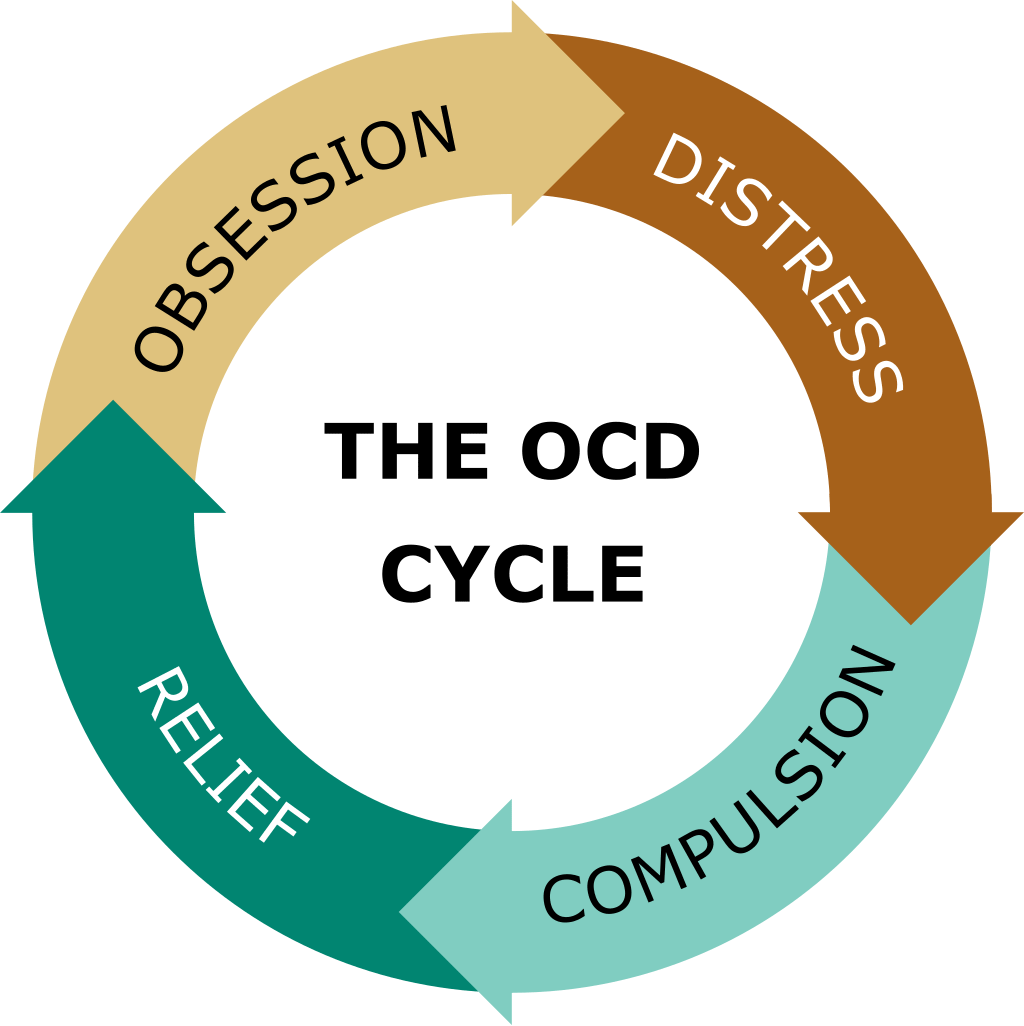
Obsessive-Compulsive Disorder is a very different thing, even though intrusive thoughts are one of the most important parts of what makes OCD what it is. In general, it’s part of the anxiety disorder family, meaning that it’s a struggle people have based on fear that they’re feeling. OCD is unique in that you focus on those anxieties—like a person might if they had generalized anxiety disorder—and that they manage by doing something specific and ritualistic, which is just a fancy way of saying rules-based and really specifically-defined. And OCD is rare—only about 1% of the population has it at any given time. This diagram is a fantastic way of looking at the basic mechanics of how the OCD cycle works:
Let’s get into the nitty-gritty of what the DSM-5 says you have to experience to have OCD. This is gonna be a bit technical for a moment, but we’ll break it down right afterward.
The presence of obsessions, compulsions, or both.
Obsessions are defined as both:
Recurrent and persistent thoughts, urges, or images that are experienced, at some time during the disturbance, as intrusive and unwanted, and that in most individuals cause marked anxiety or distress.
The individual attempts to ignore or suppress such thoughts, urges, or images, or to neutralize hem with some other thought or action (i.e., by performing a compulsion).
Compulsions are defined as both:
Repetitive behaviors (e.g., hand washing, ordering, checking) or mental acts (e.g., praying, counting, repeating words silently) that the individual feels driven to perform in response to an obsession or according to rules that must be applied rigidly.
The behaviors or mental acts are aimed at preventing or reducing anxiety or distress, or preventing some dreaded event or situation; however, these behaviors or mental acts are not connected in a realistic way with what they are designed to neutralize or prevent, or are clearly excessive.
The obsessions or compulsions are time-consuming (e.g., take more than 1 hour per day) or cause clinically significant distress or impairment in social, occupational, or other important areas of functioning.
The obsessive-compulsive symptoms are not attributable to the physiological effects of a substance (e.g., a drug of abuse, a medication) or another medical condition.
The disturbance is not better explained by the symptoms of another mental disorder (e.g., excessive worries, as in generalized anxiety disorder; preoccupation with appearance, as in body dysmorphic disorder; difficulty discarding or parting with possessions, as in hoarding disorder; hair pulling, as in trichotillomania [hair-pulling disorder]; skin picking, as in excoriation [skin-picking] disorder; stereotypies, as in stereotypic movement disorder; ritualized eating behavior, as in eating disorders; preoccupation with substances or gambling, as in substance-related and addictive disorders; preoccupation with having an illness, as in illness anxiety disorder; sexual urges or fantasies, as in paraphilic disorders; impulses, as in disruptive, impulse-control, and conduct disorders; guilty ruminations, as in major depressive disorder; thought insertion or delusional preoccupations, as in schizophrenia spectrum and other psychotic disorders; or repetitive patterns of behavior, as in autism spectrum disorder).
Obviously, that’s A Whole Lot. Let’s take a second pass at it, simplifying the language.
To be diagnosed with OCD, you need all four of the following main things to be true. Everything that’s bolded means that the part before it is linked to the part after it, so there might be a sort of a or b option at one point, where there’s more than one way to fill a part, but a required link later on. I did this to try and keep things less confusing.
Remember, you have to hit all 4 main points to be diagnosible with OCD.
You have an obsession or a compulsion.
An obsession is intrusive thoughts that make you feel anxious AND that you try to suppress, usually by doing something physical.
A compulsion is a physical thing that you do over and over AND/OR something you do in your head that you feel forced to do according to a really rigid set of rules that you feel you have to follow, AND those actions, mental or physical, are what you do to try and keep something bad from happening. They ALSO must be way out of proportion to whatever it is that you’re trying to prevent.
A good example here is washing your hands. Washing once, thoroughly, whenever you feel your hands are dirty is very reasonable. Washing them five or six times in a row is not reasonable.
You spend at least an hour of every day doing stuff from point 1 OR they really, really upset you.
No other medical condition or drug that you take, prescribed or otherwise, can have any of this as a potential side effect.
You can’t have another mental disorder that explains things more cleanly.
For example: if someone seems obsessed with being skinny, that’s anorexia or bulimia, not OCD, even though it seems like an obsession or a compulsion.
It seems, like… really hard to match all of those criteria, doesn’t it? That’s because OCD is something called a diagnosis of exclusion. Basically, that means that it’s a diagnosis that you can only get if there’s a clear problem, but no other explanation.
No.
Other.
Explanation.
None.
And now it’s time for why you’re here. If you’re reading this, there’s probably only one of two things going on: you’re just plain curious, or you’re worried that you might have Transgender OCD—a subtype of obsessive-compulsive disorder where the thing you’re anxious about is that you might be trans.
Trans OCD, sometimes called gender OCD, is a new version of something we used to see back in the ‘00’s and ‘10’s, but not so much now. It was called either homosexual OCD or sexual orientation OCD, and it’s basically the same deal, just with gender subbed in instead of sexuality. In a nutshell, it’s the fear or anxiety that you might be trans and forced to transition against your will. The fear usually stems from two things:
Having a body you love change into something you find unrecognizable and repulsive because you were somehow forced to transition.
Having to live a life where you get treated much more poorly because you were somehow forced to be trans or transition, where the things that bring you safety and happiness are forever taken from you.
So, to try and avoid these things, you obsessively seek proof of some kind that you are indeed your gender assigned at birth. You might obsessively talk with trans people or medical experts over and over, and despite the fact that their answers confirm your gender, the fear crops up over and over again. You might obsess in your past for signs that somehow might prove that you are or are not trans. You might compulsively experiment with your gender, even though you hate the results of that experimentation because they make you feel less like your gender assigned at birth. You might check yourself in the mirror over and over to make sure your appearance hasn’t suddenly changed to be a gender other than your gender assigned at birth.
Trans OCD is also really rare—it’s a tiny fraction of people who have OCD, which is itself a tiny fraction of everyone. It’s so rare, in fact, that no systematic studies have ever been done on it, just a handful of case studies.
But you can see how it links up with what we talked about with OCD in general above, but more importantly—you can probably also see how a lot of what people with Trans OCD do overlaps a whole lot with what gender-questioning people do. Like, for instance, a trans woman who hasn’t figured it out yet might try wearing a dress or doing her makeup, but feel awful about it.
The difference is in the why. A person with Trans OCD actively loves their gender assigned at birth, and I can’t say loudly enough that their fear is ultimately that they won’t get to be that gender anymore. An exploring trans person, on the other hand, is usually feeling a lot of gender dysphoria, and feels awful because they feel like they’ll never escape their gender assigned at birth.
So, how can you tell the difference?
Thanks for hanging in there with me. I know, if you’re afraid that you might have Trans OCD, that you’re scared as heck and that you want some sort of certainty here. So, let’s do a couple of basic questions to help you figure yourself out.
Question 1: Have you been diagnosed with Obsessive-Compulsive Disorder before you started questioning your gender?
Almost everyone is going to answer “no” here, just because OCD is rare. And the thing is?
If you answered no to this question, you don’t have Trans OCD.
In every case study we’ve ever had on Trans OCD, the appearance of Trans OCD was a sudden evolution of a person’s pre-existing Obsessive-Compulsive Disorder. We have no evidence that Trans OCD ever presents in someone who doesn’t already have a pretty significant history of OCD.
In short: unless you’ve got an existing OCD diagnosis, hun? You’re just experiencing intrusive thoughts, which is both normal and part of questioning your gender, wherever that questioning journey takes you. This article might help you make some progress on that journey.
Only if you have a history of OCD is the second question even relevant.
Question 2: Imagine there was a blood test that someone could take to determine if they were trans or cis, and that it was magically, perfectly, 100% accurate. You took the test, and when the results came in, they say that you’re trans.
How would you feel about those results? And why?
Think about it for a minute.
Keep thinking.
Okay.
If you felt relieved: Go read this article and do the exercises.
If you felt awful about it because of how your life as a whole would change, go read that article I just linked and try again, working as hard as you can to exclude those parts.
If you felt awful about it because of how transition would change your body, it’s time to talk to a therapist specializing in Obsessive-Compulsive Disorder about how you’re feeling.
If you’ve been paying attention in this article, you’ve probably noticed something, and it’s time to be honest about it. I want you to take a breath if you’re feeling a whole lot right now, maybe take a bit of a walk, okay?
Ready?
So, Here’s The Thing You Probably Noticed: almost all roads in this journey end up in the same place: that you’re transgender, and all of this is anxiety over how being trans, and transitioning, is going to impact every part of your life. Like, if you’re here, if you’re reading these words right now, if you started this article wondering if what you’re feeling might “just” be Trans OCD, the chances that you’re anything but transgender are really pretty slim.
And… yeah. That’s how it is.
If you’re reading this as anything except idle curiosity, you’re probably trans.
The overwhelming majority of cases where someone thinks they’ve got Trans OCD are like this case study. A trans person, either in denial or who’s faced with an unsupportive living situation, either grasps for Trans OCD in a desperate attempt to stay safe or is accused of having it by that unsupportive family member who’s equally-desperate to find an explanation for what they’re feeling that’s anything at all except that their family member is trans.
Trans OCD, in short, is almost always a diagnosis that someone seeks because of harassment, not because they actually have it.
So, with all gentleness: if you came here wondering if you have Trans OCD, I want you to stop and really think about why you’re looking into what is, very frankly, an extremely niche diagnosis before trying on the idea that you, like at least 1.6% of the world’s population, are trans.
Because I’ll bet that what you’re really worried about are the consequences if you are, not the reality of just being trans.
And that?
That’s not OCD. Not even close.
Comments
Nothing yet. Say the first thing.
Sign in to join the conversation.