
Balzac said that those who live furthest away from a party are always the first to arrive. In Britain there is a similar pattern: those with the most power find it hardest to wield it. Despite almost hegemonic control of discourse, the centre-left is failing in government, the centre-right is failing in opposition, and the Liberal Democrats have disappeared. Our politics focuses on the resurgent extremes, but the centre will be what decides our future.
The centre in Britain is best described as the party of inertia. It represents a continuum from Sunak to Starmer, focused on small changes and firmly tied to the media establishment, be it in the press or broadcast TV. It is made up of the wealthy who benefited from the 1979–2008 economy and were not adversely affected after 2008, other than by the irritation of Brexit. With so much political and organisational power, they should shape the terms of our debate, but instead these forces of political order seem destined for destruction.
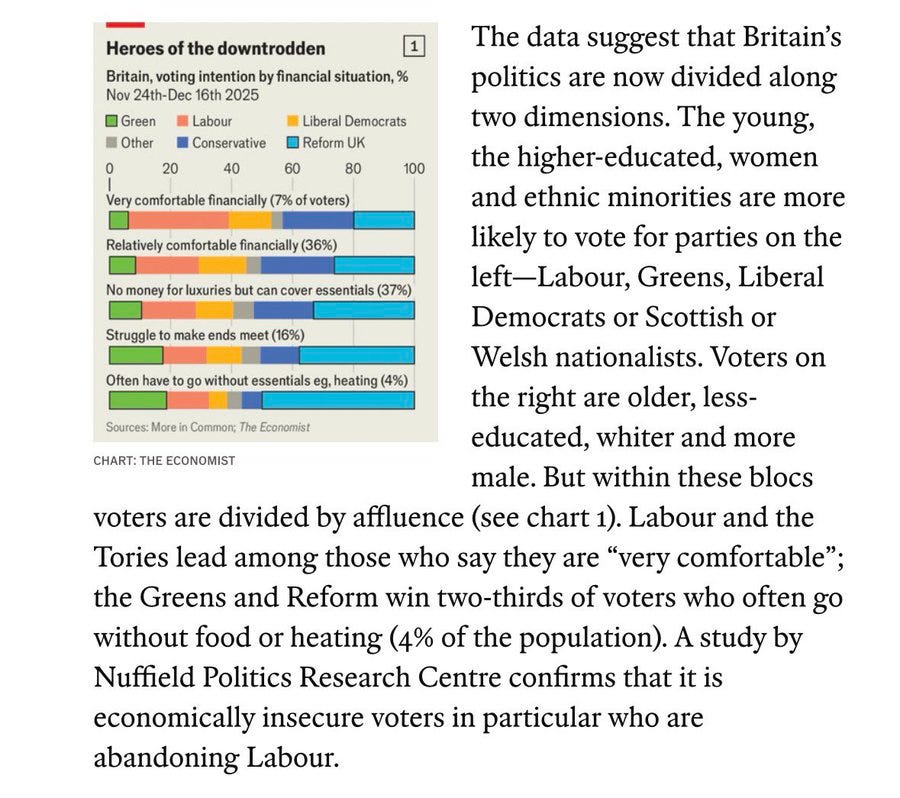
This electoral Balkanisation resembles the worst forms of tribalism over very few real differences. A closer relationship with Europe, net migration of between 100,000 and 200,000, decreased welfare spending, and preservation of post-1997 institutions are probably political tenets on which all would agree. Despite this, it is squandered between different bands of The Thick of It re-enactors. The consequences of this disorganisation are felt in the pockets of Britain’s upper middle class.
As it is, the current party system is a disaster for Britain’s well-off. The political mythologies of Labour and the Conservatives, long divorced from any historical or sociological basis, have merely operated as mechanisms for transferring resources from the productive centre to the poorer voters whose support they need. Brexit broke open the gates to this political inferno, and it has been a doom loop of minimum wage rises and tax increases ever since.
Modern Britain, in this respect, offers a striking rebuke to historical materialism. Vibes-based myths predominate across the breadth of political debate, and dinner-party conversation rules all. Large, spectrum-spanning majorities agree on immigration policies very similar to those of Nigel Farage. But blame for Brexit and an aversion to someone who has long defined the limit of the Overton window make him anathema to many “sensible” people.
Unable to countenance Reform, and with the Greens an existential threat to their economic status, what ought centrists do? The current strategy of guardrails on online discourse is probably the right one, but they aren’t strong enough to achieve it. De Tocqueville described the engine of France’s revolutionary fervour as “the press of London with the government of St Petersburg”; we have the same gap between the rhetoric and the practicalities of power.
The other option is to join the revolutionary storm. Historian-cum-adviser John Bew said in an interview this week that Britain should effectively give up on manifestos, as barely any MPs read them, never mind voters. Bew is right that having to stick to past promises which are now clearly unwise is irrational. The problem is the entire edifice of traditional politics is built upon the same myths as manifestos. If you ask British politics to be rational, the consequences would be far larger than just ignoring a manifesto. By that logic, the three traditional parties should combine into one, releasing themselves from radical bargaining exercises which come at such political and economic cost.
A new “party of stability” is probably impossible. Too many people rely on bloated party machinery to pay for a roof over their heads every month. The other danger is that in admitting things have to change you provide the rationale for your own destruction. Britain’s political revolution will only begin when the upper middle class asks the government to serve its interests. Then things could really start to get interesting.
No posts
Comments
Nothing yet. Say the first thing.
Sign in to join the conversation.