
A few years ago, British journalists discovered The Leopard. The Italian classic by Giuseppe di Lampedusa charted a Sicilian aristocratic family’s journey through the trials of the Risorgimento. The decline of the old order, the rise of the bourgeoisie: there were plenty of big questions to cover, and at only 170-odd pages, you could read it in an afternoon. As Keir Starmer becomes the next victim of Britain’s post-Brexit reordering, was he doomed like the Bourbon kings of Naples, or did he ever have a chance?
“Everything has to change so that everything can stay the same.” This is the quote from Il Gattopardo everyone remembers. Those looking for strong, stable leadership from Prime Minister Starmer hoped he could channel this message into British politics. Instead, nothing changed and everything got worse.
The final blow to this dream came as senior civil servants told The Spectator that the PM was “worse than Boris”. Such an excommunication from the guardians of Westminster politics seems to be the final act in a story of mistakes, misjudgements and, ultimately, failure. But, to echo Yeats, what could Keir have done, being what he is?
Immigration is the biggest issue in British politics. It is thanks to this issue that Reform are favourites to win the next election. Britain’s right has, for over a decade, struggled to win debates on any other issue. The effects of immigration on politics have been so total that it is easy to imagine a world where, with migration decreased a little, we are still in the European Union and George Osborne is hailed the world over as master of Europe’s revolutionary temper.
Keir Starmer entered office with the “Boriswave” already exploding. What had become the name for Boris Johnson’s government’s huge visa liberalisation was going to define his government — he just didn’t know it. The new PM had to choose between fighting it or accepting it, and he failed.
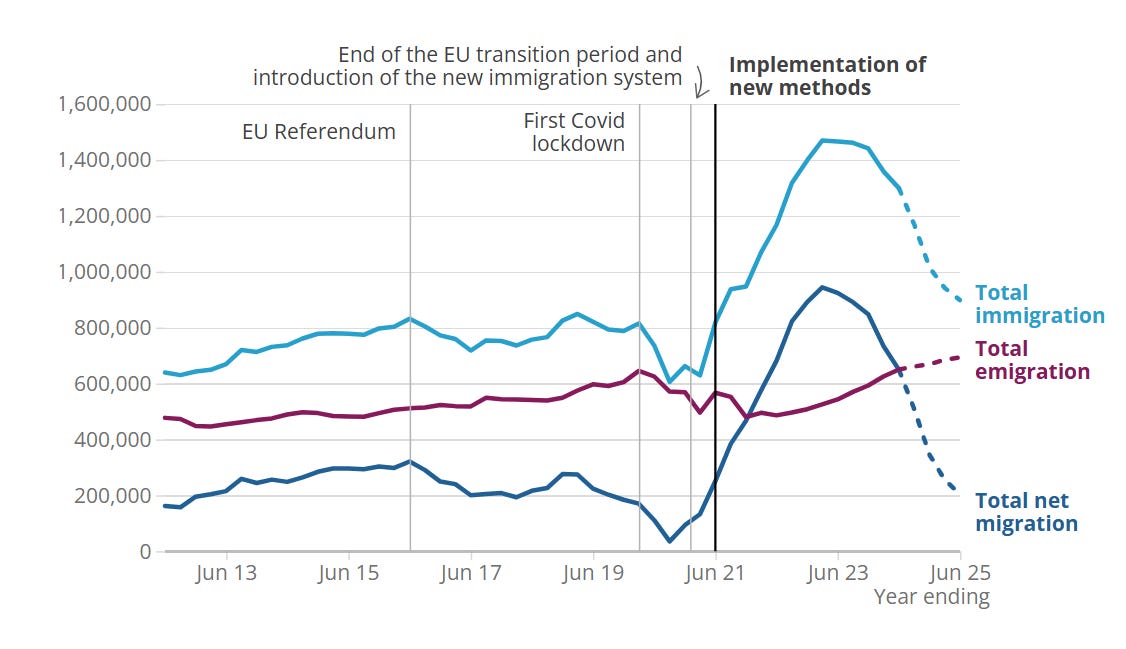
The political danger of immigration as an issue is that it isn’t only immigration — it is how your streets look, smell and feel. Even worse, the public continually underestimate how much migration there has been — particularly legally. This means that, even with significant decreases in headline numbers, much more political action would have to be taken to actually improve public perceptions. This was impossible for a Labour government, as it forced a choice between a group of MPs who are sheepish at best about border control and a significant part of their electorate who want change. Trying to appease both groups has failed; like water spiralling into an electoral sink, despite constant circling, motion has only been downwards.
A smarter course of action would be to follow the Spanish model. Embrace immigration and let the right purity spiral so much that liberals run to the Left. But Britain is not Spain. Even before Starmer entered government, he couldn’t control what was to his left.
If immigration was an unavoidable disaster, Gaza policy was not. Keeping the country’s left vaguely corralled around the party was the only chance for survival. Staying so close to the centre ground of British politics on the issue was a political catastrophe. This was underlined by repeated gaffes from before he was even PM, most notably when he said Israel had “the right” to cut off power and water in Gaza. We saw the damage this could cause in the 2024 election itself, when pro-Gaza parties almost removed figures such as Wes Streeting. This may have been bad, but the Greens made it a nightmare.
The Spanish example has been thrown around as an avenue for Labour’s survival, and in this respect it is correct. A full-throated anti-Netanyahu position taken early on would have spiked the guns of the far left and allowed them to remain around the leader. Pedro Sanchez’s polling ratings in Spain are only holding up because of the suppression of the left, and he could have done a similar thing. This has been achieved by becoming a totem for pro-Palestinian politics the world over. Sadly for Starmer, it is hard to imagine a scenario where this could have happened. The right of the Labour Party would never have accepted it, nor the media, nor most importantly himself.
The dual issues of immigration and Gaza made Starmer vulnerable on all flanks, and after winning an election with only 33% of the vote, he didn’t have much space to fall. The effects of new arrivals on streets as well as migrant hotel protests made immigration and integration an immediate crisis, while climbdowns on his position towards Gaza were as inevitable as they were damaging.
Of course, there were scandals which a better government could have avoided, Lord Alli’s gifts being one. But there is no social democratic solution to avoid the Gordian Knot of modern Britain. It is possible to campaign as a centre-left government, like Sanchez, making big moves on the international stage, but with the political and financial state of the nation, governing is impossible.
Put simply, there is not enough money to go around, and, worse, any savings are unacceptable. The easiest cuts are to take money from Labour’s own voters — hardly an ideal starting position. Many say a version of the welfare bill was possible if backbenchers had been sufficiently doted on and told everything would be OK. Perhaps, but was it ever possible to gain serious savings and mollify Labour’s NGO-fed backbenches? I don’t think so.
Could Parliament have been handled better? Of course. Too many MPs were scorned for too little. Nevertheless, with no significant growth in sight, even if welfare reforms could have been forced through, the rise of the Greens made more moves like this incredibly difficult electorally.
Among progressives, there is a belief that there must always be someone else to pay. There is an ultra-rich out there who, when finally made to pay taxes, will unleash unlimited resources for Britain’s “working people”. This is part of the mindset which led to the inability to pass cost-cutting measures like welfare reforms or winter fuel cuts. In a certain aspect, these rebels were right. They not only won but saw that the fiscal sky didn’t fall in, even if the government had increased spending commitments. Reality is a lot more complex than this, but this basic belief, now backed by real experience, makes compromise inconceivable. Only the bond market realistically keeps this dynamic in check.
It would be boring to say no other path was possible, but Keir Starmer’s unique inheritance of huge immigration, the conflict in Gaza and a woeful fiscal position gave him few options. The Sanchez strategy of being pro-immigration and vehemently anti-Israel was never available to him, and he probably couldn’t have won an election on it. There is space for many Labour politicians and some of their ideas to be successful. However, this won’t be as part of a Labour government, but in entities which are hitherto hypothetical.
All of the above are why Labour are now in the position they find themselves in. Considering Starmer himself, what more could he have done, being what he is? The fact there is no clear Labour challenger to the PM suggests there isn’t an obviously better course of action. His failure cannot be separated from the Party as a whole, and frankly the country. The current system cannot contain the nation’s desires. Everything has changed; we will be lucky if it stays at all the same.
No posts
Comments
Nothing yet. Say the first thing.
Sign in to join the conversation.