
A stablecoin that has processed exactly zero transactions just wiped billions off a real company’s market cap in one afternoon. Circle didn’t lose a single USDC customer last week. It lost 17.55% of its stock price anyway, on nothing but a press release and a list of logos. Wall Street, it turns out, prices in vibes just fine.
In this week’s brief:
Open USD launches with 140-plus partners, Circle’s stock craters, and the most interesting part isn’t even the launch
MiCA’s transitional period ends and USDT gets locked out of the EU for good
Crédit Agricole, BNY, and PayPal all quietly expand the stablecoin plumbing while everyone was watching Circle’s stock chart
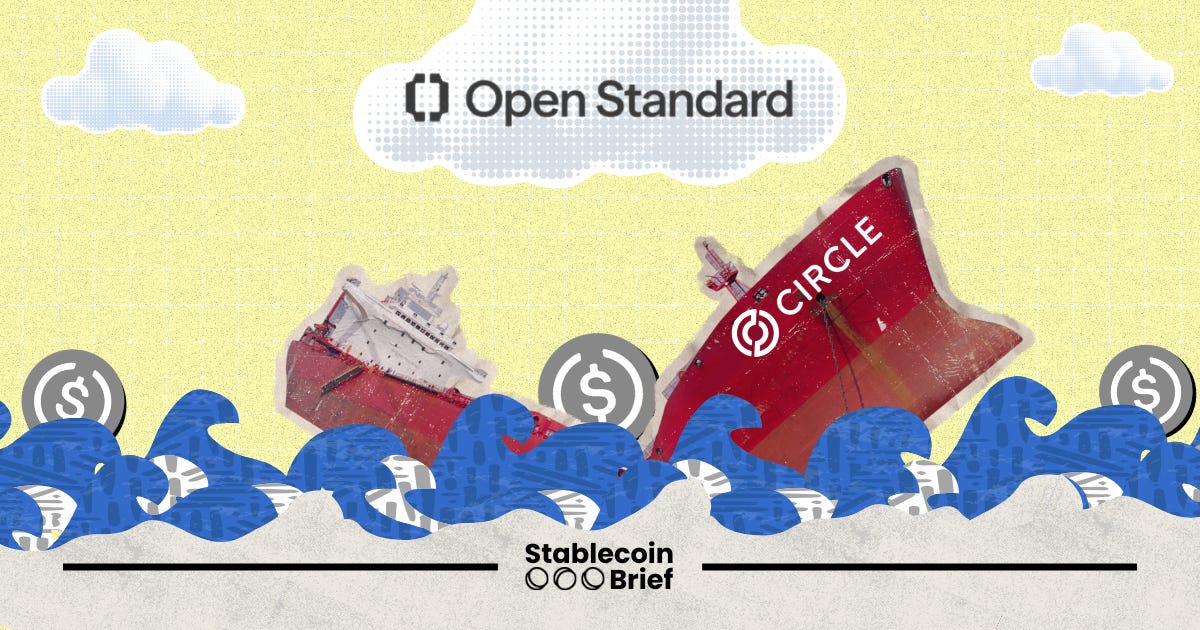
On June 30, a consortium of more than 140 companies, Visa, Mastercard, Stripe, BlackRock, Coinbase, BNY, American Express, Google, and Shopify among them, announced Open USD, a dollar stablecoin with zero mint and redemption fees and no volume caps. Circle’s stock dropped 17.55% that day to a four-month low. The joke practically writes itself: it’s the most expensive product launch in stablecoin history, and the product isn’t live yet.
The pitch: Open USD is governed by a new nonprofit-style entity called Open Standard, run by founding CEO Zach Abrams (who co-founded Bridge before Stripe bought it in 2024). Instead of Circle’s model, where distribution partners negotiate individually for a cut of reserve interest, OUSD makes revenue-sharing the default: every partner gets a slice of the yield after a small management fee. It’s launching later this year, starting on Solana.
What Open Standard hasn’t said: anything about reserve composition, attestation cadence, redemption windows, the final list of supported chains, or the actual revenue-split formula. Ark Invest’s Lorenzo Valente compared the whole structure to Diem, Facebook’s stablecoin project that died under the weight of coordinating too many corporate egos. A consortium of 140 competing companies making decisions together has no working precedent, and “glacial” is the polite word for how that usually goes.
The Coinbase angle nobody’s writing about: Coinbase is a founding OUSD member. Coinbase is also the party that has collected over $908 million from Circle under a revenue-share deal that expires August 18, less than two months from now. By joining the consortium built to make that exact kind of negotiated payout obsolete, Coinbase just handed itself leverage on both sides of the renewal table. It gets to sit across from Circle in August and say: match this, or we walk.
What actually moved the stock: part of the 17.55% wasn’t even about OUSD. FTSE Russell’s annual index reconstitution landed the same day, booting Circle from several Russell growth indexes and forcing mechanical selling from funds that track them, with or without an Open USD press release.
By the numbers:
17.55%: Circle’s single-day stock drop on June 30, a four-month low
~$908M: total fees Circle has paid Coinbase under their current revenue-share deal
August 18, 2026: when that deal’s initial term expires, weeks after Coinbase joined OUSD
96%: the share of Circle’s revenue that comes from interest on USDC reserves, the exact model OUSD’s default yield-sharing is built to undercut
Nobody’s stablecoin actually changed hands last week. A logo list and a governance memo did $60 billion in mark-to-market damage anyway.
MiCA’s transitional period officially ended July 1, and Coinbase, Kraken, Crypto.com, and Binance’s EU entity closed out remaining USDT spot access for EU and EEA users, the final compliance cliff after 18 months of gradual delistings. Tether never sought MiCA authorization, with CEO Paolo Ardoino arguing the rule’s European bank-deposit reserve requirement adds risk rather than removes it.
India’s Enforcement Directorate raided six Bengaluru crypto-payment firms over $265 million in unauthorized USDT transfers, and the crackdown pushed India’s USDT premium to 8.5%, more than double its typical range and the widest gap of the year.
Revolut confirmed it will delist USDT for EEA and Switzerland users, citing MiCA non-compliance. New purchases stop July 6, deposits stop July 30, and remaining balances get force-converted to fiat on August 31. Switzerland isn’t even under MiCA’s jurisdiction, and Revolut hasn’t explained why Swiss users got swept in anyway.
Crédit Agricole became the first major French bank to launch a euro stablecoin, EURXT, on Ethereum via its CACEIS arm, with about €20 million circulating at launch and its first real use case funding an Amundi tokenized money-market fund.
BNY made USDC the first stablecoin on its Digital Asset Custody platform, letting institutional clients mint and burn USDC directly against custody balances alongside traditional assets. More issuers are reportedly coming.
PayPal consolidated its crypto operations into a single Payment Services & Crypto division and brought PYUSD natively onto Polygon via Paxos, extending its footprint to 70 markets.
BlackRock integrated Ethena’s USDe into its Aladdin platform and backed a $100 million liquidity facility for BUIDL holders. ENA popped 12% on the news, then gave it all back within 24 hours as a scheduled $16.3 million token unlock added supply pressure right into the rally.
📊 CEX.IO’s “Stablecoins in Q2 2026: When the Rotation Becomes a Contraction” lays out the quarter that just closed: total supply fell for the first time since Q3 2023, yield-bearing tokens lost $3.5B, and Ethena’s sUSDe alone shed 52% of its supply. Read this before you decide whether OUSD and Ethena’s rough week were shocks or symptoms.
🌍 Launch Base Africa’s “Beyond the Remittance Hype” skips the well-worn “remittances are big” pitch and actually breaks down which specific business models are pulling VC money in Africa’s stablecoin market right now.
A stablecoin that doesn’t exist yet just cost Circle a chunk of its market cap, and the company most responsible for the pain is also the company still cashing Circle’s checks until August. Watch what Coinbase actually asks for at the renewal table. That’s the real story, not the logo list.
Comments
Nothing yet. Say the first thing.
Sign in to join the conversation.