
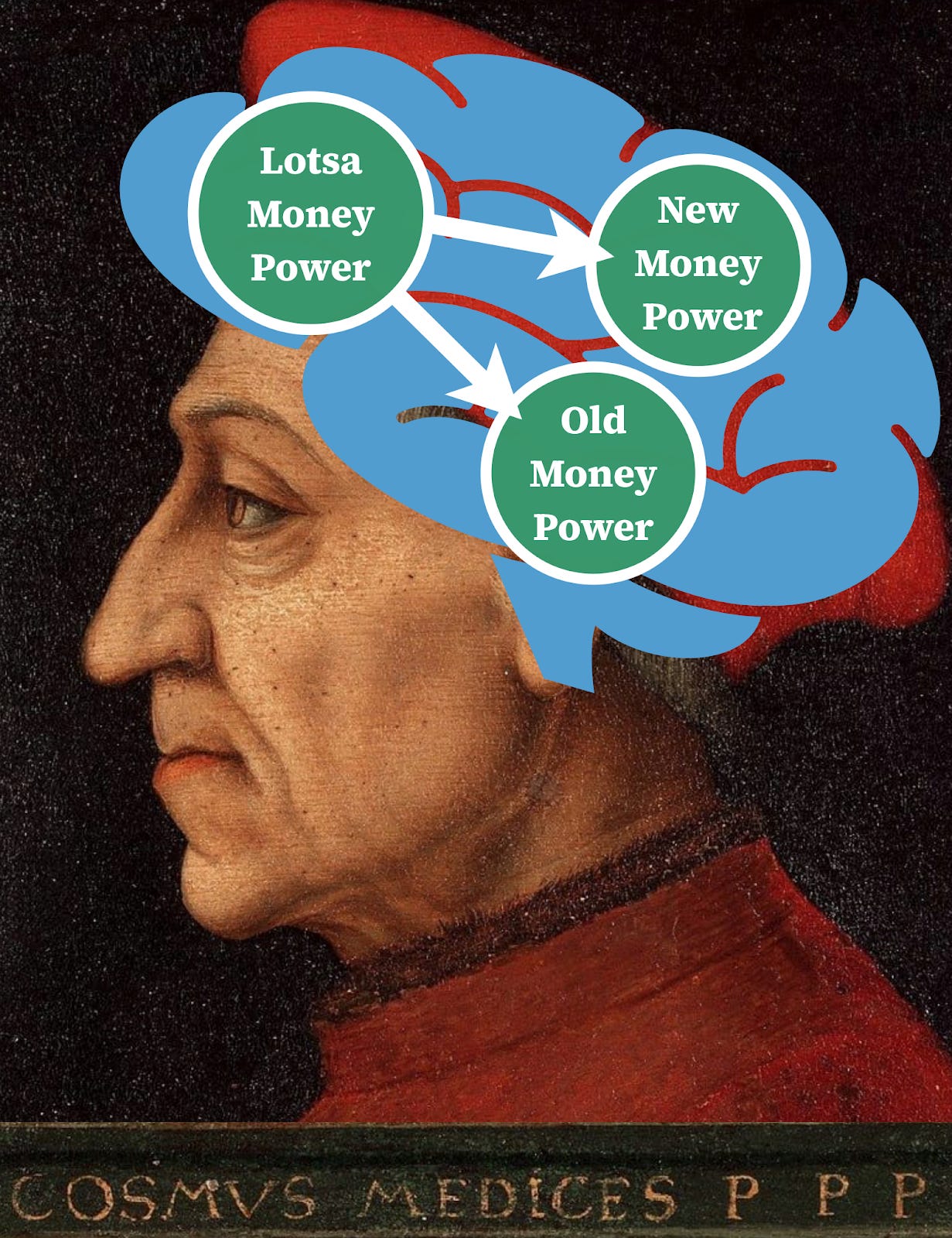
In the early 1400s, Florentine oligarch Cosimo de’ Medici rewired political access through credit controlled by the Medici Bank, consolidating Medici power by bridging hereditary oligarchs and new-money leaders. In this WIRe, I show how to adapt this network-bridging strategy within modern organizations.
Above all else, the oligarchs wanted to signal their exclusive superiority, which created a narrow worldview centered on prestige rivalries. The Medici arranged marriages and did business with select oligarch rivals. The Medici concurrently made business and banking deals with connected, wealthy, and enfranchised new men families who lacked the hereditary power of the oligarchs. Oligarch factionalization made it difficult for the oligarchs to match the Medici’s growing influence.
I examine this history to extract and teach a transferable strategy to avoid power struggles as an organization grows. It might be handy in situations resembling pre-Renaissance Florence: there, progress was impeded by a legacy leadership clique—the oligarchs—hesitant to share their “ancestral” power with new recruits. This strategy can help fuse the hard-won know-how of senior leadership with the dynamism of new recruits to stimulate organizational renaissance.
Fellow oligarchs thought the Medici’s promotion of economic diversity and inclusion of new men was unacceptably “woke”. The Medici were master social network engineers, but they were also ahead of their time in welcoming and developing business relationships with clans lacking hereditary titles.
The oligarchs who ruled Florence before 1400 were nothing if not class-conscious: they refused to arrange marriages with non-oligarch families; they avoided business partnerships and friendships with outsiders; and they loaned and traded mostly with other oligarchs. Politically, they conspired to keep others poor, dependent, and disenfranchised. The oligarchs’ lack of social and business connections with outsiders may have impeded their ability to imagine how their repression strategy risked backlash and the neutering of their power.
Urban-dwelling oligarchs began to populate Florence in the 1200s, coming from rural feudal manors, often bringing their feudal tenants along. The population of Florence ballooned from ~10,000 in 1175 to a peak of 120,000 in the 1330s before a plague outbreak reduced the population by half in 1348.
The oligarchs were the first families to form and participate in the city’s ruling council, the Signoria (the “lordship”). Later, new men families started to participate when they garnered sufficient political support, including amassing sufficient financial reserves capable of providing loans to the government in times of crisis.
In 1378, the Ciompi Revolt broke the oligarch’s monopoly on government: unrepresented and disenfranchised wage laborers, artisans, and craftsmen violently overthrew the government. The Ciompi Revolt is named after the unskilled wool carders who led it—ciompi is Tuscan/Italian for the English carders.The Ciompi government ruled chaotically until the oligarchs regained power in 1382 through violent repression. A Medici patriarch who supported the Ciompi was exiled. Little did the oligarchs know, their repression pointed out exactly where the Medici should invest in order to consolidate power and dominate oligarch rivals.
The Medici selectively arranged marriages with other oligarch families to retain hereditary prestige while loaning money to new men families who were capitalizing on emerging global markets. By avoiding the entangled, cyclical hierarchies of the oligarchy and selling business loans to dependent new men, the Medici built an efficient banking and political machine.
To understand the Medici strategy better, I now turn to illustrate and analyze the social network that the Medici constructed in the early 1400s. The data are adapted from an article published in the American Journal of Sociology in 1993 by John Padgett and Christopher Ansell, “Robust Action and the Rise of the Medici”.
The illustration represents oligarch clans and new men clans by their names, and represents relationships between clans by lines. There are three line styles for three relationship types: marriage, obligation, or peer relationships.
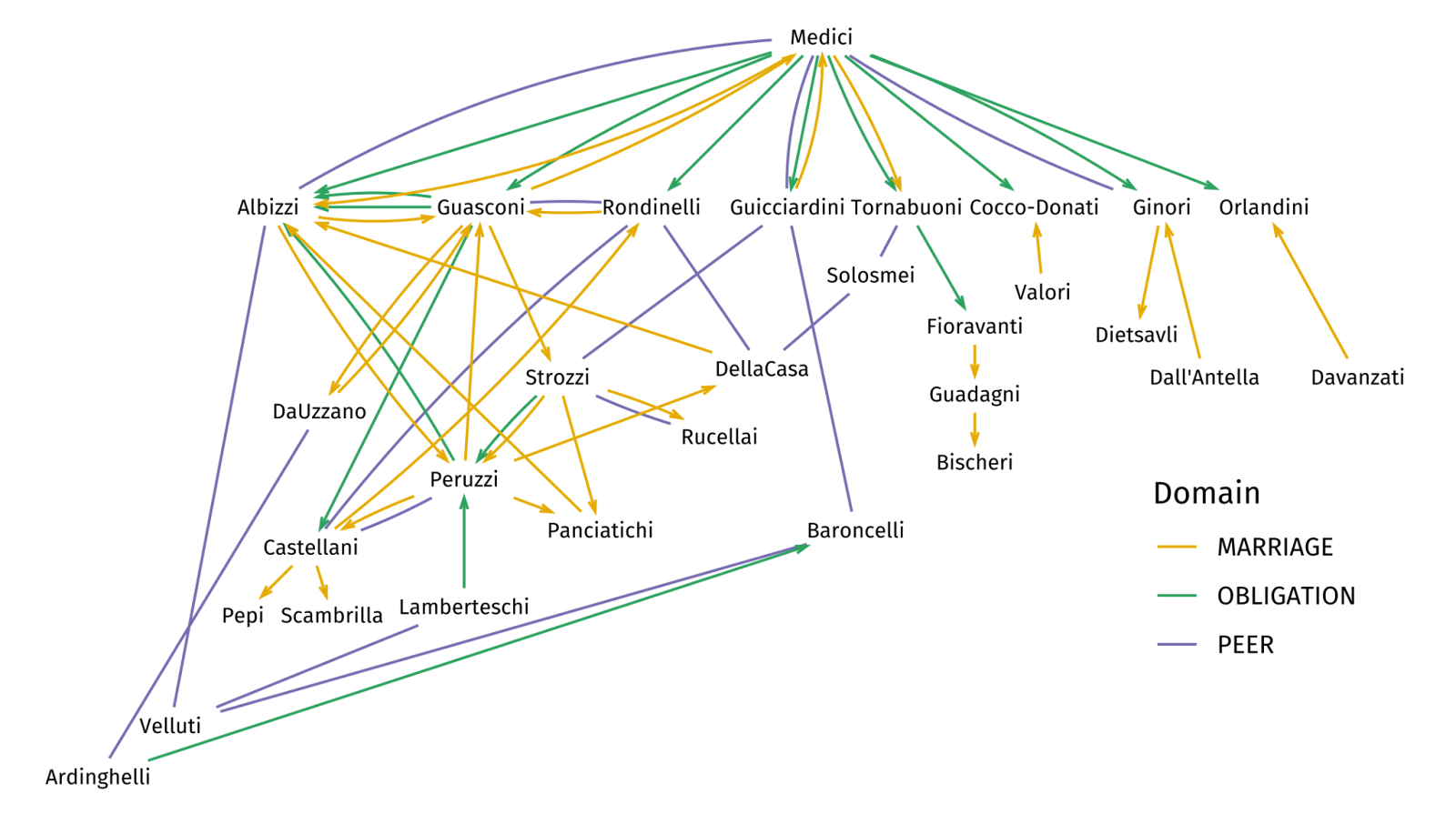
Arranged marriage is represented by a gold arrow that points from the family contributing a daughter to the family contributing a son. Contributing daughters was seen as more prestigious because son-in-laws became political lieutenants. The oligarch social network consists mostly of tangled marriage ties.
An obligation relationship here is a financial obligation in the form of a business loan or patronage, for example. Obligations are represented by green arrows pointing towards the borrower or receiver.
Finally, peer relationships include business partnerships and friendships, represented by purple lines, not arrows since peer relationships are symmetric—there’s no default power differential in these relationships.
The strengths of the Medici strategy versus the oligarchs’ are illustrated by a disastrous, failed attempt by the oligarch party to violently overthrow the Medici-controlled government…The oligarchs fled at the threat of a rapid, massive counter-insurgency led by Medici supporters.
The Medici arranged marriages with four oligarch clans: the Albizzi, Guasconi, Guicciardini, and Tournabuoni—but marriage failed to form a chain of command among oligarchs. Marriage prestige was directional for the oligarchs, with arrows pointing from more to less prestigious positions (recall that contributing a daughter was more prestigious than a son). But marriage prestige among oligarch clans is tangled up—it could never be used to build an org chart, or any other hierarchical chain of command, because the resulting structure violates a basic rule of power called transitivity.
Transitivity is a math term, meaning that if a family or organization. If power is assumed to be transitive, then if A is more powerful than B, and B is more powerful than C, then A must be more powerful than C. If arrows indicate “more powerful” (or “controls”, etc.), transitivity is the property where if A → B and B → C, then A → C. Marriage prestige does not create a hierarchy among oligarchs because it is not transitive.
To see why marriage prestige is not transitive, consider the marriage between the Guasconi (contributing a daughter) and the Strozzi (son): the golden marriage arrow points from Guasconi to Strozzi. The Strozzi contributed a daughter in a marriage with the Peruzzi, who in turn contributed a daughter to a marriage with Guasconi. The Guasconi-Strozzi-Peruzzi marriage prestige ties, then, are: Guasconi → Strozzi; Strozzi → Peruzzi; and Peruzzi → Guasconi. The final tie means we have a cycle of prestige, not a hierarchy of prestige. We would have a transitive hierarchy if Guasconi → Peruzzi.
As an exercise, I invite the reader to identify at least three other prestige cycles like the Guasconi-Strozzi-Peruzzi cycle—I counted six, total.
The Medici were the only oligarch clan to invest in the elite new men, namely the Cocco-Donati, Ginori, and Olandini. This gained the Medici direct political influence over not only their new men business partners, but also indirect political influence over those business partners’ social contacts. The more hierarchical social relationships among the Medici and new men enabled a rapid defeat of the oligarch’s last stand against the ascendent Medici.
The strengths of the Medici strategy versus the oligarchs’ are illustrated by a disastrous, failed attempt by the oligarch party to violently overthrow the Medici-controlled government. Rinaldo Albizzi called on his allies to assemble their troops on September 26, 1433, to forcibly seize the Medici-controlled government buildings and remove the Medici party from power. Unfortunately for Rinaldo, his clan and its oligarch “frenemies” failed to provide a critical mass of fighters, resulting in the rout of the oligarchs practically without a fight. The oligarchs fled at the threat of a rapid, massive counter-insurgency led by Medici supporters. Medici patriarchs, including Cosimo, were in exile in Venice at that time, so the counter-insurgency was led by lieutenants—making the event an even greater testament to the organizational advantage the Medici had built.
To follow the Medici strategy for solving power struggles, first identify a small group of trusted allies within the existing leadership…Concurrently, invest in one-on-one mentorship and development of emerging leaders.
To see how you might use the Medici Strategy, imagine you are part of a leadership team at a company planning to hire new employees and managers to support growth, even as some senior leaders remain uncomfortable sharing responsibility and credit with new recruits.
To follow the Medici strategy for solving power struggles, first identify a small group of trusted allies within the existing leadership to serve as your interface with the broader leadership team. Concurrently, invest in one-on-one mentorship and development of emerging leaders—provide them the resources they need to build teams, get up to speed, and begin innovating.
This structure helps protect against turmoil if senior leaders attempt to band together to resist organizational change. Recall the case of Rinaldo Albizzi, whose attempted insurgency against the Medici collapsed before it began due to poor organizational capacity. Social heterogeneity among senior leadership, combined with organizational momentum towards growth, makes it difficult for incumbents to impede change.
Fellow oligarchs thought the Medici’s promotion of economic diversity and inclusion of new men was unacceptably “woke”. The Medici were master social network engineers, but they were also ahead of their time in welcoming and developing business relationships with clans lacking hereditary titles.
Of course the Medici were still chauvinist patriarchs. I imagine a Medici patriarch would dismiss any suggestion of women’s suffrage with a haughty guffaw and incredulous slack-jawed stare at the idea, for example.
That’s why the next WIRe will focus on a truly woke, feminist, and critically urgent issue of power for our time: how social science can help normalize women leaders. The Medici prove the point that diversity, equity, and inclusion pay off. To capitalize, one must confront the cultural momentum that created a lack of diversity, equity, and inclusion, both personally, and within organizations.
No posts
Comments
Nothing yet. Say the first thing.
Sign in to join the conversation.