
Let me catch you up on some recent industry changes happening to writers. Last year, Amazon changed their royalty on novels. Novels published through Amazon’s KDP must be between $2.99 and $9.99. But only books higher than $9.99 are eligible for their 60% royalty rate. Draft 2 Digital (D2D), a common alternative for independent authors, changed their free service to requiring an account activation fee and an annual maintenance fee for accounts that do not generate $100 in sells in a 12-month time period. I’ll remind you now, few authors, let alone new authors, generate 100 sells on a novel. Lastly, Barnes & Noble announced this year that all physical books must be price at $14.99 or higher.
I do not have a strong stance in this. In fact, I could say I am almost detached as I’m not heavily impacted by Amazon’s change, I do not use D2D, and B&N distributes my hardcovers that need to be priced higher than their minimum.
But is there a reason for this?
And is there any good that comes out of it?
Let’s first look at what authors face.
Remember I stated, both here and in the past, few authors actually make 100 sells in their book’s lifetime? Well, bad news, 100 sells also doesn’t equal $100. Many debut authors have lowered their prices to entice readers to read their work, with the hopes that a fan will be more invested in future novels. Changes such as those made by D2D and B&N remove that capability. Amazon’s is more forgiving but still has a minimum price and a lower royalty share.
There’s also now more tipping the scale edging out competition from potential monopolies. AiHello tracks Amazon as making up 50% of physical book sells and 83% of all eBook sells. That is massive market control. If you have issues with Amazon, you now need to weigh the option of paying fees and potentially not making the minimum sells necessary to use D2D.
Why would companies do this?
I believe a lot of this has to do with AI. You’ll recall my interview with Glen Weatherhead last year about the saturation that has happened in the creative community. Not just in writing, but now in videos, movies, music, and even advertising, by easy and cost-effective Artificial Intelligence. If we read D2D’s justification, it boils down to: Offsetting maintenance costs for accounts, compliance, and upkeep. All of which are burdened by an influx of AI generated content.
You can see Draft 2 Digital’s FAQ HERE.
Jamica-gleaner shares how Squibler can generate full-length novels in seconds.
“The potential of AI-generated “literature” to turn a quick-and-easy profit ensures that readers will continue to encounter more of this content in the future, especially as AI’s large language models become more refined. Already, studies have shown that readers cannot easily distinguish AI-generated forgeries from original prose.” - Jamica-gleaner
Here we get the sense of why companies want barriers. Without a cost barrier, nothing stops someone from opening a free account and populating 900 novels in the hopes of generating even meager profits. For the readers, this floods the market with novels generated not by experience and human connection, but learned prose spat out in seconds.
Why don’t these companies simple require every piece to pass through an AI checker? Well, I think this is for a few different reasons.
First, I don’t think they want to completely stop AI use.
Second, and probably the easiest to explain, is the companies would need to invest in a platform and that requires money from them.
Third, and probably the hardest to fight, is that AI checkers are going to be fighting an uphill battle. Some checkers are better than others, for example Mary Shelly’s Frankenstein shows as 98% human from Winstonai but 99% AI generated by ZeroGPT. But the checkers are trained on AI generated text, which is being trained by existing authors and their works. I think you can see the circular pattern that is emerging here.
If you think AI is not stealing works by authors, you should know Anthropic is facing a $1.5 billion lawsuit for using pirated books to train their AI models. Grammarly is facing a similar lawsuit for training its AI to mimic established academics and author identities.
As a large company, how do you prevent overwhelming your infrastructure with AI generated content? Right now, the companies are using financial barriers. Now as of 5/29/26 there are still free alternatives, but I think we’re going to start seeing more reputable organizations implementing these barriers.
Please understand this is not an argument for financial barriers. I only wanted to share the reality, because if you aren’t an author, you may want to consider how AI not only impacts your work, but your hobbies as well.
Is there a way out of this?
Yes, and both require a lot of effort and time which I don’t think we’ll get. The first is regulation. Right now, every case of intellectual theft has to be brought up and proven in court. Unless regulations tight how data is collected (scraped) and used, it’ll remain the burden of the artists to fight this.
The other side, which can only happen with the right culture, is that people have to choose not to engage in AI works. I really don’t see this being the answer. A large segment of the population likely cannot identify AI, and the conflict between the United States and Iran has proven this to be true. There’s also various level of AI usage. Are we going to burn an author for using a word processor that utilizes AI even if it’s not generating text? And how do you tell? What about the various other uses for AI? There’s also the reality that AI is getting exponentially better.
While I mourn the versatility of the free or very cheap options available, I understand the barriers being applied—even if I don’t agree with the implementation.
I’ll end by sharing my use of AI tools.
I do not generate my text with AI. My pledge to my readers is I will not charge for a product I personally did not create, which mean I’m not going to sell an AI generated product.
I do use ProWritingAid which has an AI component. I don’t generate text with it, but the AI does help me identify bad habits, like using the same word too often.
I also will generate my ads with some element of AI. I don’t see an issue with this, as I’m not selling these, they are just a backdrop for advertising my book. I did see someone get upset one of my trailers included an AI video of a helicopter. Again, I’m not selling the trailer, and if AI wasn’t involved, I would have just used a royalty free clip instead. AI also tells me what is wrong with my ads. Learning market trends is complicated work and take hours of study. Instead, I can ask AI what popular keywords to use and then create my ad without the hours of analytics required for success.
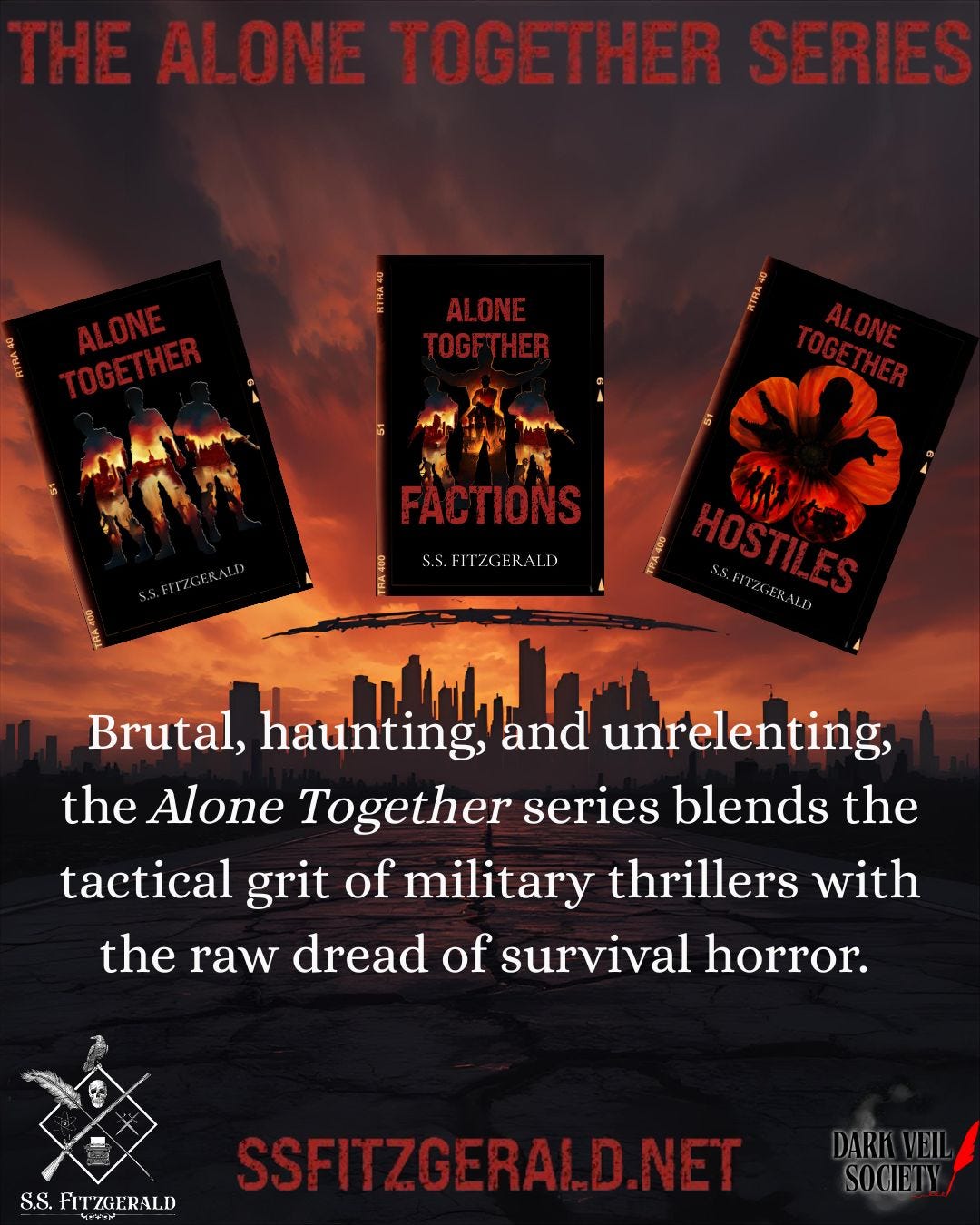
I’ll end with an example. Below is a simple graphic for selling my series. The background was generated by Canva’s AI. Everything else, my novels, my text, my logos, are created by me or a human artist or a human reviewer.
We are back! Today we dissect 28 Weeks Later and the military blunders within the amazing film. I am joined by Christopher Michael, (author, veteran, and federal agent) who shares his experience as we go through key moments of 28 Weeks Later and the downfall of the containment by the U.S. military.
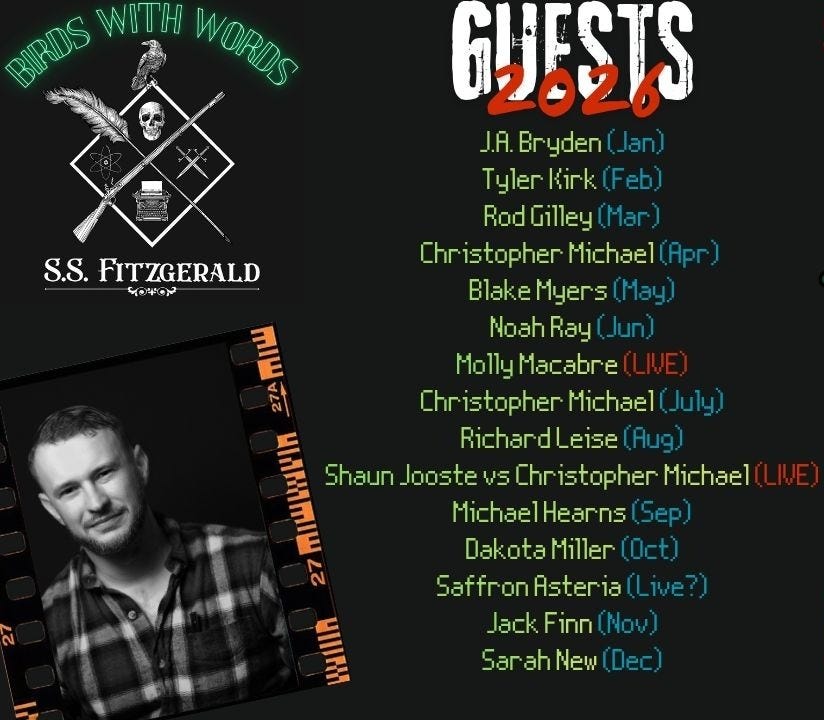
Birds with Words, Episode 18 was a LIVE stream with Molly Macabre. This was a blast and I the audience got to participate with our questions. I did not feel having a live episode edited down for Substack was necessary when the majority of the audience watches on YouTube. You can find Episode 18 on YouTube along with all of my episodes!
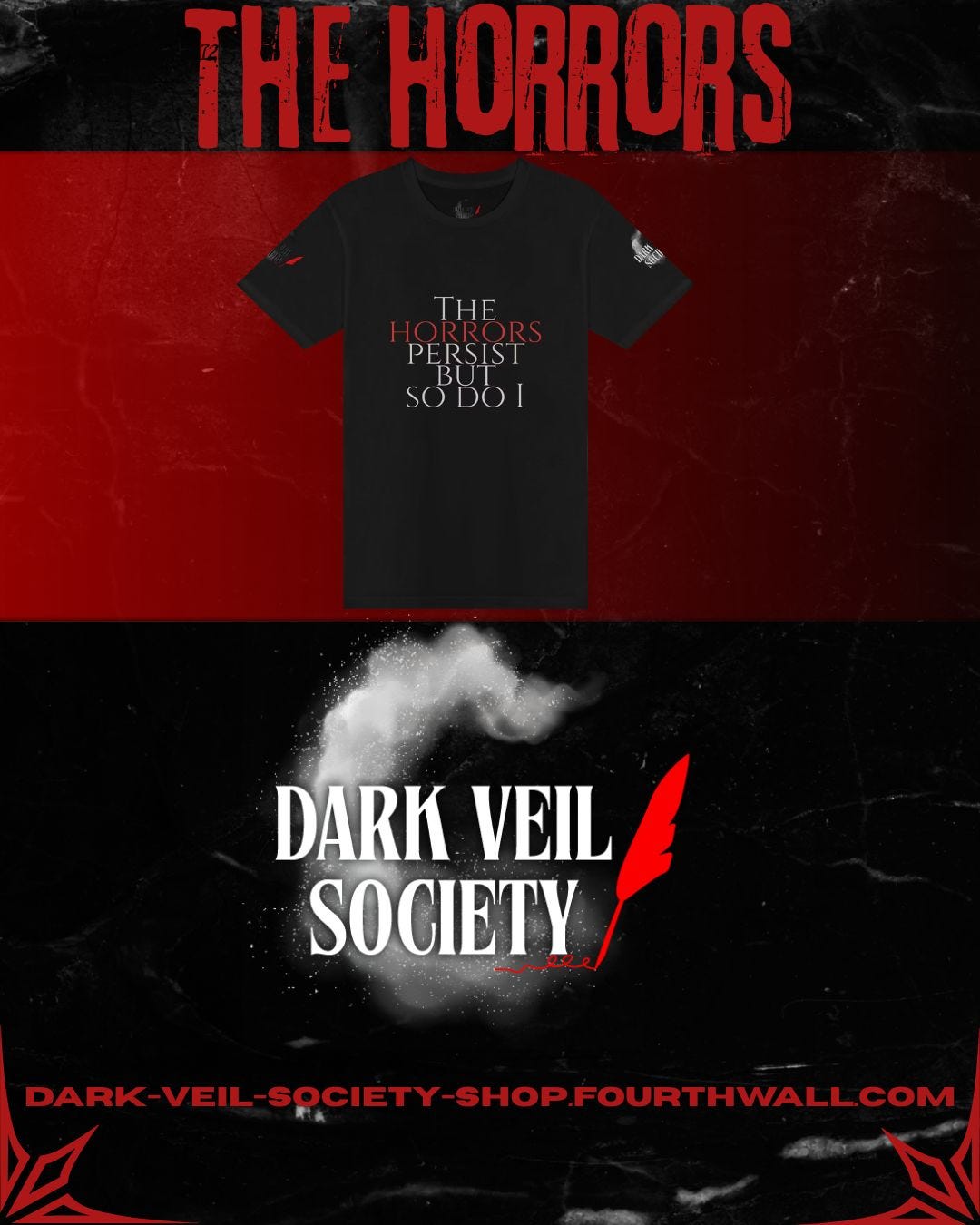
Darkness has a new style, and I have my own collection! You can see the entire Dark Veil Society’s lineup and feel good about your purchase because parts of our proceeds go to supporting Walpurgis Words for Literacy!
The Crafty Bookstore and I are partnering to provide our readers a better experience in book shopping. All future titles will be available in both signed and unsigned editions!
Walpurgis Words for Literacy is a 501(c)(3) nonprofit organization, incorporated in Ohio and founded by a collective of indie horror and dark fantasy authors from around the world united under The Dark Veil Society. We believe that literacy is transformative, and that the darkest, most imaginative stories often come from the youngest voices.
Our mission is to support high school students as readers and writers. Through our annual Halloween Horror Flash Fiction Student Contest, school and library book donation program, and author mentorship initiatives, we provide the resources and recognition that young authors deserve. Our annual fundraising drive runs from April 1st through Walpurgis Night—because we believe in the power of stories, told in the dark.
Support the future readers and writers today.
Sinner's Pass | Barnes & Noble
If interested in becoming an Alpha, Beta, or ARC reader, please use the request form!
Comments
Nothing yet. Say the first thing.
Sign in to join the conversation.