
During my April newsletter, I wrote a lovely piece about which rifle should be the standard rifle for most survivors during SHTF (sh*t hits the fan) or TEOTWAWKI (the-End-of-the-world-as-we-know-it). Shortly after my newsletter went out, my writing friend Rod Gilley from RDG BOOKS PRESS asked if I planned a pistol article.
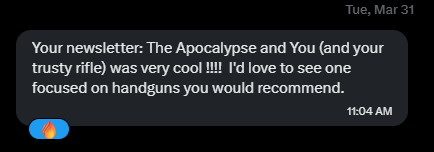
Well, everything I plan to do is based on what you, the best and coolest readers/survivors, want!
So, let’s set the stage again. We are discussing TEOTWAWKI. I am using the bases of ALONE TOGETHER as the situation, because it’s fictional but with enough real-world application you can take this home to think about. The caveats I laid out on rifles can be applied here as well. Not to quote myself but…
“‘I shot 1,000 rounds with my rifle and it never jammed’ saying. As a shooter, 1,000 rounds is not a benchmark. Far from it. I’ve done afternoon competition shoots that required 1,000 rounds.” - Shaun Fitzgerald, April 2026 Newsletter
Alright, with the situation set, let’s build the criteria. Unlike with rifles, this is going to be very broad. Why? Well, the honest answer is, pistols don’t matter. I touched on this during one of my Fitz’s Corner posts on Instagram. Big picture wise, in conflicts firearms don’t make up a large portion of casualties. The mass casualty producers are the bombs, artillery, and other heavy ordinance. The remainder goes to machineguns and rifles. Pistols, don’t really make a major impact. In such situations, pistols are a last resort weapon.
Just like with rifles, there’s a lot of personal emotions attached to pistols, and a lot of myths. I could spend all day writing an article to break down each myth, that’s not my intention here. Nor is this article going to call out one specific platform as the “end all be all” for such a situation. So, if you were worried I’d list the Glock 19 at the end of this, don’t worry, that’s not what I’m doing.
My last point before getting to our criteria is going to be a tough one to accept, but we need to remember the scenario here. We aren’t talking self-defense, which would make the pistol the primary tool for day-to-day life. This is TEOTWAWKI. Our workhorse is the rifle, which is to say not everyone needs a pistol. Which is the same concept the U.S. military applies to infantry. Pistols are assigned to support roles, positions not expected to see direct combat or select direct engagement units that need to be in tight spaces. Where I’m going with this centers on the team you’re building, (family, friends, strangers who you join at an abandoned warehouse), not everyone needs a pistol. But the information here can be used to make good, rational pistol selections in everyday use as well.
Now, onto the good stuff, let’s talk about the big iron on your hip!
What can we dismiss immediately?
My first dismissal are “mouse” guns. These pistols are chambered in small varmint calibers such as .22, .25, and .32 ACP. I know many people admire these rounds, and harp on shot placement being king. I suggest you look at the pistol caliber study I linked in the next section. Aside from not stopping a threat, we often find malfunctions are prone in smaller calibers. Not something we want in a life-or-death situation.
The next dismissals are gimmick guns. Look, the gun community calls these “range toys” for a reason. Most Kel-Tec guns fall into this category, as does the mighty Desert Eagle. If you’re not sure if a pistol is a gimmick or not, walk into several dozen gun stores, if you don’t see that model or common accessories for that model in the vast majority of stores, it’s probably a gimmick.
The next dismissal will be grip safeties. Spare me the “two world wars” from the 1911 lovers. This is not a safety gripe, but specifically a concern around grip safeties themselves. A grip safety requires depressing the safety before the trigger can be engaged. Two popular guns that have this feature are the 1911 and the Springfield XD. There are unique guns that have the safety on the front, but they are rare. But this additional mechanism provides several failure opportunities. The first is dirt can stall this mechanism from being engaged, preventing you from using the sidearm. Given that pistols are carried either on the waist or hip, lint and dirt build up (especially in TEOTWAWKI) is going to stack up on this exposed area. The other, and probably more likely point of failure, is improper grip in high intensity situations. At the range, you have the perfect grip, perfect stance, the target is exposed and not moving, when in TEOTWAWKI you might be on your back, injured, shooting off handed and scared. If your grip isn’t perfect, that safety won’t depress to allow the trigger to operate. Again, not a gripe on safeties, but this particular feature is a no-go from me. You can read more about safeties HERE if you’re so inclined.
Here’s the one I’m sure someone will be upset about. Wheel guns. Revolvers. The biggest argument I heard for revolvers is they don’t jam. They do, just like any other machine, they have failure points. Their internal mechanisms are also far more complex than people assume. But the real rule out factor for me, is the capacity and speed for the average person, which I’ll discuss below.
Caliber.
“…if you spend enough time reading forums, you’ll see the .22lr (one of the smallest) is somehow the deadliest thing on earth, but then at the same time, anything less than the old trusty .45 ACP is a wimpy round you can’t trust your life on.” - Shaun Fitzgerald, April 2026 Newsletter
There is a great video that discusses a long study on pistol calibers used in self-defense, which I’ve linked HERE if you’re invested for a short watch. While I don’t agree with their assessment on the Drudge pistol, their statistics tell a startling picture of what you can expect in a deadly self-defense situation. That being, you’re probably going to have to shoot twice. Generally, anything from .380 to the mighty .45 ACP have the same stats, so pick one you’re comfortable with.
One caliber I will say you should be hesitant about, is .40 SW. There’s nothing inherently wrong with .40 SW. It was created to bridge the gap between 9mm and .45 ACP, which I think we know now is unnecessary especially with modern ammunition. That’s not the problem. The issue is older guns rechambered in .40 SW. When .40 SW first hit the market, many fans converted their 9mm handguns to .40 SW. The problem came that .40 SW carries a higher chamber pressure and over time, cracked the frames of the handguns. This is NOT a problem for guns that were manufactured specifically to be .40 SW for the record.
Given this is the end of the world, you know what is also going to be a major factor?
Capacity.
I’m only addressing standard capacity magazines here. A standard Glock 19 carries 15 rounds, the Glock 17 carries 17, the Beretta M9 carries 15, the Sig 226 carries 15, the HK VP9 carries 17, the 1911 carries…7? Revolvers usually carry 5 or 6 shots… why am I putting myself at a disadvantage? From above, we know you likely will need to fire twice on a single threat, and given that pistols are last resort defensive options, you may find yourself outnumbered.
I do not want to make assumptions of the best-case situation. After all, this is TEOTWAWKI. That means it doesn’t matter how accurate my first 4 or 5 shots might be. It doesn’t matter how fast I can reload. Because there may be factors out of my control. I’m out numbered, I’m injured, I’m pinned in an awkward position, or a combination of factors. I don’t want to limit myself.
The standard for capacity will be 10 rounds for this reason. This means, even if you love the revolver, it may not give you the full advantage a smaller 9mm semi-automatic would. This also rules out most single stack pistols, the 1911 included.
There’s also the speed discussion that I lightly touched on with revolvers. I understand speed-loaders exist for some models of revolvers. But if I had the choice between reloading my 17 round VP9 with another magazine of 17 rounds vs reloading my 6-shot revolver with another 6 shots… guess what? I’m going to choose 34 rounds over 12 rounds every day.
Hammer Fired vs Striker Fired.
Don’t worry, we aren’t going to get technical here. Simply put, a hammer fired pistol has an external hammer, and a striker fired has an internal system. Is one better than the other? If I had to answer, slightly? There’s the opportunity for something to block the hammer on a pistol, stopping it from striking the firing pin. Generally, it’s rare enough I wouldn’t be concerned.
What does that leave us with?
A ton of options. Remember, pistols really aren’t that critical in the grand scheme of things. TEOTWAWKI they are assets but aren’t your primary tool.
Unlike with the rifle article I wrote, is there a single platform that reigns supreme? No. But if you had to outfit your survivors with pistols, what are we considering?
We want a semiautomatic handgun, magazine fed, chambered in a common caliber of either, .380, 9mm, or .45 ACP, that does not fall into one of the dismissals categories above.
Do I have recommendations? Of course!
Glock 17 or Glock 19
The model doesn’t matter here, as both the 17 and 19 will fill the role. Glock is a brand of polymer-framed, short-recoil-operated, locked-breech semi-automatic pistols designed and produced by Austrian manufacturer Glock GmbH. The Austrian military and police adopted them in 1982 after outperforming established competitors in reliability and safety tests. Despite initial market resistance to its “plastic” construction, the Glock became the first commercially successful line of pistols with a polymer frame and paved the way for future striker fired pistols.
Chambered in 9mm.
H&K VP9
My personal choice.
The VP designation in the name refers to Volkspistole, which translates to “people’s pistol.” The 9 stands for the caliber designation of 9 mm. The VP9 is the third striker-fired pistol that HK has produced. A variant of the VP9, the VP40, is chambered for .40 SW.
Chambered in 9mm.
Sig 227
The P227 is similar in many ways to the P220 in .45 ACP that SIG Sauer introduced in 1975. It uses the same SIG Sauer designed short recoil locking system with their Single/Double Action trigger. The P220 is a full-sized large pistol. The P227 uses a double row magazine for increased ammunition capacity and is slightly larger to the point that it is not very noticeable.
The 226 is similar and chambered in 9mm.
Chambered in .45 ACP
Beretta APX
Designed largely for the U.S. Armed Forces’ XM17 Modular Handgun System competition. Beretta had offered to provide their M9A3 model at a reduced price as a continuance of M9 procurement program but were informed that the changes to the M9A3 were so significant that it fell outside the scope of an Engineering Change Proposal.
While I’ve never handled the APX, I’ve heard nothing but positive things on this platform.
Chambered in 9mm.
Final thoughts.
I wanted to provide a .380 but having no experience with one and not hearing universal praise over any particular platform made me hesitant to recommend one. This is not to say there aren’t any, I just lack this knowledge. If I needed to list a .380, I’m sure the Glock 42 would serve fine despite being a compact pistol.
Even if you don’t choose one of my suggestions from above, I believe this criteria list arms you with the knowledge to make a well-informed decision.
What should I do next survivors? Specialty role? Gear? You tell me!
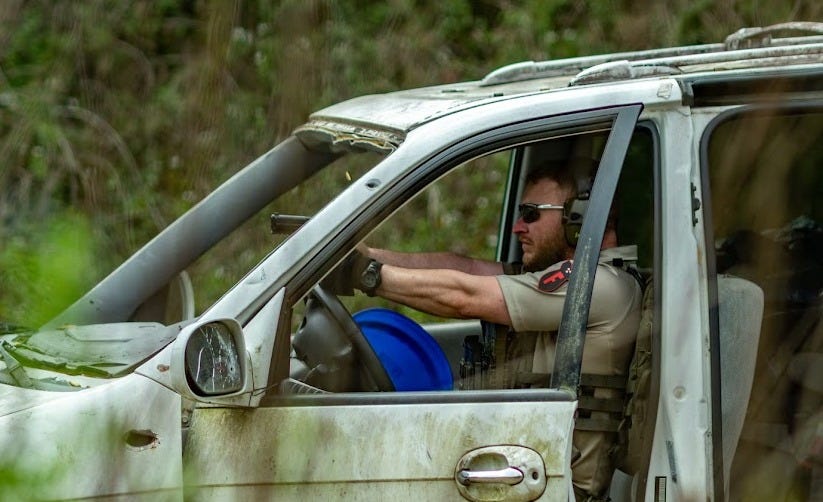
Richard Leise is a traditionally published author and schoolteacher. Unfortunately, after this interview, Richard’s X account was compromised by hackers. You can find all of his works on Amazon.
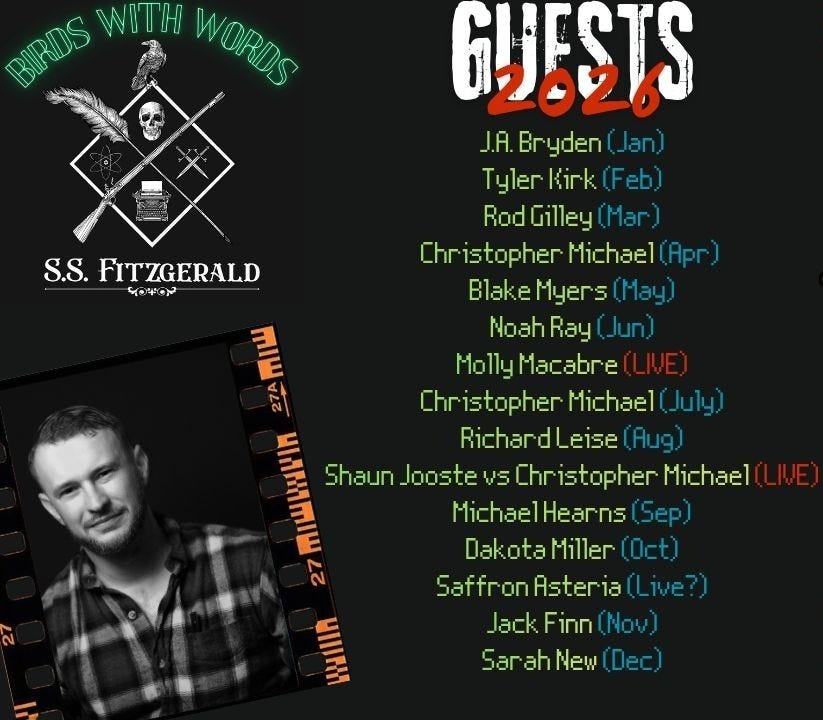
We will have a LIVE episode 8/29 1 PM EST where two authors go head-to-head in a creature feature. They will determine the ultimate monster!
Then the official episode for September will be with a retired undercover narcotics detective, Michael Hearns. Get geared up to explore the dark underworld of the Miami night life.
If you don’t follow me on X you may not have been told… I am already booked solid for 2027! That means I’ll be able to focus on editing interviews and planning live episodes for next year!
Each month I will highlight a horror author from the Dark Veil Society.
William J. Burkhardt is a man of many talents and few words. He is both writer and editor. Along being talented, he is also the newest addition to the Dark Veil Society.
The Dark Veil Society is a collective of independent horror authors united by a shared love for the eerie, the unsettling, and the unknown. Founded by a group of self-published writers, we are storytellers who breathe life into nightmares and find beauty in the macabre. Our mission is to craft tales that linger long after the last page, to champion the dark corners of fiction where others fear to tread, and to uplift the voices of fellow creators walking this shadowy path.
We operate the nonprofit, Walpurgis Words for Literacy which focuses on improving children’s literacy. You can donate directly or purchase our merchandise which also supports our non-profit goals!

New York, NY, June 23, 2026 — Author S.S. Fitzgerald announces the release of Alone Together: Hostiles, the third installment in the Alone Together series. Expanding the scope of an already dangerous world, the novel plunges readers into a relentless struggle for survival as humanity faces not only evolving infected creatures but also growing divisions among the remaining survivors. Combining action, suspense, and emotional depth, the book explores what happens when the greatest threats come from both outside and within. Set three months after Captain Dillion Hawkins and Roland Donovan successfully secured a refuge for survivors in Tallahassee, Alone Together: Hostiles finds the fragile stability of their community under increasing pressure. The infected are no longer behaving as expected. Their patterns are changing, their abilities are evolving, and every new mutation makes them more dangerous than before. As the boundaries between humanity and monstrosity become increasingly blurred, survival requires constant adaptation and difficult decisions. The inspiration behind the novel stems from Fitzgerald's interest in exploring how individuals and societies respond when familiar rules no longer apply. While the infected remain a significant danger, the story also examines the consequences of fear, power struggles, and ideological extremism. As radical movements gain influence and survivors are forced to choose sides, the novel highlights the tensions that emerge when communities are pushed to their limits. At its core, Alone Together: Hostiles is a story about leadership, sacrifice, and the cost of protecting what matters most. Dillion and Roland must navigate a landscape filled with competing threats while confronting questions that have no easy answers. The novel explores themes of loyalty, resilience, trust, and moral responsibility, asking readers to consider what survival truly means when the world itself continues to evolve. The book will appeal to readers who enjoy post apocalyptic fiction, survival thrillers, dystopian adventures, and character driven stories. Fans of evolving threats, intense action sequences, and emotionally complex decision making will find themselves immersed in a narrative that balances suspense with meaningful character development. As the concluding volume in the trilogy, it delivers both high stakes conflict and significant emotional payoff. S.S. Fitzgerald brings a dynamic storytelling style and a keen understanding of human nature to the Alone Together series. Through Alone Together: Hostiles, the author expands a richly developed world while challenging readers to consider how far people are willing to go to survive and what they are willing to sacrifice along the way. The result is a compelling and thought provoking finale that leaves a lasting impression.
Sinner's Pass | Barnes & Noble
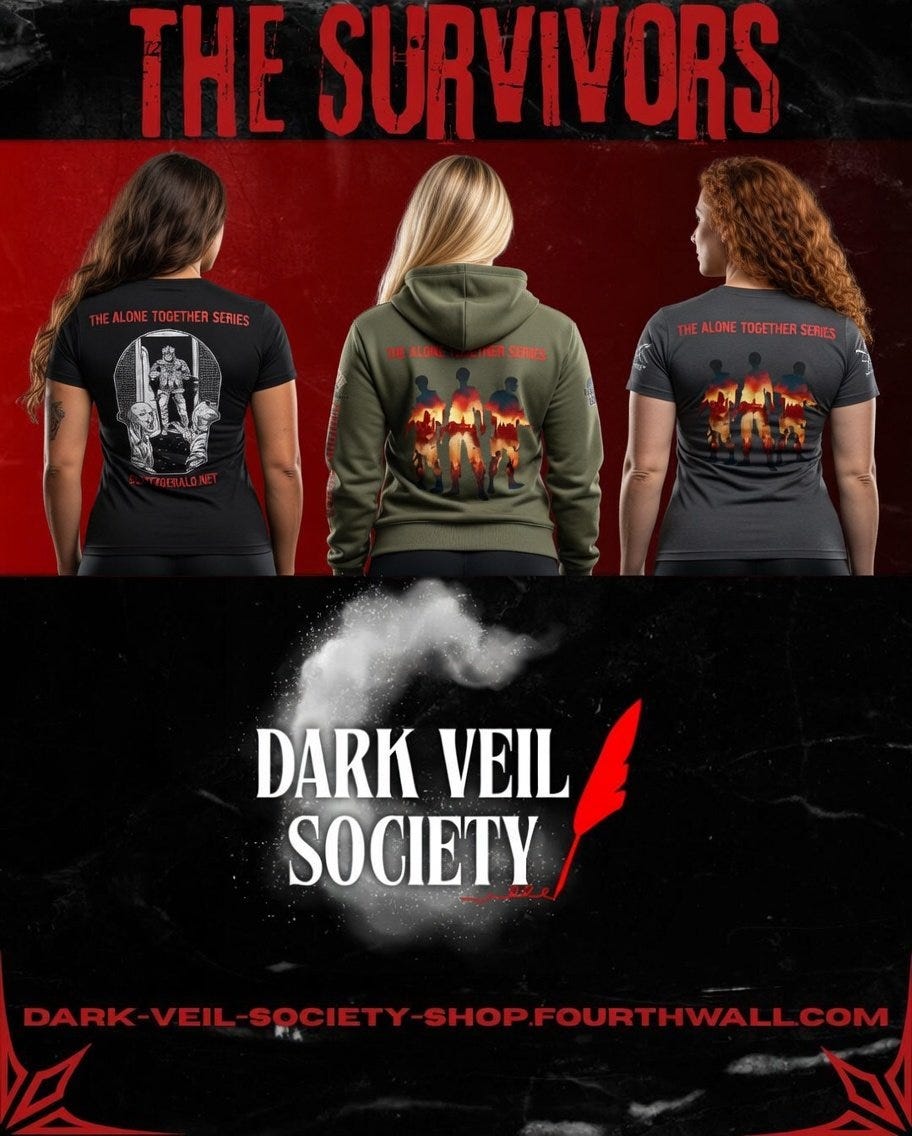
Darkness has a new style, and I have my own collection! You can see the entire Dark Veil Society’s lineup and feel good about your purchase because parts of our proceeds go to supporting Walpurgis Words for Literacy!
If interested in becoming an Alpha, Beta, or ARC reader, please use the request form!
Comments
Nothing yet. Say the first thing.
Sign in to join the conversation.