
🙏 Thank you to all our new paid subscribers! They and our sponsors help us do more. The main newsletter will always be free, but our new virtual salon series will be for paid members. Here’s how you can support Sree’s Sunday Note, even if you can’t afford to pay.
🙌 Prefer Patreon? We have just revived our account there. You can chip in as little or as much as you like to support all our online shenanigans: this newsletter, the Sunday NYT Readalong, the 30-group WhatsApp Community I run (specialized groups on AI, hip hop, baseball) and more! Here’s our link.
💪 My Pre-diabetic Life: How I’m using some AI, some planning, some advice, and some luck to reverse a worrisome diagnosis. Powered by AROGYA WORLD, one of the most innovative health nonprofits in the world. Join our WhatsApp group and learn with me.
* * *
THINGS I NEVER ever thought would be legal in the US: Marijuana. Marriage equality. Sports gambling (and online gambling of all kinds). This is an essay about the last of these. From fantasy sports to sports betting to prediction markets, gambling is now everywhere.
The word I think of when I see how gambling fever has gripped Americans of various age groups and every economic strata is epidemic. And the group being hit the hardest—by a wide margin—is young men. There are countless forms of gambling, but low-friction, phone-based sports betting is the driving force here. And it is booming. To top it all, the government doesn’t treat gambling like it does other dangers such as tobacco and alcohol, even though almost 80 percent of Americans say it can be more addictive (more on this below).
Here’s a quick bit of history and scale from Sequoia Carrillo for NPR from this April:
Gambling has soared in the U.S. since a key Supreme Court ruling in 2018 allowed states to legalize sports betting. That opened the floodgates, from one state back then to 38 in 2024.
Before that decision, Americans spent $4.9 billion annually on sports betting. By 2023, that figure had ballooned to $121 billion, according to The Journal of the American Medical Association (JAMA).
And those were just the legal bets. No one under 18 can gamble legally, but experts say the opportunities are everywhere.
“If I wanted to bet on the [Washington] Nationals,” says Matt Missar, an addiction counselor in Pittsburgh, “20 years ago, as a teenager, I’ll go find a bookie and I’ll place a bet. Nowadays, I can bet on every single pitch of a game.”
Much of the explosion in legalized gambling is happening on cellphones, Missar notes. “It is incredibly easy.”
With sports, it’s so tempting to bet online. For example, I am a hardcore fan of American football, and anytime the NFL is on, I drop what I’m doing and watch till the end (I do the same anytime “The Shawshank Redemption,” the prison movie starring Tim Robbins, is on). I know the game, so I could so easily put some money on that knowledge. But I’ve never even opened an account, at least not yet. As I said, it’s so tempting.
To me, this is the danger zone of gambling: Hardcore fandom meets up with the sports media-sports gambling marriage of convenience and profitability. If you consume sports media, you see nonstop ads for betting apps. Teams are entwined with sportsbooks: fields and stadiums, broadcast studios, ad space during the game—the list goes on and on.
Now, with the advent of so-called “prediction markets,” the zone is officially flooded. If you’ve been within shouting distance of the news, you’ve heard of Polymarket and Kalshi. Prediction markets are gambling in every sense of the term, but they are peer-to-peer, there is no “house money” anywhere in the process.
Partner message
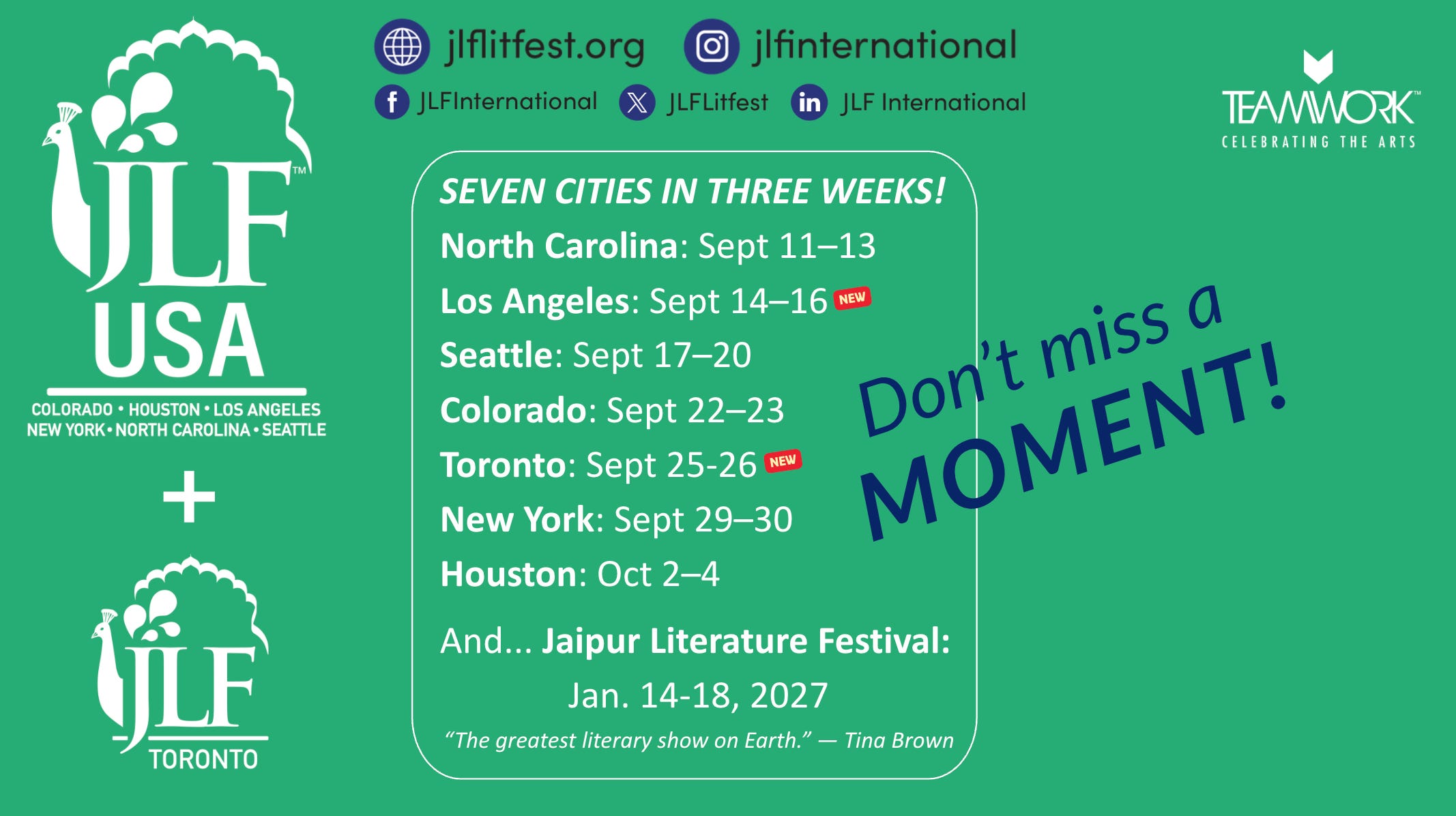
Teamwork Arts, producers of the Jaipur Literature Festival (which Tina Brown called “the greatest literary show on Earth”), presents the 2026 edition of JLF USA. We started with JLF Colorado in 2015 and grew to five cities by 2025. This year, we've added Los Angeles and Toronto! Take a look at the seven cities and forward to any friends and family there. And, of course, make your plans to visit at least one of the festivals. FUN FACT: With the addition of LA, ~20% of the US population (~68.5 million people), lives within a two-hour drive of a JLF USA venue this year. And about ~26% (~88 million) lives within a three-hour drive. So no excuses! You can see the program at the button below. If you’re a journalist/blogger/photographer/creator and would like to get on our media lists (including for our virtual press previews, please fill in this form. Questions and comments to jlfusa@digimentors.group.
You can bet on individual pitches in a baseball game, you can bet on coin tosses, you can bet on the distance a footballer runs—you name it, someone has odds on it. In 2025, the NCAA struck deals with Genius Sports, a firm that sells real-time data to sports books—further dropping the floor for would-be bettors. Billions of dollars were wagered on teenagers playing basketball last March.
Self-styled experts who want to put money on something can find a market on a traditional sports book app—and probably get something like $100 in free bets—or go on a prediction market and just create your own betting pool.
Before the first whistle blew in this year’s World Cup final, a combined $5.69 billion dollars was riding on the game on just Kalshi and Polymarket.
Via NYT’s Lauren McCarthy:
Prediction market users are poised to make the World Cup the largest gambling event in history, analysts said. In June, total wagers on the platforms topped $50 billion for the first time, much of it driven by the soccer tournament, according to data from Dune Analytics, a crypto data tracker. That was up from about $2 billion the same month a year ago.
According to The New York Times, DraftKings, FanDuel and Fanatics have put $41 million into the formation of a lobbying group ahead of the 2026 midterms.
Win for America, according to a Wednesday filing with the Federal Election Commission. The striking total signals that the group is likely to be one of the biggest spenders in the 2026 election cycle.
Kalshi spent as much on lobbying in the first half of 2026 as it spent in all of 2025. To date, gambling has largely been a state-by-state regulatory web. I suspect these groups, flush with cash, will try everything they can to get in at the federal level with a Trump Administration that never met a gambling scheme it didn’t like.
Here’s how Harry Levant, Director of Gambling Policy at Northeastern University School of Law’s Public Health Advocacy Institute, puts it:
Think of any other addictive product. With every other product, the government seeks to regulate the advertising, distribution, promotion, and consumption to keep the public safe.
With gambling, governments have become a financial partner. So, what we continue to see is the onus being placed on the individual. ‘Just bet responsibly, just be smart.’ So, if you have a problem, like me, you’re dumb as a bag of rocks.
Safe to say that “tighter regulations on gambling” is probably not a winning argument in this version of the Oval Office. The guy who runs Trump’s teleprompter was betting on Trump phraseology on Kalshi, and reportedly won about $100,000 doing it. In March, the White House did manage to tell government employees not to bet on things like the Iran war on prediction markets—a clear sign that many were.
Nine connected Polymarket accounts have raked in more than $2.4 million betting almost exclusively on U.S. military actions in what digital detectives from the data analytics firm Bubblemaps have identified as a potentially egregious case of insider trading.
The anonymous accounts made winning bets on the specific dates of pivotal moments in the war with Iran: the first U.S. strikes, the removal of Iran’s supreme leader, and the announcement of a ceasefire.
Across more than 80 bets, the accounts had a 98% win rate, even as many wagers were made when the odds of winning were low, according to Bubblemaps co-founder and CEO Nicolas Vaiman, who shared their findings first with 60 Minutes.
“This might be the most insane pattern we have found on Polymarket so far,” Vaiman said. “Luck alone cannot explain those numbers.”
Prediction markets are, naturally, rife with insider trading. CNN has a story about arsonists starting fires after placing bets on future wildfires. NPR has one about campaign staffers betting on their candidates. Here’s Wired on an OpenAI employee getting fired for betting on ChatGPT product updates. If stories like this are being reported, I cannot imagine how many we don’t hear about.
None of this is good or healthy. It’s also not a shrinking violet of an industry. With ever-more-powerful computing power to mine and activate the swathes of personal and behavior data these gambling firms have, growth is on the agenda, consequences be damned.
Your support helps us talk to more people, host more interesting conversations, and so much more. Paid subscribers to Sree’s Sunday Note have some extra special perks, but we appreciate everything, even a quick social share. Thank you!
Gambling is generally a scourge, but what’s happening now is something wholly different. Young men, a broad group that we as a society seem to be failing en masse, do not need easy ways to bet money they don’t have.
In March, the National Council on Problem Gambling released the results of survey that shows, as I’ve written many times, that there are many things Americans overwhelmingly agree on. Gambling is one of them. From the survey:
Younger adults report even higher rates of early sports betting and online casino play before age 21 compared to older generations. The survey found that 33% of 21–44-year-olds placed a sports bet before 21, versus 11% of 55+.
Two-thirds of Americans (66%) say they are concerned about the impact of underage exposure to gambling or gambling-like activities.
Nearly eight in ten Americans (79%) say gambling addiction is as serious as or more serious than other forms of addiction like alcohol or drug addiction.
I do not trust the Trump Administration to get anything right, and I would certainly not trust it to do so with gambling. But, from my vantage point, this looks to be an utter failure at the policy level, and state-by-state, piecemeal approaches simply don’t work. If someone living in one of the 11 states that don’t allow online gambling, they will simply pay a couple bucks for a VPN that can be set to “Illinois” and that’s that.
The other side of the regulatory side of the coin is Native American reservation gambling. If online gambling were federalized, it would likely mean nothing short of financial ruin for the casino industry on native lands. It would probably have more broad effects on native sovereignty as well.
Another issue to consider is that there’s now so much money to be made in sports gambling and so many minute actions that can be bet upon that we have already seen major scandals in every sport caused by the actions — not of superstars making untold millions in salaries and endorsements — but by journeymen players for whom even a little extra money is tempting.
There has to be a middle ground here—something to make gambling, and addiction to it, harder to come by.
57% of 2026 is already over. What will you do with the remaining 43% of the year? LMK and I’ll see you made it all the way down here.
ICYMI, OUR MOST RECENT ESSAYS:
Have an idea for anything we’re up to? Let’s collaborate! sree.sreenivasan1@gmail.com
🙌 Patreon Patron? We have just revived our account there. You can chip in as little or as much as you like to support all our online shenanigans: this newsletter, the Sunday NYT Readalong, the 30-group WhatsApp Community I run (specialized groups on AI, hip hop, baseball) and more! Here’s our link.
Comments
Nothing yet. Say the first thing.
Sign in to join the conversation.