
First dedicated in November 1990, Kryptos was created by artist Jim Sanborn with the help of the former chairman of the CIA’s Cryptographic Center, Edward Scheidt. Sanborn himself came up with the text for the installation, while Scheidt devised the encryption system. The sculpture consists of four separate panels of coded text, constructed from verdigrised copper, granite, and a petrified tree trunk. The word Kryptos is derived from the Greek word for “hidden”, and is entirely fitting for such a mysterious work of art.
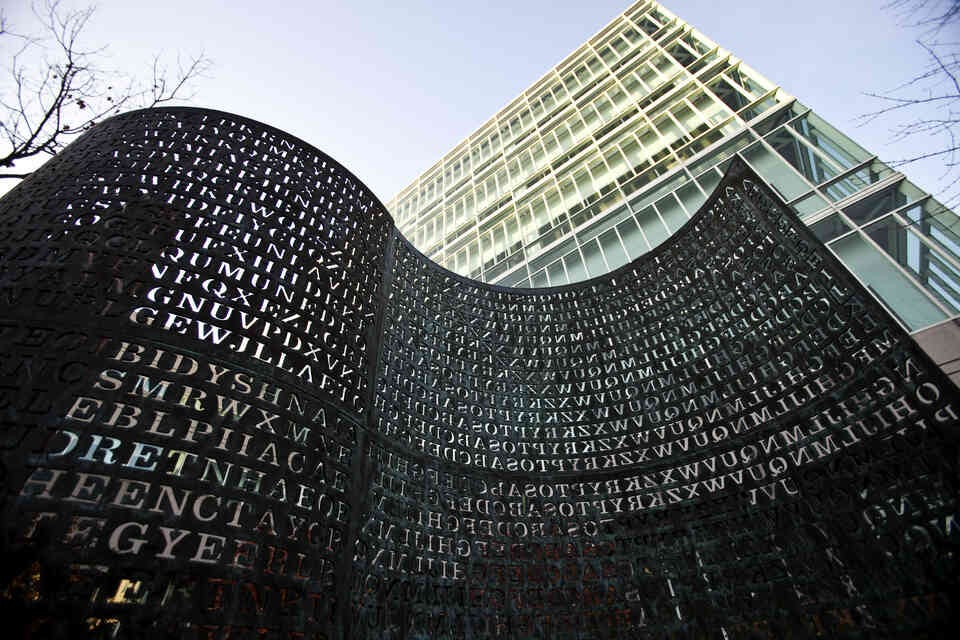
Scheidt elected to create a complex system which paid homage to well-known historic methods and didn’t compromise any systems that might still be in use by the agency. For example, the first and second passages are based on methods devised by Blaise de Vigenère, a 16th Century French cryptographer. Sanborn deliberately included several misspelled words in the sculpture, presumably to further confound attempts to solve it.
Three of the panels, known as K1 through K3, were solved in the 1990s. Some of the greatest codebreakers in the NSA, CIA, and civilian world have all worked against it, arriving separately at the correct interpretation without being aware of the other groups or individual efforts. CIA technical analyst David Stein decoded the first three panels using pencil and paper by 1998, after approximately 400 hours of effort and deliberation over the course of several years. And a team at NSA also decoded the same three panels as early as 1992. The fourth panel, K4, remained a mystery for 35 years.
Comments
Nothing yet. Say the first thing.
Sign in to join the conversation.