
As a red-blooded American, I didn’t grow up in a tea-drinking culture. Unless you count Diet Snapple and spiked Arnold Palmer as tea culture.
That changed when I married an Irish woman. Like Ted Lasso, I was thrust into a foreign world where everyone pretends tea is anything other than hot brown lake water.
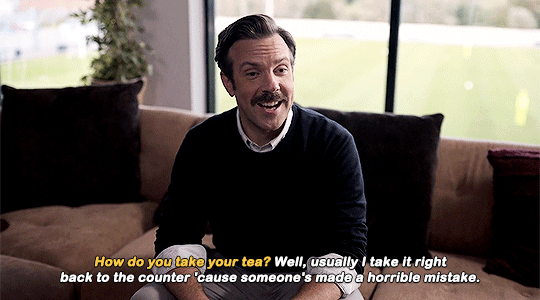
While I might not particularly fancy the taste of Barry’s Tea, I like being “involved.” Being involved means being good craic. It means investing in people, relationships, and conversations. So when someone asks me if I want tea, I say yes.
Such is how I became a tea drinker. (If “tea drinker” isn’t an insult used by American Olympians, it should be)
While I don’t drink tea in my lonesome, I’ve come to love the culture of it. For instance, I happily drink 3-4 cups/day when I’m hangin’ with Mamò (my mother-in-law).


Because I often have energy on the back of my potato brain, these frequent tea sessions have resulted in two energy thoughts:
We don’t appreciate how much the world depends on the simple process of boiling water to survive and thrive.
We’re overestimating the future potential of demand-side flexibility on the electricity grid.
The first realization came from drinking tea on American soil. In our home, we have a whistling tea kettle and a gas stove. That means tea-drinking escapades require filling up the kettle, blasting the flame, and waiting for the steam whistle to signal that the water is boiling.
Fill up kettle. Blast flame. Boil water.
Fill up kettle. Blast flame. Boil water.
Repeat. Repeat. Repeat.
Boiling water is such a simple process and it’s crazy how much our civilization depends on it.
For one, the electricity sector depends on it. If there were a bunch of smart people in a smart person room talking about electricity, the topic of conversation would be “how do we boil water for less money?” Coal, oil, natural gas, biomass, geothermal, and nuclear power plants all boil water to produce steam… and then that steam spins a turbine to produce electricity.
We dig holes spanning thousands of acres with gargantuan hole-digging machines… so we can burn coal to boil water.
We drill into the ocean floor with unimaginable engineering prowess… so we can burn oil to boil water.
We drill horizontally for thousands of feet thousands of feet underground… so we can burn natural gas to boil water.
We collect and put trash in big piles… so we can burn biomass to boil water.
We collect the heat from the earth’s core… so we can use geothermal energy to boil water.
We split the atom… so we can create heat in a nuclear reactor to boil water.
All told, over 70% of global electricity generation boils water to create steam to spin a turbine to create electricity.
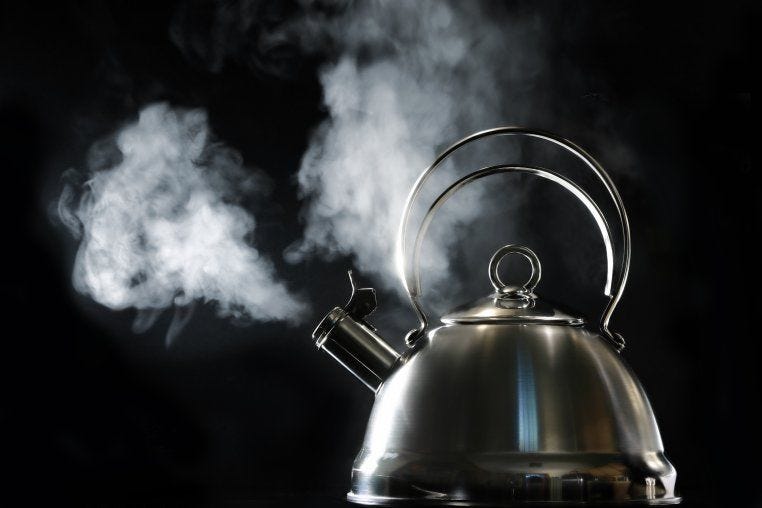
And hold your steaming horses, electricity generation is nowhere near the only place where we boil water. For example, steam is used across all industries in a variety of applications, from heating and sterilizing equipment to facilitating chemical reactions.
When you add electricity and industrial processes together, boiling water to produce steam accounts for ~25% of global primary energy use. Wild.
The second realization came from drinking tea in Ireland where anyone who’s anyone uses an electric kettle.
When tea drinking is a cultural norm, grid operators have to worry about sudden surges in electricity demand. In July 1990, the UK grid experienced a ~10% demand spike (2,800 MW) from tea kettle demand at the end of the penalty shootout in the England v West Germany FIFA World Cup semi-final. For context, 2,800 MW is equivalent to the normal electricity demand of about 1.8 million homes.
1.8 million homes worth of instantaneous electricity demand from tea kettles. Wild.
“TV pick-ups,” as they’re called, have been thought of as being “funny” and the responsibility of the grid operator to ensure it doesn’t escalate into “not funny.” (aka blackout)
It’s a simple illustration of how modern society expects the grid to work. You use electricity to boil water whenever you want tea.
This isn’t how “the grid of the future” works.
Imagined/imaginary futures with large-scale deployment of wind & solar include assumptions of demand-side flexibility (even after accounting for unrealistic deployments of energy storage). That means, it’s assumed that grid operators will be able to influence consumer behavior… one way or the other.
We are being incredibly naive as to how well that will go.
First, we will try to incentivize behavior change. We will reward end users who can immediately adjust their electricity consumption. As we’ve seen with Bitcoin miners doing just that, this will quickly be demonized when too much money is being made.
Then, we will try to penalize behavior. We will raise electricity prices. Are we willing to raise the price high enough? Who gets charged exorbitant rates and who doesn’t? Color us skeptical on the fruitfulness of this path.
Finally, we will execute change via centralized control. Grid operators will decide who gets electricity and how much. It’s a sophisticated rolling blackout.
The more intermittent wind & solar and less dispatchable generation we have, the closer we march to centralized control of when you can and can’t use electricity. That doesn’t mean this will happen all of the time, but it’ll be required in some capacity. It sounds like a talking point from your right-wing Uncle Teddy, but even Uncle Teddy is right sometimes.
Who knew that a tea kettle could induce so much thinking on energy? I guess it’s a natural by-product of being fascinated by, and engaged with, the world around you.
We aren’t nearly interested enough in the seemingly mundane things in our lives. If we were, maybe we wouldn’t be so energy blind.
^^There’s something for you to chat about during your next cup of tea.
Thanks for reading my fellow potatoes!
No posts
Comments
Nothing yet. Say the first thing.
Sign in to join the conversation.