
I can’t watch horror movies, and that’s how I know it’s not just my algorithm that’s filled with people obsessing over Obsession, the new Curry Barker movie. Maybe you’ve seen more about Backrooms, the A24 feature from the studio’s youngest ever director, Kane Parsons, who was 19 when he made the movie.
Like I said, horror is not my bag, so I haven’t seen either of these movies. I am an overthinker and may never sleep again if I watch either for more than five minutes. But seeing them both take over the zeitgeist this week did get me thinking about social media’s impact on the real world, from point of creation to point of execution.
We should be careful about grouping these movies too closely together, despite the obvious similarities. Obsession comes from “the mind of Curry Barker”, as he himself puts it, while Backrooms capitalizes on the existing internet lore of a creepypasta. The former was acquired for distribution after its debut at the Toronto International Film Festival, while the latter was a co-production between A24 and others from the start.
So these are two distinct entities.
But what you can’t get away from is the influence that social media, and YouTube in particular, clearly had on the development of both concepts, both as an origin story and as an amplifier.
Both Barker and Parsons made a name for themselves on YouTube; Barker as part of a sketch group “that’s a bad idea” (a channel that he later used for his early horror experimentation), and Parsons as a director and VFX artist. Both profiles boast millions of followers, hundreds of millions of views and, most importantly, active fan communities. And that’s the crucial part, because this is a story of promotion as much as one of topic creation.
There’s a lot of coverage of the YouTube to Hollywood pipeline now, with these recent simultaneous wins emphasizing this pattern in people’s minds. But to some extent, these stories have been a long time coming as echoes of previous successes.
Back in 2022, Danny and Michael Philippou set the precedent by moving from YouTube creation to the horror film Talk to Me. Meanwhile, Iron Lung, which was based off of a 2022 video game and directed by YouTuber Markiplier, debuted in early 2026 and was the prototype for the creator-driven community enthusiasm formula. Initially slated for a limited release, the creator encouraged his very active community of fans to ask their local cinema to play the movie. It worked, and the movie returned box office receipts of $50 million off a budget of $3 million, despite middling reviews and no major distribution partner. If anything, that might be even more telling than the success of an A24-backed project like Backrooms.
In the last few years, studios have been stubbornly clinging to existing IP, reboots and star power to sell their movies. But there’s growing evidence that audiences are hungry for change, evidenced by successes like Sinners and Weapons last year. If you’re a risk-averse studio not wanting to gamble on the wrong piece of new material, what better partner than someone who’s used to working on a tight budget, who intuitively understands a key audience segment, and not only brings that audience with them, but is in regular two-way conversation with that audience? If directors can activate that audience to get out to the movie theater, that’s a huge win for everyone.
But community isn’t only important in terms of mitigating audience size risk; it can also help choose subjects of interest, or expand the idea of what IP could be. Here, Backrooms is the most prominent example. It started as a creepypasta about liminal spaces, before moving more mainstream. r/backrooms alone (where people share photos of these spaces) peaked in 2022 with almost 2 million engagements, but has seen hundreds of thousands of engagements every year since its inception.
As of writing this piece, Parsons’ own experimentation with Backrooms material on his YouTube from four years ago has more than 100 million views combined. That’s a pretty safe bet for a studio to throw a few million dollars at. It’s IP, but not in the traditional sense, and the film has returned a 10x+ ROI on its opening weekend.
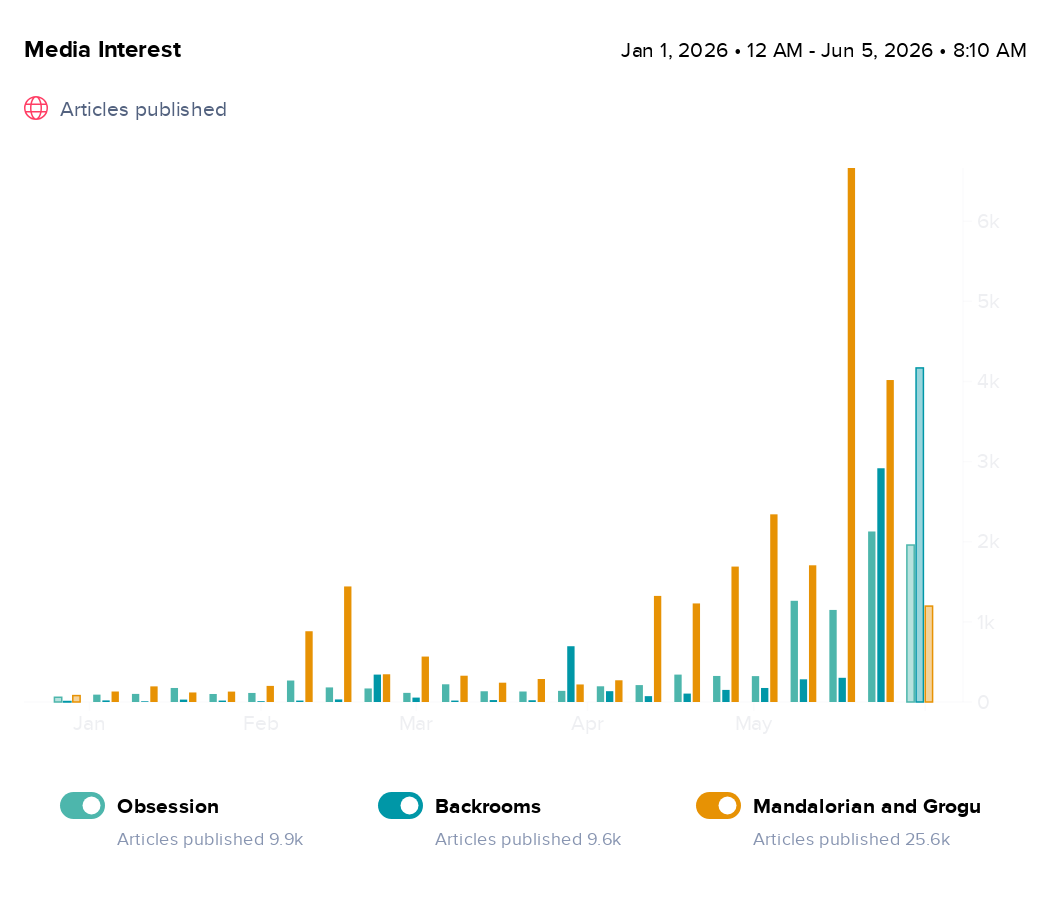
Of course, a lot of the success of both of these movies has been driven by social media. Here’s a look at how both have compared to the summer’s other big release so far: The Mandalorian and Grogu (no shade to Pedro Pascal, the Mandalorian or Grogu, I just need a mainstream hit to benchmark them against.)
Let’s start with press coverage. Here is where the Mandalorian clearly pulls ahead, at least until the social feedback loop around the two smaller films really took off in the last few weeks. There’s a lot of anticipatory coverage, then a burst of articles when the movie came out in May. But you can see people clearly start to take an interest in the other two movies as the social feedback loop kicks in.
And now let’s look at social, which is the real story of the three movies.
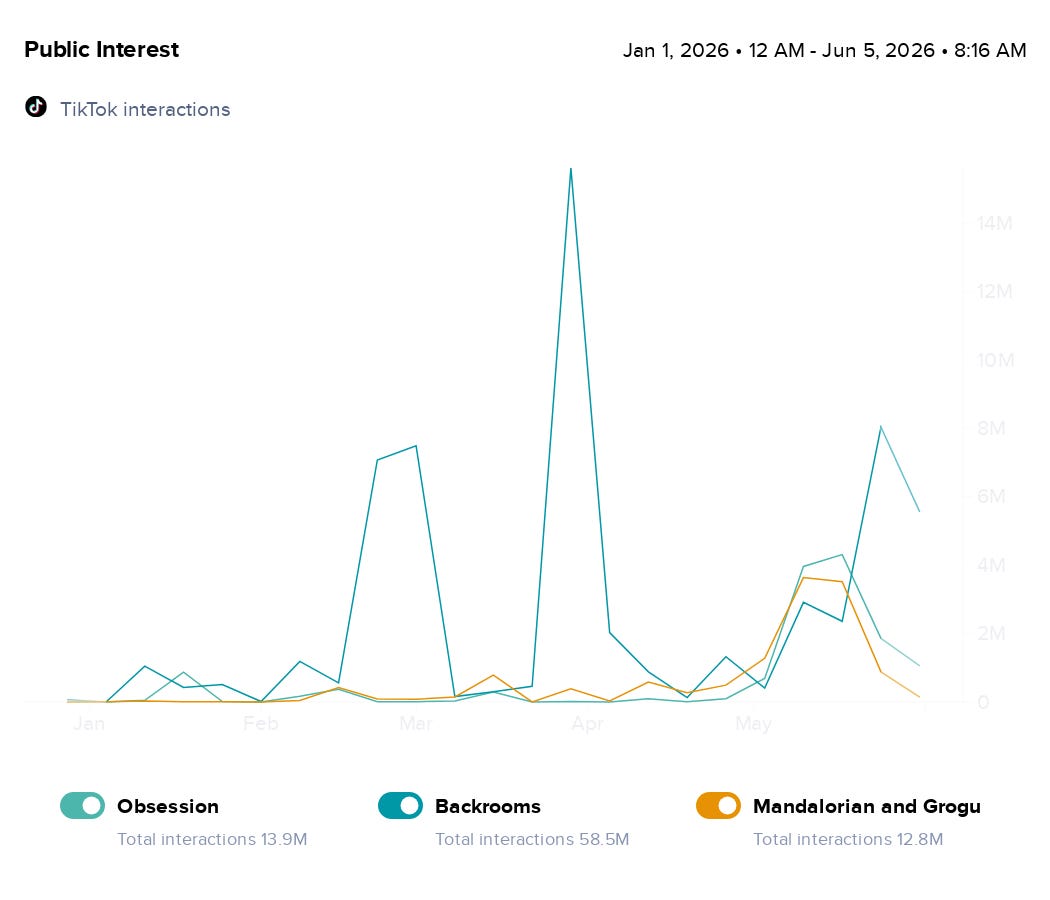
Despite a $100 million-plus legacy studio budget, organic TikTok engagement for The Mandalorian was utterly eclipsed by Backrooms’ grassroots community, with Obsession also holding its own. Film discussion on X and Reddit has generated far more messages discussing the two smaller budget movies too.
The Mandalorian has brought in more than $200 million at time of writing, so it’s hardly a flop, but you can clearly see in the data the excitement that suddenly exploded around Obsession and Backrooms once they came out. That’s all down to community and culture, and studios being willing to take a risk based on the proven engagement of those communities.
Amid these success stories, it also tells us something about brands and their willingness to engage and amplify culture. Every brand is trying to capture a share of voice from viral moments, but how do brands know when to jump in, and what does success look like? It’s about knowing the culture and context behind these moments, understanding where they come from and the reason they’re resonating. And this is particularly true for Backrooms, which has a more established lore than Obsession.
For example, IKEA is often tied into the backrooms lore thanks to being one of the most common warehouses the general public actually spends time in. The brand’s Canadian account had some fun with the launch, placing a floor uplighter and a chair within the backrooms setting.
McDonald’s took an even bigger swing, with a video that dropped the day the movie released. This is a major undertaking that goes beyond a meme, and requires significant upfront investment for a social post. The video features McDonald’s branded items in the film’s settings, as the main character navigates the labyrinth from a first-person POV.
That’s a lot of effort for something that hasn’t been a success yet. So how do brands know when to take these big swings? Well, let’s go back to that engagement analysis, but we’re going to take a look back before the movie was even released.
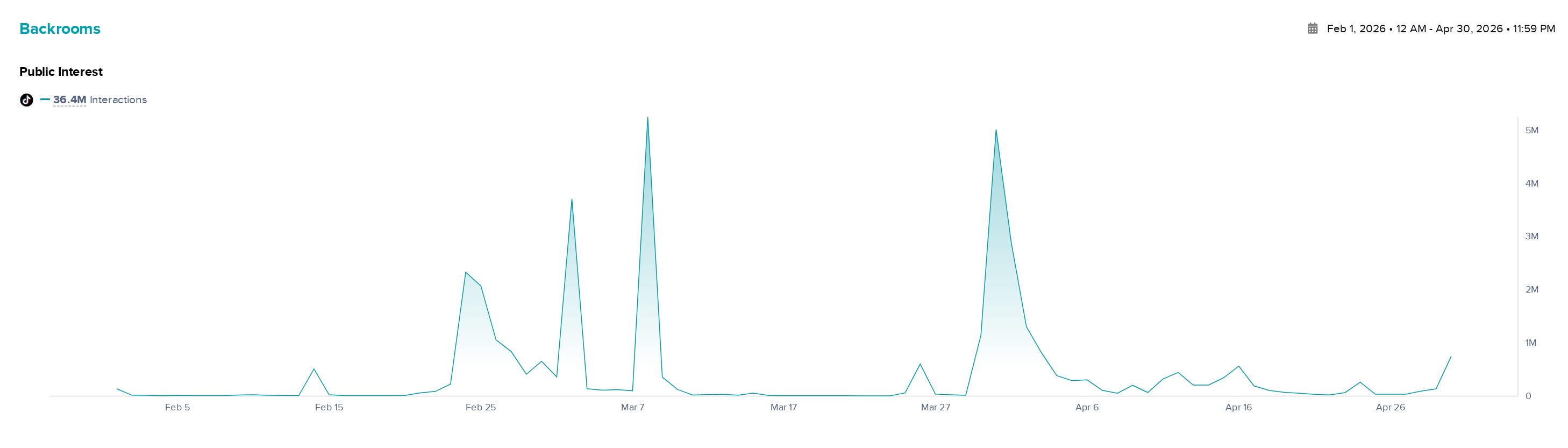
The data clearly shows early signs that Backrooms had the potential to be a huge success among internet users and create a cultural moment. The first teaser was released at the end of February and within days had accumulated five million engagements on TikTok. Then another trailer at the end of March hit seven million engagements within its first week, and had risen to 12 million by the end of the first month. Anyone looking at that data can see a cultural moment forming, and this was all happening months before it came out.
Having a view into internet culture beyond the brand itself emboldens teams to make decisions early that predict where the market is going, rather than reacting to it. It’s part of a social intelligence framework that gives first-mover advantage in a trend everyone is now trying to jump on. That advantage led to more than half a million engagements across platforms for the McDonald’s Backrooms posts, and its top performing TikTok post of the year so far in terms of engagement by a considerable margin.
But timing is only part of the story. McDonald’s also got the cultural references right, while being able to take advantage of its own cultural capital and brand equity. The brand’s choice of references matched the tone and lore perfectly, and even included Easter eggs for internet sleuths to find and pick up on. This mix of content, context and timing is what allows posts like this to win in 2026.
The Hollywood breakthrough of Obsession and Backrooms is a blueprint for future wins. We have officially moved past the era when social media was just a megaphone used to hype up traditional media and brand messaging. Now, social is the incubation lab, the focus group, and the ultimate distribution engine.
Brands and studios must stop trying to manufacture cultural relevance exclusively from the top down. There’s a valuable strand of IP being built organically by community-driven creators and the audiences who rally around them. The feed is driving future success. The only question is whether your brand is equipped to act on it.
No posts
Comments
Nothing yet. Say the first thing.
Sign in to join the conversation.