
Honestly, I’ve never been a “tough love” person.
I’m more of a love-love person.
So when you read this, friend, know that it’s coming from the deepest crevices of my heart, the ones shaped by years of learning and un-learning.
This isn’t about telling you you’re doing anything wrong.
You’re doing great. Beyond great. Magnificently, in fact.
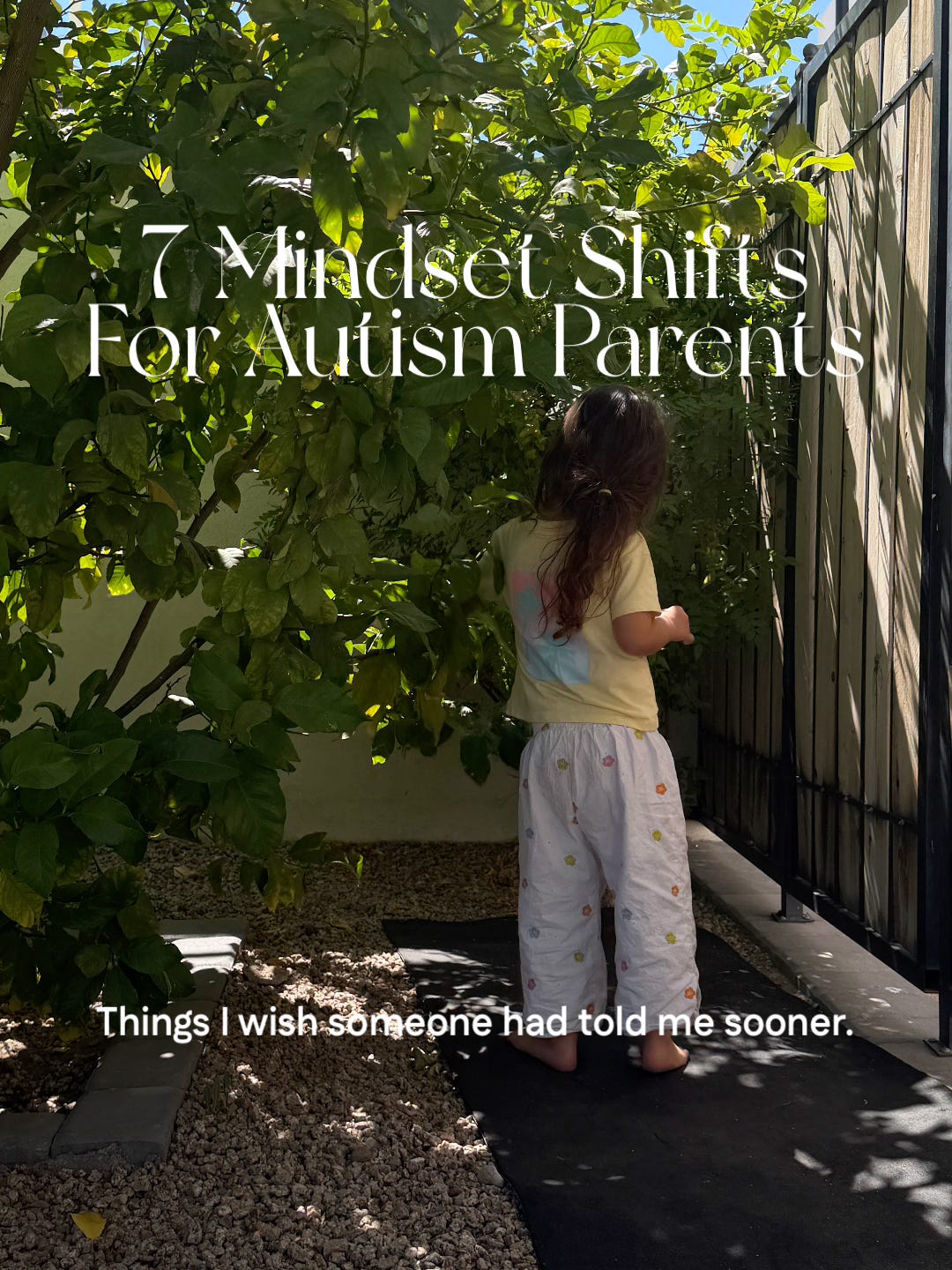
It’s me sharing the mindset shifts I wish someone had shared with me when my daughter was first diagnosed.
So grab a cup of coffee, or pour a glass of wine, settle in, and let’s have a chat.
These are the things I wish someone told me waaaayyyyyy sooner:
Not a zillion acronyms (IEP, MET, ARFID, ODD, PDA etc. etc.)
Not a new therapy modality.
Not a magical potion that will allegedly “make your child speak!”.
Just some solid, hard learned (and hard earned) truths—all of them, shared with love.
You may not agree with all of these. That's okay. Every family finds their own way. These are simply the truths that changed mine.
They already are, just because they're here.
Whether they speak, point, make eye contact, have friends, or achieve any of the other milestones we revere in our neuronormative society—they’re worthy, as they are.
Reminding yourself of this helps you reframe the “when will they do this” to the “what are they doing now”, and you’ll start to celebrate the child before you rather than the one you think they might one day be.
This parenting journey is almost defined by hyper-vigilance. We’re constantly aware of how our children are experiencing the world—and how the world in turn is experiencing them.
Taking care of your nervous system will allow you to be a powerful co-regulation partner for your child while also preparing you to handle any outside forces (stares, judgements) with strength.
Your child doesn't need a perfectly regulated parent. They need one who keeps finding their way back.
It’s so hard not to, but try to focus on your child’s unique journey rather than comparing them to any other child—neurotypical or autistic.
I remember reading Reddit threads about when other people’s children started talking, wondering if there was some magic formula for when mine would.
But there isn’t.
She will when she will, or maybe she won’t communicate primarily with speech, and that’s her journey and her truth.
Really, you aren’t.
There is a whole community of parents out in the world walking a similar path, waiting to remind you that you don’t have to do this by yourself.
When we were waiting for my daughter’s diagnosis, I felt completely isolated. Like no one got it.
My sister had neurotypical kids. My friends had neurotypical kids. They loved us deeply, but they couldn’t fully understand what we were navigating.
So I turned to social media.
I found parents who spoke my language. Parents who celebrated the victories no one else noticed. Parents who understood why one new word, one decent grocery trip, or one successful haircut could feel monumental.
And eventually, I built a community of my own.
Today, our little corner of the internet is more than 40,000 strong, reminding one another that we're not in this alone—we're a global family bound by our love for our children.
Sometimes it’s pain.
Sometimes it’s anxiety.
Sometimes it’s tummy troubles.
Sometimes it’s sensory overload.
Sometimes it’s autism.
Don’t let anyone dismiss your concerns with “that’s just autism.”
Most behavior is communication—when your child is exhibiting something you’ve never seen before, or something they’ve done has ramped up in intensity and frequency, this can be them trying to communicate something to you in the only way they can.
It also requires that you advocate unapologetically for them in medical settings and therapy settings.
I say this with all of the love in my heart—if we don’t believe in our own children, how can we expect anyone else to?
Our children are capable and competent, and if we learn them, we can be a powerful partner in helping them achieve what nobody else believes is possible.
The world will place limits on your child soon enough. Don't let the first limits they encounter come from you.
Many of us spend time grieving the life we imagined. If that's you, know that grief isn't a sign you love your child any less. It's simply the process of letting go of certainty.
Grief may enter the picture time and time again, and it deserves it’s place—but don’t build a home there.
It’s not our child’s job to fulfill the expectations we had for parenthood—it’s our job to adjust the expectations to support the child we were given.
Gratitude is work, but our children are worthy of that work.
And when we let go of the imagined child and embrace the one before us, we realize that acceptance isn’t the end of hope—it’s the beginning of wonder, joy, and a beauty we never knew was possible.
If I could leave you with one thing, it would be this:
Spend less time trying to predict who your child will become.
Spend more time getting to know who they already are.
They will surprise you.
And one day, you’ll realize that the child you were trying so hard to help the world understand was actually your greatest teacher all along.
Love,
Lei
No posts
Comments
Nothing yet. Say the first thing.
Sign in to join the conversation.