
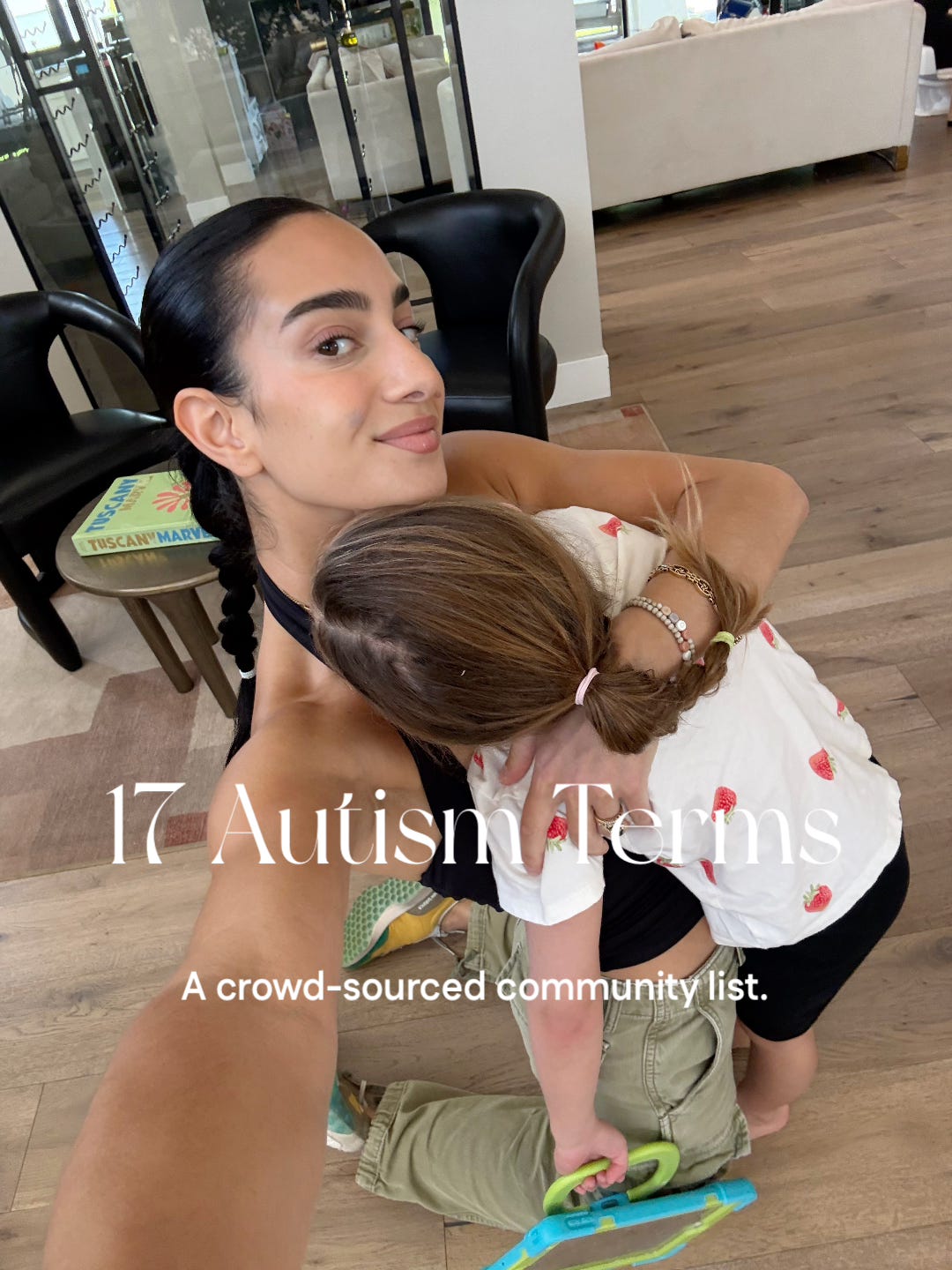
I posted this on Instagram and it went viral for all of the right reasons.
Early last month, I shared some important terms that are applicable within the autism world, and asked the community what else they would add.
Almost 400,000 views and 2400+ comments later, we worked together to crowd-source this list, and I couldn’t be more in awe of the power of community.
Many of these terms are relevant not only when we’re talking about autism, but that’s part of the point.
Autism is a deeply human experience, and these traits and terms are uniquely human in nature.
Here is a list—though it’s not exhaustive—of some important terms and concepts that will help you understand autism and the autistic experience better.
Is when the brain has difficulty creating and sending the motor plan needed to carry out a task, despite understanding the task and having the desire to do it.
A specific type of apraxia that affects the motor planning and coordination required to produce speech.
Means believing a child is capable of thinking, learning, understanding, and communicating, even when they can’t consistently show it in ways others expect.
Means a child’s abilities are real, but not always consistently accessible. Factors like stress, sensory input, fatigue, illness, or demands can affect what they are able to do in a given moment.
Is a natural way of acquiring language in scripts, phrases, and songs before they learn to build language word by word.
Short for self-stimulatory behavior, can be a form of self-regulation, a way to express joy, or to support focus that involves repeating movement, sounds, or actions. Examples include rocking, flapping, humming, singing, tapping, finger posturing, and much more.
Pathological Demand Avoidance (or Persistent Desire for Autonomy) describes a profile in which every day demands can trigger an intense threat response. It’s often mischaracterized as defiance, but is rooted in anxiety and a neurological need to preserve autonomy.
An intense, often involuntary response to sensory overwhelm, communication breakdowns, emotional or cognitive overload, and other triggers. Meltdowns are a nervous system in crisis, not a tantrum or bad behavior.
Is the ability to receive and understand internal signals from the body, such as hunger, thirst, the need to go to the bathroom. It’s often categorized as the 8th sense of the sensory system. Autistic individuals can have differences in interoceptive awareness, which requires support recognizing bodily needs, understanding emotions that have physical sensations, and improving overall regulation. Sensory integrated occupational therapy can be a great resource for this.
Is a neurological trait that results in decreased body muscle tone. It requires more effort from the individual to carry out movements, which can mean much more exertion and exhaustion. Individuals with hypotonia may benefit from deep pressure, opportunities for rest, strengthening activities, and postural supports.
Is the act of leaving a safe, supervised environment often referred to as wandering, but is an involuntary response to sensory overload (running away from something) or a focused drive to pursue a strong interest (running toward something). It is a major safety issue and prevention should be top of mind for families.
The desire to eat non-food items. Commonly, dirt, ice and paper, but can be anything. It’s sometimes associated with nutritional deficiencies and may be also driven by sensory needs.
Avoidant Restrictive Food Intake Disorder. This is an eating condition in which the individual limits the types and amounts of food they will eat, often due to fear of outcomes (choking, gagging), anxiety around the experience (textures, taste), lack of interest, as well as sensory sensitivities. It is not just picky eating and can greatly affect the individuals health and quality of life.
Is the ability to sense one’s own position within a space. The sensors—called proprioceptors—live within the joints, muscles, and tendons. Autistic individuals often process this sensory feedback differently, which can affect motor coordination, body awareness, and self-regulation.
Is when an autistic person suppresses their traits in order to blend in with societal expectations, keep themselves safe, or avoid rejection. It can be conscious or unconscious, and comes with a great tax to the person masking, including burnout, anxiety, and exhaustion.
All humans have a sensory system. Sensory processing is how our brains receive, organize, and react to feedback from that system.
The common sensory profiles are:
Hypersensitivity, which may lead to avoidance of sensory input
Hyposensitivity, which may lead to seeking out sensory input.
Many autistic individuals experience a mixed profile, seeking some input and avoiding others.
Is a deep concentration and allocation of attention on a singular or small number of things. It often leads to intense interests and deep engagement, which can make shifting attention difficult while also allowing for remarkable expertise and learning within those areas.
I hope this list proves to be helpful, and will continue to add to it. Education supports awareness, which leads to acceptance.
Love,
Lei
No posts
Comments
Nothing yet. Say the first thing.
Sign in to join the conversation.